 BIS Certification
 CDSCO
CDSCO
 PESO
PESO
 CPCB
CPCB
 LMPC
LMPC
 WPC Approval
 Global Approvals
 TEC
TEC
 ARAI
ARAI
 BEE
BEE
 ISO Certification
 DGCA Certification
 NOC For Steel
 APEDA Registration












 Business Registration
 FSSAI Mark Certification


 (32).jpg)
 Legal Services
 Trademark Registration
 Copyright Registration
 Patent Registration
 By
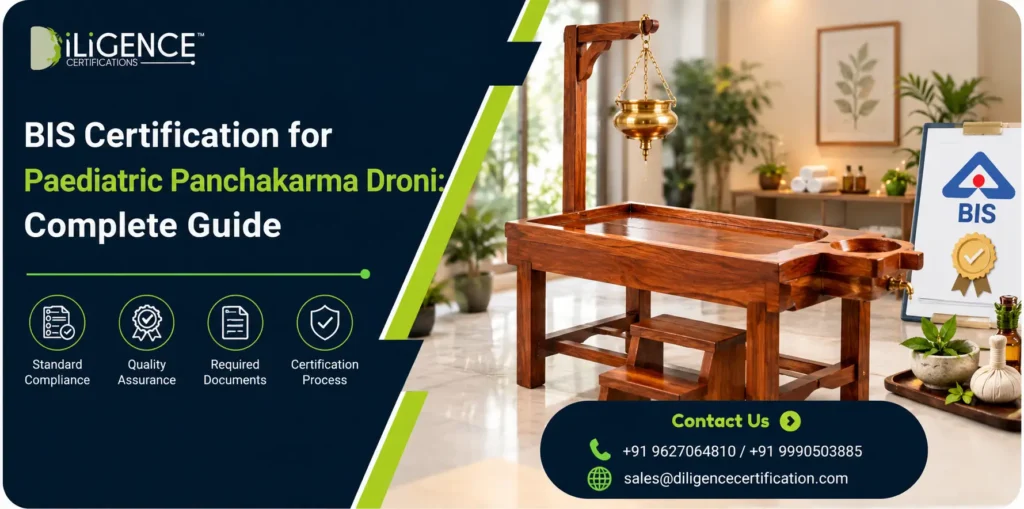
By - BIS Certification for Paediatric Panchakarma Droni requires checking the applicable Indian Standard and product specifications.
- IS 18089 (Part 1):2022 is the key standard for Droni specifications review.
- Producers are required to create technical drawings, specifications for the product, documents on the materials involved, as well as quality control certificates.
- The requirements for BIS certification and testing, as well as the fees and timing, depend on the particular certification process used.
- The compliance process and documentation that both importers and producers need can be assisted with the help of Diligence Certifications.
Introduction
It is possible for a creator of equipment based on Ayurveda to devote a huge amount of time to product crafting, material selection, production and promotion prior to appealing to any hospital or Ayurveda center. The problem starts when a potential client asks about the compliance documents concerning the product or the certifications available. The manufacturer may not know which Indian standard is applicable in this case or whether a BIS license is necessary.
It’s worth noting that this case is significant for specialized devices meant for children. Production companies should be able to know how the product specifications should be stated, have full technical documentation and check the existing regulations prior to selling the equipment.
BIS Certification for Paediatrics Panchakarma Droni is very relevant for producers, importers, and vendors of Ayurveda equipment. The first step is to understand the applicable standard in India and ascertain whether your product goes under the mandatory certification requirement.
The Bureau of Indian Standards (BIS) is the national organization of standards in India. It formulates Indian Standards is and designs product testing schemes in order to establish compliance with the relevant legislation in force. For Droni devices, manufacturers ought to examine IS 18089 (Part 1): 2022, Panchakarma equipment - Part 1: Droni specifications.
It is worth noting that the presence of Indian Standard does not mean that it is applicable to all products within the scope of the Indian Standard, which means that mandatory BIS certification may not be required for all. It is essential to consult the appropriate Quality Control Order (QCO) and the relevant certification scheme, together with the latest government notifications.
What Is BIS Certification for Paediatric Panchakarma Droni?
The scheme of the Bureau of Indian Standards (BIS) is a conformity assessment system intended to verify that a product conforms with the relevant Indian Standard.
The Paediatric Panchakarma Droni is a Droni designed for pediatric Ayurvedic treatments. Depending on the type of design of the Droni, its dimensions and the parameters may differ from those in the adult Droni design.
As it comes to manufacturers, the task is to determine whether the proposed product is covered by the relevant Indian Standard and, if applicable, choose the certification path.
It is necessary to ensure compliance with the necessary requirements and prove compliance when making statements about mandatory certification, authorization, and use of the Bureau of Indian Standards.
Which Indian Standard Applies to Paediatric Panchakarma Droni?
IS 18089 (Part 1):2022, Panchakarma Equipment - Part 1: Droni Specifications, is the principal published Indian Standard to investigate for Droni equipment.
It is essential for manufacturers to acquire the official standards and examine them in relation to the specific product being produced, since a paediatric model might differ in dimensions or applications from the standard product. Conformity testing cannot merely be based on the commercial name.
The manufacturer should verify:
- The intended use and technical classification of the product.
- Whether the product falls within the scope of the relevant Indian Standard.
- Whether any applicable Quality Control Order makes certification compulsory.
- Regulations regarding certification and application may be in effect.
- Existing regulations regarding testing, documentation, or labeling may apply.
The official BIS website provides information about Indian Standards and product certification. Manufacturers can begin their research through the BIS website and the Know Your Standard portal.
Why Is Product Compliance Important for Paediatric Panchakarma Droni?
Compliance of products allows for constant specifications and giving customers good technical information while enhancing quality control methods in the production process.
The manufacturer of products for children should take extra care to ensure that the design will be suitable for its users and the clinical settings for the uses.
Some of the most relevant considerations to keep in mind are as follows:
1. Product dimensions and design
Specifications related to the dimensions, shape, and proposed user market for the Droni must be maintained at every stage. That ensures that the specifications agree between production drawings, catalogs, product labeling, and operating instructions.
2. Structural stability
The supporting structure, connections, and other structural parts must be compared against the relevant product requirements and expected working conditions.
3. Material selection
Material selection must follow from the planned application of the equipment in question, its durability, maintenance requirements, and the details of the relevant product. The data on the materials must be documented and traceable when needed.
4. Surface finish and maintenance
The design of the product should concentrate on its finishing, cleaning, inspections, and regular maintenance. Manufacturers must create the written procedure for servicing the product according to customer’s needs
5. Product documentation
Accurate technical specifications, operating instructions, inspection records, and product identification.
So far, these aspects support the product quality and do not substitute the required criteria in the relevant Indian Standard.
Documents Required for BIS Certification for Paediatric Panchakarma Droni
The necessary documents rely on certification schemes, classification of products, and conditions of the manufacturer. Hence the checklist provided here would be a helpful start for you to prepare a technical file.
| Document | Purpose |
| Business registration documents | Establish the legal identity of the applicant |
| Manufacturer and factory details | Identify the manufacturing location |
| Product specifications | Highlight model, size, materials, and use. |
| Technical drawings. | Explain the design and construction |
| Material and component records | Support traceability and material verification |
| Manufacturing process details | Describe production and assembly procedures |
| Quality-control procedures | Document manufacturing checks |
| Inspection and test records | Provide evidence of relevant product assessments |
| Product labels and user instructions | Ensure consistency of product information |
| Authorisation documents | Establish the signatory’s authority, where required |
| Application and fee records | Support the relevant certification process |
Not every document mentioned above is necessarily required for every application. The final checklist should be prepared once the relevant Indian Standard and certification scheme has been confirmed.
Manufacturers must also confirm that the documents correctly reflect the actual product needed for manufacturing. Old drawings, incorrect measurements and incomplete material information can lead to delays in compliance.
What Is the BIS Certification Process for Paediatric Panchakarma Droni?
Initially, the classification of the items and the verification of authorities should be performed before sending the application for registration.
Step 1: Identify the product category
Explain thoroughly the characteristics of Paediatric Panchakarma Droni based on its role, dimensions, structure, constituent components etc.
Use the information mentioned above to determine if the product is included in IS 18089 (Part 1):2022 standards.
Step 2: Verify mandatory certification requirements
Check the actual compulsory certification list that the Bureau of Indian Standards bears, along with Quality Control Orders and notices.
If approval is required, manufacturers or importers must obey the specific norm. If there is no compulsory certification, do not claim it indicates legal requirements.
Step 3: Review the applicable Indian Standard
Upon the acquisition of the needed standard, it becomes important to compare the requirements it poses with details of the product and other relevant documentation.
The first step consists of a gap analysis that must be conducted prior to any documentation, design issues, or testing.
Step 4: Prepare technical documentation
Collating several important business items such as documents, drawings, production specifications, and quality of materials tests is an important event.
The importance of verifying the reliability of data presented about the products is obvious.
Step 5: Arrange applicable testing and inspection
Testing and inspection requirements should be determined according to the applicable scheme of certification. The relevant testing method should be chosen, and relevant procedures and criteria should be thoroughly followed.
A general test report does not indicate that evaluation process has been completed successfully in accordance with all applicable requirements.
Step 6: Submit the application, where required
If a BIS license is needed and the product is eligible in accordance with the regulations, the following application process should be followed and all the required documents and payments should be submitted.
The BIS product certification process provides a starting point for understanding the general process.
Step 7: Respond to assessment findings
In case the BIS states some concerns or problems that might require attention after the assessment, you should submit the necessary documents and proofs accordingly. If any corrective measures are required, they should be recorded and their effectiveness checked.
Step 8: Follow certification and marking conditions
A manufacturer is not allowed to declare that a product is BIS certified or to apply the BIS Standard Mark unless permitted to do so. Any authorisation is provided based on the license.
How Much Does BIS Certification for Paediatric Panchakarma Droni Cost?
Determining the cost of getting BIS certification for the Paediatric Panchakarma Droni is impossible until the necessity for certification is clarified and the relevant scheme is established.
Where a certification route applies, the overall budget may include:
- Official application and certification charges.
- Product testing and laboratory expenses.
- Inspection and assessment costs.
- The technical documentation must be prepared.
- There could be modifications to the approach employed in manufacturing and quality control.
- In addition, if a consultant has to be hired by the manufacturer, it will incur certain consulting fees.
Government costs and professional fees must be assessed separately. A consultancy proposal should clearly state the services provided and what any extra costs are likely to occur.
Manufacturers should check the proper scheme for them with the relevant BIS guidance before making a commitment. No consultant can guarantee approval solely because an application has been made.
How Long Does BIS Certification Take?
The timeline generally relies on the selected certification scheme, the amount of documentation required, and testing and inspection procedures if needed.
The sources of delay can include improper technical documentation, defective product specifications, testing arrangements, factory readiness, and requests for corrective action.
First of all, the manufacturer must perform the applicability review of the product and evaluate the technical documentation. This is needed to better plan the subsequent steps and avoid applying for certification for a wrong product.
Any practical timeline should always be compared with valid official documents concerning this certification method instead of being presupposed to apply to all Droni products.
Common Mistakes to Avoid
Assuming that every Indian Standard makes certification mandatory
An Indian Standard may exist without making certification compulsory for every product within its scope. Always verify the applicable QCO and current government notifications.
Ignoring the product’s paediatric configuration
A paediatric model may have different specifications from an adult model. The manufacturer should document the actual design and verify the relevant standard’s scope.
Submitting inconsistent technical documents
Drawings, specifications, test records, and product labels should refer to the same product configuration.
Assuming that a consultant can guarantee approval
A consultant can assist with documentation and procedural coordination, but the final certification decision rests with the relevant authority.
Using the BIS Standard Mark without authorisation
Certification marks should only be used when the necessary authorisation has been granted and the use complies with the applicable conditions.
Why Choose Diligence Certifications for Compliance Support?
Manufacturers and importers may need assistance understanding which standard applies, whether certification is mandatory, and what documentation should be prepared.
Diligence Certifications can support businesses through an initial compliance review and guidance on the relevant certification process, subject to confirming the applicable product category and service scope.
Potential support activities include:
- Preliminary review of product specifications and intended use.
- Assistance in organising business and technical documents.
- Identification of documentation gaps.
- Guidance on applicable testing and certification procedures.
- Support in understanding certification claims and marking restrictions.
The benefit of a structured review is that businesses can identify potential compliance issues before investing time and money in an application.
For more information, visit the Diligence Certifications services page. Review the live page and confirm the final URL before publishing the article.
Conclusion
BIS Certification for Paediatric Panchakarma Droni requires a product-specific assessment of the applicable Indian Standard, the intended use of the equipment, and the current certification requirements.
IS 18089 (Part 1):2022 is the key published standard to investigate for Droni specifications. However, manufacturers should not assume that every paediatric model automatically requires a BIS licence. The applicable government notifications and certification scheme must be verified first.
By preparing consistent technical documents, reviewing product specifications, and identifying the correct compliance route, manufacturers and importers can make better-informed decisions and reduce avoidable documentation issues.
If your business manufactures or imports Paediatric Panchakarma Droni equipment, contact Diligence Certifications for an initial compliance discussion and guidance on the appropriate next steps.
Frequently Asked Questions
Is BIS certification mandatory for Paediatric Panchakarma Droni?
Not automatically. The manufacturer must verify the product's classification, applicable Indian Standard, and current compulsory-certification requirements. The existence of an Indian Standard alone does not establish that a BIS licence is mandatory.
Which Indian Standard is relevant to Panchakarma Droni?
IS 18089 (Part 1):2022, Panchakarma Equipment - Part 1: Droni Specifications, is the published standard to investigate. Its scope should be checked against the particular paediatric product.
What documents should a manufacturer prepare?
Potential documents include business registration records, factory details, technical drawings, product specifications, material records, manufacturing-process information, quality-control procedures, and relevant test reports. The final requirements depend on the applicable certification scheme.
How much does BIS certification cost for Paediatric Panchakarma Droni?
The cost depends on the applicable certification route. Where certification is required, expenses may include official charges, testing, inspection, documentation, and professional support.
Can an importer apply for BIS certification?
Eligibility depends on the applicable certification scheme. The importer should confirm the permitted applicant category, manufacturer's responsibilities, and any relevant import requirements before proceeding.
What is the difference between BIS registration and BIS certification?
Both terms are commonly used in product compliance discussions, but the applicable scheme determines the formal authorisation process. Manufacturers should identify the correct scheme rather than assume that every product follows the same procedure.
Are paediatric and adult Panchakarma Droni subject to the same requirements?
Not necessarily. Their dimensions, construction, and intended use may differ. Each model should be assessed against the scope of the relevant Indian Standard and applicable regulatory requirements.
How can I verify the applicable BIS standard for Panchakarma Droni?
Check the official BIS website and its standards resources. Compare the standard's scope with the product's intended use, technical specifications, and configuration.
What are the common reasons for delays in BIS Certification?
Common causes include incomplete technical documents, inconsistent product specifications, testing issues, factory-readiness concerns, and failure to address assessment findings promptly.
Can a BIS consultant help with Panchakarma Droni certification?
A compliance consultant can assist with preliminary applicability reviews, documentation preparation, identification of gaps, and procedural guidance. The relevant authority retains responsibility for certification decisions.