BIS Certification
 CDSCO
CDSCO
 PESO
PESO
 CPCB
CPCB
 LMPC
LMPC
 WPC Approval
 Global Approvals
 TEC
TEC
 ARAI
ARAI
 BEE
BEE
 ISO Certification
 DGCA Certification
 NOC For Steel
 APEDA Registration























 Business Registration
 FSSAI Mark Certification












 (32).jpg)
 Legal Services
 Trademark Registration
 Copyright Registration
 Patent Registration
 By
By Ensures Mandatory Government Compliance
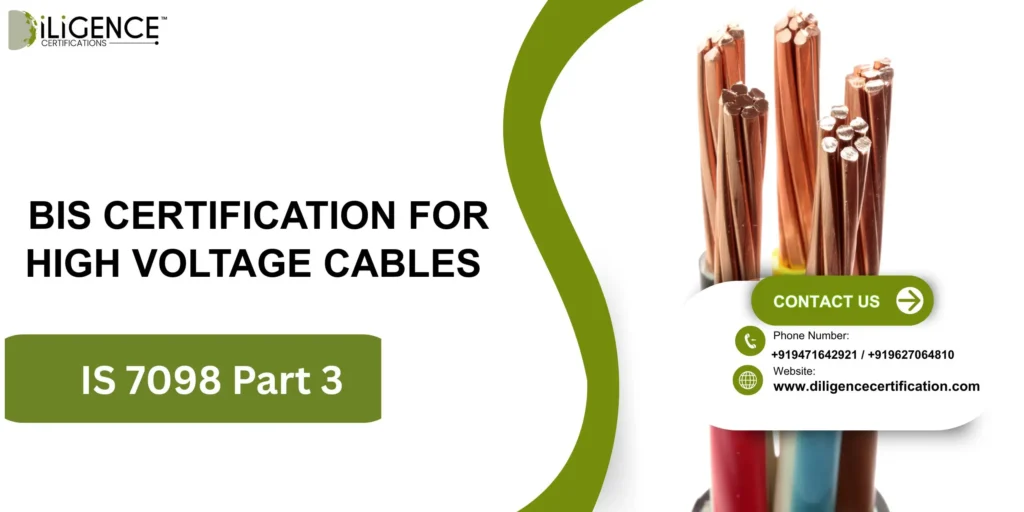
BIS certification is the proof that high-voltage cables are in accordance with Indian safety and quality regulations, thus they are approved by law for use.
Guarantees Cable Safety and Reliability
The certification confirms that the cables which are designed as per IS 7098 Part 3 can endure high electrical stress, very low or high-temperature conditions, and prolonged operation.
Involves Strict Testing and Quality Checks
Before being allowed to carry the certification, the producers have to be through various tests such as insulation resistance, voltage withstand, mechanical strength and so on.
Builds Trust with Buyers and Project Authorities
High-voltage cables certified by BIS are the first choice in government tendering processes, utility projects, and industrial installations.
Reduces Risk, Failures, and Maintenance Costs
Through a regulated manufacturing process, certified cables are at a lesser risk of breaking down, causing outages, and operational losses.
Introduction
BIS Certification for High Voltage Cables - IS 7098 Part 3 basically serves as a safety net that allows the safe and efficient transfer of electric power to companies, substations, and large-scale infrastructure projects. These powerful cables, if not certified, can be a safety hazard as they might be the causative factors of short circuit, blackout, equipment break down, or even an accident that can cost human lives. Such a standard sets the rule for every wire to be built, tested, and fabricated in line with the quality features prescribed. BIS certification is important to the manufacturers, the EPC contractors, the utility providers, and the project developers who have to abide by the government rules and at the same time ensure the high-voltage applications are safe and have good performance over time. Bureau of Indian Standards
What Is BIS Certification for High Voltage Cables - IS 7098 Part 3 and Why It Matters?
BIS Certification for high voltage wires as per IS 7098 Part 3 is a green signal given by the Bureau of Indian Standards to indicate that the product in question complies with all the safety and quality requirements laid down. IS 7098 Part 3 is the Indian Standard that specifies the design, insulation, construction, and testing of high-voltage cables (above 33 kV).
A BIS-certified cable is one that has undergone and passed stringent laboratory tests and is made according to the regulated manufacturing practices as confirmed by the product inspection. This means that the cable is capable of withstanding high electrical stress situations, can operate without failure for a long time, and is allowed as per government rules to be installed in vital power systems.
Why BIS Certification for High Voltage Cables - IS 7098 Part 3 is Necessary and Required.
BIS certification for high voltage cables as per IS 7098 Part 3 is a must in India as it assures that all the cables used in power transmission are in compliance with the safety and quality standards laid down by the national authority. The Government of India, through BIS guidelines, insists on manufacturers getting this certification if they want to sell or install high-voltage cables. In this way, the use of unsafe products, which may lead to short circuits, system failures, fires, or blackout of large areas, is ruled out. For businesses, BIS certification is a great asset-it helps them gain the confidence of government departments, utilities, EPC contractors, and industrial clients. Certified cables qualify first in tenders, contribute to cutting down long-term maintenance costs, and enhance brand credibility. In short, BIS certification is a safeguard for public safety as well as business stability.
Step-by-Step BIS Certification Process for High Voltage Cables (IS 7098 Part 3)
1.Confirm scope and product definition
Describe the type of cable in detail (Voltage class, conductor material, insulation type such as XLPE/EPR, single/multi-core, armoured/unarmoured) and make sure it is covered by the scope of IS 7098 Part 3 (high-voltage cables). This helps in preventing mistakes in the application and unnecessary testing.
2. Prepare technical dossier
Gather product detailed drawings, bill of materials, conductor and insulation specifications, manufacturing process flow, quality control plan, and previous test data (if any). These are mandatory for filing an application and for the factory assessment.
3. Register and submit application to BIS
On the BIS portal, open your account and submit the application form for certification under the concerned scheme. Attach the technical dossier, company profile, and other necessary files (GMP/QMS records, factory address, IEC/IS references).
4. Choose an accredited test laboratory and prepare samples
Pick a laboratory that is either BIS-recognized or NABL-accredited. Prepare production representative samples (lengths and quantities as mentioned by IS/BIS for type tests and routine tests) in a correct manner with regard to the marking and packing.
5. Conduct type tests at accredited lab
Perform and complete all the mandatory type tests. These tests include voltage-withstanding (impulse and/or power frequency where applicable), insulation resistance, partial discharge/PD (if required), conductor DC resistance, thermal/heat cycle/thermal stability/ageing tests, mechanical strength and sheath/armour tests. Acquire official lab test reports signed by the responsible person.
6. Perform routine/acceptance tests
Execute the routine test that is suitable for every production reel or batch of materials-conductor resistance, insulation resistance, high-voltage test (as per standard), dimensional checks, and visual inspection. Maintain records in a production test logbook.
7. Submit test reports and quality documents to BIS
Upload original type and routine test reports, calibration certificates for test equipment, inspection checklists, QC records, and factory quality manual through the BIS portal for technical evaluation.
8. Pay fees and schedule factory inspection
Make a payment for the application and/or the inspection if it is required. BIS will organize a factory inspection to confirm the manufacturing process, test facilities, QMS implementation, and sample traceability.
9. Prepare factory for inspection
Production lines, testing labs, calibrated instruments, trained personnel, sample storage, and QMS records should all be in good condition and ready for use. Inspectors will verify the traceability from raw material to the finished cable and if R&D/production/testing staff are available, they might witness the execution of routine or type tests.
10. Facilitate BIS factory inspection
During the audit, BIS officials should be made comfortable to do their job. Apart from the manufacturing records, they need to see test logs, calibration certificates, material purchase records, and final product marking procedures. Non-conformities are issues that come up at the time of the visit and you should deal with them by providing explanations, corrections, or both.
11. Correct non-conformities and resubmit evidence
In case there are remarks in the inspection report, you should take the necessary steps to put them right, keep detailed records of these actions and send BIS the proof of closure (updated records, re-tests, photos, revised procedures).
12. Grant of BIS license / Certification decision
At the end of the technical evaluation and factory inspection that proves everything is in order, BIS will grant the certification/license for the IS 7098 Part 3. The license includes product scope allowed, license number, and terms.
13. Marking, labelling and documentation
Upon the license, you may enhance the production. The ISI mark, BIS license number, manufacturing date/lot, and product designation as stipulated should be printed on each cable/reel. In addition, you should keep production & test records, traceability logs, and customer complaint registers.
14. Post-grant surveillance and renewal
BIS performs regular surveillance visits and may take samples for testing. Keep up with the standard by ensuring that test instruments are calibrated, routine tests are carried out as per the standard, customer complaints are resolved, and you apply for the license renewal with updated records before its expiration.
Documents Required for BIS Certification for High Voltage Cables - IS 7098 Part 3
Getting a BIS Certification is a long haul that needs a full technical, legal, and quality-related documents set. All these papers give BIS the opportunity to check that the high-voltage cables are in line with IS 7098 Part 3 and that they meet all the safety requirements that are mandatory.
A. Company & Legal Documents
- Factory registration certificate
- MSME/Udyam registration (if applicable)
- GST certificate
- Factory layout and address proof
- Authorization letter for BIS signatory
B. Product Technical Documents
- Detailed product specifications
- Cable construction drawings
- Conductor details (material, size, structure)
- Insulation type and thickness details (e.g., XLPE)
- Screening, armoring, sheathing material specifications
- Bill of Materials (BOM)
- Product catalog or datasheet
C. Quality Management & Production Documents
- Manufacturing process flow chart
- In-house quality control plan
- List of test equipment (with serial numbers)
- Calibration certificates of testing instruments
- Raw material inspection records
- Finished goods inspection report
- Internal test logs (routine tests, acceptance tests)
D. Testing Documents
- Type test reports from BIS-recognized/NABL-accredited lab
- Routine test records
- Acceptance test records
- Sample identification slip
E. BIS Application Documents
- Filled application form
- Undertaking for compliance
- Marking details (how ISI mark will be printed)
- Packaging and labeling details
2. Documents Required from Importers (Foreign Manufacturers)
(For FMCS / Foreign Manufacturer Certification Scheme)
A. Exporter & Factory Documents
- Business license of foreign manufacturer
- Factory registration and address proof
- Manufacturing capability documents
- Organizational structure and company profile
- Letter of authorization for Indian representative (AIR)
B. Authorized Indian Representative (AIR) Documents
- Indian ID proof
- Address proof
- Undertaking to act on behalf of the foreign manufacturer
- Agreement between AIR and foreign manufacturer
C. Product Technical Documents
- Detailed cable design documents
- Raw material specifications
- Production flow chart
- Quality control procedures
- Product datasheets and catalogues
D. Testing Documents
- Type test reports from BIS/NABL/ILAC-accredited labs
- Sample testing reports
- Calibration certificates for foreign factory lab instruments
E. BIS Application Documents
- BIS application form (FMCS)
- Declaration for conformity to IS 7098 Part 3
- Marking scheme showing where ISI mark will be applied
3. Optional Supporting Documents (Useful for Faster Approval)
- ISO 9001 certificate
- Previous compliance certificates (if any)
- Material test certificates from suppliers
- Safety audit reports
Importance and Benefits of BIS Certification for High Voltage Cables - IS 7098 Part 3
| Importance | Benefits |
| Provides a guarantee that the product complies with Indian safety standards and BIS guidelines. | BIS certification is a trust-building tool with government departments, EPC contractors, and utility companies. |
| It is a method to stop the circulation of high-voltage cables that are dangerous or composed of inferior materials. | Increasing the brand image and market standing is one of the indirect benefit |
| Power systems are safely protected from failures, breakdowns, and fire hazards | The costs of maintenance are reduced along with the long-term operational risks |
| It is a prerequisite for the sale and use of HV cables in large-scale projects | Granting of government tenders and major infrastructure contracts become easier |
| The first priority of the cables is their meeting of the most stringent standards in terms of performance, insulation, and durability. | By using these cables, field operations become safer, more reliable, and more efficient. |
Common Challenges in Applying for BIS Certification - IS 7098 Part 3
Getting an application for a BIS Certification for High Voltage Cables - IS 7098 Part 3 through is like solving a riddle, and the manufacturers are usually unaware of the problems that cause the delay of their approval. One of the faults that are most frequently found in the work is half-done and even wrongly done paperwork, for example, the lack of type test reports or quality control records. When you choose the wrong test lab or give them a sample that is not in the proper condition, the outcome will be a failed test. Applicants often factory readiness is the issue and thus they are unaware of the instrument calibration and production traceability. Besides that, misunderstanding BIS marking and labeling requirements and not following routine test procedure could also be the causes of non-conformities during the inspection. Being aware of these issues and having a complete preparation will definitely make the certification approval go more smoothly.
Conclusion
Obtaining a BIS Certification for High Voltage Cables - IS 7098 Part 3 is the necessary first step to take in order to guarantee the safety, conformity, and dependability of high-voltage appliances. It not only protects your projects from law and technological risks but also gives your brand credibility and trust in the market. Most of the businesses because of the complexity of the certification processes (documentations, testing, factory inspections) decide to take professional advice to make the requirement fulfillment process less complicated. Your choice to engage in a collaborative working relationship with experienced consultants or certification experts may be the determining factor of whether you get the timely approval you want, as well as your full compliance and peace of mind. What is stopping you from taking the first step now to assure the production of certified, top-quality cables that conform to the standards of IS 7098 Part 3 and simultaneously build up your business reputation Achieving BIS Certification for High Voltage Cables - IS 7098 Part 3 helps businesses ensure safety and compliance
Frequently Asked for Questions
BIS Certification for High Voltage Cables - IS 7098 Part 3 is what?
This certification is a must-have approval that essentially lays down the safety and quality standards that need to be followed by high-voltage cables in India.
Why should high-voltage cables be certified according to IS 7098 Part 3?
The source of this requirement is the assurance that India is the place where the HV cables with a rating of more than 33 kV have been made, are being sold and installed in compliance with the regulations either locally or through imports.
Who are the people that need to get a BIS Certification for High Voltage Cables - IS 7098 Part 3?
The list of bis certification holders includes manufacturers, EPC contractors, utility providers, and importers of high-voltage cables.
What is the Voltage Range of IS 7098 Part 3?
The scope of this document refers to cable systems designed to work at a voltage level higher than 33 kV.
Is BIS Certification necessary for the sale of HV cables in India?
As a rule, one has to obtain certifications in line with safety regulations set by the government in order to sell HV cables in India.
What tests are to be performed for IS 7098 Part 3 certification?
The tests include type tests, routine tests, insulation tests, voltage-withstand tests, and mechanical tests.
How much time is needed for obtaining BIS Certification for high-voltage cables?
The waiting time is in most cases between 30 and 90 days and is dependent on the factory's readiness and the tests that need to be performed.
Are foreign manufacturers allowed to apply for IS 7098 Part 3 certification?
Yes, an Authorized Indian Representative under the BIS FMCS scheme can be a facilitator for the certification of foreign manufacturers with IS 7098 Part 3.
What are the required documents for BIS Certification for HV cables?
The required documents includeTechnical drawings, Quality control records, Test reports, Manufacturing details, and Legal documents.
What is the next step after BIS Certification?
After the certification is secured, manufacturers have to follow the BIS marking standards and they can anticipate the regular supervision visits of inspectors.