 BIS Certification
 CDSCO
CDSCO
 PESO
PESO
 CPCB
CPCB
 LMPC
LMPC
 WPC Approval
 Global Approvals
 TEC
TEC
 ARAI
ARAI
 BEE
BEE
 ISO Certification
 DGCA Certification
 NOC For Steel
 APEDA Registration























 Business Registration
 FSSAI Mark Certification












 (32).jpg)
 Legal Services
 Trademark Registration
 Copyright Registration
 Patent Registration
 By
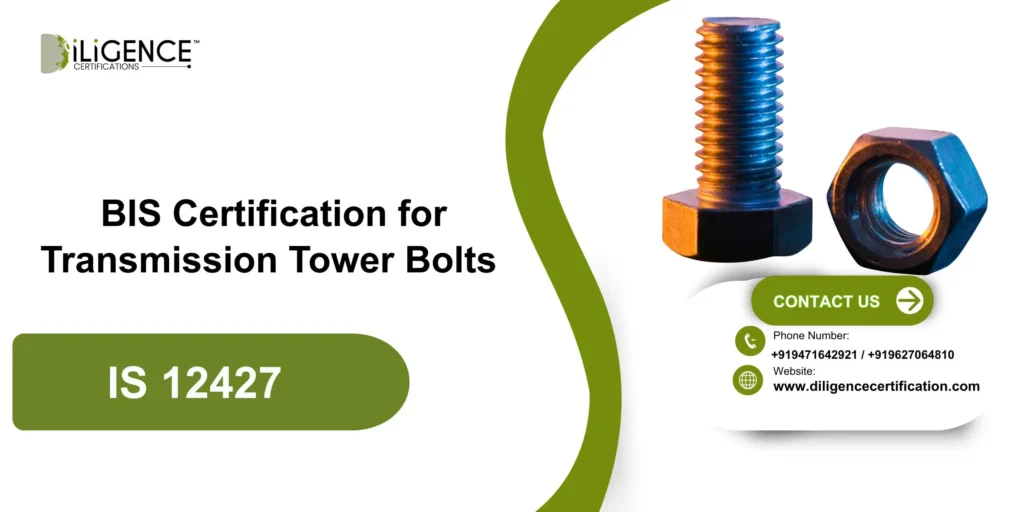
By IS 12427 defines the specification and materials standards that Indian standard compliant transmission tower bolts for the power transmission and distribution structures shall meet. In order to ensure the stability of the structure throughout the period extension, these bolts are subjected to strict tests concerning their chemical composition, mechanical strength, size, and surface finish.
BIS certification attests that the bolts used for the transmission towers can endure high tensile loads, vibration, wind pressure, and even harsh environmental conditions. The ISI mark is a must-have for those manufacturers who are willing to produce and market transmission tower bolts in the Indian market. It serves as a safety, reliability, and standards compliance guarantee to the customer.
BIS certification acquisition is a detailed procedure that covers the submission of documents, product testing, factory inspection, approval, and issuing the license. Certified bolts stabilize the trust level between the utilities, EPC contractors, and the government authorities while at the same time they guarantee the execution of the failure-free performance in the most critical power infrastructures for long service periods.
Introduction
Transmission tower bolts are the most important fastening elements that can be found in electricity transmission towers, substations, and high-voltage line structures. These bolts are the main holders of the tower members and the ones responsible for the structural integrity to be maintained under the continuous mechanical stress and environmental exposure.
Considering the fact that transmission towers are subjected to extreme conditions such as high wind zones, temperature fluctuations, and corrosive environments, compliance with IS 12427 is a must if the bolts are to deliver performance, strength, and durability as promised. BIS certification is a pledge that these bolts have passed the rigorous safety and quality tests set by the Bureau of Indian Standards, thus, they are fit for the future power infrastructure sector. Bureau of Indian Standards.
What are Transmission Tower Bolts - IS 12427?
Transmission Tower Bolts IS 12427 is the Indian Standard that provides the technical and quality requirements for the hardware used in lattice steel transmission towers.
The standard covers:
Chemical composition - for strength and resistance to brittleness
Mechanical properties - Tensile strength, yield strength, elongation
Dimensional accuracy - Thread pitch, diameter, length tolerances
Surface coating - Galvanization for corrosion protection
Workmanship & finish - No cracks, burrs, or defects
Testing and inspection methods - Quality is the same for all batches
By meeting the requirements set in IS 12427, transmission tower bolts will have the capability to support any structural load in a safe manner, throughout their service life.
ISI Mark Certification for Transmission Tower Bolts
Transmission tower bolts under the ISI Mark Certification Scheme have to correspond to IS 12427, in order to be legally manufactured and supplied in India.
- ISI certification is a kind of assurance that a product possesses the qualities as below:
- Its mechanical strength and the ability to endure the load are verified.
- It is quite resistive to corrosion and other environmental factors.
- The dimensions are very accurate for proper assembly.
- The quality is the same for all production batches.
- At the stage of manufacturing, quality control is efficiently conducted.
After obtaining a valid BIS licence, manufacturers are allowed to put the ISI mark on their products.
Why BIS Certification for Transmission Tower Bolts (IS 12427) Is Mandatory in India
It is quite possible that once non-certified transmission tower bolts are being used, among other things, the following outcomes will occur:
- The loosening of the structure or its failure could be the result of the intra-arm connection points.
- The risk of accidents due to storms or seismic activity will be doubled.
- The process of rusting will be quicker, and the service life will be shorter.
- The maintenance and replacement costs will be quite high.
- Government and utility tenders will turn down your bids.
BIS certification is identical to a safety net in a high-wire act, which provides the following assurances:
It meets the requirements of IS 12427.
Despite a combination of mechanical and environmental stress, it can still work well.
Government, PSU, and power sector projects have given their nod of approval.
Transmission infrastructure will be safe both in the long term and reliable.
Importance and Benefits of BIS Certification
| Importance | Benefits |
| Compliance with IS 12427 | It makes the bolts safe and efficient. |
| Standardized manufacturing | Quality stays at the same level throughout different batches. |
| Mechanical reliability | The danger of tower failure is reduced. |
| Regulatory compliance | Prevent problems with the law and tenders. |
| Brand credibility | It builds trust with utilities and EPC contractors. |
Step-by-Step BIS Certification Process for Transmission Tower Bolts
Step 1: Documentation
Gather company details, information on the manufacturing process, and product specifications as per IS 12427.
Step 2: Product Testing
Samples undergo testing in a laboratory recognized by BIS for tensile strength, dimensions, chemical composition, and coating thickness.
Step 3: Application Submission
Filing the BIS application along with the test report and other supporting documents via the BIS portal.
Step 4: Scrutiny & Factory Inspection
BIS officials visit the manufacturing unit, quality control systems, and testing facilities.
Step 5: Grant of Licence
After the positive assessment, BIS issues the licence that enables the manufacturer to put the ISI mark on the transmission tower bolts.
Documents Required for BIS Certification
- Certificates of company registration
- Information and layout of the production unit
- Technical specifications of transmission tower bolts
- Test reports from BIS-approved labs
- Quality control procedures
- Brand authorization (if applicable)
Timeline, Validity & Renewal
- Certification Timeline: 20-30 working days
- Licence Validity: 1-2 years
Renewal: It needs updated documents and a continued compliance confirmation before the expiry date
Conclusion
BIS Certification for Transmission Tower Bolts (IS 12427) is a must step to ensure power transmission infrastructure safety, strength, and durability in India. Certified bolts are the ones that can provide reliable mechanical performance, resistance to corrosion, and dimensional accuracy, which are the most essential requirements for long-term operation.
The compliance with IS 12427 is more than just a regulatory obligation - it is a wise choice that results in higher product quality, better reputation, and easier project approvals in the power sector. The decision to use BIS-certified transmission tower bolts is a step towards safer, stronger, and more reliable electrical transmission systems nationwide.
Frequently Asked for Questions
What is IS 12427 for transmission tower bolts?
IS 12427 determines Indian standards regarding strength, durability, and quality for transmission tower bolts.
Why BIS certification is important for tower bolts?
In order to ensure the bolts are safe, reliable, and conform to Indian standards for the power infrastructure is what BIS certification does.
Who requires BIS certification for transmission tower bolts?
Any factory that is engaged in the production of the transmission tower bolts and sells them in India must undergo the BIS certification process.
What information does the ISI mark on tower bolts offer?
It is a confirmation that the bolts are in accordance with IS 12427 standards and have successfully gone through BIS quality tests.
What tests are conducted for BIS-certified transmission tower bolts?
One of the tests on the bolts is a tensile strength test. In addition to that, they verify the chemical composition, measure the dimensions, and test for corrosion resistance.
How much time is required to get BIS certification for tower bolts?
The typical time for the procedure is about 20-30 working days.
Are non-BIS-certified bolts allowed in transmission towers?
As a matter of fact, non-certified bolts are a threat to structural failure, safety risks, and legal issues.
How long a BIS licence for tower bolts is valid?
A typical BIS licence has a validity of 1-2 years and should be renewed on time.
Does BIS certification lead to easier project approvals?
Definitely, the utilities, EPC contractors, and government tenders trusting certified bolts.
Is BIS certification merely about legal compliance?
Aside from that, it also guarantees that the product will be durable, mechanically reliable, and will gain the confidence of customers.


