 BIS Certification
 CDSCO
CDSCO
 PESO
PESO
 CPCB
CPCB
 LMPC
LMPC
 WPC Approval
 Global Approvals
 TEC
TEC
 ARAI
ARAI
 BEE
BEE
 ISO Certification
 DGCA Certification
 NOC For Steel
 APEDA Registration























 Business Registration
 FSSAI Mark Certification












 (32).jpg)
 Legal Services
 Trademark Registration
 Copyright Registration
 Patent Registration
 By
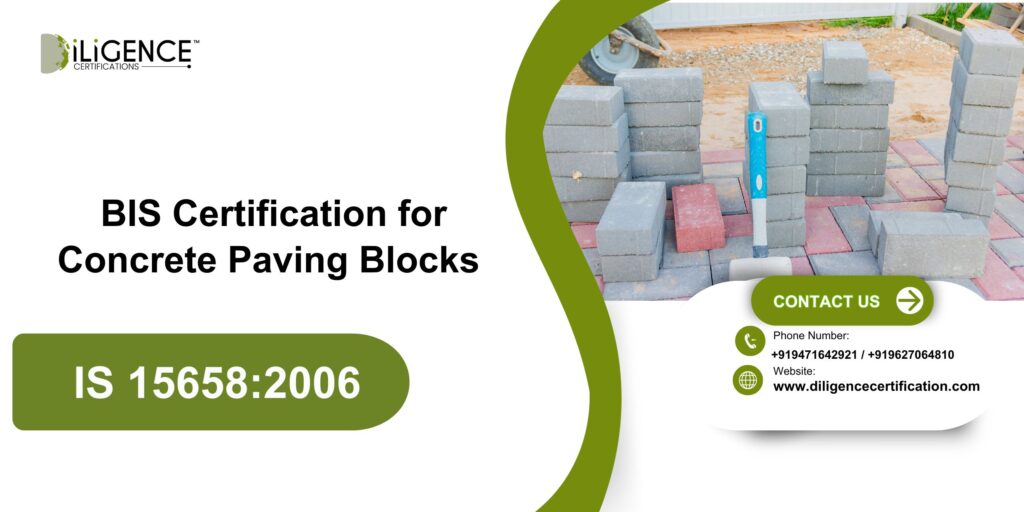
By IS 15658:2006 is a set of standards that defines the characteristics that concrete paving blocks must comply with in terms of compressive strength, abrasion resistance, water absorption, dimensional accuracy, and durability. A certification from BIS is an assurance of product quality that confirms the concrete paving blocks are able to withstand heavy loads, variations in the weather, and long-term usage in outdoor applications.
The ISI mark is a must-have for manufacturers who want to produce and sell concrete paving blocks in the Indian market. It is a mark of safety, performance, and conformity with national standards. Getting BIS certification is like a journey through different stages, i.e. documentation, product testing, factory inspection, approval and issue of the license. Concrete paving blocks that meet the standards become a source of trust for customers, the risk of surface failure is minimized, and the blocks turn out to be a dependable solution for the construction of infrastructure and landscaping projects over time.

Introduction
Concrete paving blocks have become an integral part of footpaths, driveways, parking areas, industrial floors, public walkways, and landscaping usages. Their high load-bearing capacity, ease of installation, aesthetic appeal, and long service life are mainly responsible for their widespread use of the blocks.
As these blocks are constantly subjected to vehicular loads, abrasion, moisture, and weather changes, it is necessary for them to be in conformity with IS 15658:2006. BIS certification of concrete paving blocks is an assurance that these products meet the strength, durability, and dimensional stability requirements set by the Bureau of Indian Standards (BIS), thus being fit for use in either public or private infrastructure projects. Bureau of Indian Standards
What are Concrete Paving Blocks - IS 15658:2006?
Concrete Paving Blocks IS 15658:2006 is an Indian standard that defines the technical and quality requirements of precast concrete paving blocks intended for road construction.
The standard specifies:
Compressive strength - This is the primary parameter that demonstrates the blocks can be used for heavy load bearing.
Abrasion resistance - So the surface does not wear due to traffic.
Water absorption - To limit the penetration of moisture and thus increase the lifetime of the blocks.
Dimensional accuracy - length, width, thickness, and tolerances of the standard.
Surface finish - The look is normal without the presence of the cracks, chips or any defects.
Testing and inspection methods - This is the way to keep the quality standards of each batch.
If concrete paving blocks are manufactured according to IS 15658:2006, they will be able to maintain their structure, surface and wear-resistance features.
ISI Mark Certification for Concrete Paving Blocks
Concrete paving blocks manufactured under the ISI Mark Certification Scheme must conform to IS 15658:2006 to be legally sold in India.
ISI certification provides assurance of:
- Adequate compressive and flexural strength
- Resistance to abrasion and surface wear
- Uniform dimensions for easy installation
- Long-term durability under traffic and environmental stress
- Consistent quality control during production
Manufacturers are permitted to affix the ISI mark on concrete paving blocks only after obtaining a valid BIS licence.
Why BIS Certification for Concrete Paving Blocks Is Mandatory in India
The use of non-certified concrete paving blocks may cause different problems, among which are:
- They crack or break under heavy traffic
- Wear of the surface happens very quickly and the original look is lost.
- Due to dimensional inconsistency, drainage is poor.
- Costs of maintenance and replacement rise higher and higher.
- Among professionals in government and infrastructure projects, there is rejection.
BIS certification serves as a preventive measure for these problems by:
- Ensuring compliance with IS 15658:2006
- Being capable of holding up under both mechanical and environmental stress
- Being chosen and used in public, municipal, and industrial projects
- Giving the pavement the ability to perform for a long time and be dependable
Importance and Benefits of BIS Certification
| Importance | Benefits |
| Compliance with IS 15658:2006 | Ensures strength, durability, and performance |
| Standardized production | Maintains uniform quality across batches |
| Mechanical reliability | Reduces pavement failure and damage |
| Regulatory compliance | Avoids legal issues and project rejection |
| Brand credibility | Builds trust with contractors and authorities |
Step-by-Step BIS Certification Process for Concrete Paving Blocks
Step 1: Documentation
Get ready with the company details, information of the manufacturing process, and product specifications according to IS 15658:2006.
Step 2: Product Testing
Samples of concrete paving blocks are tested in laboratories that are BIS recognized for compressive strength, water absorption, abrasion resistance, and dimensions.
Step 3: Application Submission
File the BIS application along with the test reports and necessary documents through the BIS online portal.
Step 4: Scrutiny & Factory Inspection
BIS officials verify the manufacturing unit, production process, and quality control systems by their visit.
Step 5: Grant of Licence
After the inspection and evaluation are successful, BIS issues the licence that authorizes the manufacturer to put the ISI mark on concrete paving blocks.
Documents Required for BIS Certification
- Company registration certificates
- Manufacturing unit details and layout
- Technical specifications of concrete paving blocks
- Test reports from BIS-recognized laboratories
- Quality control and testing procedures
- Brand authorization (if applicable)
Timeline, Validity & Renewal
- Certification Timeline: 20-30 working days
- Licence Validity: 1-2 years
- Renewal: Updated documents and a compliance check by the time of expiry should be submitted
Conclusion
BIS Certification for Concrete Paving Blocks (IS 15658:2006) is an essential requirement that aims to maintain the quality, strength, and durability of pavement works all over India. Concrete paving blocks that are certified provide good performance under heavy loads, are resistant to wear, and have uniform dimensions, thus they are suitable for the development of the public utility sector in the long run.
Adherence to IS 15658:2006 is not only a legal requirement but also a tactical move that leads to higher product dependability, better brand image, and easier acceptance in projects of government, commercial, and industrial sectors. Using BIS-certified concrete paving blocks is a wise decision that offers safety, high performance, and durability, which are the core values of paving applications anywhere in the country.
Frequently Asked for Questions
Why is BIS certification important for concrete paving blocks?
Hence, the blocks have to be strong, long-lasting, and reliable for outdoor and high-traffic areas that are of a nature generally held for several years, this comes as the main reason why BIS certification is of such great importance to concrete paving blocks.
Is BIS certification compulsory for selling concrete paving blocks in India?
Yes. The manufacturer has to be granted BIS certification, in order to be allowed to sell concrete paving blocks in the Indian market.
What does IS 15658:2006 actually cover?
It clearly specifies the main features that ought to be of a certain quality standard, those features being ones like strength, water absorption, abrasion resistance, and size accuracy, of paving blocks.
Who should legally apply for BIS certification under IS 15658:2006?
If the production is of concrete paving blocks for commercial sales or projects, then the manufacturing entity ought to file for BIS certification.
What would be the outcome of noncertified ones in the case of paving blocks?
Such blocks could fracture, become unwearable in a very short span of time, and will most definitely not be accepted in government projects related to infrastructure.
What is the normal duration for the BIS certification journey?
The usual duration is from 3 to 4 weeks and it mainly depends on the inspection and testing schedule.
Which methods are to be used on the certification samples?
One of the tests are on their strength, durability, and water absorption, on the other hand, there are tests on their abrasive attack, and dimensional accuracy as well.
Can BIS certification open opportunities for the government tenders?
Yes, BIS certification is needed for the block tendering of government and municipal projects and is treated as a plus by the decision-makers.
What is the term of the BIS licence?
The licence normally holds from 1 to 2 years ,and put in order, it can be extended by compliance with the ongoing conditions.
In what ways can a Paving block manufacturer profit from a BIS accreditation?
The manufacturer-stakeholder incentive is enhanced consumer confidence, smoother market integration, and a verified National Standard quality product labeling.


