 BIS Certification
 CDSCO
CDSCO
 PESO
PESO
 CPCB
CPCB
 LMPC
LMPC
 WPC Approval
 Global Approvals
 TEC
TEC
 ARAI
ARAI
 BEE
BEE
 ISO Certification
 DGCA Certification
 NOC For Steel
 APEDA Registration























 Business Registration
 FSSAI Mark Certification












 (32).jpg)
 Legal Services
 Trademark Registration
 Copyright Registration
 Patent Registration
 By
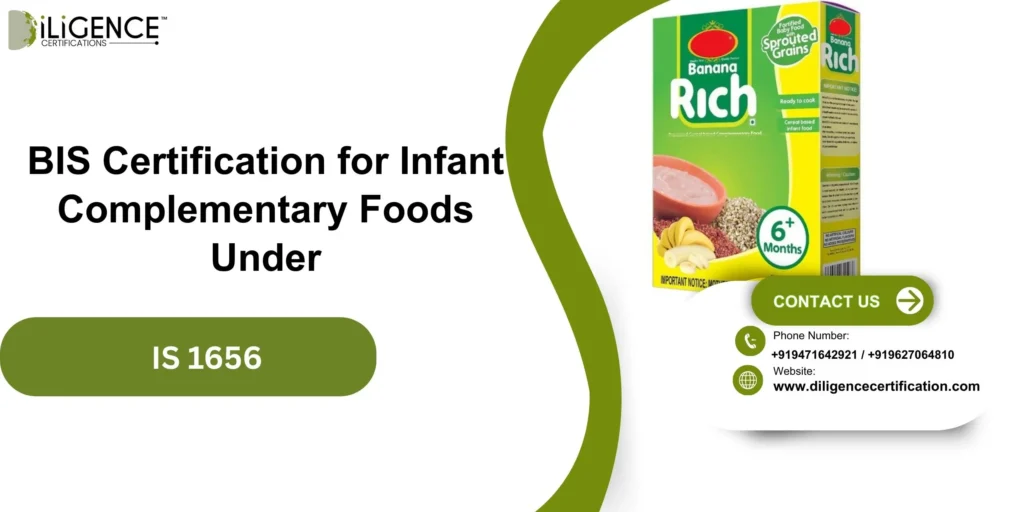
By BIS certification for infant complementary foods - IS 1656 sets the standards to which infant complementary food products should adhere regarding the nutritional composition, microbiological safety, packaging, labeling, and quality requirements. BIS certification guarantees that infant foods are safe, hygienic, nutritionally adequate, and appropriate for infants over six months of age. The ISI mark is a must-have for manufacturers who plan to produce and sell infant complementary foods in India. This certification serves as a safety, nutrition, and regulatory compliance as well as infant health and consumer trust protection.
Getting BIS certification is like going through a well-organized compliance process where each stage-documentation, product testing, factory inspection, approval, and licence issuance-has an important role. Products in compliance with IS 1656 lead to increased brand credibility, easier market acceptance, and sustained consumer trust.
Introduction
It is very important that infant complementary foods should be used as those are necessary to support the growth and development of infants, i.e., at the time when breast milk alone is no longer sufficient. These foods are designed especially to meet the nutritional needs of infants and at the same time, they conform to the safety and hygiene standards of the highest level. As infants are very susceptible to contamination and nutritional deficiencies, it is very important to follow IS 1656 very strictly.
In order to ensure that infant complementary foods are nutritionally balanced, free from any harmful substances, and produced under controlled conditions, the Bureau of Indian Standards (BIS) has made certification mandatory.
What are Infant Complementary Foods IS 1656?
Infant Complementary Foods - IS 1656 is an Indian Standard that defines detailed requirements for foods intended for infants aged six months and above. The standard specifies:
Nutritional composition - Providing good enough levels of proteins, carbohydrates, fats, vitamins, and minerals
Raw material quality - Use of clean and approved ingredients
Microbiological requirements - No harmful bacteria and pathogens
Contaminant limits - Control of heavy metals, toxins, and residues
Packaging requirements - Clean, tamper-proof, and packaging that protects
Labeling norms - Easy to understand nutritional information, age indication, and preparation instructions
Testing and inspection methods - Quality and uniformity of different production batches
So, infant complementary foods guarantee nutritional integrity, safety, and suitability all along their shelf life by following IS 1656.
ISI Mark Certification for Infant Complementary Foods
Infant complementary foods should be certified under IS 1656 according to ISI standard mark before they can be sold in India. The certification assures:
- Nutritional adequacy as per standards set
- Very good food safety and hygiene standards
- Adherence to the regulation and quality standards
- Quality and uniformity at the level of the batch
The manufacturers can put the ISI mark on their products only after they have obtained a valid BIS licence which confirms that all the requirements of IS 1656 have been complied with.
Why is BIS Certification Mandatory for Infant Complementary Foods?
Non-compliant infant food products may cause major risks, such as:
- Nutritional deficiencies that can affect the overall growth of an infant
- Microbial contamination that can lead to health complications
- Introduction of harmful additives or contaminants to the food
- Decrease of consumer trust and imposition of regulatory penalties
BIS certification is a guarantee of the following:
- - Adherence to IS 1656 standards
- - Safety and appropriateness of the product for infant consumption
- - Prevention of health risks
- - Good brand image and easy entry in the market
Considering the importance of infant nutrition, BIS certification is not merely a legal obligation, but a vital public health intervention.
Importance and Benefits of BIS Certification
| Importance | Benefits |
| Compliance with IS 1656 | Ensures nutritional safety and food quality |
| Standardized manufacturing | Maintains consistency across batches |
| Microbiological safety | Reduces health risks for infants |
| Regulatory compliance | Prevents legal issues and product rejection |
| Brand credibility | Builds consumer trust and confidence |
Step-by-Step BIS Certification Process
Step1: Documentation
Prepare company details, manufacturing unit information, product formulation, and quality control procedures as per IS 1656.
Step2: Product Testing
Infant complementary food samples are tested in BIS-accredited labs to confirm nutrition facts, microbiological safety, and contaminant limits.
Step3: Application Submission
Submit the application along with the test reports and supporting documents through the BIS online portal.
Step4: Scrutiny & Factory Inspection
BIS officials visit the factory to verify the hygiene practices, manufacturing processes, and quality control systems.
Step5: Grant of Licence
If everything goes well during the assessment, BIS issues the license which permits the manufacturer to put the ISI mark on the certified infant complementary food products.
Documents Required for BIS Certification
- Company registration certificate
- Details of the manufacturing unit
- Product formulation and technical specifications
- Test reports from BIS-recognized laboratories
- Documentation related to food safety and hygiene
- Brand authorization (if applicable)
Timeline, Validity & Renewal
- Certification Timeline: 20-30 working days
- Licence Validity: 1-2 years
- Renewal: It is necessary to have updated documents and confirmation of continued
Conclusion
BIS Certification for Infant Complementary Foods - IS 1656 identifies the products as safe, nutritious, and of high quality. Such products are the best in terms of nutrition, hygienic safety, and the observance of national standards. For the producers, getting a BIS certification is not only a legal obligation but also a pledge to the health of infants, the quality of the product, and brand loyalty for a long time. Following the standard IS 1656 is beneficial for the producers as it elevates their business reputation and ensures their continued presence in the market.
Frequently Asked for Questions
Environmental-friendly organic baby food next in the diet requires BIS certification?
BIS certification is one of the paramount baby food safety certifications that essentially should be based on IS 1656.
Is BIS certification mandatory for infant first foods in India?
Surely, the answer is affirmative. BIS certification is a must for infant complementary food products that are available for sale in the Indian market and that additionally should display the ISI mark.
What is the coverage of IS 1656?
IS 1656 is a standard that defines the nutritional, safety, packaging, labeling, and quality aspects of a product.
Who, according to IS 1656, requires a BIS certificate?
Those who manufacture the infant food products in India and promote and sell them locally are the ones that have to obtain BIS certification.
How long is the BIS license valid for baby-related foods?
The BIS license is generally valid for a duration of one or two years.
How long is BIS certification?
The entire process takes from 20 to 30 working days, depending on the availability of the documents and the completion of the testing.
Are product tests the only mandatory ones for BIS certification?
Without a doubt, the products have to be tested in a laboratory that is certified by BIS.
Can infant foods be sold without BIS certification if they are imported?
Not at all. In the case of imported infant foods, they must conform to the requirements of IS 1656 and also comply with BIS standards.
What is the ISI mark on infant food products?
The ISI mark is the mark that indicates that the product meets the BIS standards and is safe for consumption.
What is the need for baby food manufacturers to get a BIS certification?
BIS certification is an indication of the compliance of regulations, product safety, consumer trust, and brand reputation.


