BIS Certification
 CDSCO
CDSCO
 PESO
PESO
 CPCB
CPCB
 LMPC
LMPC
 WPC Approval
 Global Approvals
 TEC
TEC
 ARAI
ARAI
 BEE
BEE
 ISO Certification
 DGCA Certification
 NOC For Steel
 APEDA Registration























 Business Registration
 FSSAI Mark Certification












 (32).jpg)
 Legal Services
 Trademark Registration
 Copyright Registration
 Patent Registration
 By
By - Mandatory Compliance: BIS certification for hot rolled steel plates - knowing IS 9442:1980 is a must if you want to manufacture and sell hot rolled steel plates legally in India.
- Provides Mechanical Strength: This BIS certification is a guarantee that the metal sheets will have the necessary tensile strength, hardness, and structural stability.
- Dimensional Accuracy and Quality: BIS certification for hot rolled steel plates - knowledge of IS 9442:1980 secures uniform thickness, exact measurements, and good surface evenness for all the batches.
- Regulatory and Market Acceptance: Using this certification, manufacturers can meet regulations and get a go-ahead from industrial and construction markets without much hassle.
- Increases Brand Credibility: BIS certification for hot rolled steel plates - Knowledge of IS 9442:1980 is instrumental in generating customer loyalty, industrial trust, and consequently, brand prestige.
Introduction
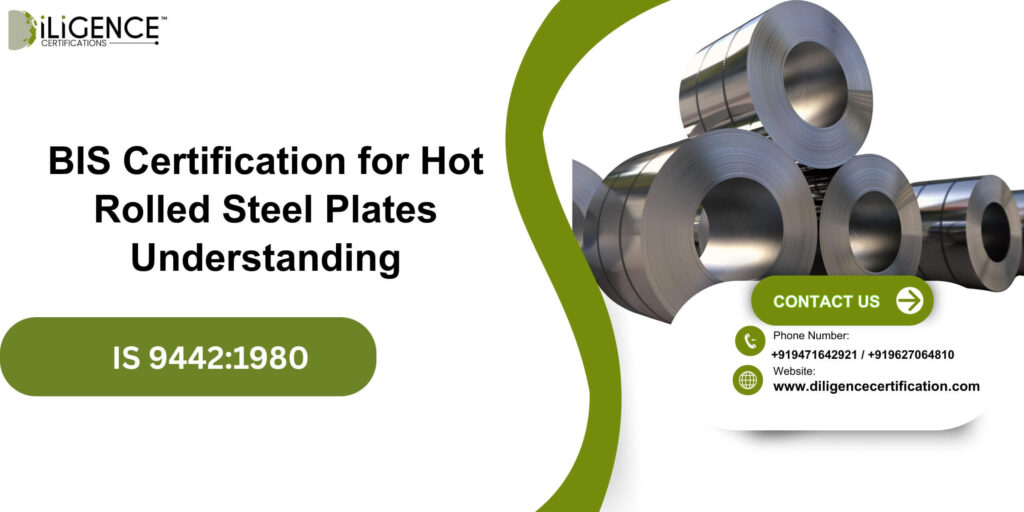
Hot rolled steel plates find application extensively in areas like building, making of machines, and various heavy industries that require strong, long-lasting, and evenly uniform materials. BIS Certification for Hot Rolled Steel Plates - Understanding IS 9442:1980 is the guiding factor that assures that these plates conform to the tough quality norms given by the Bureau of Indian Standards (BIS).
By accomplishing BIS certification, the producers show their adherence to the set standards of the country which leads to an increase in the product trustworthiness, working capability, and good name in the market.
What Are Hot Rolled Steel Plates - IS 9442:1980?
IS 9442:1980 outlines the criteria for Indian standard hot-rolled steel plates, emphasizing:
- Chemical Composition: The steel is made to be strong, flexible, and suitable for use in different industrial areas.
- Mechanical Properties: It is limited to tensile strength, elongation, and hardness tests.
- Dimensional Accuracy: The thickness, width, and tolerance levels are consistent.
- Surface Finish: The surfaces are smooth and free of any defects to ensure maximum usability.
- Testing & Inspection: The quality of each batch is the same because of the standard tests performed.
Hot rolled steel plates that are BIS certified keep these characteristics during their entire service life and thus can be trusted in situations that are critical.
ISI Mark Certification for Hot Rolled Steel Plates
Under the ISI Mark Certification Scheme, hot rolled steel plates must comply with IS 9442:1980 to be legally sold in India. BIS certification guarantees:
- Standard mechanical properties
- Consistent dimensional accuracy
- Smooth, defect-free surface
- Quality control during manufacturing and batch processing
Only after obtaining a valid BIS license can manufacturers affix the ISI mark to their certified steel plates.
Why BIS Certification Is Mandatory for Hot Rolled Steel Plates
Without BIS certification, hot rolled steel plates may:
- Exhibit rapid corrosion or wear
- Fail under mechanical stress
- Lead to higher maintenance and replacement costs
- Shorten the lifespan of construction or industrial applications
BIS-certified plates:
- Conform to IS 9442:1980 standards
- Offer superior mechanical strength and durability
- Comply with national regulations, ensuring consumer safety
- Enhance market trust and brand credibility
Importance and Benefits of BIS Certification
| Importance | Benefits |
| Compliance with IS 9442:1980 | Ensures mechanical reliability and durability |
| Standardized Production | Maintains consistent quality across batches |
| Mechanical & Structural Strength | Reduces risk of failure in construction and industry |
| Regulatory Compliance | Avoids legal issues and market rejection |
| Brand Credibility | Builds customer trust and industrial recognition |
Step-by-Step BIS Certification Process
Step 1: Documentation - Get ready with company details, manufacturing information, and technical specifications of hot rolled steel plates.
Step 2: Product Testing - The samples are taken to testing labs which are recognized by BIS and are tested for chemical composition, tensile strength, and dimensional accuracy.
Step 3: Application Submission - Upload the test reports and other supporting documents on the BIS online portal.
Step 4: Scrutiny & Factory Inspection - BIS inspectors check the manufacturing processes, quality control, and standards compliance.
Step 5: Grant of Licence - After the inspection is found to be satisfactory, BIS gives the license which permits the manufacturer to use the ISI mark.
Documents Required for BIS Certification
- Company registration certificate
- Manufacturing unit details
- Technical specifications of hot rolled steel plates
- Test reports from BIS-recognized laboratories
- Brand authorization (if applicable)
Timeline, Validity & Renewal
- Certification Timeline: 20-30 working days
- Licence Validity: 1-2 years
- Renewal: Upload the latest documents and verify that you are still compliant before the expiry.
Conclusion
BIS Certification for Hot Rolled Steel Plates - Understanding IS 9442:1980 serves as a standard in terms of quality, safety, and stability. The certified plates ensure that the metal has good mechanical strength, high resistance to rust, and that the dimensions are stable.
It is more than a legal requirement for producers to conform to IS 9442:1980. It is also a wise decision to build up their reputation, gain the trust of the industry, and get the confidence of the clients for a long period of time.
Frequentlu Asked for Questions
What is BIS Certification for Hot Rolled Steel Plates?
BIS certification is a quality and compliance indicator of steel plates based on the IS 9442:1980 standards.
Why is BIS certification mandatory for hot rolled steel plates?
By giving a BIS certified hot-rolled steel plate, the consumer is assured of the product mechanical strength, durability, and also as per the law that the product has been approved for the Indian market.
What does IS 9442:1980 standard cover?
This standard is concerned with the chemical composition, mechanical strength, room size, and gloss of the plate.
Can I sell hot rolled steel plates without BIS certification?
You are not permitted to sell non-certified steel plates that are for common use.
How long is a BIS license valid for steel plates?
The license will normally be good for 1-2 years before it is renewed.
What are the benefits of BIS-certified hot rolled steel plates?
BIS-certified steel sheets allow the user to enjoy the benefits of dependable strength, long-lasting, safety, and industrial trustworthiness, which are all qualities that are necessary for the steel industry.
What documents are required to get BIS certification?
Business registration, production information, steel features, and lab test reports.
How long does it take to get BIS certification?
Generally, the process takes about 20-30 business days.
Can small manufacturers apply for BIS certification?
Sure, if the small-scale manufacturer meets the standards, he can apply for and get a BIS certification letter.
Does BIS certification improve customer trust?
Definitely! It is a strong indicator of a company’s adherence to national quality standards and serves as a reliable partner in the industrial sector.