 BIS Certification
 CDSCO
CDSCO
 PESO
PESO
 CPCB
CPCB
 LMPC
LMPC
 WPC Approval
 Global Approvals
 TEC
TEC
 ARAI
ARAI
 BEE
BEE
 ISO Certification
 DGCA Certification
 NOC For Steel
 APEDA Registration























 Business Registration
 FSSAI Mark Certification












 (32).jpg)
 Legal Services
 Trademark Registration
 Copyright Registration
 Patent Registration
 By
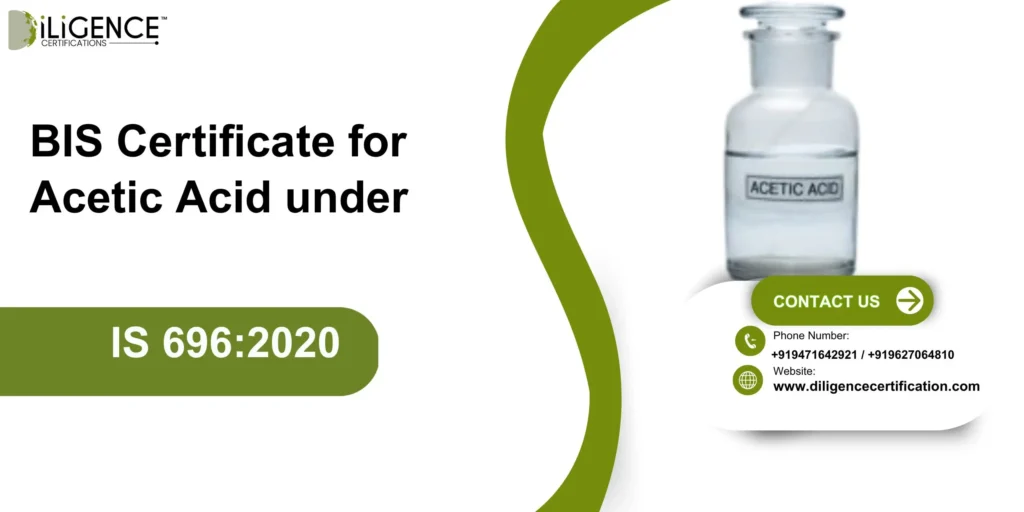
By - Mandatory ISI Certification: BIS certification under IS 696:2020 by the manufacturer is compulsory to sell or distribute acetic acid in India.
- Quality & Purity Assurance: The standard determines the chemical composition, purity, and safety of the product
- Regulatory Compliance: Producers are completely in line with Bureau of Indian Standards (BIS) and have no legal or market restrictions.
- Industrial Reliability: The chemical is classified according to the standard which gives not only performance but also safe handling and industrial or commercial applications.
- Brand Credibility Enhancement: The consumers are attracted to BIS, certified products which is a trust, building, market, acceptance enhancing and brand, reputation strengthening process for the manufacturer.
Introduction
Acetic acid functions as a vital component in various industries which include chemicals, pharmaceuticals, food processing, textiles, dyes, plastics, and adhesives. The substance needs strict quality and purity standards because of its acidic nature and its widespread industrial usage.
The Bureau of Indian Standards (BIS) requires all manufacturers to follow IS 696:2020 which serves as a safety standard for dependable and uniform products. The BIS-certified acetic acid meets all specified chemical and physical standards. This makes it suitable for long-term industrial applications.
What is Acetic Acid IS 696:2020?
Acetic Acid IS 696:2020 is an Indian Standard that details the quality norms for acetic acid that will be used in the industry and for commercial purposes. According to the standard the following things are defined:
- Chemical composition - Purity and concentration are guaranteed to be at the required levels
- Physical properties - Through appearance, clarity, and solubility
- Acidity and strength - Chemical concentration confirmed through given specifications
- Limits for impurities - No harmful or performance-affecting contaminants in the final product
- Testing and inspection methods - Quality of each batch is uniform
- Packaging and labeling requirements - Safe storage and handling ensured
Through the application of IS 696:2020, the power, safety, and the uniformity of acetic acid products are all in place for the duration of their shelf life.
ISI Mark Certification for Acetic Acid
Acetic acid that falls under the ISI Mark Certification Scheme must meet IS 696:2020 to be legally sold in India. BIS certification ensures the following:
- Standardized chemical purity
- Safe handling and usage
- Consistent quality across production batches
- Compliance with Indian regulatory requirements
Manufacturers can only put the ISI mark on their products after obtaining a valid BIS license.
Why is BIS Certification Mandatory for Acetic Acid?
- Uncertified acetic acid or that of poor quality can lead to the following severe problems:
- Health hazards and safety dangers during its application and handling
- Loss of efficacy in the manufacture of products
- Negative impacts on machinery and production
- Penalties imposed by the authorities and non-acceptance by the market
- Disillusionment of customers and brands with image problems
The Bureau of Indian Standards (BIS) certification guarantees:
- Adherence to IS 696:2020
- Capability of satisfying both the chemical and safety criteria
- Reliable performance in the industrial applications
- Long-lasting Acceptance and Credibility in the market
Importance and Benefits of BIS Certification
| Importance | Benefits |
| Compliance with IS 696:2020 | Ensures purity, safety, and effectiveness |
| Standardized production | Maintains uniform quality across batches |
| Chemical reliability | Reduces risk of industrial failure |
| Regulatory compliance | Prevents legal issues and market rejection |
| Brand credibility | Enhances customer confidence and trust |
Step-by-Step BIS Certification Process
Step 1: Documentation
The recording of the company, the production method, and the technical specifications of acetic acid according to the BIS standards is to be done.
Step 2: Product Testing
The mentioned above, which are recognized by BIS, are laboratories that are responsible for testing the acetic acid samples for purity, composition, and compliance with the standard IS 696:2020.
Step 3: Application Submission
The test reports and related documents are to be submitted to the BIS portal for review.
Step 4: Scrutiny & Inspection
A company that is registered with BIS will undergo an inspection at the manufacturing site to verify that its practices, quality control systems, and testing facilities are as claimed.
Step 5: Grant of Licence
The manufacturers are allowed to use the ISI mark on the certified acetic acid after a successful inspection and verification, which is the grant that BIS gives.
Documents Required for BIS Certification
- Company registration certificate
- Manufacturing unit information
- Acetic acid technical specifications
- Testing reports from a lab recognized by BIS
- Brand authorization (if needed)
Timeline, Validity & Renewal
Certification Timeline: 20-30 working days
License Validity: 1-2 years
Renewal: Submission of updated documents and confirmation of continued compliance before expiry
Conclusion
BIS certification for Acetic Acid under IS 696:2020 indicates that the product is safe, of good quality, and meets Indian standards. Acetic acid which has BIS certification is always pure, safe to handle, and used correctly in all sectors.
In the industry where chemical precision and safety are the main concerns, the use of BIS certified acetic acid would not only lower the risk but also improve the overall process, and make the brand more popular. Following IS 696:2020 standards is not just a legal obligation; it is a strategic approach to guaranteeing quality, winning over customers, and growing a business in a sustainable manner.
Frequently Asked for Questions
What does IS 696:2020 imply with regard to acetic acid?
The standard prescribes unambiguous quality and safety regulations which serve the purpose of assuring the acetic acid is of the highest purity, utmost reliability and complete safety for human consumption.
Am I obliged to obtain a BIS certificate in order to produce acetic acid?
Absolutely, it is a must that a BIS certificate be secured if you are intending to legally case and distribute acetic acid.
How does the ISI mark advantage buyers?
For buyers, the ISI mark acts as a guarantee that the acetic acid in question has the approval of the quality and safety standards.
Is BIS certification only a matter of conformity with law?
The answer is no, it also brings in the area of reliability of the product, trust of the customer, and general acceptance in the market.
How long does it take on average for the BIS certification process to be completed?
Usually, the processing time is around 20-30 working days.
Will there be a BIS inspection carried out at my manufacturing unit?
Indeed, an on-site inspection will take place to verify and monitor the QC and DP.
What penalties face the sellers of acetic acid without BIS certification?
The scenario might include fines, rejection of the product, and tarnishing the name of the manufacturer.
Does BIS certification assuage the concern regarding the purity of acetic acid?
It certainly does, the standard assures that the product satisfies the required purity and impurity limits specified in IS 696:2020.
What is the lifespan of a BIS licence once it is granted?
Alicence typically remains valid for one or two years and can be extended through renewal.
What are the reasons for the preference of customers for acetic acid of BIS certification?
The answer is that it guarantees quality that is not only consistent, but also that it is safe to be handled and has reliable performance.


