BIS Certification
 CDSCO
CDSCO
 PESO
PESO
 CPCB
CPCB
 LMPC
LMPC
 WPC Approval
 Global Approvals
 TEC
TEC
 ARAI
ARAI
 BEE
BEE
 ISO Certification
 DGCA Certification
 NOC For Steel
 APEDA Registration























 Business Registration
 FSSAI Mark Certification












 (32).jpg)
 Legal Services
 Trademark Registration
 Copyright Registration
 Patent Registration
 By
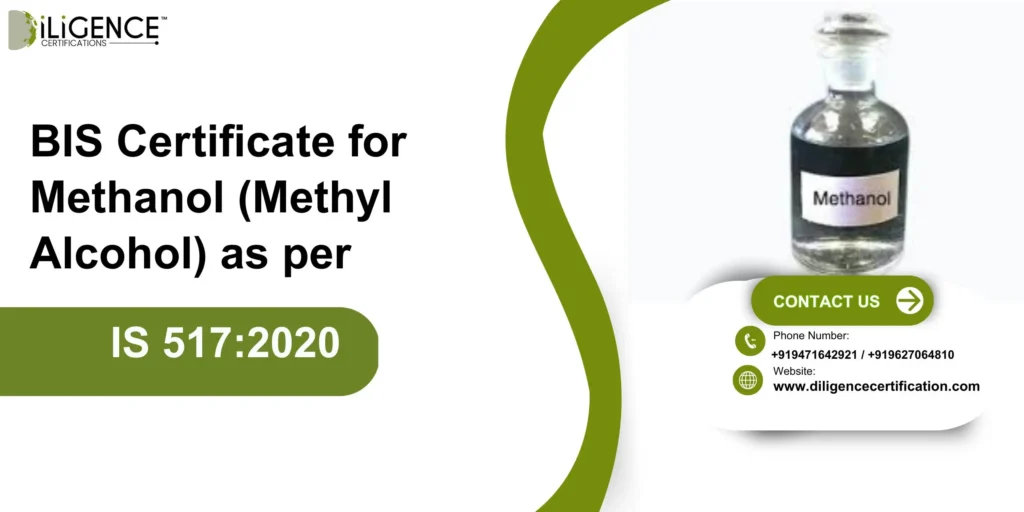
By - Mandatory ISI Certification: The certification under IS 517:2020 by BIS is a necessity for the manufacturers who are producing Methanol methyl alcohol for sale or distribution.
- Quality & Purity Assurance: It ensures that the methanol has the specified purity levels, the impurity limits and is safe for use in accordance with the prescribed parameters.
- Regulatory Compliance: It allows manufacturers to be in accordance with the BIS regulations and thus not subject to legal penalties or being rejected in the market.
- Industrial Reliability: It secures the supply of across-the-board performance, safe use in and even in the most critical industrial applications.
- Enhanced Brand Credibility: Methanol that has received BIS certification is regarded as more trustworthy by customers, more readily accepted in the market, and the brand name is more strong.
Introduction
Methanol methyl alcohol, is the name that the methanol molecule is known with scientifically and the name that it is most commonly used industrially for. This chemical is extensively used in the production of chemicals, and pharmaceuticals, as well as in the production of fuels, solvents, paints, plastics, and formaldehyde. The toxic and flammable characteristics of methanol cause it to be strictly controlled and monitored throughout the preparation and handling stages.
In order to prevent non-uniformity of products, and moreover, to guarantee that the products are safe for consumption and are of good quality, the Bureau of Indian Standards (BIS) has made it mandatory to implement IS 517:2020 as the standard practice in this industry. Methanol that has been certified by the BIS is compliant with the set chemical and physical requirements, therefore, it can be used for long-term industrial applications that require strict control.
What is Methanol methyl alcohol IS 517:2020?
Methanol methyl alcohol IS 517:2020 is the Indian Standard that establishes the quality requirements for methanol intended for the industry and the market. The standard includes:
- Chemical composition - Guarantees the necessary purity and the controlled constituents
- Purity requirements - Verifies the acceptability for the industrial processes
- Limits for impurities - Avoids the negative impacts on the applications and safety
- Physical properties - Looks like, weighs, and mixes up
- Testing and inspection methods - Keeps the same quality for different batches
- Packaging and labeling requirements - Guarantees that the product is safe and that it can be easily stored and identified
With the help of IS 517:2020, the performance, safety, and reliability of methanol products are preserved over their entire shelf life.
ISI Mark Certification for Methanol methyl alcohol
The ISI Mark Certification Scheme places Methanol methyl alcohol under the category of substances that are required to comply with IS 517:2020 in order to be legally produced and sold. The certification of BIS provides the following assurances:
- Purity of chemical guaranteed by the standard
- Handling that is safe and usage that is controlled
- Quality that is same in all production batches
- Meeting the requirements of the relevant regulations
No intervention of manufacturers is allowed for the use of the ISI mark until a proper BIS license is secured.
Why is BIS Certification Mandatory for Methanol?
Using methanol that is not up to standard or not certified could lead to considerable complications such as:
- Health and safety risks with handling and storing
- Processes in the industry that are not efficient or unsafe
- Breakdown of machines and products
- Fines from regulators and not being accepted in the market
- Decline in trust of customers and brand power
The Bureau of Indian Standards (BIS) certification is a guarantee of:
- Being in line with IS 517:2020
- Meeting the chemical and safety criteria
- Industry wise, being a product that performs consistently
- Gaining and retaining acceptance and credibility in the market for a long time.
Importance and Benefits of BIS Certification
| Importance | Benefits |
| Compliance with IS 517:2020 | Ensures purity, safety, and effectiveness |
| Standardized production | Maintains uniform quality across batches |
| Chemical reliability | Reduces risk of industrial process failure |
| Regulatory compliance | Avoids legal issues and market rejection |
| Brand credibility | Enhances customer trust and industry reputation |
Step-by-Step BIS Certification Process Methanol methyl alcohol
Step 1: Documentation
Company information, production details, and methanol technical data in accordance with BIS standards are prepared.
Step 2: Product Testing
Purity, chemical composition, and IS 517:2020 compliance of the methanol samples are checked in BIS recognized laboratories.
Step 3: Application Submission
The test reports along with supporting documents are uploaded on the BIS portal for reviews.
Step 4: Scrutiny & Inspection
BIS does a factory inspection to assess the practices of manufacturing, quality control methods, and test facilities.
Step 5: Grant of Licence
BIS, after conducting a successful inspection and verification, issues the license that permits manufacturers to apply the ISI mark to the methanol that is certified.
Documents Required for BIS Certification Methanol methyl alcohol
- Company registration certificates
- Details of the manufacturing unit
- Methanol technical specifications
- Test reports from a laboratory recognized by BIS
- Brand authorization (if applicable)
Timeline, Validity & Renewal
- Certification Timeline: 20-30 working days
- Licence Validity: 1-2 years
- Renewal: Submission of updated documents and confirmation of continued compliance before expiry.
Conclusion
BIS certification for Methanol methyl alcohol in accordance with IS 517:2020 indicates that the product is safe, of good quality, and meets the requirements. Methanol certified by BIS guarantees purity under control, safe use, and trustworthiness of performance in all industrial applications.
In those industries where chemical accuracy and safety are the ultimate concerns, the use of BIS-certified Methanol methyl alcohol not only eliminates risks but also enhances production efficiency and builds the manufacturer’s reputation. Adhering to IS 517:2020 is not merely a matter of conforming to government regulations-it is a wise tactical move that facilitates quality assurance, customer loyalty, and eco-friendly business expansion.
Frequenlty Asked for Questions
What is the reason BIS certification is needed for methanol from manufacturers in India?
The reason is that methanol being a toxic chemical, the certification by BIS makes sure that indus.
Who is to be the applicant for the BIS certificate for methanol?
At least one manufacturer of methanol that is made for sale or distribution in India has to apply for BIS certification.
What are the contents of IS 517:2020?
It specifies the standards needed for purity, safety, and overall quality of methanol to be in accord with Indian law.
Is it difficult to renew the BIS certification?
Not at all. The renewal process is simple if the manufacturer keeps on being compliant with the BIS standards, and the recent documents are submitted on time.
Is methanol allowed to be marketed without ISI mark?
Absolutely not! Selling methanol without the ISI mark is against the law and thus bring punishments.
What are the benefits of BIS certification to the manufacturers?
The certification keeps the company in compliance with the law, legal issues are avoided, the quality of the product is.
What is the estimated time to take to receive the certification for methanol from BIS?
The whole process is normally finished in about 20 to 30 days working.
Is it necessary that the product should be tested in a BIS-certified laboratory for BIS certification?
Absolutely, the methanol must undergo testing in a BIS-recognized laboratory to
Does the BIS certification really assure the customer of a consistent quality?
Indeed it does since it confirms that every production batch is up to the quality standards set.
What is the period of validity for a BIS license for methanol?
A BIS license usually has a validity period of one to two years, during which time it needs to be renewed before its expiry.