BIS Certification
 CDSCO
CDSCO
 PESO
PESO
 CPCB
CPCB
 LMPC
LMPC
 WPC Approval
 Global Approvals
 TEC
TEC
 ARAI
ARAI
 BEE
BEE
 ISO Certification
 DGCA Certification
 NOC For Steel
 APEDA Registration























 Business Registration
 FSSAI Mark Certification












 (32).jpg)
 Legal Services
 Trademark Registration
 Copyright Registration
 Patent Registration
 By
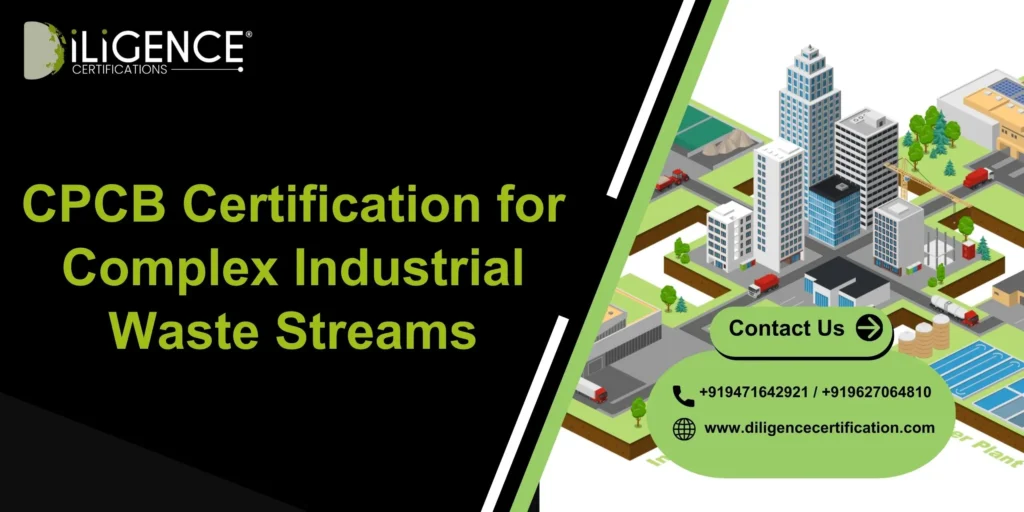
By - The CPCB Certification for Complex Industrial Waste Streams guarantees that the industries comply with the environmental laws regarding the management of hazardous and mixed waste.
- The certification implies the scientific waste characterization and segregation for the safe handling and disposal of the waste.
- The implementation of advanced treatment systems is necessary to regulate the emissions, effluents, and toxic residues.
- Regular monitoring and precise documentation are the key to supporting successful certifications and audits.
- The certification offers the advantage of reducing environmental risks, while simultaneously improving the compliance with regulations and the corporate credibility.

Introduction
The modern industries like chemicals, pharmaceuticals, petrochemicals, metal processing, and manufacturing produce waste streams that are not only very complicated but also very costly to manage; hence they have to face the environmental risk of soil and water contamination and air quality degradation etc. The CPCB has made it compulsory for the industries to get their waste management systems certified by a scientific-based design that will be able to manage the waste safely, sustainably and in compliance with the law which is what CPCB Certification for Complex stands for. Central Pollution Control Board
What Are Complex Industrial Waste Streams?
Complex industrial waste streams are the ones that contain a variety of substances and are generated from industrial processes that are like but not limited to the following:
- Hazardous chemicals and toxic residues
- Mixed liquid effluents with heavy metals
- Volatile air emissions
- Solid and semi-solid sludge
- Recyclable and non-recyclable waste combinations
It is because of their complex nature that these waste streams require very advanced treatment technologies, constant monitoring, and peak CPCB compliance all along.
What is CPCB Certification for Complex Industrial Waste Streams?
CPCB Certification for Complex is an authentication that is exclusively given to industries that are able to prove that they are following the set environmental standards for giant waste disposal. It guarantees:
Regulatory Compliance - Compliance with the Environment Protection Act, Hazardous Waste Rules, and Air & Water Acts.
Waste Characterization - A scientific way of identifying and classifying waste streams.
Treatment & Disposal Systems - Use of TSDFs that are authorized for treatment, storage, and disposal.
Emission & Effluent Control - Meeting the limits set for discharge and emissions.
Monitoring & Reporting - Continual environmental monitoring and precise record-keeping.
Industries that hold CPCB certification are acknowledged for their responsible waste management and their commitment to the environment.
Why CPCB Certification is Mandatory for Complex Waste Streams
The wrong treatment of complex industrial waste can have serious effects like:
- Long-lasting pollution of the soil and groundwater
- Toxicity risking people’s health who work in the industry or live near
- Fines, ceasing operations, and damaging image
- More expensive clean-up and compliance All of these situations make it more costly for the company
CPCB Certification for Complex is like a protection for industries as it compels them to adopt organized waste management techniques which not only reduce but also protect the environment thus making it possible for industries to grow safely.
Importance and Benefits of CPCB Certification
| Importance | Benefits |
| Legal compliance | Prevention of penalties and restrictions on operations |
| Environmental protection | Minimization of pollution and damage to nature |
| Waste optimization | Promotes the activities of segregation, recycling, and reuse |
| Risk reduction | Accidents and hazardous exposure are minimized |
| Corporate credibility | Trust is built with regulators and stakeholders |
CPCB Certification for Complex also aligns industrial operations with global environmental sustainability standards.
Step-by-Step CPCB Certification Process for Complex Waste Streams
Step 1: Waste Identification & Characterization
Industries are supposed to do an in-depth analysis and classification of every waste stream considering its toxicity, composition, and impact on the environment.
Step 2: Documentation Preparation
Waste equivalents, treatment processes, and monitoring reports along with compliance certificates should be the basis of detailed records.
Step 3: Treatment & Infrastructure Assessment
Factories that handle waste, such as effluent treatment plants (ETP), air pollution control devices (APCD), and waste storage facilities should be in compliance with the standards of the CPCB.
Step 4: Internal Audit & Compliance Review
The internal audit that helps the identification of gaps and the implementation of corrective actions before the CPCB inspection should be a routine practice at the company.
Step 5: CPCB Inspection & Verification
Inspection by the CPCB will involve a thorough checking of the waste management practices, infrastructure, and compliance documentation in the facility.
Step 6: Grant of CPCB Certification
At the end of the verification process, the CPCB will issue a certification which allows the company to legally handle and dispose of complex waste streams.
Documents Required for CPCB Certification for Complex
- Environmental clearance approvals
- Waste characterization and analysis reports
- Consent to Establish (CTE) and Consent to Operate (CTO)
- Emission and effluent monitoring data
- Hazardous waste authorization records
- SOPs for waste handling and emergency response
Timeline, Validity & Renewal
Certification Timeline: 30-45 working days after inspection
Validity: 1 to 3 years depending on industry type
Renewal: Updated compliance documents and re-inspection prior to expiry
Conclusion
CPCB Certification for Complex Industrial Waste Streams is a crucial necessity for industries that manage different and hazardous waste. It assures legal compliance, environmental safety, and responsible industrial growth. By following organized waste management techniques, contributing in treatment tools, and keeping correct logs, companies can get the CPCB certification in a smooth manner.
More than compliance, CPCB Certification for Complex shows an organization’s dedication to sustainability, risk management, and long-term environmental care-thus providing a strategic edge in the presence of such a contemporary environmentally conscious industrial scene.
Frequenlty Asked for Questions
CPCB Certification for Complex Industrial Waste Streams is what?
The hazardous and mixed waste management practices of the industries are legit and thus approved by the environment.
What are the businesses requiring this CPCB certification?
Chemicals, pharmaceuticals, the petrochemical, and metal-processing industries that produce complicated wastes are the ones that will have to be certified.
What is the reason that a CPCB certificate is a must for the waste that is complex?
To protect the environment from pollution and also to make sure that the waste is treated and disposed of safely.
Complex waste is what kind of waste?
Waste that is classified as complex consists of hazardous substances, mixed waste liquids, sludge, pollutants of air, and recyclables plus non-recyclables combined.
Which legislation forms the foundation for the CPCB waste certification?
The Environment Protection Act, Hazardous Waste Rules, and Air & Water Acts are the three legal foundations supporting the CPCB waste certification.
How long does it generally take to get CPCB certification?
The standard processing time is between 30 to 45 working days after conducting the inspection and verification process.
What are the required documents for CPCB certification?
You would have to submit CTE, CTO, waste analysis reports, monitoring data, and SOPs.
Is there an up-front CPCB inspection?
CPCB site inspection is a prerequisite for the issuance of the certificate.
What is the life span of the CPCB certification?
The normal duration will be 1 to 3 years, depending on the industry category.
What are the benefits of CPCB certification?
The main benefits are legal compliance, reduced environmental risk, and improved corporate image.