BIS Certification
 CDSCO
CDSCO
 PESO
PESO
 CPCB
CPCB
 LMPC
LMPC
 WPC Approval
 Global Approvals
 TEC
TEC
 ARAI
ARAI
 BEE
BEE
 ISO Certification
 DGCA Certification
 NOC For Steel
 APEDA Registration























 Business Registration
 FSSAI Mark Certification












 (32).jpg)
 Legal Services
 Trademark Registration
 Copyright Registration
 Patent Registration
 By
By - Bomb disposal equipment in India is now governed under IS 19445:2025, making BIS Certification mandatory for manufacturers and importers.
- IS 19445 for bomb disposal robots and tools sets strict benchmarks for safety, mobility, blast resistance, and operator control.
- BIS Certification for bomb disposal equipment is no longer optional-it is a legal, operational, and reputational requirement.
Introduction
When a bomb disposal robot is deployed, there is no room for trial and error. One system failure, one signal drop, or one unstable manipulator can cost lives. This is exactly why India has brought Explosive Ordnance Disposal (EOD) Equipment under a formal safety framework through IS 19445:2025. Today, whether you manufacture locally or import from overseas, BIS Certification for Explosive Ordnance Disposal (EOD) Equipment is no longer a procedural formality-it is a legal and operational necessity. Defence agencies, police units, and procurement bodies now insist on a valid BIS Certificate under IS 19445 before deployment or purchase.
What Is Bomb Disposal Equipment?
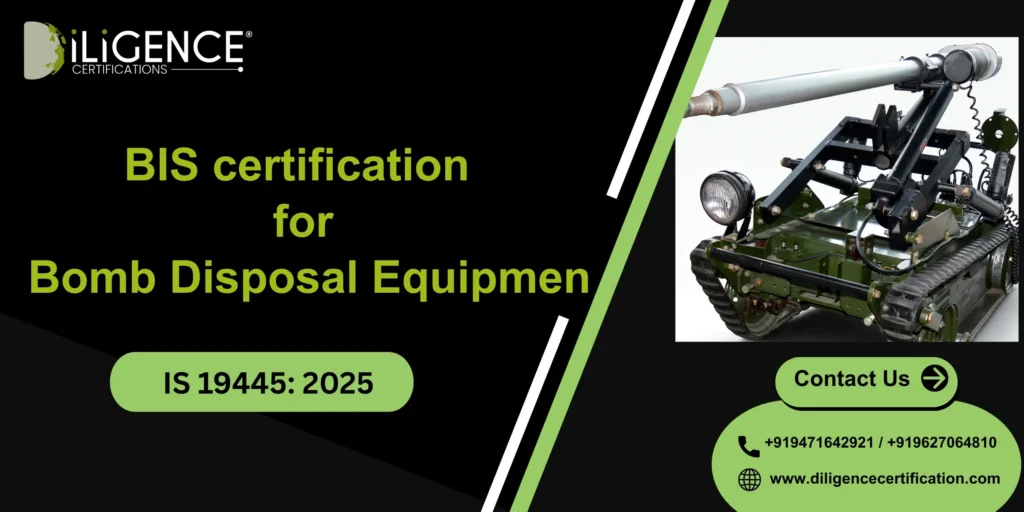
Explosive Ordnance Disposal (EOD) Equipmentrefers to tools, machines, and systems designed to detect, approach, neutralise, or safely destroy explosive devices without exposing human operators to direct risk.
Under IS 19445, this includes:
- Bomb disposal robots (tracked or wheeled)
- 4 Remote manipulators and disruptors
- Portable X-ray systems for IED inspection
- Protective blast containment units
- Operator control consoles and communication systems
The key point regulators focus on is operator safety. If a product claims to reduce human exposure to explosive threats, it falls squarely under this standard.
Understanding IS 19445:2025
IS 19445:2025 is the Indian Standard that defines performance, safety, design, and testing requirements for Explosive Ordnance Disposal (EOD) Equipment and robots.
It is issued by the Bureau of Indian Standards, India’s national standards authority.
Why IS 19445 Was Introduced
Earlier, Explosive Ordnance Disposal (EOD) Equipment entered India under fragmented defence procurement norms. There was no uniform benchmark for:
- Payload stability under blast pressure
- Communication reliability in RF-dense environments
- Fail-safe behaviour during power loss
- Operator distance and line-of-sight safety
IS 19445 standardises all of this.
Key Technical Requirements Under IS 19445
IS 19445 is not a paperwork standard. It is engineering-heavy.
1. Mechanical & Structural Integrity
Equipment must withstand shock, vibration, and partial blast exposure without catastrophic failure.
2. Mobility & Terrain Performance
Robots must demonstrate stable operation on:
- Uneven terrain
- Stairs
- Debris-filled environments
3. Remote Control & Communication Safety
Latency, signal loss recovery, and encrypted communication channels are evaluated.
4. Power System Safety
Battery systems are tested for:
- Thermal stability
- Emergency shutdown
- Fire containment
5. Operator Safety Distance
IS 19445 defines minimum safe operating distances under different explosive threat levels.
This is where many imported products fail-not on design, but on documentation and test validation.
BIS Certification for Bomb Disposal Equipment: Legal Status
BIS Certification is mandatory when Explosive Ordnance Disposal (EOD) Equipment is notified under a Quality Control Order (QCO).
Once notified:
- Manufacturing
- Importing
- Selling
- Supplying to government or private agencies
without a valid BIS Certificate becomes illegal.
This applies equally to:
- Indian manufacturers
- Foreign OEMs
- Defence integrators sourcing from abroad
BIS Certification for Bomb Disposal Robots (IS 19445)
Bomb disposal robots receive special scrutiny because they combine:
- Mechanical systems
- Electronics
- Software control
- Human-machine interfaces
Under IS 19445, robots are tested as complete systems, not as individual components.
A common misconception is that CE or MIL-STD compliance is enough. It is not. BIS Certification is India-specific and non-transferable.
BIS Certificate Types Applicable
Depending on your business model, one of the following applies:
1. ISI Mark Certification (Indian Manufacturer)
For companies manufacturing Explosive Ordnance Disposal (EOD) Equipment in India.
2. FMCS (Foreign Manufacturer Certification Scheme)
For overseas manufacturers exporting bomb disposal robots or equipment into India.
Both require:
- Factory audit
- Product testing in BIS-recognised labs
- Technical documentation review
Common Compliance Mistakes We See
After working with multiple defence and safety equipment suppliers, a few patterns repeat:
- Submitting incomplete technical drawings
- Ignoring operator console safety requirements
- Using test reports from non-recognised labs
- Assuming defence exemption applies automatically
One client lost six months simply because the battery safety report did not align with IS 19445 clauses, even though the product was field-proven.
Step-by-Step Process for BIS Certification of Bomb Disposal Equipment (IS 19445:2025)
Step 1: Identify Applicability Under IS 19445
The first step is confirming whether your product falls under IS 19445:2025.
If the equipment is designed to detect, inspect, handle, neutralise, or dispose explosive devices remotely, it is covered.
This includes:
- Bomb disposal robots
- Remote manipulators and disruptors
- Portable inspection and neutralisation equipment
Many suppliers make the mistake of assuming defence-use products are exempt. They are not.
Step 2: Decide the Applicable BIS Certification Scheme
Based on manufacturing location, the correct BIS route is selected:
- Indian Manufacturer → ISI Mark Certification
- Foreign Manufacturer / Importer → FMCS (Foreign Manufacturer Certification Scheme)
Choosing the wrong scheme at this stage leads to automatic rejection later.
Step 3: Gap Analysis Against IS 19445 Requirements
Before applying, a technical gap assessment is conducted against IS 19445 clauses.
This includes:
- Mechanical stability and structural strength
- Remote-control reliability and signal safety
- Battery and power system protection
- Emergency shutdown and fail-safe behaviour
- Operator safety distance and controls
This step saves the most time and cost during testing.
Step 4: Product Testing at BIS-Recognised Laboratory
The equipment is sent to a BIS-approved laboratory for testing strictly as per IS 19445.
Typical tests include:
- Mechanical endurance and shock resistance
- Electrical and battery safety
- Communication and control stability
- Environmental and operational stress testing
Only test reports from recognised labs are accepted.
Step 5: Preparation of Technical Documentation
Alongside testing, a complete documentation set is prepared, including:
- Product technical specifications
- Design drawings and schematics
- Bill of materials (BOM)
- Risk analysis and safety manuals
- Quality control and inspection procedures
Incomplete or inconsistent documents are the most common reason for delays.
Step 6: Online BIS Application Submission
The application is filed on the BIS portal under the relevant scheme with:
- Test reports
- Technical documents
- Factory details
- Authorised Indian Representative (for foreign manufacturers)
At this stage, accuracy matters more than speed.
Step 7: Factory Audit by Bureau of Indian Standards
BIS conducts a factory inspection to verify:
- Manufacturing capability
- Quality control systems
- In-house testing facilities
- Traceability and batch control
For foreign manufacturers, the audit is conducted overseas.
Step 8: Closure of Non-Conformities (If Any)
If BIS raises observations, corrective actions must be submitted with evidence.
Examples:
- Updated safety procedures
- Design clarifications
- Revised test parameters
Quick and technically sound responses speed up approval.
Step 9: Grant of BIS Certificate
Once all requirements are satisfied, BIS issues the BIS Certificate under IS 19445:2025.
Only after this:
- The product can be legally sold or supplied in India
- Government and defence procurement becomes possible
- The ISI mark can be used (for Indian manufacturers)
Step 10: Ongoing Compliance & Surveillance
BIS Certification is not a one-time activity.
Post-certification includes:
- Surveillance audits
- Sample testing
- Renewal compliance
Non-compliance can lead to suspension or cancellation
Documentation Required for BIS Certification
Expect to prepare:
- Product technical specification dossier
- Electrical and mechanical drawings
- Bill of materials
- Risk assessment and safety manuals
- Test reports as per IS 19445
- Factory quality control procedures
Documentation clarity often decides approval speed more than testing itself.
Testing & Lab Evaluation Under IS 19445
Testing is conducted only at BIS-recognised laboratories.
Typical tests include:
- Mechanical endurance
- Environmental resistance
- Electrical safety
- Communication reliability
- Emergency failure simulation
Reference authority:
https://www.bis.gov.in
(This is a do-follow authoritative source.)
How Long Does BIS Certification Take?
If prepared properly:
- Indian manufacturers: 8-12 weeks
- Foreign manufacturers: 12-16 weeks
Delays usually come from design-standard mismatch, not bureaucracy.
Cost Factors to Consider
Certification cost varies based on:
- Product complexity
- Number of variants
- Testing scope
- Factory audit location
Trying to “save cost” by skipping pre-assessment usually increases total expense later.
Why IS 19445 Compliance Is Also a Business Advantage
Beyond legality, BIS Certification offers:
- Faster government procurement approvals
- Higher trust with defence and police agencies
- Reduced liability exposure
- Stronger export credibility
Several OEMs now use IS 19445 compliance as a tender qualification filter.
Why Choose Diligence Certifications?
Explosive Ordnance Disposal (EOD) Equipment under IS 19445:2025 requires precise technical and regulatory handling. Diligence Certifications specialises in BIS Certification for high-risk, safety-critical products where compliance errors can delay approvals or reject tenders.
- IS 19445 expertise - Clear understanding of bomb disposal equipment and robot safety requirements
- End-to-end BIS handling - Testing, documentation, audits, and BIS coordination managed in one place
- Pre-testing gap analysis - Issues identified before lab testing to avoid rework and delays
- Support for Indian & foreign manufacturers - ISI Mark and FMCS certification handled efficiently
- Procurement-ready compliance - Documentation aligned with defence and police tender expectations
Diligence Certifications focuses on first-time approval, realistic timelines, and long-term compliance, not just filing applications.
Conclusion
Explosive Ordnance Disposal (EOD) Equipment, IS 19445, BIS Certification for Explosive Ordnance Disposal (EOD) Equipment, and IS 19445 for bomb disposal robots are now inseparable terms in India’s defence and safety ecosystem.
If your product operates where human life is at stake, regulatory silence is no longer acceptable.
A valid BIS Certificate under IS 19445:2025 is not just compliance-it is proof of responsibility.