BIS Certification
 CDSCO
CDSCO
 PESO
PESO
 CPCB
CPCB
 LMPC
LMPC
 WPC Approval
 Global Approvals
 TEC
TEC
 ARAI
ARAI
 BEE
BEE
 ISO Certification
 DGCA Certification
 NOC For Steel
 APEDA Registration























 Business Registration
 FSSAI Mark Certification












 (32).jpg)
 Legal Services
 Trademark Registration
 Copyright Registration
 Patent Registration
 By
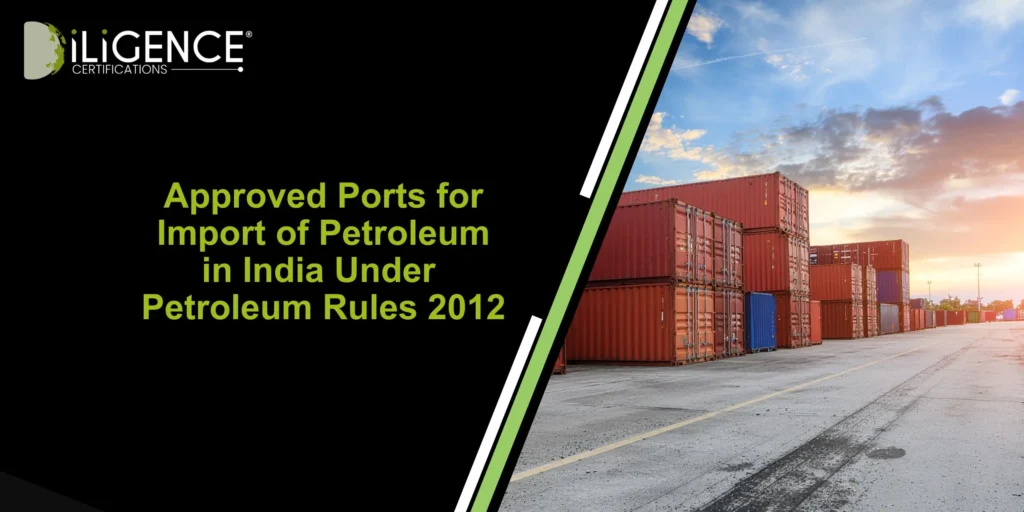
By - Only government-authorized ports are permitted for Petroleum Import Ports in India under Petroleum Rules, 2012
- Approval is regulated by the Petroleum and Explosives Safety Organization (PESO)
- Ports must meet strict safety, storage, and handling infrastructure requirements
- Unauthorized import through non-approved ports can lead to penalties, seizure, or cancellation of licenses
- Importers must obtain prior approvals, licenses, and compliance clearances before shipment
Introduction | Petroleum Import Ports in India
Importing petroleum products in India is not just a logistics activity-it is a highly regulated compliance process. Due to the hazardous nature of petroleum (flammable, explosive, and environmentally sensitive), the government has enforced strict regulations under the Petroleum Rules, 2012 (Petroleum and Explosives Safety Organization (PESO)).
One of the most critical compliance requirements is that Petroleum Import Ports in India can only be imported through approved ports. These ports are specifically evaluated for safety infrastructure, emergency response capability, storage facilities, and regulatory compliance.
Many importers fail at this stage because they assume all ports are eligible. This is incorrect. Using a non-approved port can result in shipment rejection, financial losses, and legal complications.
This guide explains the concept, importance, process, and compliance requirements in a structured way so you can avoid costly mistakes.
What Are Approved Petroleum Import Ports in India?
Authorized Petroleum Import Ports in India refer to those ports which have been formally authorized to discharge petroleum by the relevant regulatory authorities according to the provisions of Petroleum Rules 2012.
Salient Features of Authorized Ports:
- Facility for handling Flammable Liquid
- Fire Fighting facilities
- Specialized petroleum storage terminals
- Following Explosive Safety standards
- Regulated by relevant regulatory authorities
Examples of some of the Commonly Authorized Ports in India:
- Seaports such as Mumbai port, Kandla port, Chennai port, Visakhapatnam Port
- Selected Private ports approved by PESO
- Oil terminals
(Kindly note that the authorization status may keep changing. Verify prior to shipment.)
Why Petroleum Import Ports in India Are Mandatory
Using an approved port is not optional-it is a legal requirement. The government enforces this to prevent accidents, environmental damage, and illegal handling of petroleum.
Key Reasons:
1. Safety Compliance
Petroleum is highly flammable. Approved ports ensure proper storage, handling, and transfer systems to prevent explosions and fires.
2. Regulatory Control
Authorities can monitor imports effectively through designated ports, ensuring compliance with safety and documentation standards.
3. Environmental Protection
Spillage or mishandling can cause serious environmental damage. Approved ports have containment and response systems.
4. Risk Mitigation
Ports are evaluated for risk management, emergency planning, and disaster control mechanisms.
5. Legal Enforcement
Importing through unauthorized ports is a violation that can lead to:
- Heavy penalties
- License suspension
- Shipment confiscation
Importance and Benefits Petroleum Import Ports in India
| Factor | Importance | Benefit to Importer |
| Regulatory Compliance | Mandatory under law | Avoids penalties and legal action |
| Safety Infrastructure | Prevents accidents | Protects assets and workforce |
| Efficient Handling | Specialized petroleum systems | Faster clearance and unloading |
| Environmental Protection | Spill control systems | Reduces liability risks |
| Government Monitoring | Ensures proper documentation | Smooth approval process |
| Insurance Compliance | Required by insurers | Easier claim processing |
| Risk Reduction | Emergency preparedness | Business continuity |
Process to Petroleum Import Ports in India
This is where most businesses fail-not because of complexity, but because of poor planning.
Step 1: Identify Approved Port
- Verify whether your selected port is authorized for petroleum imports
- Cross-check with regulatory authorities or consultants
Step 2: Obtain Import License
- Apply for petroleum import license under relevant rules
- Submit documentation like:
- Company details
- Product specifications
- Storage arrangements
Step 3: Get PESO Approval
- Approval for storage, handling, and transport
- Site inspection may be required
Step 4: Ensure Storage Compliance
- Tie-up with approved storage terminals
- Follow tank safety and design standards
Step 5: Documentation & Customs Clearance
- Bill of lading
- Safety certificates
- Product classification
Step 6: Safety & Handling Arrangements
- Fire safety systems
- Trained personnel
- Emergency protocols
Step 7: Inspection & Clearance
- Authorities may inspect shipment
- Final clearance granted after compliance check
Challenges of Getting This Approval Without a Consultant
Trying to manage this process alone is risky and inefficient.
1. Lack of Clarity on Approved Ports
Most importers don’t know which ports are actually authorized. Lists are not always clearly updated.
2. Documentation Errors
Even small mistakes can delay approvals or lead to rejection.
3. Technical Compliance Issues
- Storage design
- Fire safety systems
- Handling procedures
These require technical knowledge.
4. Delays in Approval
Without proper follow-up, approvals can take months.
5. Coordination Problems
You must coordinate between:
- Port authorities
- PESO
- Customs
- Storage providers
6. Risk of Rejection
Incorrect applications often get rejected, leading to:
- Financial loss
- Shipment delays
Why Diligence Certification Is the Right Partner for Petroleum Import Compliance
Most importers don’t fail because the process is impossible-they fail due to incorrect documentation, wrong port selection, and compliance gaps. This is where Diligence Certification adds measurable value.
1. Correct Port Identification
They ensure you select only approved and compliant ports, avoiding rejection risk.
2. End-to-End Documentation
- Accurate application filing
- Error-free submissions
- Compliance alignment
3. Faster Approvals
Established process knowledge reduces delays significantly.
4. Technical Compliance Support
They guide on:
- Storage requirements
- Safety systems
- Regulatory expectations
5. Risk Elimination
Minimizes chances of:
- Application rejection
- Legal penalties
- Shipment delays
6. Single Point Coordination
They handle communication with all authorities, saving time and effort.
Conclusion
Petroleum Import Ports in India is a compliance-heavy process where mistakes are costly. The requirement to use approved ports under Petroleum Rules, 2012 is a critical checkpoint that cannot be ignored.
Businesses Petroleum Import Ports in India that treat this as a simple logistics step often face delays, penalties, or rejection. On the other hand, those who follow a structured compliance approach-starting from selecting the right port to obtaining approvals-ensure smooth operations.
The key is not just understanding the rules, but executing them correctly. Proper planning, accurate documentation, and expert guidance can significantly reduce risks and improve efficiency.
Frequently Asked Questions (FAQs)
What are approved ports under Petroleum Rules, 2012?
Approved ports are government-authorized ports that meet safety and infrastructure requirements for handling petroleum imports.
Can I import petroleum through any port in India?
No. Only ports approved under the Petroleum Rules, 2012 are allowed for petroleum imports.
Who approves these ports?
Regulatory authorities, primarily PESO, approve ports based on safety and compliance standards.
What happens if I use a non-approved port?
Your shipment can be rejected, seized, or penalized, and your license may be suspended.
Do all major ports qualify as approved ports?
Not necessarily. Even major ports must have specific approvals for petroleum handling.
Is PESO approval mandatory for importers?
Yes. Importers must comply with PESO regulations for handling and storage of petroleum.
How long does the approval process take?
It depends on documentation and compliance readiness. Typically, it can take a few weeks to months.
What documents are required for petroleum import?
Key documents include:
Import license
Safety certificates
Product details
Storage approvals
Can private ports be used for petroleum import?
Yes, but only if they are officially approved under Petroleum Rules, 2012.
Why should I hire a consultant for this process?
Because the process involves technical, legal, and regulatory complexities. A consultant reduces errors, delays, and compliance risks.