BIS Certification
 CDSCO
CDSCO
 PESO
PESO
 CPCB
CPCB
 LMPC
LMPC
 WPC Approval
 Global Approvals
 TEC
TEC
 ARAI
ARAI
 BEE
BEE
 ISO Certification
 DGCA Certification
 NOC For Steel
 APEDA Registration























 Business Registration
 FSSAI Mark Certification












 (32).jpg)
 Legal Services
 Trademark Registration
 Copyright Registration
 Patent Registration
 By
By - Under BEE, Evaporative Air Coolers provide efficient cooling with reduced energy consumption.
- BEE certification enables manufacturers to comply with government standards on energy efficiency and labeling.
- Documentation such as test results and product information is necessary for certification.
- The process of obtaining certification involves testing, registration, application, and approval.
- There are advantages of using BEE-rated air coolers, including economical operations and environmental sustainability.
Introduction
The use of evaporative air coolers in households as well as offices is prevalent in various regions due to their efficiency and economy in terms of energy consumption. Yet, many manufacturers face the problem of proving that their products have such properties without BEE certification. Thus, the importance of BEE for the certification of evaporative air coolers cannot be overlooked.BEE certification guarantees that the products under consideration conform to certain energy performance criteria, thus providing consumers with valuable information regarding their purchase choices and energy saving in general. Moreover, such certification increases the credibility of the products, makes sure that manufacturers comply with necessary regulations, and improves market reception.
What is BEE Certification?
“Certificate of BEE” means the certificate granted by the Bureau of Energy Efficiency, which is a statutory organization in India. This certificate guarantees the adherence of particular appliances to the required standards of energy performance.The process involves rating the product on a scale from 1 to 5 stars, with the star indicating the energy performance of the equipment - the more stars, the greater the energy performance and lesser the energy consumption.Certification is mandatory for manufacturers for marketing their products in India. It helps consumers to make comparisons among products and select the energy-efficient option.
What are Evaporative Air Coolers?
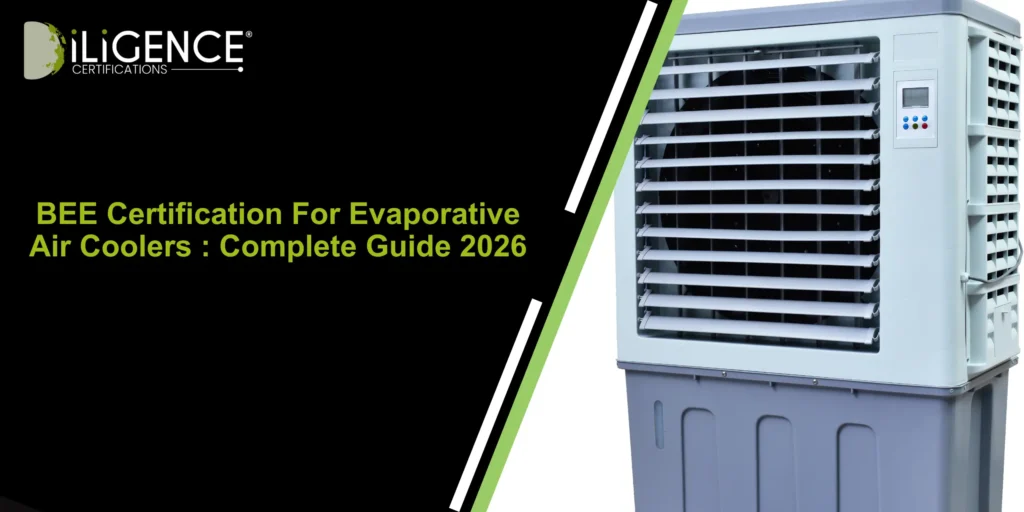
Evaporative Air Coolers, popularly called air coolers, are cooling units that make use of the principle of evaporation of water to lower the temperature of air. They are extensively used in households, offices, and stores, particularly in places having hot climatic conditions.
How Do They Work?
The evaporative air cooler draws in the ambient warm air and then passes it through wet cooling pads where water gets evaporated while absorbing heat from the air, thus producing cool air.
Features
- Water is used instead of chemicals
- Less electricity consumption than ACs
- Supply fresh air with humidity
- Environmentally friendly and cost-saving cooling optionPlaces
Where They Are Used
- Evaporative air coolers are suitable for
- Households and small rooms
- Office premises
- Shops and outdoor spaces
Simply put, evaporative air coolers are environment-friendly alternatives to traditional air conditioning.
Applicability of BEE for Air Coolers
Applicability of Bureau of Energy Efficiency (BEE) in case of air coolers refers to those products and brands that will have to comply with energy efficiency standards and labeling requirements.
Scope of Applicability
- The applicability of BEE covers evaporative air coolers produced, imported, or sold in India.
- Applicability includes residential as well as commercial air coolers.
- Applicability also extends to all varieties of air coolers including desert coolers, tower coolers, and personal coolers.
Whom Does Applicability Apply To
Air cooler manufacturers operating in India
Importers importing air coolers from other countries
Air cooler brands marketing their products in India
Scope of Compliance
- Air coolers come within the scope of BEE Standards & Labeling (S&L)
- Based on government notification, it could be voluntary or mandatory compliance
- All products need to be tested in designated laboratories for energy efficiency
Requirements of Applicability
- Registration on the BEE website
- Product submission and testing reports
- Labeling approval for placing BEE star rating on products
Why Should You Know About Applicability of BEE
- It ensures provision of energy efficient products in the market
- Makes it easy for consumers to choose and compare different products
- Helps in achieving energy conservation objectives at national level
Thus, if you are working in air coolers industry, knowing BEE applicability becomes important.
Key Features of BEE-Compliant Air Coolers
- Star Rating Label:Equipped with a star label by BEE (1-5 star rating) based on energy efficiency.
- Low Electricity Consumption:Engineered to use minimal electricity while providing efficient cooling.
- Airflow Optimization:Efficient airflow and cooling efficiency verified according to BEE specifications.
- High-Quality Cooling Pads:Utilizes superior honeycomb or wood wool cooling pads for increased efficiency and longevity.
- Eco-Friendly Operations:Operates without any refrigerants, thereby making it environmentally friendly.
- Quality Standardization Testing:Subjected to quality testing in authorized labs.
- Enhanced Construction and Design:Sophisticated design using robust material for extended durability.
- Control System:Includes features such as speed control, water level indication, etc.
Who Needs BEE Certification?
Certification by the Bureau of Energy Efficiency (BEE) is mandatory for all manufacturers/importers/distributors/traders who make/supply/sell air coolers in India.
Manufacturers
Companies manufacturing evaporative air coolers in India have to be certified by BEE.
Importers
Importers of air coolers will have to conform to the BEE norms before offering them for sale in India.
Brand Owners/Private Labelers
In case any company markets an air cooler as its own branded product but outsources production, then it must get itself certified by BEE.
Traders/Sellers
Even though the actual BEE Certification is not needed by traders, they will have to ensure that they only deal in BEE compliant air coolers (if applicable).
OEM/Contract Manufacturer
Air coolers made for OEM/Contract Manufacturing purposes also will have to comply with BEE standards after testing.
Why It’s Important
- Ensures compliance with Indian laws/regulations
- Helps build customer trust through energy labeling
- Gains market acceptance & competitive edge
Documents Required for BEE Certification
| Document Name | Description |
| Company Registration Certificate | Proof of legal existence of the manufacturer or brand owner company |
| Product Test Reports (NABL Lab) | Test reports from NABL-approved labs confirming energy performance standards |
| Technical Specifications | Detailed product information including design, capacity, and performance data |
| Brand Authorization Letter | Authorization from brand owner (if applying through a third party or OEM) |
| ISO Certificate (if applicable) | Quality management certification (e.g., ISO 9001) to support product credibility |
Step-by-Step Process to Get BEE Certification
Step 1: Product Testing in Approved Lab
Get your air cooler tested in a NABL-approved laboratory to verify energy performance and efficiency.
Step 2: Documentation Preparation
Prepare all required documents such as test reports, company details, and technical specifications.
Step 3: Online Registration on BEE Portal
Create an account and register your company on the official BEE online portal.
Step 4: Application Submission
Fill out the application form with accurate product details and upload the necessary documents.
Step 5: Fee Payment
Pay the prescribed registration and labeling fees as per BEE guidelines.
Step 6: Review by Authority
BEE officials review your application, documents, and test results for compliance.
Step 7: Grant of Star Label
Once approved, BEE issues the star rating label, allowing you to legally market your product as energy-efficient.
Timeline, Cost, and Renewal
| Aspect | Details |
| Timeline | 4-8 weeks total (process via Bureau of Energy Efficiency) |
| Testing Duration | 1-2 weeks (NABL lab testing) |
| Cost | Depends on product type and testing fees |
| Validity | Limited period; renewal required as per Bureau of Energy Efficiency guidelines |
Common Mistakes to Avoid
- Incomplete documentation - Missing or incorrect documents delay approval from the Bureau of Energy Efficiency.
- Testing from non-NABL labs - Only NABL-accredited lab reports are accepted.
- Incorrect product details - Mismatch in specifications can lead to rejection.
- Wrong label usage - Using unapproved or incorrect star label format is non-compliant.
- Delay in model registration - Late submission can slow down the entire process.
- Ignoring guideline updates - Not following latest BEE norms may cause compliance issues.
- No renewal tracking - Forgetting renewal can stop product sales legally.
Benefits of BEE Certification
- Assurance of Energy Efficiency:Provides assurance that the energy efficiency standards of air coolers are met and minimize energy consumption.
- Cost Saving from Lower Electricity Charges:Energy efficiency products can help save electricity bills in the long run.
- Legal Obligation:For some products, it is mandatory, hence avoiding any legal implications.
- Enhanced Market Reputation:Bee rating labels improve the credibility of products in the market.
- Market Differentiation:Product differentiation increases brand loyalty and market share.
- Environmental Considerations:It is more environmentally friendly, hence minimizing carbon emissions.
- Easy Product Evaluation:Consumers can easily evaluate energy-efficient products due to the rating system.
Why Choose Diligence Certification?
Diligence Certification is a reliable firm that can help your company achieve BEE certification for its air coolers without any problem or difficulty. The experienced team will offer you proper guidance and ensure that everything related to the certification process is done in the right manner.Their expertise will not only increase the probability of getting certified but will also help you complete the process successfully without wasting a lot of time.
Conclusion
In the current scenario, where energy conservation has become a priority, it is vital to meet the requirements laid down by the Bureau of Energy Efficiency (BEE). Certification for evaporative air coolers not only guarantees energy efficiency but also creates trust and boosts the credibility of products while promoting environmental sustainability.For business organizations, adhering to the proper procedure of testing, documentation, and certification will prevent any hurdles. On the other hand, consumers will benefit from better-performing air coolers that consume less electricity.
Frequently Asked Questions (FAQs)
BEE Certification Definition?
It is a certification by the Bureau of Energy Efficiency that certifies that the products are energy-efficient.
Is BEE certification for Air Coolers Mandatory?
It may not be necessarily mandatory, as per government notification.
Definition of BEE Star Rating?
It refers to the number of stars between 1 and 5, indicating the energy efficiency level of a product.
Who is Eligible for Applying for BEE Certification?
The manufacturers/importers/brand owners can apply for it.
How long is BEE Certification Process?
This process can take a few weeks to a couple of months.
What Documents are Required for BEE Certification?
It includes test reports, business registration papers, and other related documents.
Why Product Testing is Required?
For checking the performance based on BEE specifications.
Can Imported Products Be Certified under BEE Certification?
Yes, provided they satisfy the Indian energy efficiency criteria.
Advantages of BEE Certified Air Coolers?
Reduced power bills, improved performance, and environment-friendly operations.
Validity Period of BEE Certification?
It is usually valid for a defined period only.