 BIS Certification
 CDSCO
CDSCO
 PESO
PESO
 CPCB
CPCB
 LMPC
LMPC
 WPC Approval
 Global Approvals
 TEC
TEC
 ARAI
ARAI
 BEE
BEE
 ISO Certification
 DGCA Certification
 NOC For Steel
 APEDA Registration





















 Business Registration
 FSSAI Mark Certification











 (32).jpg)
 Legal Services
 Trademark Registration
 Copyright Registration
 Patent Registration
 By
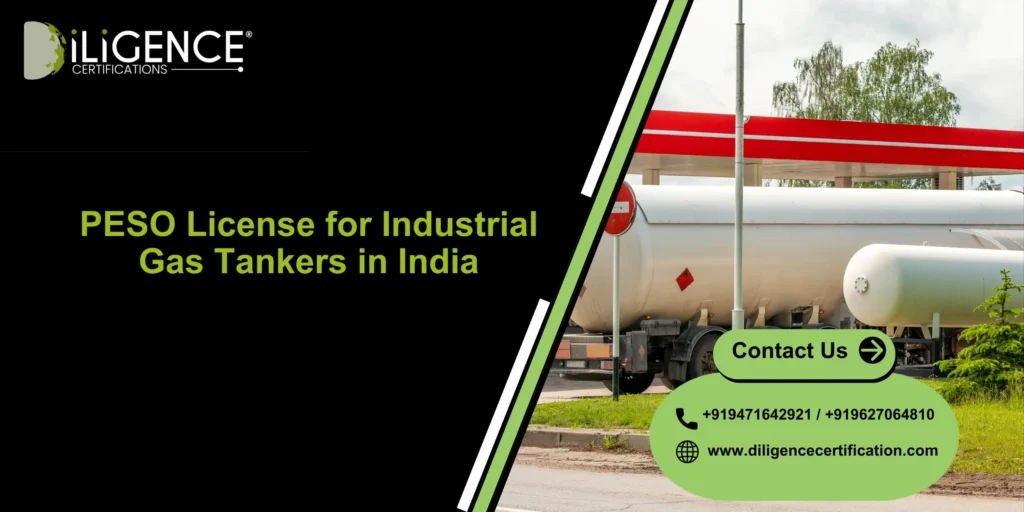
By - PESO for Industrial Gas Tankers is required for safe transportation of industrial gases through tankers in India.
- Industrial gas tankers come under safety control because they carry compressed, liquefied, flammable, toxic, or cryogenic gases.
- The license is regulated under PESO and mainly linked with the SMPV(U) Rules, 2016.
- Proper design approval, testing, inspection, safety fittings, and documentation are required before approval.
- Without PESO compliance, tanker operation can face rejection, penalties, detention, and serious safety risks.
Introduction | PESO for Industrial Gas Tankers
Industrial gases are widely used in manufacturing, healthcare, metal fabrication, food processing, chemicals, power plants, and many other industries. These gases are often transported in special tankers because normal vehicles cannot safely carry compressed or liquefied gases. Since these gases may be flammable, toxic, corrosive, cryogenic, or stored under high pressure, their transportation requires strict safety control.
A PESO License for Industrial Gas Tankers ensures that the tanker is designed, tested, inspected, and operated as per Indian safety standards. PESO checks whether the tanker, fittings, valves, pressure systems, safety devices, and documents are suitable for safe transportation. This license helps prevent leakage, explosion, fire, pressure failure, and accidents during gas movement.
For any manufacturer, gas supplier, transporter, importer, or industrial operator dealing with gas tankers, PESO approval is not only a legal requirement but also a safety responsibility.
What is PESO License for Industrial Gas Tankers?
PESO License for Industrial Gas Tankers is an official approval issued by the Petroleum and Explosives Safety Organisation for tankers used to transport industrial gases in India. These tankers are generally covered under the Static and Mobile Pressure Vessels (Unfired) Rules, 2016, which apply to vessels used for storing or transporting compressed gases.
Industrial gas tankers may carry oxygen, nitrogen, argon, carbon dioxide, hydrogen, LPG, LNG, nitrous oxide, ammonia, chlorine, and other compressed or liquefied gases depending on the industry requirement. Each gas has different safety risks, so PESO verifies the tanker design and safety system before permitting use.
Key points:
- It applies to mobile pressure vessels used for gas transportation.
- It ensures the tanker is suitable for pressure-based gas movement.
- It checks design, fabrication, testing, inspection, and safety fittings.
- It is required before using the tanker commercially in India.
- It helps protect workers, transporters, industries, and the public from gas-related hazards.
- It supports legal transportation of industrial gases across Indian states.
- It reduces the risk of leakage, fire, explosion, and pressure failure.
Why is PESO License Required for Industrial Gas Tankers?
Industrial gas tankers carry materials that can become dangerous if not handled correctly. A small leakage, weak valve, poor welding, wrong pressure setting, or missing safety device can create a major accident. PESO licensing makes sure that every approved tanker follows proper technical and safety requirements before it is used on road or at industrial sites.
The license is required because industrial gases are not ordinary cargo. Many gases are stored under high pressure or extremely low temperature. Some gases can catch fire, some can cause suffocation, and some can damage skin, lungs, or equipment. PESO approval creates a regulated system for safe design, operation, maintenance, and movement.
Key points:
- It is legally required for transporting compressed and liquefied gases.
- It confirms that the tanker design is safe for the gas category.
- It ensures pressure relief valves, emergency valves, fittings, and insulation are proper.
- It helps authorities track and regulate hazardous gas transportation.
- It protects industries from non-compliance penalties and operational stoppage.
- It improves safety during filling, transportation, unloading, and maintenance.
- It builds confidence among clients, gas buyers, and industrial users.
Importance and Benefits of PESO License for Industrial Gas Tankers
| Importance | Benefits |
| Legal compliance | Allows lawful transportation of industrial gases in India |
| Safety assurance | Reduces accident risks related to leakage, fire, explosion, and pressure failure |
| Technical approval | Confirms tanker design, material, fittings, and pressure systems are suitable |
| Business continuity | Avoids detention, rejection, shutdown, and compliance delays |
| Market credibility | Builds trust with industrial clients, gas companies, and government bodies |
| Risk control | Helps manage hazardous gases through approved safety systems |
| Smooth operation | Supports proper filling, dispatch, transport, and unloading activities |
| Inspection readiness | Keeps documentation, test certificates, and approvals organized |
| Regulatory confidence | Shows that the tanker follows PESO and SMPV(U) safety requirements |
| Long-term asset safety | Supports periodic testing, maintenance, and safe tanker lifecycle management |
Process of Getting PESO License for Industrial Gas Tankers
The process of getting PESO License for Industrial Gas Tankers requires technical accuracy, complete documentation, and proper coordination with approved inspectors, fabricators, and PESO authorities.
- Identify gas category
First, identify the type of gas to be transported, such as flammable gas, non-flammable gas, toxic gas, corrosive gas, cryogenic gas, or liquefied gas. - Check tanker applicability
Verify whether the tanker falls under PESO and SMPV(U) Rules based on capacity, pressure, design, and intended use. - Prepare technical documents
Tanker drawings, design calculations, material details, pressure rating, valve details, safety fittings, and fabrication records are prepared. - Design approval
The design of the tanker is submitted for review and approval as per applicable rules and standards. - Fabrication and inspection
The tanker must be manufactured or verified as per approved design. Inspection may include welding checks, material verification, dimensional checks, and quality review. - Testing and certification
Required tests such as hydrostatic test, pneumatic test, leak test, pressure test, and safety valve test may be conducted as applicable. - Safety fittings verification
PESO checks pressure relief valves, emergency shut-off valves, level indicators, pressure gauges, earthing, vents, insulation, and other safety systems. - Application filing
The license application is submitted with complete documents, test certificates, drawings, inspection reports, vehicle details, and applicant information. - PESO review and inspection
PESO reviews the application and may conduct inspection or ask for clarification if documents are incomplete or technically incorrect. - License grant
After successful review and compliance verification, PESO grants the license or approval for the industrial gas tanker. - Renewal and compliance maintenance
The license must be renewed as required. Periodic testing, inspection, and record maintenance are important for continued compliance.
Documents Required for PESO License for Industrial Gas Tankers
Common documents may include:
- Application form
- Applicant company details
- Tanker ownership documents
- Vehicle registration certificate
- Tanker design drawing
- General arrangement drawing
- Pressure vessel design calculation
- Material test certificates
- Fabrication certificate
- Welding and inspection records
- Hydrostatic or pressure test certificate
- Safety valve calibration certificate
- Approved inspector certificate
- Gas details and safety data sheet
- Undertaking and compliance declarations
- Previous approval or renewal documents, if applicable
The exact document list may change based on gas type, tanker design, pressure rating, and application category.
Challenges of Getting This Certification Without a Consultant
Getting PESO License for Industrial Gas Tankers without expert support can be difficult because the process is highly technical. It is not only a simple online application. The applicant must understand gas classification, pressure vessel rules, design approval, inspection requirements, safety fittings, testing standards, and documentation format. Even a small mistake in drawings, test certificates, or technical details can delay approval.
Key challenges:
- Difficulty in identifying correct gas category and applicable rule.
- Confusion between static vessel, mobile vessel, gas cylinder, and tanker requirements.
- Incorrect or incomplete technical drawings.
- Missing design calculations or pressure details.
- Wrong safety valve, fitting, or testing documentation.
- Delay in coordination with approved fabricators and inspectors.
- Application rejection due to document mismatch.
- Lack of clarity in PESO portal submission.
- Difficulty in responding to PESO queries.
- Poor renewal tracking and compliance record management.
- Risk of business delay due to licensing mistakes.
Why Choose Diligence Certification for PESO License for Industrial Gas Tankers?
Diligence Certification provides professional support for PESO license and regulatory compliance for businesses dealing with hazardous, compressed, liquefied, and industrial gases. Our team helps applicants understand the exact requirement, prepare proper documents, coordinate technical compliance, and manage the application process smoothly.
For industrial gas tankers, the approval process requires both regulatory knowledge and technical understanding. Diligence Certification helps reduce confusion, avoid documentation errors, and improve the chances of faster approval by following a structured compliance approach.
Key points:
- Expert guidance for PESO and SMPV(U) compliance.
- Support in identifying applicable license category.
- Assistance in document preparation and technical file review.
- Coordination for drawings, testing, inspection, and certificates.
- Proper application filing and query handling.
- End-to-end support from applicability check to license approval.
- Help in renewal, amendment, and post-license compliance.
- Practical guidance for manufacturers, transporters, importers, and gas suppliers.
- Reduced risk of rejection due to incomplete or incorrect documents.
- Transparent and professional compliance support.
Conclusion
PESO License for Industrial Gas Tankers is essential for any business involved in transporting compressed, liquefied, cryogenic, flammable, toxic, or industrial gases in India. It ensures that the tanker is technically safe, legally approved, and suitable for carrying hazardous gases under controlled conditions.
The licensing process includes design approval, inspection, testing, safety fitting verification, documentation, application filing, and PESO review. Because industrial gas transportation carries high safety risks, compliance cannot be handled casually. Proper approval protects the business, workers, clients, public safety, and the environment.
For smooth approval and safe operation, businesses should follow PESO requirements carefully and maintain all records, test certificates, and renewal documents on time.
Frequently Asked Questions
What is PESO License for Industrial Gas Tankers?
It is an approval required for tankers used to transport industrial gases safely and legally in India.
Who issues the PESO License?
The license is issued by the Petroleum and Explosives Safety Organisation.
Is PESO License mandatory for gas tankers?
Yes, it is required for tankers carrying applicable compressed, liquefied, or hazardous gases.
Which rules apply to industrial gas tankers?
Industrial gas tankers are generally regulated under the Static and Mobile Pressure Vessels (Unfired) Rules, 2016.
What gases are covered under this license?
Gases such as oxygen, nitrogen, argon, hydrogen, LPG, LNG, carbon dioxide, ammonia, chlorine, and other industrial gases may be covered.
Can a tanker operate without PESO approval?
No, operating without required approval can lead to penalties, detention, rejection, and safety risks.
What documents are needed for PESO tanker approval?
Documents include drawings, test certificates, material certificates, vehicle details, safety fitting records, and application documents.
How long does PESO approval take?
The timeline depends on document accuracy, inspection status, technical compliance, and PESO query resolution.
Is renewal required for PESO License?
Yes, renewal is required as per the validity and applicable compliance conditions.
Why should I hire a consultant for PESO License?
A consultant helps prepare correct documents, manage technical compliance, handle queries, and reduce approval delays.