BIS Certification
 CDSCO
CDSCO
 PESO
PESO
 CPCB
CPCB
 LMPC
LMPC
 WPC Approval
 Global Approvals
 TEC
TEC
 ARAI
ARAI
 BEE
BEE
 ISO Certification
 DGCA Certification
 NOC For Steel
 APEDA Registration























 Business Registration
 FSSAI Mark Certification












 (32).jpg)
 Legal Services
 Trademark Registration
 Copyright Registration
 Patent Registration
 By
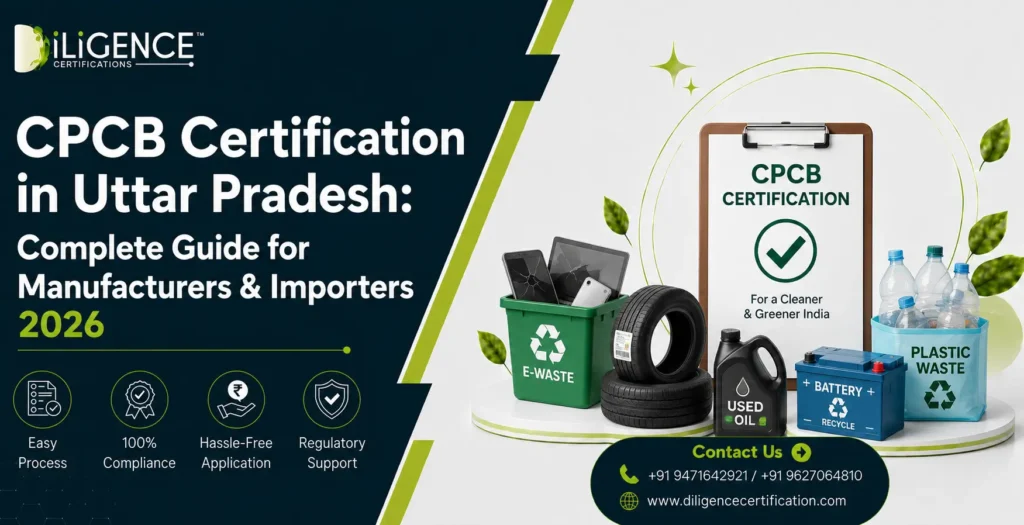
By - CPCB Certification is a requirement for the manufacturer, importer, producer, and brand owner for products that come under India’s environmental law such as e-waste, plastic waste, batteries, and waste tyres.
- The companies operating in Uttar Pradesh have to follow the CPCB norms to evade any kind of penalty and be legally operational. Guidance from experts makes it easy for the business to register themselves with ease.
Introduction
As Uttar Pradesh emerges as one of the most important states in terms of industry and manufacturing in India, environment compliance becomes an important concern for the business community. Be it electronics manufacturers, battery importers, plastic packaging companies or even brand owners - businesses must ensure compliance with the environmental rules laid down by the Central Pollution Control Board (CPCB).
Getting CPCB certification is more than just being compliant with the law - it shows your seriousness towards responsible waste management, sustainable practices and environmental protection. Non-compliance can lead to penalties, limitations on business activity and even legal action.
Whether you are a manufacturer, importer, producer or even a brand owner in Uttar Pradesh, knowledge of CPCB certification procedure becomes absolutely necessary.
Our guide tells you all that you need to know about CPCB Certification in Uttar Pradesh including eligibility criteria, list of products applicable, documents needed, registration procedure, fees, validity, benefits of certification and how we can help with that at Digilence Certifications.
What is CPCB Certification?
CPCB Certification means the process of getting registered under several environmental regulations under which the Central Pollution Control Board (CPCB), operating under the Ministry of Environment, Forest & Climate Change (MoEFCC) functions in the Indian government.
This organization implements policies for environmental protection and also checks pollution level and compliance to waste management rules by industries.
CPCB registration can be needed for different types of businesses based on products under these regulatory environments, which include:
- E-Waste Management Rules
- Plastic Waste Management Rules
- Battery Waste Management Rules
- Hazardous Waste Management Rules
- Waste Tyre Management Rules
The primary objective of CPCB registration is to ensure that businesses responsibly collect, recycle, and dispose of waste generated by their products while minimizing environmental impact.
Why is CPCB Certification Important in Uttar Pradesh?
There are thousands of manufacturing companies, industrial complexes, electronics industries, and consumer goods firms in Uttar Pradesh. With increasing industrialization, the aspect of proper waste disposal is becoming crucially essential.
Some of the benefits of CPCB Certification are as follows:
- It ensures that you abide by all environmental laws in India.
- Avoids any legal issues or penalties.
- Enhances your customer and business relations.
- Provides a platform for sustainable manufacturing process.
- Increases the company’s reputation.
- Helps in an easy way to participate in government and corporate tenders.
Companies that follow CPCB laws show their dedication towards environmental responsibilities.
Businesses That Require CPCB Certification in Uttar Pradesh
Several categories of businesses may require CPCB registration depending on their operations.
These include:
- Manufacturers
- Importers
- Producers
- Brand owners
- E-commerce sellers
- Original Equipment Manufacturers (OEMs)
- Battery manufacturers
- Plastic packaging companies
- Electronics manufacturers
- Recycling companies
- Dismantlers
- Refurbishers
- Authorized representatives
Even businesses importing regulated products into India may require CPCB authorization before commencing operations.
Products Covered Under CPCB Certification
The CPCB regulates various products under different waste management rules.
Some commonly covered categories include:
- E-Waste Products
- Computers
- Laptops
- Mobile phones
- Tablets
- Televisions
- Printers
- Monitors
- Networking equipment
- Servers
- Electronic accessories
- Plastic Waste Products
- Plastic packaging materials
- Carry bags
- Multi-layer plastic packaging
- Compostable plastic products
- Battery Waste
- Portable batteries
- Automotive batteries
- Industrial batteries
- Lithium-ion batteries
- EV batteries
- Waste Tyres
Manufacturers and importers of tyres must comply with Waste Tyre Management Rules.
Used Oil
Businesses dealing with used oil recovery, recycling, or import may also require CPCB registration.
Types of CPCB Registration
Different businesses require different CPCB registrations depending on the applicable environmental rules.
EPR Registration for E-Waste
Applicable to producers, importers, and manufacturers of electronic products who are responsible for collecting and recycling electronic waste.
Plastic Waste EPR Registration
Required for businesses manufacturing, importing, or selling plastic packaging materials.
Battery Waste Management Registration
Mandatory for battery manufacturers, importers, producers, and recyclers.
Waste Tyre EPR Registration
Applicable to tyre manufacturers and importers to ensure responsible collection and recycling of waste tyres.
Used Oil Registration
Required for businesses engaged in the generation, collection, transportation, or recycling of used oil.
Eligibility Criteria for CPCB Certification
Businesses eligible to apply for CPCB Certification generally include:
- Registered manufacturers
- Importers
- Producers
- Brand owners
- Recycling companies
- Refurbishers
- Dismantlers
- Authorized business entities
Applicants should possess valid business registrations and comply with applicable environmental regulations before submitting their applications.
Documents Required for CPCB Certification in Uttar Pradesh
Documentation is one of the key things for getting CPCB Certification. Incorrect or incomplete data may lead to inquiries from the regulatory body and postpone certification process. Businesses need to collect all the necessary documents first and only then start applying for CPCB Certification.
The commonly required documents include:
- PAN Card
- GST Registration Certificate
- Import Export Code (IEC) for importers
- Certificate of Incorporation or Partnership Deed
- MSME Registration Certificate (if applicable)
- Factory License
- Business Address Proof
- Authorized Signatory Identity Proof
- Product Details
- Product Images
- Brand Authorization Letter (where applicable)
- Technical Specifications
- Recycling Plan or EPR Plan (if applicable)
- Environmental Compliance Documents
- Digital Signature Certificate (where required)
Depending on the applicable waste management rules, CPCB may request additional supporting documents during verification.
Step-by-Step Process to Obtain CPCB Certification in Uttar Pradesh
Obtaining CPCB Certification involves several systematic stages.
Step 1: Eligibility Determination for Business
Find out the regulation of waste management and decide on the registration category that is appropriate for your product range.
Step 2: Preparation of Documents
Make sure to gather all the necessary documents before proceeding with the online application process.
Step 3: Registration on Portal
Register yourself on the CPCB website and fill in the profile of your business.
Step 4: Filling of Application
Submit all the documents by filling in the application form.
Step 5: Document Verification
Officials at CPCB will verify the document and check whether the applicant is complying with all the regulation criteria.
Step 6: Clarification of Queries
In case any queries arise, the applicant needs to answer them via the online portal only.
Step 7: Approval and Certification
On successful verification, CPCB will grant registration/authorization to your business.
CPCB Certification Fees in Uttar Pradesh
The cost of obtaining CPCB Certification varies depending on several factors rather than a single fixed amount.
The fee may depend on:
- Product category
- Type of registration
- Number of products covered
- Business turnover
- Government application fees
- Professional consultancy charges
- Scope of compliance services required
Businesses should verify the latest fee structure applicable to their specific registration category before applying.
Validity of CPCB Certification
The validity period of CPCB registration depends on the applicable waste management rules and the category of authorization issued.
For maintaining compliance, organizations need to:
- Check the validity of the certificate.
- Ensure timely renewals by applying early.
- File mandatory annual returns.
- Keep proper records for waste collection and recycling.
- Meet their EPR obligations.
By doing so, organizations can easily maintain their compliance without facing any disruptions in their business operations.
Challenges Encountered When Gaining CPCB Certification
Although the registration process is online, many businesses encounter avoidable challenges during application.
Some common issues include:
- Incorrect documentation
- Missing mandatory information
- Improper product categorization
- Delayed responses to CPCB queries
- Incomplete recycling plans
- Errors in product details
- Portal submission mistakes
Absence of familiarity with relevant regulations on waste management. Collaboration with experts in the field of regulation can help overcome these problems.
Penalties for Non-Compliance
Working without required registration with the CPCB can put businesses at risk of legal and financial ramifications.
Possible penalties include:
- Monetary fines
- Suspension of business operations
- Cancellation of registration
- Product seizure
- Import restrictions
- Regulatory inspections
- Legal proceedings under environmental laws
- Business Reputation Damage
Timely compliance ensures that businesses will be able to reduce risks and have smooth business operations.
Advantages of CPCB Certification
There are a number of important benefits associated with the acquisition of CPCB Certification for business activities in Uttar Pradesh.
They include:
- Adherence to Indian Environmental Standards
- Compliance with Indian environmental regulations
- Improved corporate reputation
- Increased customer confidence
- Better opportunities in government tenders
- Enhanced business credibility
- Easier import and distribution of regulated products
- Promotion of sustainable business practices
- Reduced legal and operational risks
- Improved environmental responsibility
- Long-term regulatory compliance
The advantages not only assist companies in fulfilling statutory requirements but also enable them to gain an edge in the market.
How Digilence Certifications Assists in Getting CPCB Certification
It is quite difficult to navigate CPCB regulations, particularly when it comes to getting registered for the first time. Digilence Certifications assists you in all aspects to make your certification process easier.
Some of the ways that we do it include:
- Assessment of the applicable CPCB registration category.
- Preparation and verification of all required documentation.
- Assistance with online portal registration and application filing.
- Coordination with regulatory authorities for timely query resolution.
- Guidance on Extended Producer Responsibility (EPR) compliance.
- Support for renewals and ongoing regulatory obligations.
- Transparent process management with regular application updates.
Professional support to reduce the chances of delay in the process of getting approvals.
With the help of Digilence Certifications, companies can concentrate on their primary work while professionals handle the intricacies of CPCB.
Conclusion
The CPCB certification is extremely important for the manufacturers, importers, producers and brand owners in the state of Uttar Pradesh in order to work according to the rules set by the Indian environment laws. Being sustainable and managing wastes responsibly becomes more and more important, and CPCB registration is not only a legal requirement but also a business benefit in this regard.
There are numerous long-term advantages of obtaining CPCB certificate including better compliance, improved brand reputation and better market access among others. However, the registration process itself needs certain preparation, documentation and knowledge about the relevant waste management norms.
With the help of Digilence Certifications, you will be able to simplify the process of CPCB registration and get your certificate without any problems and compliance issues.
Frequently Asked questions
1. Is CPCB Certification mandatory in Uttar Pradesh?
Yes. Companies involved in dealing with the products that fall under the purview of the related environmental regulation have to register themselves or get CPCB authorization.
2. Who needs CPCB Certification?
Manufacturer/importer/producer/brand owner/recycler/refurbisher/dismantler/certain e-commerce companies dealing with regulated products may require CPCB registration.
3. How long does the CPCB Certification process take?
Processing time differs based on the type of registration applied for, completeness of the process, and prompt addressing of any concerns raised by the authority.
4. What documents do you need for CPCB Certification?
The documents that may be required for getting CPCB certification include PAN/GST registration/IEC (importers)/incorporation certificate/address proof/product description/specifications/other compliance documents.
5. Is CPCB Certification required for importers?
Yes. Importers dealing with products falling under the purview of CPCB regulations will be required to register before importing and selling the products in India.
6. What is the validity of CPCB Certification?
Validity of CPCB certification differs from one registration type to another.
7. What are the consequences if a company fails to get CPCB Certification?
Penalty, suspension of operations/seizure of products, import ban, cancelation of CPCB registration/other legal actions based on environmental laws.
8. Can Digilence Certifications help with CPCB Certification?
Yes. Digilence Certifications provides end-to-end assistance, including eligibility assessment, documentation, application filing, query resolution, and ongoing compliance support.