BIS Certification
 CDSCO
CDSCO
 PESO
PESO
 CPCB
CPCB
 LMPC
LMPC
 WPC Approval
 Global Approvals
 TEC
TEC
 ARAI
ARAI
 BEE
BEE
 ISO Certification
 DGCA Certification
 NOC For Steel
 APEDA Registration























 Business Registration
 FSSAI Mark Certification












 (32).jpg)
 Legal Services
 Trademark Registration
 Copyright Registration
 Patent Registration
 By
By - EPR Registration for Pharma Companies is compulsory for the relevant category of pharma packaging and pharma waste management.
- Relevant for manufacturers, importers, brand owners, and marketers.
- The registration process is done via the CPCB EPR Portal.
- Failure to comply will lead to environmental compensation and penal sanctions.
Introduction: EPR Registration for Pharma Companies
Indian pharmaceuticals is among the largest industries in the world producing tablets, syrups, injections, and a wide variety of other products every day.
There is always a flip side of the coin. Packaging waste produced in the form of plastic is enormous every year.
Government of India is worried about it. Extended Producer Responsibility (EPR) is the solution to this problem.
Extended Producer Responsibility is making the producer responsible for the waste produced through its packaging. Extended Producer Responsibility is specifically applicable to pharmaceutical companies utilizing plastic packaging.
In this guide, you will get all details related to EPR Registration for Pharma Companies.
What is EPR Registration for Pharma Companies?
EPR stands for Extended Producer Responsibility. It is a policy mechanism. It holds producers responsible for the whole life cycle of the packaging of their products.
This responsibility does not end at the point of sale. It continues till the packaging waste is collected and recycled.
Key objectives of EPR:
- Minimisation of plastic waste in the environment.
- To encourage recycling and reuse of packaging material.
- To transfer the responsibility of waste management from municipalities to the producer.
- Support India’s circular economy goals.
Circular economy means that resources can remain in use for a longer period. Recycling, reusing, and recovering are key to minimizing waste.
According to the EPR regulations, the responsibility of the producer continues even after the goods leave the factory premises. It also covers the brand owner and importer.
CPCB (Central Pollution Control Board) is the nodal agency for the implementation of EPR in India. All the activities regarding registration and compliance go through CPCB.
Why EPR Registration is Important for Pharma Companies
EPR Registration is not just a legal formality. It brings real value to your pharma business.
- Environmental protection - Reduces the impact of plastic packaging waste on soil and water.
- Sustainable plastic waste management - Ensures proper collection and recycling channels.
- Compliance with government regulations - Avoids penalties and legal action.
- Corporate environmental responsibility - Builds a responsible brand image.
- Improved brand credibility - Buyers and distributors prefer compliant companies.
- Contribution to a circular economy - Supports India’s national sustainability targets.
Pharma companies that register early gain a compliance advantage. This becomes important during tenders, exports, and B2B partnerships.
Legal Framework Governing Pharma EPR
EPR Registration for Pharma Companies is governed by a clear legal structure.
- Rules for Plastic Waste Management, 2016 (amended) - Main legislation relating to plastic packaging waste management and EPR responsibility.
- Environment (Protection) Act, 1986 - Main legislation under which environmental laws are enacted in India.
- CPCB EPR Guidelines - Detailed guidelines issued by CPCB for registration and compliance.
- State Pollution Control Boards (SPCBs) - Support implementation and monitoring at the state level.
- Relevant notifications issued by MoEFCC - The Ministry of Environment, Forest and Climate Change periodically updates EPR targets and rules.
Pharma companies must stay updated with these notifications. Rules around plastic categories and targets are revised from time to time.
Who Needs EPR Registration for Pharma Companies?
| Business Type | EPR Registration Required |
| Pharmaceutical Manufacturers | Yes |
| Importers | Yes |
| Brand Owners | Yes |
| Contract Manufacturers | Depends on responsibility |
| Marketing Companies | Applicable in certain cases |
| Export-only Manufacturers | Usually No |
If your pharma business falls under any “Yes” or “Depends” category above, EPR Registration applies to you.
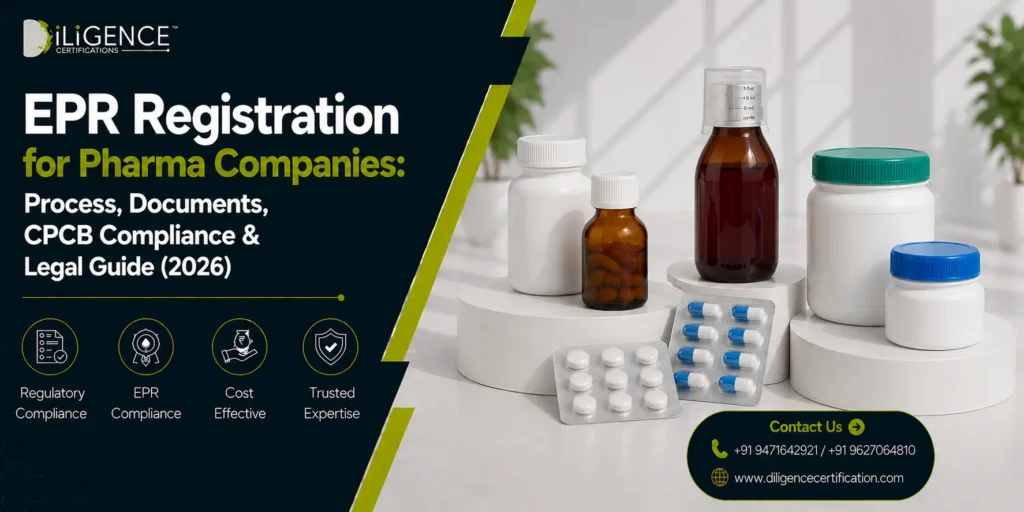
Types of Pharmaceutical Packaging Covered Under EPR
| Packaging Type |
| HDPE Bottles |
| PET Bottles |
| Glass Bottles |
| Blister Packs |
| Strip Packs |
| Plastic Containers |
| Sachets |
| Laminated Packaging |
| Corrugated Boxes |
| Secondary Packaging Materials |
Almost every pharma product uses one or more of these packaging types. This makes EPR Registration relevant for nearly all pharma businesses.
Which Pharma Businesses Need EPR Registration?
EPR applies across a wide range of pharma and related businesses:
- Tablet manufacturers
- Capsule manufacturers
- Syrup manufacturers
- Injectable manufacturers
- Vaccine manufacturers
- Nutraceutical companies
- Ayurvedic medicine manufacturers
- Cosmetic pharmaceutical companies
- Veterinary medicine manufacturers
- OTC medicine brands
- Medical device companies using plastic packaging
If your business fits any of these categories and uses plastic packaging, EPR Registration is likely mandatory for you.
Documents Required for EPR Registration for Pharma Companies
Keep these documents ready before starting your application:
- PAN Card
- GST Registration Certificate
- IEC (for importers)
- Certificate of Incorporation / LLP Certificate
- Factory License
- CIN Details
- Authorization Letter
- Address Proof
- Product List
- Packaging Material Details
- Annual Sales Data
- Plastic Consumption Details
- Waste Management Plan
- Brand Details
- Authorized Signatory Documents
Incomplete documentation is one of the biggest reasons for delay. Prepare each document carefully before applying.
Step-by-Step EPR Registration Process for Pharma Companies
Step 1: Assessment of Eligibility
Determine whether your organization qualifies as an entity which must mandatorily implement EPR due to packaging types and roles within the business.
Step 2: Assessment of Packaging Material
Determine the types and classification of all plastics used for packaging purposes.
Step 3: Documentation Preparation
Ensure that you have all the documentation required.
Step 4: Registration on CPCB EPR Portal
Create your business profile on the official CPCB EPR Portal.
Step 5: Application Submission
Submit the completed application along with all supporting documents.
Step 6: Government Fee Payment (if applicable)
Pay the applicable government fee based on your business category.
Step 7: Application Verification by CPCB
Your application and documents are scrutinized by CPCB for their correctness and completeness.
Step 8: Clarifications / Supplementary Documents (as applicable)
Provide clarification or supplementary documents on any queries from the CPCB.
Step 9: Grant of EPR Registration Certificate
EPR Registration Certificate is issued to your business after approval by the CPCB.
Timeline, Fees & Validity
Registration Process: Usually takes a few weeks, dependent on the accuracy of the documents and the workload of the CPCB.
Government Charges: Vary depending on your business sector, turnover, and quantity of packaging materials.
Professional/Consultancy Fees: Vary dependent on the nature of the service and the diversity of your packaging material range.
Validity of Certificate: The EPR registration certificates usually have a validity of a specified period after which it needs to be renewed.
Process of Renewal: Is done by providing updated information about your packaging materials and their sale before the expiration of the certificate.
Factors Affecting Approval Timeline:
- Accuracy of submitted documents
- Correct packaging classification
- Timely response to CPCB queries
- Portal processing load
Who Can Issue EPR Certificates?
- Central Pollution Control Board (CPCB) - The sole authority for granting EPR Registration in India.
- Role of CPCB in granting EPR Registration - Reviews, verifies, and approves applications on the official portal.
- State Pollution Control Boards (where applicable) - Support monitoring and enforcement at the state level.
Why registrations must be obtained through the official CPCB EPR Portal: Only the CPCB portal can issue a legally valid EPR Registration Certificate.
Difference between registration assistance by consultants and certificate issuance by CPCB: Consultants like Diligence Certifications help prepare and file your application correctly. The certificate itself is issued only by CPCB, never by a consultant.
Producer Responsibilities After EPR Registration
Registration is just the beginning. Producers must fulfil ongoing obligations:
- Annual Return Filing
- Meeting Plastic Waste Collection Targets
- Recycling Obligations
- Record Maintenance
- Submission of Compliance Reports
- Maintaining Traceability of Waste
- Updating Business Information on CPCB Portal
- Working with Authorized Recyclers
Non-fulfilment of these responsibilities can lead to compliance action even after registration is granted.
Benefits of EPR Registration for Pharma Companies
- Legal Compliance
- Avoid Regulatory Penalties
- Improved Corporate Reputation
- Stronger ESG Performance
- Sustainable Waste Management
- Increased Customer Trust
- Better Business Opportunities
- Easier Government Approvals
- Competitive Advantage
EPR compliance is increasingly linked to business growth. Many distributors and institutional buyers prefer EPR-registered pharma companies.
Common Compliance Challenges
- Incorrect Packaging Classification
- Incomplete Documentation
- Incorrect Plastic Quantity Declaration
- Failure to Meet Recycling Targets
- Delay in Annual Return Filing
- Working with Unauthorized Recyclers
- CPCB Notices
- Lack of Internal Compliance Monitoring
These challenges are common among pharma companies handling EPR compliance without expert guidance.
Common Mistakes to Avoid During EPR Registration
- Applying under the wrong business category
- Providing incorrect packaging data
- Uploading incomplete documents
- Missing annual compliance deadlines
- Not maintaining proper records
- Ignoring CPCB clarifications
- Using unauthorized recyclers
- Delaying renewal or compliance updates
- Incorrect calculation of plastic packaging quantities
Avoiding these mistakes saves time and prevents rejection of your application.
Penalties for Non-Compliance
- Environmental Compensation
- Monetary Penalties
- CPCB Regulatory Action
- Suspension of Registration
- Restrictions on Business Operations
- Legal Proceedings
- Increased Regulatory Scrutiny
Non-compliance can directly impact your ability to manufacture, sell, or distribute pharma products in India.
Why Choose Diligence Certifications for EPR Registration For Pharma Companies
Diligence Certifications offers complete, hassle-free EPR Registration support for pharma businesses across India:
- Complete eligibility assessment
- End-to-end documentation support
- CPCB portal registration assistance
- Expert application review
- Faster query resolution
- Dedicated compliance consultants
- Annual return filing support
- Renewal assistance
- Post-registration compliance management
- Transparent process with regular updates
- PAN India service coverage
With Diligence Certifications, your pharma business gets certifications, legal services, and business registration under one roof.
Conclusion
EPR Registration for Pharma Companies has now become mandatory for compliance purposes. The environment and your business will both be safeguarded because of it.
Pharma companies ignoring EPR may have to face consequences of fines and other negative repercussions, while those complying can develop better brand reputation.
It requires many processes and paperwork from beginning to end. Professional help makes it easy and hassle free.
Diligence Certifications helps pharma companies across India complete EPR Registration without stress. Reach out today to start your compliance journey.
Frequently Asked Questions
What is EPR Registration for Pharma Companies?
EPR Registration for Pharma Companies is a mandatory requirement set forth by CPCB, where pharmaceuticals become accountable for the management and recycling of their plastic waste.
Is EPR registration mandatory for pharma companies in India?
Yes, EPR registration is mandatory for all pharma companies engaged in manufacturing, importing, or selling any products having plastic packaging in accordance with CPCB plastic waste management regulations.
Who issues EPR Registration for pharma companies?
Central Pollution Control Board (CPCB) is the sole body issuing EPR Registration certificates in India via the EPR portal.
Which pharmaceuticals need EPR registration?
Companies producing tablet, capsule, syrup, injection, vaccine, nutraceutical, ayurvedic, veterinary, and OTC drugs in plastic packaging need EPR registration.
Which documents are needed for EPR registration of pharmaceutical companies?
Documents include PAN card, GST certificate, certificate of incorporation, factory license, IEC (importers only), product list, packaging details, and waste management plan.
What is the time taken for EPR registration?
It depends upon the correctness of documentation and verification by the CPCB. It usually takes some weeks after filing of the application.
What are the main responsibilities after obtaining EPR registration?
Companies must meet recycling targets, file annual returns, maintain records, work with authorized recyclers, and ensure continuous compliance with CPCB guidelines.
What would be the consequences in case of non-compliance with the EPR regulations by a pharma company?
Consequences of non-compliance could include payment for environment compensation, financial fines, intervention from the CPCB, registration suspension, and operational restrictions.
What packaging materials are included in the EPR for pharma companies?
HDPE bottles, PET bottles, glass bottles, blister packs, strip packs, sachets, laminated packaging, plastic packing, and other secondary packagings come under EPR.
Can consultants help in EPR registration for pharma companies?
Yes, consultants assist in documentation, application filing, CPCB portal registration, and compliance management, but the EPR certificate is issued only by CPCB.