 BIS Certification
 CDSCO
CDSCO
 PESO
PESO
 CPCB
CPCB
 LMPC
LMPC
 WPC Approval
 Global Approvals
 TEC
TEC
 ARAI
ARAI
 BEE
BEE
 ISO Certification
 DGCA Certification
 NOC For Steel
 APEDA Registration

















 Business Registration
 FSSAI Mark Certification











 (32).jpg)
 Legal Services
 Trademark Registration
 Copyright Registration
 Patent Registration
 By
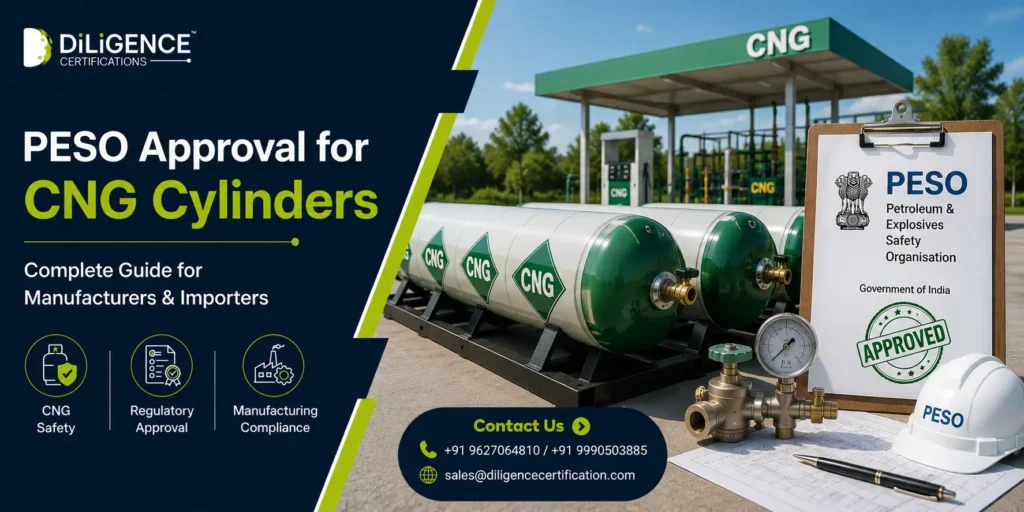
By - PESO Approval for CNG Cylinders is an obligatory regulatory approval which guarantees that cylinders for compressed natural gas (CNG) conform to India’s safety and technical specifications before manufacture, import or use.
- Companies which manufacture, import or supply CNG cylinders have to follow the PESO rules in order to avoid fines, delays and potential hazards.
- In this guide, you will find everything about PESO Approval for CNG Cylinders procedure, requirements and more.
Introduction
Recently, a firm dealing in automotive components approached our team because they were inquiring about CNG cylinders by an automobile manufacturer. Everything seemed to be going on fine until the buyer posed this question - “Is your product approved by PESO?”
The cylinders were successful in passing through all their internal quality assurance procedures; however, the company never sought out any approvals from the regulatory body. It was decided that there will be no further progress on the purchase order until all approvals are done. Not only have they wasted time but they also have to restructure their manufacturing calendar to fulfill customer expectations.
Incidents like this occur more often now that India is increasingly adopting greener fuels. The number of CNG vehicles is increasing in the fields of public transport, logistics, personal cars, and industry too.
This is when PESO Approval of CNG cylinders becomes necessary. This approval ensures that the cylinder has gone through the evaluation process as per the relevant safety laws, technical regulations, and testing criteria prior to manufacturing, importation, supply, or use in India.
Be it a manufacturer, an importer, a vehicle supplier, or an industrial equipment supplier, knowledge about the approval process will definitely benefit your business.
What is PESO Approval for CNG Cylinders?
Approval of CNG Cylinders by PESO means approval granted by the Petroleum and Explosives Safety Organisation (PESO) working under the Department for Promotion of Industry and Internal Trade (DPIIT), Ministry of India.
This approval ensures that CNG cylinders meet all safety regulations, technical specifications, manufacturing norms, and test conditions before introducing these cylinders to the Indian market.
As opposed to general industrial goods, CNG cylinders hold natural gas in high pressure. Any deficiency in design, material quality, weld, and manufacturing will pose a threat to safety. This is why every approved cylinder goes through thorough engineering analysis and testing.
This approval process covers several areas, such as:
- Product design verification
- Material quality assessment
- Pressure testing
- Quality control during manufacturing
- Safety inspections
- Applicable regulations
Obtaining approval not only fulfils legal obligations but also demonstrates that the product has been assessed against recognised safety standards.
Why is PESO Approval Mandatory?
Compressed Natural Gas is maintained at much higher pressures compared to most conventional fuels. Due to these operating conditions, the cylinders are supposed to maintain their integrity over their lifespan through difficult conditions.
Without regulatory measures, there will be instances where faulty cylinders reach the market with increased chances of leaks, pressure failures, accidents, and damages.
The PESO certification process guarantees:
- Designs conform to acceptable engineering standards.
- Manufacturing processes are based on acceptable quality measures.
- Material is appropriate for high-pressure gas storage.
- All cylinders have undergone required safety testing.
- The manufacturing plants have been consistent in manufacturing quality.
- Imports are made in compliance with Indian regulations.
- For organizations, compliance is not only a matter of statutory compliance. The preference of most automotive companies, fleet operators, gas distributors, and governments is suppliers of products which already comply with regulatory standards.
- Regulatory approval has become a key determinant of supplier choice in competitive markets.
Who Requires PESO Approval for CNG Cylinders?
There are several types of businesses engaged in the manufacture, importation, supply or use of CNG cylinders, which would need approval based on their business operations.
Manufacturers of CNG Cylinders
Manufacturers of high pressure CNG cylinders will have to get the requisite approvals before starting commercial manufacture and supply of their products.
Importers
The businesses importing CNG cylinders into India shall make sure that their imported products are complying with the relevant PESO requirements before clearance and distribution.
Automotive Component Manufacturers
The businesses supplying CNG cylinders to automotive manufacturers and/or conversion kits manufacturers would typically require an approved product.
Industrial Gas Equipment Manufacturers
The businesses manufacturing pressure vessels or gas storage equipment for industrial purposes could be covered under the relevant regulation.
CNG Infrastructure Providers
The companies engaged in CNG storage and distribution facilities or any other infrastructure could look into the applicability of their equipment requiring approval from PESO.
Types of CNG Cylinders Covered Under PESO Approval
Different categories of cylinders may require separate technical evaluation depending on their construction, intended application, and operating pressure.
Common categories include:
- Steel CNG cylinders
- Composite CNG cylinders
- Vehicle-mounted CNG cylinders
- Transport CNG cylinders
- Industrial CNG storage cylinders
- Cascades used for CNG transportation
- Imported CNG cylinders
- High-pressure gas cylinders for specialised applications
Each category may have different testing procedures and compliance requirements based on applicable Indian Standards and regulatory provisions.
Eligibility Criteria for PESO Approval for CNG Cylinders
Organizations seeking PESO Approval for CNG Cylinders should ensure that their product is in compliance with all the requirements for safety and quality. Considering that CNG cylinders work under high pressure, PESO assesses both the product and the quality management systems of the manufacturer before issuing an approval.
Despite the eligibility criteria varying according to the product class, the applicant should meet at least the following criteria:
- The applicant must be a registered legal entity for conducting business.
- The CNG cylinder must be developed as per Indian standards or internationally recognized standards approved by PESO.
- There must be appropriate production and quality assurance capacity in manufacturing plants.
- Quality assurance processes of the applicant must be properly documented.
- The products must pass the prescribed safety and performance tests.
- Technical documentation and engineering drawings must reflect the design of the cylinder.
Extra paperwork with regard to the foreign production factory, conformity of goods and inspections reports could also be needed for importers.
This would help in ensuring that approvals would be completed quickly and avoid unnecessary regulatory inquiries.
Documents Required for PESO Approval for CNG Cylinders
Complete documentation is considered an extremely crucial phase in the entire approval process. Lack of technical documents and incomplete applications often lead to preventable delays.
Although the list of documents varies depending on the type of cylinders and the nature of business activities, some of the documents that are generally required include the following.
Business documents
- Incorporation certificate / business registration certificate
- GST registration certificate
- PAN card
- Factory license (if any)
- Import export code (IEC) for importers
- Authorization letter, if any
Technical documents
- Product specification
- Engineering drawing
- Design calculation
- Manufacturing process details
- Material specification
- Welding procedure specification
- Quality manual
Testing documents
- Pressure hydro test report
- Burst pressure test report
- Material test certificate
- Non-destructive test report
- Inspection reports
- Calibration certificates of testing equipment
Compliance documents
- Indian standard compliance certificates, if any
- Previous approvals, if any
- Product catalogues
- Technical literature
- Factory quality records
Review of documentation in detail before application often helps save weeks of processing. This is because most applications take more time due to incomplete or conflicting documentation rather than non-compliance of products with the regulations.
Step-by-Step PESO Approval Process for CNG Cylinders
By comprehending the approval process, companies can be better prepared and prevent any unnecessary delays.
Step 1: Product Evaluation
The initial step comprises identifying relevant regulatory requirements and technical standards for the CNG cylinder.
The professionals examine the design, application, working pressure, material specification, and manufacturing process of the product.
Step 2: Technical Documentation
The applicant gathers all necessary documents which include engineering drawings, quality manual, manufacturing process, and test report.
It is vital to provide proper documentation since it is used as the starting point for conducting the technical evaluation by PESO.
Step 3: Product Testing
In order to pass the approval procedure, CNG cylinders must go through several mandatory tests to confirm their technical characteristics and safety.
Common tests are as follows:
- Hydrostatic test
- Burst test
- Leak test
- Material test
- Mechanical strength test
- Visual inspection
- Dimensional verification
- Only those products that will successfully fulfill the set technical requirements advance to the next step.
Step 4: Application Filing
The application is filed using the approved system of PESO together with technical documents, supporting records, and government fees.
Properly filed applications decreases chances of being asked for additional clarifications.
Step 5: Technical Evaluation
The PESO evaluates the documentation provided, engineering data, test results, and compliance documentation provided.
In case there is any discrepancy found, observations may be sent out to the applicant for further clarification and information.
It will ensure that no undue delay occurs in the process.
Step 6: Factory Inspection
In case of manufacturers, PESO may inspect the factory to check the following:
- Manufacturing capacity
- Production machinery
- Testing facilities
- Quality control systems
- Safe working practices
- Traceability of product
This ensures that the production process is able to manufacture cylinders as per the approved standards.
Step 7: Grant of Approval
Once all the evaluations and inspections and documentation have been done successfully, the approval is granted for the applicable CNG cylinders.
The manufacturer/importer can now supply the approved cylinders in accordance with the regulatory body’s requirements.
Testing and Inspection Requirements
Testing forms an integral part of PESO Approval for CNG Cylinders since the cylinders contain compressed natural gas, which has to be at very high pressures. The cylinder has to prove that it can perform without failure during operation even in worst conditions.
For different categories of products, the following are among those performed.
Hydrostatic Pressure Test
The hydrostatic pressure test determines the cylinder’s capability of maintaining pressure inside itself without any damage or leaks.
Burst Pressure Test
The cylinder is exposed to pressure much higher than it is supposed to have during normal use.
Leak Test
Inspection of the cylinder and accessories of the same is done to ascertain that the cylinder does not have leaks.
Material Testing
This test is done on the raw material of the cylinder.
Weld Inspection
Testing of the welds in the cylinder using a non-destructive testing method is done.
Dimensional Inspection
Dimensions, including wall thickness, of the cylinder are checked.
Applicable Rules and Standards
PESO Approval for CNG Cylinders is governed by several statutory and technical regulations.
Some of the important legal provisions include:
- Petroleum Act, 1934
- Petroleum Rules, 2002
- Gas Cylinders Rules, 2016
- Applicable Indian Standards (IS)
- PESO technical guidelines
- Government notifications issued from time to time
Applicants should always verify the latest regulatory updates before initiating the approval process, as technical requirements may change based on revised standards or government notifications.
Common Reasons for Application Rejection
Many applications are delayed due to avoidable mistakes during preparation.
The most common reasons include:
- Incomplete documentation
- Incorrect engineering drawings
- Missing pressure test reports
- Non-compliance with applicable Indian Standards
- Poor quality control procedures
- Deficiencies observed during factory inspection
- Incorrect material specifications
- Delayed responses to regulatory queries
- Submission of outdated compliance records
Conducting an internal compliance review before submission helps identify these issues early and improves the chances of obtaining approval without repeated revisions.
Processing Time for PESO Approval for CNG Cylinders
PESO Approval Time for CNG Cylinder depends upon completeness of the application, intricacies in the design of the product, testing needs, and if there are any further requests from the PESO during the approval process.
Applications which contain complete technical information and test reports are expected to go through the approval process quickly. However, delays arise if there are incomplete or conflicting technical documents, material certification and inspection reports.
To ensure a quick approval process, one must take the following measures:
- Verify all technical documents before applying.
- Get the tests performed at recognised labs.
- Answer questions raised by regulators.
- Update quality control records.
- Ensure that engineering drawings tally with the final product.
Starting the approval process before beginning commercial production or import planning can help avoid project delays and unnecessary costs.
Government Fees for PESO Approval
There is no standard government fee applicable to every application for PESO Approval for CNG Cylinders. The cost varies depending on several factors, including:
- Type of CNG cylinder
- Product category
- Number of models requiring approval
- Scope of testing
- Inspection requirements
- Applicable statutory fees
Apart from government charges, businesses should also consider expenses related to product testing, documentation, laboratory evaluations, engineering support, and compliance consultancy.
Obtaining a project-specific cost estimate before filing the application helps organisations plan their compliance budget more effectively.
Validity and Renewal of PESO Approval
The legitimacy of PESO Approval for CNG Cylinders relies on the category of the approval and the related regulations.
Despite obtaining approval, manufacturers and importers need to continue meeting requirements for the approved design, manufacturing process, quality assurance system, and safety requirements.
Should there be any substantial changes in the design of the cylinder, the manufacturing plant, raw material, or manufacturing process, re-approval or further assessment might be needed.
Approval conditions must be closely watched, and companies need to ensure that they initiate the renewal process much earlier than the expiry of the relevant period.
Benefits of PESO Approval for CNG Cylinders
PESO Approval for CNG Cylinders is not just about complying with regulations but also improving product credibility and market acceptability.
1. Conformity to Indian Laws
This will help firms adhere to the Petroleum Act, Gas Cylinders Rules, Petroleum Rules, and all other relevant laws.
2. Increased Customer Trust
Customers will be more inclined to buy products that are subject to recognized regulatory approvals by automotive manufacturers, fleet owners, gas distributors, and industrial customers.
3. Facilitated Market Entry
Government departments, public sector organizations, and big private firms always insist on statutory approvals before purchasing goods.
4. Increased Product Safety
Regulated testing and inspections assure that CNG cylinders can function safely at the required pressure conditions.
5. Minimized Business Risk
Regulation ensures that there are no problems like delayed shipments, legal issues, recalls of the products, and fines due to violations.
6. Competitive Business Edge
Products with approvals have a competitive edge in tenders, OEM sourcing, and business dealings.
Challenges Businesses Commonly Face
Many businesses underestimate the technical requirements associated with PESO Approval for CNG Cylinders. While the approval framework is well defined, practical challenges often arise during implementation.
Some common issues include:
- Difficulty interpreting technical standards.
- Delays in obtaining test reports.
- Incomplete engineering documentation.
- Multiple revisions after regulatory observations.
- Lack of familiarity with the latest compliance requirements.
- Coordination between manufacturers, laboratories, and regulatory authorities.
Addressing these challenges early can significantly improve approval timelines and reduce compliance costs.
Why Choose Diligence Certifications?
Gaining approval from PESO on CNG cylinders needs skills and knowledge in the field. Sometimes, the tiniest mistake can lead to postponement of the entire process.
Here at Diligence Certifications, we assist companies such as manufacturers, importers, and industrial organizations to manage the approval process through:
- Complete application support from start to finish.
- Technical documentation review and preparation.
- Assistance in coordinating product testing.
- Guidance on applicable regulations and standards.
- Support during inspections and regulatory queries.
- Renewal and post-approval compliance assistance.
Our team focuses on simplifying complex regulatory procedures so businesses can concentrate on manufacturing, importing, and expanding their operations with confidence.
Conclusion
As India increases its use of clean fuel technology, the significance of PESO Approval for CNG Cylinders cannot be underestimated. Regardless of whether you manufacture, import or supply CNG Cylinders, it is important that you are compliant and ensure your safety, credibility in the market and compliance with the statute.
Properly prepared applications coupled with proper technical documentation, product testing and compliance with the relevant laws will increase the chances of getting approval without any hassle.
If you are planning on entering the market of CNG cylinders or expanding your current operations, then getting PESO Approval for CNG Cylinders should be an important step of compliance.
Need help with PESO Approval for CNG Cylinders?
Diligence Certifications can assist you with documentation, product testing, application and compliance related issues.
Frequently Asked Questions
What is PESO Approval for CNG Cylinders?
PESO Approval for CNG Cylinders is a regulatory approval that confirms CNG cylinders comply with prescribed safety, design, and technical requirements before they are manufactured, imported, or supplied in India.
Who needs PESO Approval for CNG Cylinders?
Manufacturers, importers, automotive component suppliers, industrial gas equipment manufacturers, and businesses dealing with CNG cylinders may require approval depending on their activities.
Which documents are required for the approval process?
Common documents include business registration certificates, engineering drawings, product specifications, material test certificates, quality manuals, inspection reports, and applicable compliance records.
How long does the approval process take?
The timeline depends on the completeness of the application, testing requirements, factory inspection, and the complexity of the product.
Is product testing mandatory?
Yes. CNG cylinders are generally required to undergo prescribed safety and performance tests before approval can be granted.
Can imported CNG cylinders be sold without PESO approval?
Imported CNG cylinders must comply with applicable Indian regulations and obtain the required approvals before they can be supplied in the Indian market.
What are the common reasons for application rejection?
Incomplete documentation, missing test reports, incorrect engineering drawings, non-compliance with standards, and deficiencies identified during inspections are among the most common reasons.
Can PESO approval be renewed?
Where applicable, businesses should apply for renewal before the approval expires and continue complying with all regulatory conditions.
Why is factory inspection important?
Factory inspections verify that the manufacturing facility has the capability, testing infrastructure, and quality management systems needed to consistently produce compliant CNG cylinders.
How can Diligence Certifications assist?
Diligence Certifications offers end-to-end support for documentation, technical reviews, testing coordination, application filing, regulatory follow-up, and ongoing compliance.