BIS Certification
 CDSCO
CDSCO
 PESO
PESO
 CPCB
CPCB
 LMPC
LMPC
 WPC Approval
 Global Approvals
 TEC
TEC
 ARAI
ARAI
 BEE
BEE
 ISO Certification
 DGCA Certification
 NOC For Steel
 APEDA Registration























 Business Registration
 FSSAI Mark Certification












 (32).jpg)
 Legal Services
 Trademark Registration
 Copyright Registration
 Patent Registration
 By
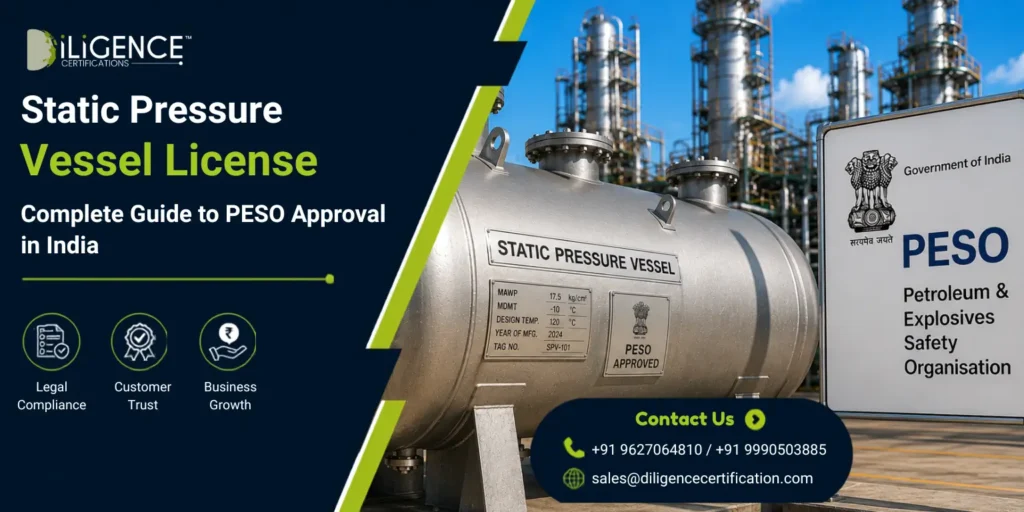
By - Static Pressure Vessel License is necessary for companies dealing with manufacturing, importing, installation, storage, or using pressure vessels holding compressed gas or liquid that is hazardous under the rules for Static and Mobile Pressure Vessels (Unfired), 2016 (SMPV Rules).
- This is essential for workplace safety, compliance, and hassle-free processing by the Petroleum and Explosives Safety Organisation (PESO).
- Diligence Certifications offers comprehensive services for obtaining Static Pressure Vessel License through documentation, application submission, and compliance.
Introduction
Recently, a manufacturing company reached out to our team due to the investment of several crores into a new LPG storage facility. All the tanks were set up, the pipeline was ready, and even the date of commissioning was fixed. Unfortunately, during the last inspection, the management found out that there was a crucial regulation that had not been taken into consideration - the Static Pressure Vessel License.
Since there was no needed certificate, the facility could not operate legally since it involved compressed gas. In result, production delays, idle contractors, and rising operational costs occurred until obtaining regulatory approvals.
However, such a case is not as rare as you might think. In the petroleum, chemical, pharmaceutical, food processing, manufacturing, and industrial gas distribution industries, pressure vessels are used to store hazardous gases and liquids under pressure. Since pressure vessels pose a significant risk to safety, Indian regulations oblige companies to acquire a Static Pressure Vessel License before installation and operation.
Getting the license means more than just fulfilling your responsibilities in terms of legal requirements. Obtaining a Static Pressure Vessel License proves that the vessel has been designed, installed, tested, and maintained according to safety standards.
What is a Static Pressure Vessel License?
Static Pressure Vessel Licence is a permission granted by the Petroleum and Explosives Safety Organisation (PESO) through Static and Mobile Pressure Vessels (Unfired) Rules, 2016 (SMPV Rules).
This permission allows companies to fix, keep, and run static pressure vessels, which are filled with compressed gas or dangerous liquids in excess of certain pressure levels.
As opposed to mobile pressure vessels used in transport applications, static pressure vessels are installed permanently within the factory premises. This pressure vessel stores such products like LPG, LNG, ammonia, chlorine, CO2, propane, butane, and other compressed gases utilized in industries.
Prior to granting permission, PESO considers a number of technical and safety criteria including:
- Pressure vessel design
- Engineering calculations
- Material specifications
- Fabrication quality
- Welding procedures
- Safety valves and accessories
- Hydrostatic testing
- Non-destructive testing (NDT)
- Site layout and installation
- Compliance with SMPV Rules
Only after satisfying these requirements does PESO issue the Static Pressure Vessel License.
Why is a Static Pressure Vessel License Important?
Pressure vessels work in high-pressure conditions and hold dangerous, flammable, or toxic chemicals. The slightest mistake in designing, manufacturing or installing them can lead to problems such as leaks, explosions, fire hazards or even pollution.
Static Pressure Vessel Licence allows minimising such risks through proper regulation.
The main advantages of the licence are the following:
Legal Requirements
Using pressure vessels without an appropriate license may have serious consequences, including regulatory actions and possible shutdowns according to the relevant laws.
Protection of Human Life
Inspection and certification prevent any potential incidents connected with compressed gases and hazardous chemicals.
Industrial Safety
Certified pressure vessels have undergone proper engineering evaluations and mandatory tests before commissioning.
Increases Customer Confidence
Large industries, government institutions, EPC contractors and multinational companies usually check for regulatory compliance before signing contracts.
Avoids Business Interruption
Getting a licence before commissioning helps to avoid business interruptions during the inspection, audit or insurance procedure.
For a business that heavily invests in industrial facilities, getting the license at the right time can be very beneficial.
Who Needs a Static Pressure Vessel License?
The Static Pressure Vessel Licence Requirement can apply to multiple industries that store or use compressed gases or hazardous liquids.
Some of the industries that require such a licence include:
Oil Companies
Terminals storing LPG, LNG, propane, butane, and other petroleum products.
Chemical Industries
Plants storing hazardous substances under pressure.
Pharmaceutical Industry
Plants using compressed gases in their production process.
Industrial Gases Supplier
Industries storing oxygen, nitrogen, argon, hydrogen, helium, and carbon dioxide in bulk tanks.
Food and Beverages
Plants using carbon dioxide, ammonia, and refrigerant gases.
Fertilizer and Petrochemical Plants
Larger storage plants dealing with pressurized chemicals.
Engineering and Manufacturing Industry
Plants operating compressed air systems, process vessels, or gas storage tanks.
Power Plants and Refineries
Plants using pressure vessels for different reasons.
In case of a new installation of a pressure vessel or expansion of existing facilities, getting the licence is necessary before operations commence.
Types of Static Pressure Vessels Covered
The licensing requirement is applicable to many types of pressure vessels depending on the type of commodity to be kept, pressure, volume, and use in industry.
Some typical pressure vessels are:
- LPG Storage Tanks
- LNG Storage Vessels
- Ammonia Storage Tanks
- Chlorine Pressure Vessels
- Propane Storage Tanks
- Butane Storage Vessels
- Carbon Dioxide Pressure Vessels
- Liquid Oxygen Storage Tanks
- Liquid Nitrogen Storage Tanks
- Industrial Gas Storage Vessels
- Cryogenic Pressure Vessels
- Refrigerant Storage Tanks
- Process Pressure Vessels
- Air Receiver Tanks (if relevant)
The exact requirements for each of the above categories will depend on the particular requirements under the SMPV Rules and guidelines issued by PESO.
Eligibility Criteria for a Static Pressure Vessel License
Getting the license for a Static Pressure Vessel entails the company proving that both the pressure vessel itself and its installation meet all the safety standards laid out in the Static and Mobile Pressure Vessels (Unfired) Rules, 2016 (SMPV Rules).
As the pressure vessel is created specifically to contain dangerous gasses or liquids under pressure, the evaluation is conducted very thoroughly by PESO.
Even though the actual requirements depend upon the specific pressure vessel used and its content, the company needs to comply with the following conditions:
Applicant Should Be a Legally Registered Body
Application shall be made on behalf of the registered company, partnership firm, LLP, government body, or authorised proprietors, who shall operate the pressure vessel.
Design of Pressure Vessel Approved
The pressure vessel design shall comply with Indian Standards, ASME code or any other engineering standard approved by PESO.
Installation at a Safe Place
The site of the installation shall be in accordance with statutory safety distance, emergency entry routes, fire safety regulations and layout plan.
Competent Engineering and Technical Team
Installation, testing and commissioning shall be supervised by competent engineers.
Safety Devices to be Installed
Relief valves, emergency shutdown, safety instruments, gauges and alarms etc. shall be installed as required.
Successful Testing and Inspection
Pressure vessels must be able to clear all inspections and performance tests before being commissioned.
Compliance with SMPV Rules
Installation must meet all the provisions set out in the Static and Mobile Pressure Vessels (Unfired) Rules, 2016, as well as any further guidelines issued by PESO for the relevant product.
Businesses looking to install storage tanks are encouraged to check their compliance before commencing construction since changes to the design post-installation would raise costs of the project.
Documents Required for a Static Pressure Vessel License
Document preparation is very important in the approval procedure. Delays often arise from poorly documented files.
Proper document preparation prior to the submission of the application can help avoid regulatory comments and shorten the approval process.
Business Documents
- Certificate of Incorporation or Registration of Company/Business Name
- PAN Card
- GST Registration Certificate
- Factory Licence (if any)
- Authorization Letter
- Identity and Address Proof of Authorized Person
Technical Documents
- Pressure Vessel Design Drawings
- General Arrangement (GA) Drawings
- Process Flow Diagram (PFD)
- Piping and Instrumentation Diagram (P&ID)
- Engineering Design Calculations
- Material Specification
- Welding Procedure Specification (WPS)
- Details of Fabrication
Installation Documents
- Site Layout Plan
- Drawing of Safety Distance
- Fire Protection System Layout
- Earthing Details
- Foundation Drawings
- Installation Completion Certificate
Testing and Inspection Reports
- Hydrostatic Test Report
- Radiographic Test Report (RT)
- Ultrasonic Test Report (UT)
- NDT (Non Destructive Testing) Reports
- Material Test Certificate
- Calibration Certificate
- Pressure Relief Valve Test Certificate
- Third Party Inspection Report (if any)
Compliance Documents
- Records of Quality Assurance by Manufacturer
- Standard Compliance Certificate
- Record of Previous Approvals (if any)
- Catalogue of Equipment
Submitting organised documentation reduces the likelihood of repeated queries from the licensing authority.
Step-by-Step Static Pressure Vessel License Process
Knowledge of the licensing process enables businesses to prepare accordingly and avoid project delays.
Step 1: Project Planning
The first step involves determining the nature of the pressure vessel, storage medium, pressure, storage capacity and statutory requirements.
In this case, the engineering consultants are able to establish which PESO approvals and inspections are necessary.
Step 2: Preparation of Engineering Documentation
This involves preparing engineering documents such as:
- Engineering drawings
- Pressure calculations
- Engineering design codes
- Material specification
- Engineering fabrication
- Quality control documents
Step 3: Pressure Vessel Fabrication
Pressure vessel is fabricated using approved engineering drawings and established fabrication codes.
Inspections are conducted to ensure that the engineering drawings conform to established specifications.
Step 4: Mandatory Testing
Pressure vessel is subjected to a number of mandatory tests before its installation, such as:
- Hydrostatic Pressure Test
- Radiographic Examination
- Ultrasonic Testing
- Leak Testing
- Pressure Relief Valve Testing
- Dimensional Inspection
- Visual Inspection
- Those vessels meeting specified safety standards move to the next step.
Step 5: Installation at Site
After transportation, the vessel gets installed at the authorized industrial site.
This involves:
- Foundations
- Piping
- Safety Valve
- Instrumentation
- Fire Fighting System
- Earthing
- This installation has to be done strictly as per the layout drawings authorized.
Step 6: Submitting the Application
The licensee applies for the license, together with technical documents, inspection reports, layout plans, and the government’s fee, to PESO.
A fully completed application will definitely facilitate processing.
Step 7: Technical Evaluation
PESO reviews:
- Drawings of engineering
- Test reports
- Design calculations
- Safety systems
- Compliance documents
- Details of installation
- Should any more information be needed, the applicant must provide it immediately.
Step 8: On-site Inspection
Often, PESO conducts an inspection in order to:
- Check the installation of the vessel
- Assess safety clearances
- Ensure fire protection arrangement
- Ensure the provision of pressure relief systems
- Evaluate emergency systems
- Overall compliance with regulations
- Any deficiency found at the inspection should be corrected.
Step 9: Issuance of Static Pressure Vessel License
Upon meeting all the regulatory requirements, PESO grants the static pressure vessel license, allowing legal operation of the pressure vessel.
The license owner must operate the vessel according to the prescribed specifications and statutory requirements.
Inspection and Testing Requirements
Testing is one of the most critical aspects of obtaining a Static Pressure Vessel License because it confirms that the vessel can safely withstand operating conditions throughout its service life.
The following inspections are generally conducted before approval:
Hydrostatic Pressure Test
Confirms the vessel can withstand pressures above normal operating conditions without leakage or deformation.
Radiographic Testing (RT)
Examines welded joints for internal defects that may not be visible externally.
Ultrasonic Testing (UT)
Detects hidden flaws or discontinuities in the vessel material.
Magnetic Particle Testing (MT)
Used to identify surface and near-surface cracks in ferromagnetic materials.
Dye Penetrant Testing (DPT)
Helps detect minute surface cracks in welds and fabricated components.
Leak Testing
Ensures there is no gas or liquid leakage from joints, valves, or fittings.
Safety Valve Testing
Verifies proper functioning of pressure relief devices under specified operating conditions.
Dimensional Inspection
Checks wall thickness, nozzle locations, vessel dimensions, and fabrication tolerances against approved drawings.
Applicable Rules and Regulations
The Static Pressure Vessel License is governed by several statutory laws and technical standards to ensure safe handling and storage of compressed gases and hazardous liquids.
Important regulations include:
- Static and Mobile Pressure Vessels (Unfired) Rules, 2016 (SMPV Rules)
- Explosives Act, 1884
- Petroleum Act, 1934
- Petroleum Rules, 2002
- Gas Cylinders Rules, 2016 (where applicable)
- Relevant Indian Standards (IS Codes)
- ASME Boiler and Pressure Vessel Code (where accepted)
- PESO Circulars and Technical Guidelines
- Notifications issued by the Department for Promotion of Industry and Internal Trade (DPIIT)
Businesses should regularly review regulatory updates because amendments may introduce new compliance requirements.
Common Reasons for Application Rejection
Many approval delays can be prevented through proper planning and documentation.
Some of the most common reasons for rejection include:
- Incomplete application forms
- Missing engineering drawings
- Incorrect design calculations
- Non-compliance with SMPV Rules
- Invalid or outdated test reports
- Defective welding documentation
- Improper installation layout
- Insufficient safety distances
- Inadequate fire protection systems
- Delayed responses to regulatory observations
Conducting an internal compliance review before submission can significantly improve the chances of first-time approval.
Processing Time for a Static Pressure Vessel License
The processing time depends on several project-specific factors, including:
- Type of pressure vessel
- Product stored
- Capacity of the vessel
- Completeness of technical documentation
- Inspection requirements
- Site readiness
- Response time to regulatory queries
Applications supported by complete engineering documents and valid inspection reports are generally processed faster.
Businesses should initiate the licensing process well before commissioning to avoid unnecessary project delays.
Government Fees
There is no uniform government fee applicable to every Static Pressure Vessel License application.
The payable fee depends on factors such as:
- Type of pressure vessel
- Storage capacity
- Nature of compressed gas or liquid
- Number of vessels
- Inspection requirements
- Applicable statutory charges
Apart from government fees, businesses should also consider expenses related to engineering design, third-party inspections, laboratory testing, fabrication verification, and professional consultancy.
Validity and Renewal of a Static Pressure Vessel License
The validity of a Static Pressure Vessel License depends on the category of licence issued and the applicable provisions under the SMPV Rules.
Obtaining the licence is only the beginning of ongoing compliance.
Businesses should ensure that:
- Pressure vessels continue operating within approved parameters.
- Periodic inspections are completed on time.
- Safety valves and protective devices are regularly tested.
- Any modification to vessel design, storage medium, or installation is reported to the competent authority.
- Renewal applications are submitted before licence expiry to avoid disruptions.
Maintaining continuous compliance helps businesses avoid penalties, operational interruptions, and safety risks while ensuring long-term regulatory approval.
Benefits of a Static Pressure Vessel License
Getting a Static Pressure Vessel Licence goes beyond fulfilling a legal requirement. Rather, it is a very important move that protects you from any legal, safety and operational problems.
1. Ensures Regulatory Compliance
Having a Static Pressure Vessel License will assure you of being in compliance with Indian rules and regulations as well as other laws enforced by PESO.
Regulatory compliance also ensures that no penalties and restrictions arise after inspections.
2. Increases Workplace Safety
Your pressure vessels contain highly dangerous materials at a very high pressure. Small mistakes on your part may cause gas leaks, explosions, fires among others.
The licensing process assures that the pressure vessel has been designed and tested properly.
3. Establishes Trust with Clients and Vendors
Government departments, EPC contractors, refineries and multinational companies are always more comfortable dealing with facilities with all their statutory compliance intact.
A Static Pressure Vessel License confirms that you operate in accordance with standard safety procedures.
4. Lowers Operational Hazards
Businesses that operate pressure vessels under licence are unlikely to be shut down because of regulatory problems or safety infractions.
Being compliant will also reduce any insurance issues and costs associated with emergency repairs.
5. Facilitates Quick Approvals
A Static Pressure Vessel Licence will make it easier to approve projects that require clearance from various regulatory authorities.
This will be particularly helpful for companies undertaking infrastructure projects.
6. Boosts the Image of a Business
Being compliant shows professionalism in the conduct of business.
The fact that a company is operating its installations under licence will give it an edge when bidding for government contracts and dealing with large industrial customers.
Common Compliance Challenges
Though the licensing procedure has already been set up, there are some firms which are experiencing delays due to their ignorance of the technical and documentation prerequisites for the licensing process.
Some of the common problems faced by the companies include:
Incomplete Engineering Documentation
Sometimes, the lack of calculations, fabrication data or pressure vessel data results in regulatory findings.
Change in Design During Installation
Sometimes, the design of the project is altered during installation without necessary approvals causing further testing and delays.
Late Submission of Test Reports
Sometimes, third party inspection report and laboratory certificate report may arrive late resulting in project delay.
Incorrect Safety Distances
Pressure vessels must be always installed with prescribed safety distances from building, road and hazardous facilities.
If not, this could result in complete redesigning of the facility layout.
Unawareness of the Regulations
Sometimes, firms think that acquiring a certified pressure vessel is all enough and overlook the point that installation itself also requires licensing.
Lack of Coordination Among Project Stakeholders
Many stakeholders are involved in the project such as manufacturer, consultant, contractor, inspector and regulatory authority.
In absence of proper project management, there could be delay in licensing process.
Why Choose Diligence Certifications?
Obtaining a Static Pressure Vessel License requires more than submitting an application. It demands technical expertise, regulatory knowledge, and careful coordination throughout the approval process.
At Diligence Certifications, we assist businesses at every stage, ensuring applications meet the latest PESO requirements.
Our services include:
- Assessment of project-specific licensing requirements
- Preparation and review of technical documentation
- Engineering compliance support
- Application filing assistance
- Coordination with authorised inspection agencies
- Support during PESO inspections
- Assistance in replying to technical observations
- Renewal and post-approval compliance guidance
Whether you are setting up a new industrial facility or expanding an existing plant, our experienced consultants help simplify the approval process while reducing compliance risks.
Conclusion
Industrial development requires proper infrastructure facilities, however, safety should always be the priority. The pressure vessel holds dangerous material at high pressure under strict operating conditions; hence regulatory requirements become mandatory for ensuring safety of life, property and environment.
The Static Pressure Vessel License confirms that your establishment meets the required safety standards, engineering specifications, and PESO regulations prior to the operation.
Proper planning for licensing procedures eliminates the chances of delaying of project, additional cost, and any kind of operational inconvenience. In addition, it promotes customer satisfaction and shows your organization’s concern towards the aspect of safety and regulatory compliance.
In case your company needs to establish or operate any pressure vessels in India, we can provide full guidance for every stage of licensing process from beginning till end.
Require help for obtaining Static Pressure Vessel License?
Please contact us at Diligence Certifications for professional guidance and regulatory assistance in obtaining license.
Frequently Asked Questions
What is a Static Pressure Vessel License?
A Static Pressure Vessel License is a PESO-issued licence that allows the safe installation and operation of pressure vessels storing compressed gases or hazardous liquids.
Who needs a Static Pressure Vessel License in India?
ndustries such as oil & gas, chemical, pharmaceutical, LPG, and industrial gas sectors operating pressure vessels generally require this licence.
Which authority issues the Static Pressure Vessel License?
The Petroleum and Explosives Safety Organisation (PESO) issues the licence under the SMPV Rules, 2016.
What documents are required for a Static Pressure Vessel License?
Business registration documents, engineering drawings, test reports, site layout plans, and safety certificates are commonly required.
How do I apply for a Static Pressure Vessel License?
Submit the application with the required technical documents to PESO and complete the prescribed inspections and compliance checks.
How long does it take to obtain a Static Pressure Vessel License?
The approval timeline depends on document completeness, technical scrutiny, and inspection schedules by PESO.
Can a Static Pressure Vessel License be renewed?
Yes. It can be renewed by applying before expiry and submitting the required documents and inspection reports.
What happens if I operate without a Static Pressure Vessel License?
Operating without a valid licence may lead to penalties, legal action, and suspension of operations.
What is the validity of a Static Pressure Vessel License?
The validity depends on the licence category and applicable PESO regulations
Why choose Diligence Certifications for a Static Pressure Vessel License?
Diligence Certifications offers end-to-end assistance with documentation, application filing, compliance, and PESO approval support.