BIS Certification
 CDSCO
CDSCO
 PESO
PESO
 CPCB
CPCB
 LMPC
LMPC
 WPC Approval
 Global Approvals
 TEC
TEC
 ARAI
ARAI
 BEE
BEE
 ISO Certification
 DGCA Certification
 NOC For Steel
 APEDA Registration























 Business Registration
 FSSAI Mark Certification












 (32).jpg)
 Legal Services
 Trademark Registration
 Copyright Registration
 Patent Registration
 By
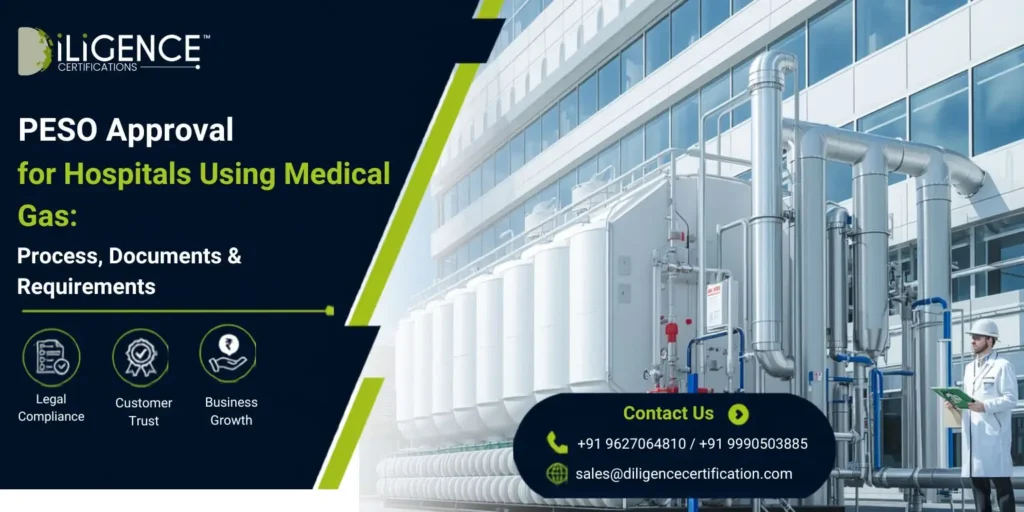
By - PESO Approval for Hospitals Using Medical Gas is mandatory for hospitals storing and handling medical oxygen and other compressed medical gases beyond prescribed limits.
- This will enable the hospitals to be in line with Indian laws on safety measures, while providing seamless treatment to their patients.
- Learning about the process and documents that go into obtaining this approval is essential.
Introduction
In order to meet the increasing demand for critical care, a multi-speciality hospital underwent an extension of the ICU along with installation of oxygen cylinders, manifolds, and gas pipelines. Though all the facilities were present, during a normal inspection of the facility, it came into light that the hospital needed to obtain an approval from the relevant authorities to operate the medical gas system legally.
This is a fairly typical problem faced by many health facilities. Even as the primary concern of the hospital is providing high-quality care to the patients, it must be remembered that the adherence to safety standards in terms of storage and handling of medical gases is just as crucial. The PESO Approval for Hospitals Using Medical Gas helps hospitals to safely store, transport, and distribute medical gases like oxygen and nitrous oxide in accordance with the Indian regulations.
What is PESO Approval for Hospitals Using Medical Gas?

PESO approval for hospitals using medical gas refers to the statutory approval provided by the Petroleum & Explosives Safety Organisation (PESO) to hospitals engaged in storage, installation, and operation of medical gas system containing compressed and liquefied gas.
Medical gases commonly covered include:
- Medical Oxygen
- Nitrous Oxide
- Carbon Dioxide
- Medical Air
- Nitrogen
- Liquid Medical Oxygen (LMO)
- Other compressed medical gases used for diagnosis and treatment
As the gases are stored under high pressure in cylinders, cryogenic tanks, or manifolds, there is always a possibility of hazards like fire, explosions, pressure, or leakage if appropriate care is not taken.
PESO determines whether the hospital’s facilities, equipment, safety systems, installations, and procedures comply with safety regulations for issuing approvals.
Who Needs PESO Approval for Hospitals Using Medical Gas?
PESO Authorization for the Use of Medical Gases in Hospitals is needed by hospitals that keep or distribute more than the permitted amount of medical gases according to regulations. This helps ensure that medical gas equipment used meets safety standards.
The following healthcare facilities commonly require PESO approval:
- Multi-Speciality Hospitals - Hospitals with central oxygen plants, liquid medical oxygen (LMO) tanks, or medical gas pipeline systems.
- Government and Private Hospitals - Facilities operating ICUs, operation theatres, emergency departments, and critical care units.
- Super Speciality Hospitals - Cardiac, oncology, neurological, trauma, and transplant hospitals with high-capacity medical gas systems.
- Medical Colleges and Teaching Hospitals - Institutions using medical gases for patient care, training, and research.
- Cancer Treatment Centres - Facilities that use medical gases for specialised treatments and radiotherapy.
- Trauma, Emergency, and Dialysis Centres - Healthcare centres that rely on a continuous supply of medical gases for patient treatment.
Types of PESO Approval for Hospitals Using Medical Gas
The exact approval requirements depend on the type of medical gas installation, storage capacity, equipment configuration, and hospital operations.
Approval for Liquid Medical Oxygen (LMO) Storage Tanks
Hospitals storing Liquid Medical Oxygen (LMO) in cryogenic tanks require approval for the storage installation, safety distances, pressure systems, and associated equipment.
These installations are commonly found in medium and large hospitals with high oxygen consumption.
Approval for Medical Oxygen Cylinder Manifold Systems
Hospitals using manifold systems that connect multiple oxygen cylinders require approval to ensure safe cylinder storage, pressure regulation, ventilation, and emergency shutdown arrangements.
Approval for Medical Gas Pipeline Systems (MGPS)
Medical Gas Pipeline Systems distribute oxygen and other gases throughout different hospital departments.
Petroleum & Explosives Safety Organisation examines the design, pressure control systems, safety valves, emergency isolation systems, and installation standards before approval.
Approval for Pressure Vessels and Cryogenic Equipment
Cryogenic vessels, vaporizers, pressure vessels, and associated equipment used for medical gas storage must comply with prescribed engineering and safety standards.
Approval for Gas Cylinder Storage Areas
Hospitals maintaining large cylinder storage facilities require approval covering:
- Storage layout
- Ventilation
- Fire protection
- Cylinder segregation
- Safety signage
- Access control
Importance & Benefits of PESO Approval for Hospitals Using Medical Gas
| Importance | Benefits |
| Ensures compliance with Petroleum & Explosives Safety Organisation safety regulations | Avoids legal issues and penalties |
| Improves medical gas system safety | Protects patients and hospital staff |
| Reduces risks related to leakage and failures | Ensures uninterrupted healthcare operations |
| Supports hospital quality standards | Helps with NABH and other compliance requirements |
| Strengthens emergency preparedness | Improves safety during critical situations |
| Supports future expansion projects | Makes approvals for new facilities easier |
Documents Required for PESO Approval for Hospitals Using Medical Gas
- Certificate for Hospital Registration
- PAN Card and Certificate for GST Registration
- Letter of Authority from the Applicant
- Plans for Site and Medical Gas Pipeline
- Details of Medical Gas Storage Tank/Cylinder Storage
- Specifications of Equipment and Manufacturer Certificates
- Certificates of Pressure Vessels (where required)
- Installation Drawings and Documents
- Fire Safety and Emergency Response Information
- Risk Assessment Report and Safety Procedures
- Application Form for Petroleum & Explosives Safety Organisation.
- Documents of PESO Approval in the Previous Years (where applicable)
Step-by-Step Process for PESO Approval for Hospitals Using Medical Gas
Approval Process through Petroleum & Explosives Safety Organisation for Hospitals Using Medical Gas has many different steps that must be considered to gain approval. Proper planning and documentation may prevent delays during the approval process.
Step 1: Assessment of Medical Gas Infrastructure
The approval procedure starts with an in-depth assessment of the hospital’s medical gas system including storage areas, pipelines, cylinder manifolds, pressure vessels, and other equipment.
As a result, it becomes possible to determine the relevant regulations taking into account the capacity of storage areas and the operations.
Step 2: Preparation of Technical Documents
Engineers produce all technical documents including drawings, layouts, equipment specifications, calculations, and other documents according to relevant standards.
Proper documentation is very important in order not to raise any objections.
Step 3: Submission of Application
After filling out the application form, together with the other necessary documents and government fees, it is then submitted to the Petroleum & Explosives Safety Organisation concerned.
Step 4: Technical Evaluation
The officials of Petroleum & Explosives Safety Organisation will review the submitted documents to check for adherence to safety codes, engineering codes, and installation codes.
Any discrepancy found could lead to requesting clarifications or submitting revised documents.
Step 5: Site Inspection
Where applicable, authorised officers conduct a physical inspection of the hospital premises to verify:
- Storage installations
- Medical gas pipeline systems
- Safety equipment
- Pressure vessels
- Fire protection measures
- Emergency shutdown systems
- Safety signage
- Operational readiness
Step 6: Compliance Rectification
Should the observation be raised during the inspection process, the hospital will need to take corrective action before moving forward with the approval process.
Step 7: Grant of PESO Approval
Once all the documentation is verified satisfactorily and the inspection process is completed successfully, the Petroleum & Explosives Safety Organisation will issue the approval.
Timeline, Cost & Validity
| Timeline | Cost | Validity |
| The approval timeline depends on the hospital’s medical gas system, storage capacity, documentation readiness, technical evaluation, and inspection process. Generally, the process may take around 4-8 weeks after successful submission and compliance. | The cost varies based on the type of medical gas installation, storage capacity, applicable government fees, technical requirements, and documentation support required for the approval process. | The validity depends on the specific PESO approval category issued for the medical gas system. Hospitals should complete renewal before expiry to maintain continuous compliance and operations. |
| Proper documentation and timely responses during the review process can help avoid unnecessary delays. | A project-specific cost estimate should be prepared according to the hospital’s installation requirements and compliance needs. | Regular monitoring of approval validity helps hospitals avoid regulatory issues and operational disruptions. |
Consequences of Non-Compliance
Running medical gas systems without proper authorization presents hospitals with serious hazards and liabilities.
Legal Action
The regulatory agencies might take legal action against the hospital that is unable to comply with the relevant safety laws in regard to the storage and handling of medical gases.
Financial Penalties
Inability to comply might lead to fines or other forms of financial penalties.
Suspension of Operations
Authorities may restrict or suspend the operation of medical gas storage facilities until all regulatory deficiencies have been addressed.
Increased Safety Risks
Improper storage, inadequate maintenance, or non-compliant installations increase the risk of gas leakage, fire, explosion, pressure failures, and equipment damage.
Project Delays
Hospitals planning new buildings, ICU expansions, or increased storage capacity may experience delays in project approvals if existing facilities are not compliant.
Insurance Complications
Failure to comply with mandatory safety requirements may create complications during insurance assessments and claim settlements following an incident.
Reputational Damage
Safety incidents and regulatory violations can affect public confidence, hospital reputation, and relationships with healthcare stakeholders.
Renewal of PESO Approval for Hospitals Using Medical Gas
PESO approval should be renewed before its expiry to ensure uninterrupted hospital operations and continued compliance with safety regulations. Timely renewal helps avoid regulatory issues, inspection objections, and operational delays.
Documents Required for Renewal
- Existing PESO Approval or Licence
- Renewal Application Form
- Updated Site Layout (if modified)
- Equipment Maintenance Records
- Pressure Vessel Test Reports
- Safety Inspection Reports
- Fire Safety Compliance Documents
- Authorisation Letter
Renewal Process
The renewal process includes reviewing the existing approval, preparing updated documents, submitting the application with applicable fees, responding to authority queries, and completing inspections (if required).
Regular monitoring and timely renewal help hospitals maintain safe and compliant medical gas operations.
Professional Assistance for PESO Approval for Hospitals Using Medical Gas
Approval of hospitals using Medical Gas under the Petroleum & Explosives Safety Organisation framework will entail the submission of technical documents, drawings by engineers, safety analyses, and adherence to relevant standards. Any mistake in the documentation or the installation details may lead to objections or delays in the approval process.
Guidance from professionals can make the approval process easier for hospitals.
A professional consultant can assist with:
- Evaluation of medical gas storage requirements
- Preparation of technical drawings and layout plans
- Documentation as per PESO requirements
- Application preparation and submission
- Liaison with the concerned authorities
- Compliance gap assessment
- Assistance during inspections
- Support for approval, renewal, amendments, and capacity expansion
Working with experienced compliance professionals enables hospital management to focus on healthcare services while regulatory requirements are handled systematically.
Why Choose Diligence Certifications?
Approval of Hospitals Using Medical Gas through PESO needs professional knowledge, understanding of regulations, and accurate documentation. Here at Diligence Certifications, we help all hospitals, health institutions, and medical facilities obtain approval in the whole process of complying with the regulations.
We know about the regulations for medical gas storage tanks and assist our clients in preparing accurate documentation.
Our Services Include
- End-to-end PESO approval assistance
- Technical documentation support
- Preparation of layout drawings
- Application filing and submission
- Regulatory compliance guidance
- Inspection support
- Assistance for approval renewal and modifications
- Dedicated compliance consultation
- Timely project updates
- Support for hospitals across India
With a structured approach and industry experience, we help healthcare organisations simplify complex regulatory procedures and achieve compliance with confidence.
Conclusion
Medical gases are a crucial component of contemporary health care facilities and are required for treatments, surgery, emergency cases, and various life-saving processes. As these gases are stored in high-pressure containers and need to be handled in a specialized way, ensuring compliance with regulations is both a legal responsibility and a fundamental aspect of patient safety.
PESO Approval for Hospitals Using Medical Gases ensures that the hospitals can provide safe and secure storage of these gases along with proper distribution systems as well as compliance with the relevant safety regulations in India.
Whether you have plans to open a new hospital or expand your existing one or are planning to enhance your medical gas setup, acquiring the relevant approval in a timely manner will prove beneficial for you.
Diligence Certifications helps you in getting all the approvals through the necessary documentation and application.
Frequently Asked Questions
What is PESO Approval for Hospitals for Medical Gas?
It is a regulatory approval which is necessary for hospitals that store, handle or use medical gases such as oxygen, nitrous oxide, and LMO.
Is PESO approval necessary for all hospitals?
No, it will depend on the type of medical gas system installed in the hospital, capacity, and regulation.
What kind of medical gases are included in PESO approval?
It includes gases like medical oxygen, LMO, nitrous oxide, carbon dioxide, medical air, and nitrogen.
How long is the approval process?
It will take 4 to 8 weeks approximately.
What kind of documentation is needed to get the PESO license?
The main documentation includes hospital registration, site plan, technical drawing, safety document, and equipment certification.
Is it possible for a hospital to request the PESO license?
Yes, an existing hospital can request a license when expanding or modifying their medical gas systems.
What are the consequences when a hospital does not have PESO approval?
It can result in fines, regulation, restrictions, and even danger.
Is PESO Approval done on medical gas installations?
Yes, PESO can carry out inspection on medical gas installations.
How can Diligence Certifications help with PESO approval?
Diligence Certifications offers comprehensive services for PESO approval.
Why is PESO Approval for Hospitals Using Medical Gas necessary?
It is necessary for the safety of medical gas operations.