BIS Certification
 CDSCO
CDSCO
 PESO
PESO
 CPCB
CPCB
 LMPC
LMPC
 WPC Approval
 Global Approvals
 TEC
TEC
 ARAI
ARAI
 BEE
BEE
 ISO Certification
 DGCA Certification
 NOC For Steel
 APEDA Registration























 Business Registration
 FSSAI Mark Certification












 (32).jpg)
 Legal Services
 Trademark Registration
 Copyright Registration
 Patent Registration
 By
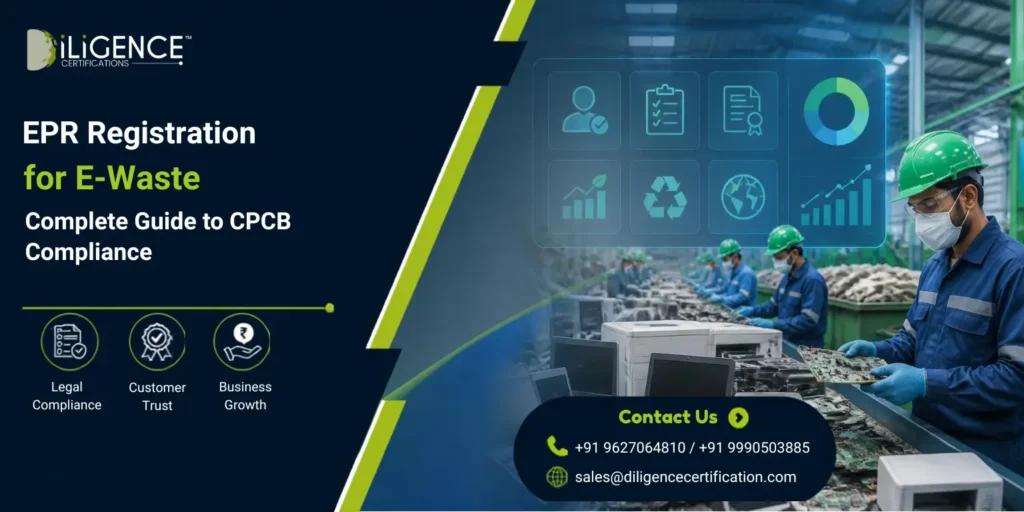
By - EPR Registration for E-Waste is mandatory for those who come under the scope of E-Waste (Management) Rules, 2022.
- It becomes imperative on the part of producers to fulfill the requirements of EPR through registration of the recyclers and record maintenance.
- Diligence Certifications can help companies with applicability assessment and registration process.
Introduction
An electronics consumer goods company can have a good product line, well-established distribution channels and solid sales but neglect one aspect of its regulation requirement: what to do about the products once their useful lives are over.
EPR registration for e-waste will then come into the picture. As per the provisions of India’s E-Waste (Management) Rules, 2022, the designated entities like manufacturers, producers, refurbishers and recyclers must register themselves under the EPR regime. Producers are responsible for fulfilling recycling requirements by using registered recyclers.
In addition to being an additional certification requirement, EPR influences product categorization, sales data, quantity of e-waste, recycling requirements, documentation, and reporting.
A manufacturer dealing with computers, LED goods, telecom equipment, and other electrical and electronic goods must review its EPR situation before expanding business operations.
What Is EPR Registration for E-Waste?
EPR registration for electronic waste entails the regulation registration process used to adhere to Extended Producer Responsibility requirements set out in E-Waste (Management) Rules, 2022.
This process involves registration of certain entities using the EPR portal. This includes the registration categories such as manufacturer, producer, refurbisher, and recycler, as stipulated in rule 4. Entities in several categories must register under those categories individually.
Producer registration is compulsory for any producers regulated by the rules and whose products fall within Schedule I, as per the Frequently Asked Questions from Central Pollution Control Board.
In essence, EPR entails linking the sale of the electronic goods with their end-of-life management responsibilities.
Who Needs EPR Registration for E-Waste?
The applicability depends on the entity’s role and the products involved.
Registration under E-Waste (Management) Rules, 2022, includes:
- Manufacturer
- Producer
- Refurbisher
- Recycler
As per these rules, such individuals/organizations need to register at the portal and are not supposed to conduct any business without registration. Also, it is not required to do business with other registered organizations under the registration scheme.
Applicability of such regulations can’t be concluded just on the basis of selling an electronic item. There needs to be consideration of the activities, product type and other criteria with respect to the concerned rules and Schedule I.
For instance, import of electronic items for sale in India can have a different compliance requirement than repair services.
Which Products Can Come Under E-Waste EPR?
The E-Waste (Management) Rules, 2022 apply to electrical and electronic equipment covered under the specified schedule.
Depending on the applicable category, this can include products such as computers, televisions, refrigerators, washing machines, air-conditioning equipment, lighting equipment, telecom equipment and various other electrical and electronic products.
The important point for a manufacturer is not simply the product’s marketing name. The technical nature and classification of the equipment should be checked against the applicable regulatory schedule.
This becomes particularly important when a company launches a new product line. A product team may classify an item commercially as an accessory, while the regulatory assessment may require a different approach.
EPR Registration for E-Waste Process in India
The EPR registration process should be treated as an ongoing compliance project rather than a simple online application. The exact requirements depend on the applicant category and the electrical or electronic products involved.
Step 1: Establish EPR Applicability
As per E-Waste (Management) Rules, 2022, check whether the organization is a manufacturer, producer, refurbisher or recycler of products. The producers need to identify the applicability of their products.
Step 2: Identify Applicable Products
Prepare a product inventory including product name, category, models, quantity, brand, imports and Schedule I classifications. This will help to define the correct compliance status.
Step 3: Gather Information
Some typical information which is gathered could be company registration information, PAN, GST, authorized signatories information, products information, manufacturing/import information, sales information etc.
Step 4: Determine EPR Targets
The EPR targets would be calculated based on the applicable regulatory framework, product category and sales/generation figures. Organizations must check the CPCB guidelines before calculating the targets.
Step 5: Choose Registered Recyclers
Choose proper registered recyclers that can provide effective environmentally sustainable management and EPR fulfillment.
Step 6: File the Application
Fill out the application using the designated CPCB EPR system. Company and product details should be checked before submission.
Step 7: Review
The authority may review the application and ask for more information if needed.
Step 8: Registration
After approval, the registration provides the foundation for EPR compliance. Companies have to keep records and fulfill all requirements and obligations.
What Are EPR Certificates for E-Waste?
EPR certificates form part of the mechanism through which applicable producer obligations can be fulfilled.
CPCB has provided for EPR certificate generation and transfer through the e-waste compliance framework. Its guidance states that registered recyclers generate EPR certificates associated with their recycling activity and transfer relevant credits to producers for fulfilment of producer obligations.
For producers, this means recycling compliance needs to be tracked systematically rather than handled at the end of the financial year.
The company should maintain a clear record of applicable obligations, recycling transactions and supporting documentation.
What Documents Are Required for E-Waste EPR Registration?
The exact documents depend on the applicant’s role and regulatory position.
Generally, a business should be prepared with its corporate and product information, including:
- Certificate of incorporation or business registration information
- PAN
- GST details
- Authorised signatory information
- Product details
- Brand details
- Manufacturing information
- Import information, where applicable
- Product quantity or sales information
- Applicable e-waste category
- Recycler-related information
- Other documents requested through the applicable portal
It is better to prepare the information systematically rather than collecting documents only after the application has been started.
EPR Compliance for Importers of Electronic Products
There is special emphasis required in case of importers since it may create EPR obligations based on the type of transaction and product imported.
For example, an importer of laptops to India under its brand name or importing ready-to-sell electrical equipment should analyze whether or not it qualifies as a producer under the regulatory definition.
The E-Waste (Management) Rules, 2022 define producers as including importers of electrical and electronic equipment and certain related products.
It is the right procedure to first examine the business model and then register under the right category.
EPR for Refurbishers and Recyclers
EPR compliance is not restricted to producers of products.
The E-Waste (Management) Rules 2022 clearly acknowledge the involvement of refurbishers and recyclers and mandate the registration of entities falling in those categories where applicable.
Hence, a refurbisher whose responsibility lies in prolonging the life cycle of electronic equipment needs to be aware of its regulatory requirements and not rely solely on the producer.
Recyclers also have obligations in terms of registration and recycling and the generation of necessary documents.
Common EPR Registration Mistakes Businesses Should Avoid
Incorrect Product Classification
A business may classify products according to internal commercial categories rather than the applicable regulatory schedule.
That can create problems when calculating obligations or preparing the registration.
Inconsistent Sales Data
EPR calculations depend on accurate product and quantity information. Data from finance, sales and logistics should be reconciled before filing.
Choosing an Unregistered Recycler
Working with a recycling partner without verifying its regulatory status can create compliance risks.
Treating Registration as a One-Time Task
EPR is an ongoing responsibility. Registration alone does not automatically satisfy future recycling, documentation and reporting requirements.
Ignoring Product Changes
Adding new models, changing product categories or expanding imports can affect the compliance position.
A periodic regulatory review is therefore useful for growing businesses.
Why EPR Compliance Matters for Electronics Businesses
Electronic devices have a relatively short lifespan in a number of consumer and commercial sectors.
The regulatory framework seeks to link product responsibility with proper management of e-waste.
EPR is considered an essential component of India’s waste management framework by the Ministry of Environment, Forest and Climate Change, while E-Waste (Management) Rules, 2022 sets out the existing regulatory framework for electronic equipment.
In the context of companies, effective EPR management will provide additional internal clarity. With the linkage of sales, packaging, recycling, and compliance reporting, it will be easier for the company to know its real environmental responsibility.
EPR Registration vs EPR Compliance
These terms are sometimes confused, although they have different meanings EPR registration implies receiving the necessary registration in accordance with the relevant legislation.
EPR compliance covers a wider range. This may include accurate product documentation, fulfillment of recycling requirements where applicable, cooperation with registered recyclers, EPR certificates management, record keeping and reporting.
If the company receives registration but fails to perform all other duties, its obligation within EPR is not fulfilled.
This becomes especially crucial for those businesses whose sales volumes are high.
How Diligence Certifications Can Help
EPR regulations may become quite complex for companies with multiple brands, multiple categories of products, multiple import routes or multiple suppliers.
Diligence Certifications can help businesses to determine whether EPR applies to them, organize all the relevant information and documentations for registration.
It is always evident on the practical side that the assistance of consultancy comes into play even before an application is prepared. Proper product categorization, organized data and documents will avoid any unnecessary goings-back and forths.
When there are multiple regulatory clearances to be managed by a company, the area of compliance may also overlap with regulations like BIS, CPCB, WPC, CDSCO or any other product registration process.
Conclusion
EPR registration for electronic waste is an essential part of the regulation process that businesses must follow as per the E-Waste (Management) Rules, 2022 of India. However, it not only consists of filling up the online form but there are other elements that need to be considered such as product classification, role of business, sales figures, documents, recycling, and subsequent EPR compliance.
In the case of an electronic manufacturer or importer, the best strategy would be to determine the applicability first, collect product and sales information, check the recycling and then register.
In case you are confused about the need for EPR registration and how e-waste responsibility for your business needs to be calculated, you can get assistance from Diligence Certifications.
Frequently Asked Questions
Who needs EPR registration for e-waste?
Manufacturers, producers, refurbishers and recyclers covered by the E-Waste (Management) Rules, 2022 are required to register under the applicable framework.
Is EPR registration mandatory for electronic products?
Yes, producer registration is mandatory for producers covered by the applicable E-Waste (Management) Rules, 2022 and Schedule
Do importers need e-waste EPR registration?
An importer may fall within the definition of a producer when importing covered electrical and electronic equipment. Applicability should be assessed based on the actual business model.
Are recyclers required to register?
Yes. Recyclers are among the entities required to register under Rule 4 of the E-Waste (Management) Rules, 2022.
Does EPR registration apply to refurbishers?
Yes. Refurbishers are specifically included among the registration categories under the 2022 Rules.
What happens if EPR obligations are not fulfilled?
Non-compliance can lead to regulatory consequences, including environmental compensation where applicable. The rules also provide for action in cases involving false information or other irregularities.
Is EPR registration a one-time compliance activity?
No. Registration is only one part of the process. Businesses must continue managing applicable recycling obligations, certificates, records and reporting.
Can a business use any e-waste recycler?
Businesses should work with recyclers that are appropriately registered under the applicable framework because producer EPR obligations are linked to recycling through registered recyclers.
How are EPR obligations calculated?
The applicable obligation depends on the product category, sales or waste-generation information and the calculation mechanism prescribed under the applicable rules and schedules.
Can Diligence Certifications help with EPR registration?
Yes. Diligence Certifications can provide assistance with applicability assessment, documentation, registration and ongoing EPR compliance support.