BIS Certification
 CDSCO
CDSCO
 PESO
PESO
 CPCB
CPCB
 LMPC
LMPC
 WPC Approval
 Global Approvals
 TEC
TEC
 ARAI
ARAI
 BEE
BEE
 ISO Certification
 DGCA Certification
 NOC For Steel
 APEDA Registration























 Business Registration
 FSSAI Mark Certification












 (32).jpg)
 Legal Services
 Trademark Registration
 Copyright Registration
 Patent Registration
 By
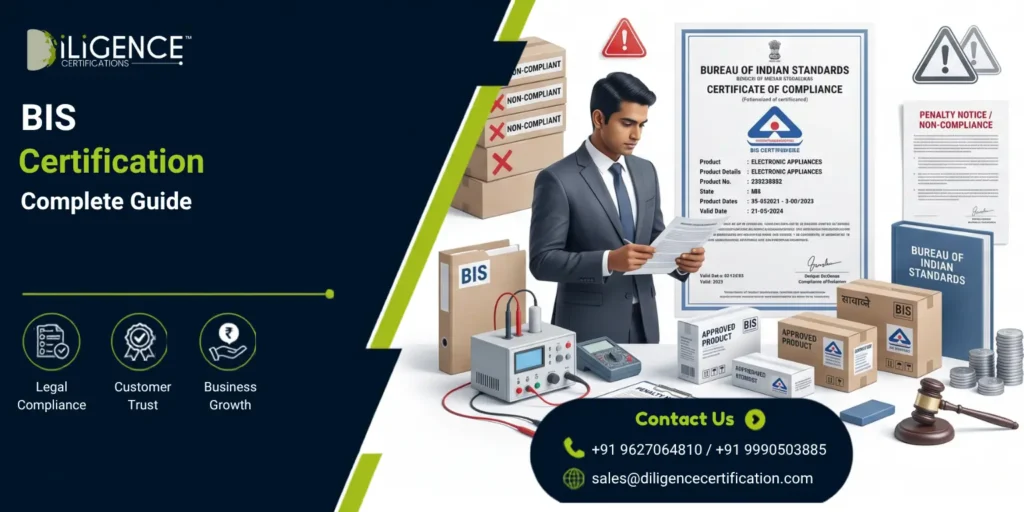
By - BIS Certification is compulsory for certain products which come under various rules and orders of quality control as per Indian laws.
- Failure to obtain BIS certification for certain products could invite heavy penalties, legal action, and the seizing of goods among others.
- Penalties are determined by considering the product involved and relevant provisions of the BIS Act 2016.
Introduction
Any business entity that is engaged with products in India should be aware of the requirement of BIS certification in terms of manufacturing, importing, selling or distribution of those products. Even though BIS certification is optional for a number of products, the Government of India has made it mandatory for some specific products using various regulations like Quality Control Orders.
This shows why it is crucial for manufacturers, importers, sellers and distributors to know the penalty for not having BIS certification.
BIS refers to Bureau of Indian Standards which is a body in India concerned with standardization, certification, conformity and other aspects related to quality. Once any product becomes subject to compulsory BIS requirements, one needs to go through the relevant certification and registration procedures.
Selling or manufacturing such products without the necessary approval will lead to compliance issues.
What is BIS Certification in India?
BIS Certification is the process of assessing the degree to which a product conforms to the Indian standard for that product.
The process of Bureau of Indian Standards Certification can consist of product testing, factory assessment, document checking, inspection, quality control assessment, and many more.
BIS certification may provide assistance with:
- BIS Certification Assistance
- BIS Compliance Assistance
- Product Testing Assistance
- Documentation Assistance
- Technical Compliance
- Certification Application Assistance
- Factory Audit Preparation
- Product Inspection
- Query Resolution
- Renewal and Surveillance Assistance
- Regulatory Compliance Management
BIS Certification is not necessary for all products. Hence, companies need to consider the relevant Indian Standard and whether the product falls under mandatory BIS certification.
Applications of BIS Certification in India
BIS certification and related conformity assessment requirements apply to different industries and product categories.
Businesses that may require BIS certification or compliance assistance include:
- Electronic Products
- Electrical Products
- Construction Products
- Cement Products
- Steel Products
- Plastic Products
- Industrial Products
- Consumer Products
- Household Products
- Machinery and Equipment
- Chemical Products
- Imported Products
- Manufacturing Businesses
- Product Importers
- Businesses Requiring Mandatory BIS Compliance
- Businesses Seeking Voluntary BIS Certification
The requirement depends on the specific product and applicable government notification or Quality Control Order.
Who Needs BIS Certification in India?
Companies that manufacture, import, distribute, or sell items that are regulated under compulsory BIS regulations may require BIS certification or registration for the same.
These may include:
- Product Manufacturers
- Importers
- Product Distributors
- Industrial Companies
- Consumer Product Businesses
- Electronics Manufacturers
- Electrical Product Companies
- Construction Product Manufacturers
- Machinery Manufacturers
- Chemical Product Manufacturers
- Overseas Manufacturers
- Indian Importers
- Businesses Subject to Mandatory BIS Requirements
- Businesses Seeking Voluntary BIS Certification
The compliance of BIS is especially significant in case of launching new products, importing goods, changing specifications of existing products, and moving into a regulated product category.
Types of Compliance Supported by BIS Certification in India
Product & Manufacturing Compliance
Products covered by mandatory BIS requirements need to meet the applicable Indian Standard and technical requirements.
A consultant can help review:
- Applicable Indian Standard
- Product Specifications
- Manufacturing Process
- Raw Materials
- Product Design
- Production Controls
- Quality Control
- Testing Requirements
- Product Marking
- Factory Readiness
Useful for:
- Product Manufacturers
- Importers
- Industrial Businesses
- Overseas Manufacturers
- Consumer Product Companies
Early compliance review can help identify problems before testing or certification begins.
Product Testing & Quality Compliance
Testing is an important part of many BIS certification processes. Depending on the product and certification scheme, samples may need to be tested by an appropriate laboratory.
Compliance may include:
- Product Sampling
- Laboratory Testing
- Quality Evaluation
- Performance Testing
- Safety Testing
- Product Specification Verification
- Test Report Review
- Corrective Actions
Proper testing preparation can reduce delays and help businesses understand whether their product meets the required standard.
Documentation & Audit Compliance
Documentation is another important part of BIS certification.
Documents may include:
- Company Registration Documents
- Business License
- Tax Documents
- Manufacturer Details
- Importer Details
- Product Specifications
- Product Drawings
- Manufacturing Process
- Quality Documents
- Test Reports
- Product Information
- Trademark Documents
- Factory Information
- Production Records
- Quality Control Records
Requirements vary according to the product and certification scheme.
Documents Required for BIS Certification in India
The required documents depend on the product, Indian Standard, certification scheme, manufacturer, and regulatory requirements.
Generally, documents may include:
- Company Registration Documents
- Business and Tax Documents
- Manufacturer Information
- Importer Information
- Product Specifications
- Technical Documents
- Product Drawings
- Manufacturing Process
- Quality Management Documents
- Factory Information
- Test Reports
- Product Labels
- Trademark Documents
- Quality Control Records
- Production Records
- Authorization Letter, where applicable
- Supporting Technical Documents
Businesses should prepare only the documents applicable to their particular BIS certification or registration route.
Step-by-Step Process for BIS Certification in India
Step 1: Eligibility Assessment
First, determine whether the product requires BIS certification or another mandatory conformity assessment.
The assessment may consider:
- Product Category
- Product Specifications
- Applicable Indian Standard
- Manufacturing Location
- Import Status
- Testing Requirements
- Certification Scheme
- Quality Control Order
- Regulatory Requirements
Step 2: Gathering Required Documents
Required corporate, technical, manufacturing, quality, and testing documents are collected and reviewed.
This helps identify missing information before the application is submitted.
Step 3: Preparation and Filing of Application
The application generally contains information about:
- Applicant
- Manufacturer
- Importer
- Product
- Factory
- Manufacturing Process
- Technical Specifications
- Quality System
- Applicable Indian Standard
Accurate information is important because inconsistencies can result in queries or delays.
Step 4: Verification of Application
Depending on the certification scheme, BIS may conduct or require:
- Document Review
- Factory Assessment
- Product Sampling
- Laboratory Testing
- Quality System Assessment
- Technical Evaluation
- Corrective Action Review
The exact procedure depends on the product and applicable scheme.
Step 5: Grant of Applicable Certification
Following the completion of the appropriate testings, assessments, and evaluations, BIS will issue the appropriate license, registration, or certificate.
Benefits include:
- Regulatory Compliance
- Product Quality Assurance
- Safer Products
- Market Acceptance
- Better Business Credibility
Where a BIS Standard Mark is applicable, it must be used according to the relevant licence and regulatory conditions.
Step 6: Ongoing Compliance
BIS certification is not necessarily a one-time responsibility. Businesses may need to maintain:
- Product Quality
- Manufacturing Controls
- Testing
- Documentation
- Factory Conditions
- Product Marking
- Surveillance Requirements
- Certification Conditions
- Regulatory Compliance
Regular monitoring helps businesses maintain their certification and avoid future compliance issues.
Timeline, Cost & Validity of BIS Certification in India
The timeline, cost, and validity depend on the product, applicable Indian Standard, certification scheme, testing, factory assessment, BIS requirements, and professional service charges.
| Timeline | Cost | Validity |
| The certification timeline depends on document verification, factory assessment, product testing, and certification processing. | The cost depends on applicable BIS fees, laboratory testing charges, inspection requirements, and professional service charges, if any. | The applicable BIS licence, registration, or certificate remains valid according to the relevant certification scheme and conditions. |
| Proper documentation helps reduce processing delays. | Additional charges may vary depending on the product, testing requirements, factory location, and certification scope. | Businesses should follow applicable renewal, surveillance, validity extension, or update requirements whenever necessary. |
| Processing time may vary based on application completeness, testing, audit findings, and regulatory verification. | Proper planning helps businesses manage certification and compliance costs efficiently. | Maintaining product quality, factory compliance, documentation, and certification conditions supports continued compliance. |
Importance & Benefits of BIS Certification in India
| Importance | Benefits |
| Helps organizations understand and comply with applicable product standards and regulatory requirements. | Enhances business credibility and demonstrates commitment to product quality and compliance. |
| Supports safe manufacturing, testing, handling, distribution, and management of regulated products. | Improves confidence among customers, business partners, importers, distributors, and regulatory authorities. |
| Encourages responsible manufacturing practices and quality management. | Enables smoother compliance with applicable product safety and quality requirements. |
| Promotes long-term product quality and responsible business operations. | Reduces compliance risks and improves operational efficiency. |
| Helps businesses fulfill their legal and regulatory responsibilities. | Strengthens long-term business growth and market reputation. |
Why is BIS Certification in India Important?
BIS certification becomes more relevant if the product is covered under the mandatory BIS regulations.
The Government can make BIS certification or the use of the Standard Mark mandatory for certain products on behalf of public interest, safety, environment, and consumer safety.
From the point of view of organizations, BIS compliance will ensure that the products comply with quality and safety standards before entering the market.
Professional guidance can be useful for:
- Compliance with Regulations
- Product Quality
- Product Safety
- Manufacturing Compliance
- Testing Requirements
- Documentation Management
- Market Acceptance
- Reducing Compliance Risks
- Regulatory Management
Businesses should identify BIS requirements before manufacturing or importing products to avoid potential compliance problems.
Consequences of Non-Compliance with BIS Requirements
Failure to follow mandatory BIS requirements can result in financial, legal, operational, and reputational problems.
Regulatory Non-Compliance
Businesses may face action if they manufacture, import, sell, distribute, store, or display products in violation of compulsory BIS requirements.
Financial Penalty
In accordance with the provisions of the BIS Act, some acts of contravention can lead to heavy fines being imposed. For some of these acts of contravention, the first act will be punished by a minimum fine of ₹2 lakh and for other acts, ₹5 lakh.
Action by the Competent Authority
BIS has enforcement powers that can include inspection, sampling, and other actions permitted under law.
Operation Restrictions
Non-compliant products may face restrictions on manufacturing, import, sale, distribution, or other business activities.
Business Activity Time Lags
Compliance problems can delay product launches, imports, certification applications, and market expansion.
Suspension or Withdrawal of Certification
Existing BIS certification may be subject to suspension, cancellation, or withdrawal if applicable conditions are not maintained.
Product Safety Risks
Failure to meet applicable standards may increase the risk of defective products, product failures, complaints, or safety concerns.
Reputation of the Business
Non-compliance can reduce customer confidence and affect relationships with distributors and business partners.
Risk of Bad Reputation
Repeated regulatory issues can negatively affect the long-term reputation of a business.
Growing the Business
Compliance problems can make it more difficult to expand product lines, enter new markets, or work with larger customers.
Renewal of BIS Certification
Companies should periodically assess their BIS certification and associated requirements, particularly after any changes to the product, factory, manufacturer, or manufacturing process.
Important areas include:
- Product
- Product Specifications
- Applicable Indian Standard
- Manufacturing Process
- Factory
- Quality System
- Product Labeling
- Manufacturer
- Importer
- Testing
- Certification Conditions
Common activities may include:
- Updating Business Information
- Reviewing Certification Details
- Updating Product Information
- Updating Factory Information
- Submitting Required Documents
- Maintaining Product Quality
- Completing Required Testing
- Maintaining Certification Compliance
- Checking Regulatory Requirements
How Professional Assistance Helps with BIS Certification in India?
A professional BIS consultant can assist businesses with:
- Understanding BIS Requirements
- Eligibility Assessment
- Indian Standard Identification
- Documentation Preparation
- Application Filing
- Product Testing Coordination
- Factory Audit Preparation
- Technical Compliance
- Regulatory Advisory
- Application Tracking
- Query Resolution
- Surveillance Assistance
- Renewal Support
Professional assistance can make the certification process easier to manage and help businesses avoid common documentation and compliance mistakes.
Why Choose Diligence Certifications for BIS Certification in India?
Diligence Certifications assists businesses with product certification, documentation, compliance, application support, and regulatory guidance.
These services include:
- Documentation Assistance
- Application Filing Assistance
- Product Certification Assistance
- Compliance Assistance
- Technical Documentation
- Product Testing Coordination
- Regulatory Guidance
- Process Management
- End-to-End Certification Assistance
With professional support, businesses can better understand applicable BIS requirements, prepare documents, coordinate testing, manage applications, and maintain compliance.
Conclusion
It is essential to know what the penalty for lack of BIS certification is if your business is associated with products subject to compulsory BIS requirements.
BIS is an abbreviation for Bureau of Indian Standards, which is a system for the certification of products used in India.
It is important to note that not all products need to undergo BIS certification. In cases where there is a requirement for BIS certification or registration, the company needs to complete the necessary requirements before producing, importing, distributing, storing, and displaying the product.
There are penalties and other measures related to the breach of BIS requirements; therefore, it is recommended to check the relevant BIS requirements before introducing the regulated products in the Indian market.
Professional BIS certification services will help you with this.
Frequently Asked Questions
What is BIS Certification?
BIS Certification confirms that an applicable product meets the relevant Indian Standard and regulatory requirements.
What is the full form of BIS?
BIS stands for Bureau of Indian Standards.
Is BIS certification mandatory for every product?
No. It is mandatory only for products covered by applicable compulsory requirements.
What is the penalty for not having BIS certification?
For certain violations, the BIS Act provides monetary fines and may also provide for imprisonment, depending on the nature of the offence.
Can a business sell products without BIS certification?
If BIS certification is compulsory for that product, the business must comply with the applicable requirement before selling it.
Can BIS take action against non-compliant products?
Yes. BIS has enforcement powers under the BIS Act, including inspection and sampling.
Does BIS certification require product testing?
Testing may be required depending on the product and applicable certification scheme.
Does BIS certification require a factory assessment?
A factory assessment may be required under the applicable BIS certification scheme.
Can imported products require BIS certification?
Yes. Certain imported products are covered by mandatory BIS requirements.
Can Diligence Certifications help with BIS Certification?
Yes. Diligence Certifications can assist with BIS documentation, application support, testing coordination, compliance, and certification-related requirements.