 BIS Certification
 CDSCO
CDSCO
 PESO
PESO
 CPCB
CPCB
 LMPC
LMPC
 WPC Approval
 Global Approvals
 TEC
TEC
 ARAI
ARAI
 BEE
BEE
 ISO Certification
 DGCA Certification
 NOC For Steel
 APEDA Registration




















 Business Registration
 FSSAI Mark Certification












 (32).jpg)
 Legal Services
 Trademark Registration
 Copyright Registration
 Patent Registration
 By
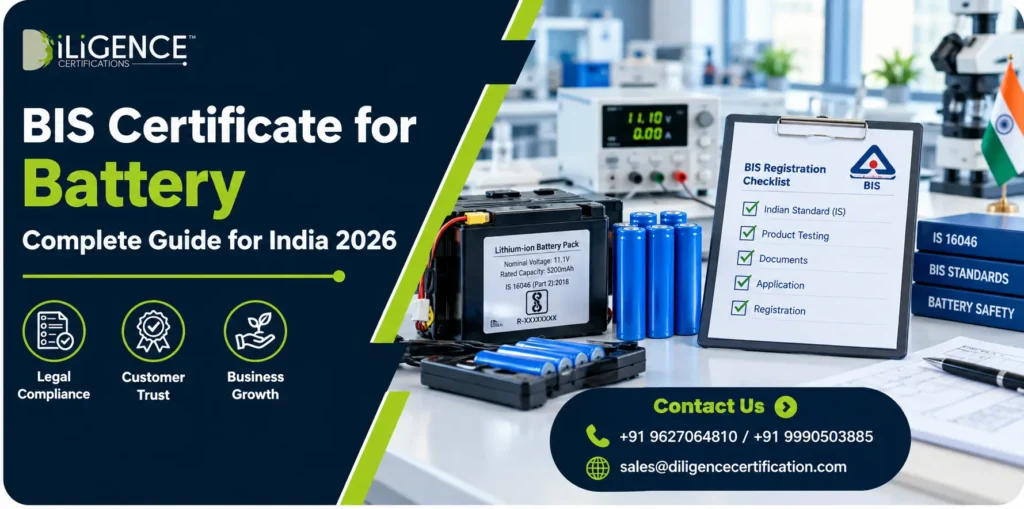
By - BIS Certificate for Battery may be required for battery manufacturers and importers in India, depending on the battery type, chemistry, application, and applicable Indian Standard.
- For portable sealed secondary lithium batteries, IS 16046 (Part 2):2018 is an important BIS standard under the Scheme-II registration framework.
- The BIS battery registration process generally includes identifying the correct standard, selecting a BIS-recognised laboratory, submitting samples for testing, preparing documents, applying for registration, and completing the BIS review.
- In 2026, rated-capacity verification became an important compliance requirement for applicable portable sealed secondary lithium cells and batteries, making accurate battery specifications and documentation more important.
- Businesses should check battery testing, BIS registration, labelling, documentation, and Battery Waste EPR requirements separately to ensure proper compliance before importing or selling batteries in India.
Intorduction
If you manufacture or import batteries in India, you may need BIS certification before selling them in the market. The requirement depends on the battery type, chemistry, application and applicable Indian Standard.
For portable sealed secondary lithium batteries, IS 16046 (Part 2):2018 is an important standard under the BIS Scheme-II registration framework.
In 2026, BIS also introduced guidance for verifying the rated capacity of applicable portable lithium cells and batteries under IS 16047 (Part 3):2018.
Before applying, make sure your battery model, specifications, labels and test report are consistent with the applicable BIS requirements.
What Is a BIS Certificate for Battery?
A BIS certificate or registration for a battery confirms that the applicable battery product has met the requirements of the relevant Indian Standard and regulatory scheme.
For portable sealed secondary lithium cells and batteries, IS 16046 (Part 2):2018 is a key standard under the BIS Scheme-II registration framework. The certification route generally involves product testing at a BIS-recognised laboratory followed by registration with BIS.
The important point is simple:
- Not every battery uses the same BIS standard.
- Lithium portable batteries commonly fall under IS 16046 (Part 2).
- Nickel systems are covered by IS 16046 (Part 1).
- Other battery categories can have different standards and certification routes.
- The battery’s intended application matters.
- A test report alone should not be confused with BIS registration.
- The model, ratings, labels and technical documents should be consistent.
- New rated-capacity requirements apply to portable secondary lithium batteries.
Which Batteries Need BIS Certification in India?
This is where many online guides become confusing.
The phrase “BIS certificate for battery” does not identify one single standard. BIS requirements vary according to the product.
For example, portable rechargeable lithium batteries are different from ordinary primary dry batteries. Likewise, a battery designed for solar energy storage may have a different compliance route from a battery used inside a portable electronic product.
Some commonly encountered categories include:
| Battery category | Example application | Possible BIS standard/route |
| Lithium secondary batteries | Portable electronics | IS 16046 (Part 2):2018 |
| Nickel secondary batteries | Portable rechargeable products | IS 16046 (Part 1):2018 |
| Dry batteries | AA, AAA and similar batteries | Applicable product-specific standard |
| Lead-acid batteries | Backup and other applications | Applicable product-specific standard |
| Solar/storage batteries | Energy-storage applications | Application-specific requirements |
This is why a company should identify the exact battery before selecting a certification route.
A useful starting point is the official BIS Scheme-II list, which includes sealed secondary cells and batteries under IS 16046.
What IS 16046 :2018?
IS 16046 (Part 2):2018 covers secondary cells and batteries containing alkaline or other non-acid electrolytes for portable applications - Part 2: Lithium Systems.
The BIS test report format identifies the standard as IS 16046 (Part 2):2018 / IEC 62133-2:2017.
In practical terms, this standard is important for portable rechargeable lithium battery products.
Depending on the product, this can include batteries used in products such as:
- Portable electronic devices
- Rechargeable equipment
- Certain communication devices
- Portable consumer electronics
- Battery packs made from lithium secondary cells
The exact applicability still needs to be checked against the product and its intended use.
One common mistake is assuming that every lithium battery automatically follows the same compliance route. That is not a safe assumption.
A battery intended for a portable electronic product may have a different regulatory position from a large energy-storage system, EV traction battery or another specialised application.
What Changed for Lithium Batteries in 2026?
This is one of the most important updates for anyone preparing a BIS certificate for battery application in 2026.
On 10 February 2026, BIS issued guidance on verification of rated capacity for portable sealed secondary lithium cells and batteries covered by IS 16046 (Part 2). The guidance refers to a MeitY Office Memorandum dated 3 February 2026.
The rated capacity is to be verified using Clause 7.3.1 of IS 16047 (Part 3):2018, which deals with discharge performance at 20°C.
In simple language, manufacturers should not only declare the battery capacity. The declared capacity now needs to be supported through the specified verification process.
BIS Certificate for Battery: Registration Process
The exact procedure depends on the product and applicable scheme, but for portable secondary lithium batteries under the CRS route, the process broadly follows these stages.
1. Identify the Correct Battery Standard
Start with the product itself.
Check:
- Battery chemistry
- Cell type
- Battery pack configuration
- Rated voltage
- Rated capacity
- Intended application
- Manufacturer
- Factory location
- Model numbers
Do not select IS 16046 only because the product contains lithium.
The application should be based on the actual scope of the product.
2. Select a BIS-Recognised Laboratory
The battery needs to be tested according to the applicable requirements.
BIS laboratory records currently show active testing under IS 16046 (Part 2):2018, including test requests received during September 2026.
This is useful for businesses planning certification because it shows that IS 16046 testing remains an active compliance area.
3. Prepare the Battery Samples
The sample should represent the exact product being submitted.
A mismatch between the laboratory sample and the product that will actually be sold can create unnecessary questions later.
Before sending samples, check the:
- Model number
- Cell configuration
- Battery capacity
- Voltage
- BMS/protection details
- Product label
- Brand information
- Technical datasheet
4. Complete Laboratory Testing
Testing depends on the applicable standard and product configuration.
For IS 16046 (Part 2), the BIS test report format covers areas such as general safety, insulation and wiring, venting, temperature/voltage/current management, terminal contacts, assembly of cells into batteries, charging, intended use, reasonably foreseeable misuse, marking and packaging.
The 2026 rated-capacity requirement adds another important compliance check for affected lithium batteries.
5. Prepare the BIS Application
Once the relevant test documentation is ready, the manufacturer submits the required information through the applicable BIS registration process.
The technical information must be consistent.
For example, if the laboratory report states one model number and the application uses another, the difference may need clarification.
6. BIS Review
BIS reviews the application and supporting documents.
If clarification is required, the applicant needs to respond with the relevant information or corrected documents.
7. Registration and R-Number
After successful registration, the manufacturer can use the applicable BIS Standard Mark and registration number according to the relevant requirements.
The registration should then be maintained through proper product and documentation control.
Documents Required for BIS Battery Registration
The exact documents vary by product and applicant, but businesses should generally prepare technical and manufacturer information such as:
- Company or manufacturer details
- Factory information
- Product technical datasheet
- Battery specifications
- Model and type information
- Product photographs
- Circuit or protection information where applicable
- Test report from the recognised laboratory
- Label and marking details
- Brand/trademark-related documents where applicable
- Authorisation documents where required
- Application and undertaking documents
- Additional documents requested by BIS
For foreign manufacturers, the Indian representation requirements should also be checked before starting the application.
A good practical rule is to prepare the technical file before sending samples to the laboratory. It is easier to correct a document before testing than after the report has been issued.
What Tests Are Done for Lithium Batteries?
Battery testing is not simply a capacity check.
The purpose is to assess safety under specified operating conditions and foreseeable misuse.
Depending on the applicable requirements, areas can include:
Electrical Safety
The battery’s electrical behaviour is examined under specified charging and operating conditions.
Short-Circuit Testing
The battery is evaluated under specified short-circuit conditions to assess its safety response.
Overcharge and Related Safety Checks
Battery protection and response under abnormal charging conditions are important parts of battery safety assessment.
Mechanical Testing
Battery products can be exposed to specified mechanical stresses, depending on the applicable requirements.
Temperature Testing
Temperature-related behaviour is important because excessive heat can affect battery safety.
Marking and Labelling
The physical product information also matters.
A technically compliant battery can still face a documentation problem if its label, model number or declared ratings do not match the approved information.
Does a Battery Pack Need BIS Registration?
This depends on the battery type, application and applicable notification.
For portable sealed secondary lithium systems covered by IS 16046 (Part 2), the standard covers both secondary cells and batteries made from those cells for portable applications. BIS’s test documentation specifically identifies both cells and batteries within the scope.
This distinction is important for OEMs.
For example, a company may purchase lithium cells from one supplier and assemble them into its own battery pack.
It should not automatically assume that certification of the individual cells makes every finished battery pack compliant.
The finished product, configuration, manufacturer and scope need to be examined before deciding what registration is required.
BIS Certificate for Battery for Imported Products
Foreign manufacturers supplying batteries to India also need to examine the applicable BIS requirements before shipment.
This matters because compliance should be resolved before the commercial shipment is dependent on the approval.
For overseas manufacturers, the applicable Indian representative and documentation requirements should also be checked before the application is prepared.
BIS Certificate for Battery vs Battery Waste EPR
These are two different compliance areas.
BIS certification deals with product conformity against applicable standards.
Battery Waste Management compliance/EPR deals with responsibilities connected with battery waste and end-of-life management.
A company may need to consider both, depending on its role and products.
Getting a BIS registration does not automatically mean that all battery-waste obligations have been completed.
Businesses importing or selling batteries in India should therefore review the two requirements separately.
Common Mistakes That Delay Battery Certification
Using the Wrong Standard
This is the biggest mistake.
A business sees “lithium battery” and immediately chooses IS 16046 without checking the application.
Sending the Wrong Sample
The sample sent for testing should match the product that will be registered.
Changing the Battery After Testing
Changing cells, capacity, protection components or configuration after testing can affect the technical basis of the report.
Incorrect Model Numbers
Small differences in model numbers can create unnecessary clarification.
Mismatch in Capacity
The capacity on the product label, datasheet, application and test report should be carefully checked.
The 2026 rated-capacity requirement makes this point even more important for applicable lithium batteries.
Treating the Test Report as the Certificate
A laboratory test report and BIS registration are not the same thing.
The test report supports the registration process; it should not automatically be presented as a BIS registration certificate.
Checking Compliance After Importing
This can turn a regulatory question into a supply-chain problem.
For importers, compliance planning should happen before the goods leave the manufacturing country.
How Much Does a BIS Certificate for Battery Cost?
There is no single fixed price for a BIS certificate for battery.
The total expense depends on factors such as:
- Battery type
- Applicable standard
- Number of models
- Testing requirements
- Laboratory charges
- Sample requirements
- Documentation complexity
- Manufacturer location
- Foreign manufacturer representation, where applicable
- Additional testing or model variations
Even laboratory testing charges can differ between recognised laboratories and product configurations. Current BIS laboratory records show different testing charges for IS 16046 Part 2 depending on the laboratory and scope.
For this reason, businesses should avoid relying on a generic “BIS battery certificate price” shown online.
The correct approach is to first identify the exact battery and standard, then calculate the certification requirements.
How Long Does BIS Battery Registration Take?
There is no universal approval timeline.
Testing availability, sample readiness, documentation, queries and BIS processing can all affect the actual duration.
One practical lesson from certification work is that laboratory scheduling should be considered early.
A company that waits until its shipment is ready may have very little room to absorb testing or documentation delays.
For overseas manufacturers, additional coordination can also be required.
The best time to start the compliance review is before finalising the commercial shipment, not after the cargo has reached India.
What Should a Manufacturer Check Before Applying?
Product
- What is the battery chemistry?
- Is it rechargeable?
- Is it a cell or battery pack?
- What is the intended application?
- What is the rated voltage?
- What is the rated capacity?
Technical File
- Is the datasheet final?
- Are model numbers correct?
- Is the BMS/protection information available?
- Do labels match the technical specifications?
- Are product photographs ready?
Testing
- Is the correct BIS-recognised laboratory selected?
- Does the sample match the production model?
- Are all required tests understood?
- Does the rated-capacity requirement apply?
Registration
- Is the correct BIS scheme identified?
- Is the manufacturer information complete?
- Are brand documents ready?
- Are foreign manufacturer/AIR requirements applicable?
- Are the application details consistent with the test report?
Why Choose Diligence Certifications for BIS Certificate for Battery Certification?
Battery compliance becomes easier to manage when the technical and regulatory steps are planned together.
Diligence Certifications provides certification and regulatory compliance services for manufacturers, importers and businesses entering the Indian market.
For businesses specifically working with battery products, BIS Certification for Battery covers battery testing, documentation and BIS approval requirements.
A practical compliance review should begin with the product itself rather than a generic certificate package. The right standard, model scope, test requirements and documentation should be mapped before testing starts.
That approach is especially useful when a business has several battery models or is importing products from an overseas manufacturer.
Where Can I Verify BIS Battery Requirements?
For current regulatory information, businesses should use official BIS material rather than relying only on old consultancy articles.
BIS’s Scheme-II page lists IS 16046 for sealed secondary cells and batteries used in portable applications.
Official BIS Scheme-II information
BIS also maintains laboratory and testing information for IS 16046. Current records show active testing activity for Part 2, which is useful when planning laboratory work.
Frequently Asked Questions About BIS Certificate for Battery
1. Is a BIS certificate mandatory for batteries in India?
It depends on the battery type, application and applicable Indian Standard. Portable sealed secondary lithium batteries covered by IS 16046 (Part 2) fall under the BIS registration framework. Other battery categories can follow different standards or schemes.
2. What is the BIS standard for lithium-ion batteries?
For portable sealed secondary lithium cells and batteries, an important standard is IS 16046 (Part 2):2018. BIS test documentation identifies it with IEC 62133-2:2017.
3. Is BIS registration required for imported batteries?
If the imported battery falls under a mandatory BIS requirement, the applicable registration or certification must be addressed before the product is legally placed on the Indian market. The exact route depends on the battery category and manufacturer status.
4. What changed for lithium battery certification in 2026?
BIS issued guidance following a MeitY direction requiring rated-capacity verification for portable sealed secondary lithium cells and batteries covered by IS 16046 (Part 2). The verification uses Clause 7.3.1 of IS 16047 (Part 3):2018.
5. Does a battery test report mean the product has BIS certification?
No. A test report is part of the conformity process. BIS registration is a separate regulatory step.
6. Can one BIS registration cover every battery model?
Not automatically. Model grouping and scope depend on the applicable requirements and technical similarity. Each product family should be reviewed before assuming that one registration covers all models.
7. Does a lithium battery need EPR registration too?
BIS certification and battery-waste EPR are separate compliance requirements. Depending on the company’s role and product, both may need to be considered.
8. Can a foreign battery manufacturer obtain BIS registration?
Foreign manufacturers can be subject to Indian BIS requirements when supplying regulated products to India. The applicable representation and application requirements should be checked based on the certification route.
Conclusion
A BIS certificate for battery is not a one-size-fits-all approval.
The correct compliance route depends on what the battery is, how it is made and where it is used. For portable sealed secondary lithium cells and batteries, IS 16046 (Part 2):2018 is a key standard under the BIS registration framework.
The 2026 rated-capacity requirement is another reason manufacturers should review their lithium battery documentation now rather than waiting for the next shipment or renewal cycle.
If you are developing, manufacturing or importing a battery for the Indian market, start by identifying the exact product category and applicable standard. Once that is clear, testing, documentation and BIS registration become much easier to plan.
Frequently Asked Questions
Is a BIS certificate mandatory for batteries in India?
It depends on the battery type, application and applicable Indian Standard. Portable sealed secondary lithium batteries covered by IS 16046 (Part 2) fall under the BIS registration framework. Other battery categories can follow different standards or schemes.
What is the BIS standard for lithium-ion batteries?
dard is IS 16046 (Part 2):2018. BIS test docuFor portable sealed secondary lithium cells and batteries, an important stanmentation identifies it with IEC 62133-2:2017.
Is BIS registration required for imported batteries?
If the imported battery falls under a mandatory BIS requirement, the applicable registration or certification must be addressed before the product is legally placed on the Indian market. The exact route depends on the battery category and manufacturer status.
What changed for lithium battery certification in 2026?
BIS issued guidance following a MeitY direction requiring rated-capacity verification for portable sealed secondary lithium cells and batteries covered by IS 16046 (Part 2). The verification uses Clause 7.3.1 of IS 16047 (Part 3):2018.
Does a battery test report mean the product has BIS certification?
No. A test report is part of the conformity process. BIS registration is a separate regulatory step.
Can one BIS registration cover every battery model?
Not automatically. Model grouping and scope depend on the applicable requirements and technical similarity. Each product family should be reviewed before assuming that one registration covers all models.
Does a lithium battery need EPR registration too?
BIS certification and battery-waste EPR are separate compliance requirements. Depending on the company's role and product, both may need to be considered.
Can a foreign battery manufacturer obtain BIS registration?
Foreign manufacturers can be subject to Indian BIS requirements when supplying regulated products to India. The applicable representation and application requirements should be checked based on the certification route.