 BIS Certification
 CDSCO
CDSCO
 PESO
PESO
 CPCB
CPCB
 LMPC
LMPC
 WPC Approval
 Global Approvals
 TEC
TEC
 ARAI
ARAI
 BEE
BEE
 ISO Certification
 DGCA Certification
 NOC For Steel
 APEDA Registration











 Business Registration
 FSSAI Mark Certification









 (32).jpg)
 Legal Services
 Trademark Registration
 Copyright Registration
 Patent Registration
 By
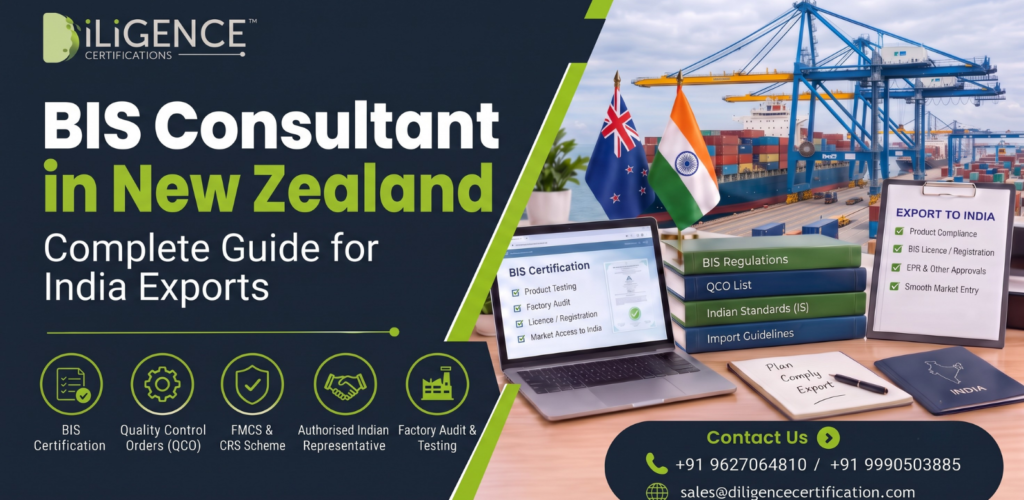
By - BIS certification may be mandatory for New Zealand products covered by India’s applicable certification requirements.
- Foreign manufacturers should identify the relevant Indian Standard and certification scheme before applying.
- The Foreign Manufacturers Certification Scheme (FMCS) and Compulsory Registration Scheme (CRS) apply to different product categories.
- Required documents may include product specifications, factory details, test reports and manufacturing records.
- A BIS consultant can help exporters understand documentation, testing, factory assessment and compliance requirements for the Indian market.
Introduction
Imagine a New Zealand manufacturer has received a large order from an Indian buyer. The price has been agreed, product samples have been approved, and both companies are ready to begin business.The manufacturer already follows quality standards, in New Zealand. Holds all required business documents. However before the shipment the Indian buyer asks a very important question: Does this product need BIS certification before it can be sold in India?
For many foreign manufacturers, this is where the process becomes confusing. They may understand their own country’s product standards but may not know which Indian regulations apply to their products. They may also be unsure about product testing, factory inspection, technical documents and the application procedure.
A BIS consultant in New Zealand can help manufacturers understand what certifications are required for products that will be sold in the market. First you need to identify the product look up the Indian Standard and decide whether a certification is compulsory.
The Bureau of Indian Standards or BIS is Indias national standards body. Depending on the product and the rules that apply a manufacturer may need a BIS licence or registration before importing or selling the product in India. A certificate issued in New Zealand does not automatically replace an approval.
I have seen many manufacturers struggle with these rules. This guide explains the BIS certification process, the role of manufacturers the documents needed the difference, between FMCS and CRS common mistakes and how businesses can prepare for the Indian market.
What Is BIS Certification?
BIS certification is a way to check that products meet rules set by India. These rules are called Indian Standards. The certification depends on the type of product. The standards might cover things like safety how well the product works, how good it is and other technical details.
A BIS Consultant in New Zealand can help manufacturers understand Indian product certification requirements before exporting goods to India. From identifying the applicable Indian Standard to preparing technical documents, the right guidance can make the compliance process easier to manage. Manufacturers should confirm whether their products require BIS certification before planning shipments.
The main goal of product certification is to make sure that products that are covered by the rules meet the requirements set by the laws.
For a company in New Zealand that wants to send products to India knowing about BIS rules is a part of getting ready for the market. A product might be good according to the companys quality system but still need a special approval, from India.
For example think of a company that makes equipment in Auckland and wants to sell it to an Indian distributor. Before sending the product the company needs to find out if the equipment is part of a rule that requires certification. If certification is needed the company must choose the plan and go through the right steps.
It is also important to know that BIS certification is not an approval that works for all products. Different products might need plans, different standards and different ways to apply.
Does a New Zealand Manufacturer Need BIS Certification to Export to India?
No BIS certification is not required for every product that New Zealand exports. Whether BIS certification is needed depends on the product the Indian Standard that applies and any government notification or Quality Control Order that is, in force.
Before you begin the application process manufacturers should answer five questions:
1. What product are you. What will it be used for?
2. Which Indian Standard applies to the product?
3. Is the product included in a certification order?
4. Which BIS certification scheme applies?
5. Are there any exemptions or special conditions?
These checks can help manufacturers avoid applications and prevent delays that come from choosing the wrong certification path.
A common mistake is to think that every electrical, industrial or consumer product needs the approval. In reality the required approvals depend on the product’s category and the regulations that are currently active.
Manufacturers should not assume that ISO certification, CE marking or a New Zealand compliance certificate automatically meets requirements. These documents can help with reviews but they do not replace mandatory BIS certification unless the Indian rules say it is allowed.
Why Is a BIS Consultant in New Zealand Useful?
Entering a market is not just about finding a buyer and organizing transport. Companies also need to know the rules of the country they are entering and make sure all the right documents are ready.
A BIS Consultant in New Zealand can support a manufacturer by helping them find the certification path explaining what is needed for the application and gathering all the information required for evaluation.
This kind of consultancy can be helpful in areas.
Identifying the Indian Standard
The product’s technical details how it will be used and how it is classified must be checked to find the right standard. Choosing the standard can cause extra work or lead to an application that does not match the product.
Understanding the certification scheme
The manufacturer must figure out if the product belongs to FMCS, CRS or another certification program. The right route depends on the product and the current rules in place.
Preparing technical documents
Product specifications, factory details, test results and declarations must all match. Going over these documents before sending them in can prevent questions and delays.
Planning. Factory assessment
Some certification paths require product testing, factory inspections or both. Getting prepared early helps the manufacturer know what must be done.
Supporting communication and compliance
A consultant can help organize paperwork explain the steps and manage replies to questions.. The consultant cannot promise approval and the manufacturer remains responsible, for meeting all standards.
Which BIS Certification Schemes Apply to Foreign Manufacturers?
BIS runs certification programs. A foreign manufacturer should not pick a scheme just because another company in the field has used it.
1. Foreign Manufacturers Certification Scheme (FMCS)
The Foreign Manufacturers Certification Scheme is meant for manufacturers whose plants are outside India.
Under FMCS BIS can give a licence to a manufacturer to use the Standard Mark on products that meet the relevant Indian Standard and follow the required licence conditions.
For a New Zealand manufacturer the first step is to check if the product is included under FMCS and if there are any rules for that product.
The process may include:
- Finding the Indian Standard.
- Getting ready the application and all needed documents.
- Setting up an Authorized Indian Representative.
- Giving details about the manufacturing plant.
- Showing that production and testing are done properly.
- Doing the required product testing.
- Taking part in the factory inspection.
- Paying the fees. Following marking and licence rules.
The exact steps depend on the product and the rules in place, at the time of the application.
2. Compulsory Registration Scheme (CRS)
CRS covers notified electronics and information technology products. Manufacturers must check if their specific product appears in the list and follow the required registration steps. I want to help you understand that CRS is not a one‑size‑fits‑all rule.
For example a company that exports an electronic product from New Zealand cannot simply assume that FMCS is the proper route just because its factory is outside India. FMCS is not automatically the path when the product originates from, outside India.
The product category and the applicable notification decide the required procedure. CRS will guide you to the steps once you identify the correct notification.
3. Other Product-Specific Certification Routes
Some products might belong to certification schemes or special regulatory arrangements. Manufacturers must verify the BIS framework instead of assuming that every product follows FMCS or CRS.
The correct route must be set up before submitting an application paying fees or arranging samples, for testing.
Documents Required for BIS Certification
The documents required for BIS certification vary according to the product and certification scheme. Foreign manufacturers should prepare their records early to avoid last-minute problems.
The following information may be required, depending on the applicable procedure:
- Company registration and legal business details.
- Manufacturer’s name and complete factory address.
- Product description and technical specifications.
- Product model numbers and proposed variants.
- Applicable Indian Standard details.
- Manufacturing process flow chart.
- Factory layout and production facility information.
- Details of manufacturing machinery.
- Information about testing equipment and facilities.
- Quality-control procedures and relevant records.
- Calibration documents, where required.
- Product drawings and technical data sheets.
- Sample details and testing information.
- Trademark or brand-related documents, where applicable.
- Required declarations, undertakings and application forms.
- Authorized Indian Representative documents for FMCS, where applicable.
This is a general preparation checklist, not a complete mandatory list for every product.
How a BIS Consultant in New Zealand Supports Exporters
A BIS Consultant in New Zealand can help manufacturers understand the Indian product certification requirements that may apply before they export goods. The first step is to identify the product, check the relevant Indian Standard and confirm whether a compulsory certification order applies.
BIS Certification Guidance for New Zealand Manufacturers
Working with a BIS Consultant in New Zealand can help manufacturers understand the documentation and technical preparation required for the Indian market. Depending on the product, this may include factory details, product specifications, testing records and quality-control documents.
Choosing the Right BIS Certification Scheme
A BIS Consultant in New Zealand can help exporters understand whether FMCS, CRS or another product-specific route may apply. The correct scheme depends on the product category and the relevant Indian regulations. Manufacturers should verify the requirements before submitting an application or arranging product testing.
Preparing for BIS Certification in India
Before starting the process, a BIS Consultant in New Zealand can review the information available from the manufacturer and identify documents that may need further preparation. Foreign manufacturers should also check Authorized Indian Representative requirements where applicable under FMCS.
Getting Started with BIS Certification
If you plan to export regulated products from New Zealand to India, a BIS Consultant in New Zealand can help you understand the next steps. Prepare your product specifications, model numbers, manufacturing address and existing test reports so the applicable certification requirements can be assessed.
Why Are Technical Documents Important?
Technical documents clearly show what the manufacturer makes and how the product should meet the Indian Standard.
For instance if the model number shown on the application differs from the model number on the product label BIS may need clarification. Similar problems can arise when the technical specifications, drawings and test reports describe product versions. Manufacturer should keep product information consistent, across all documents.
If several models are included in the proposed application the company should confirm whether each model can be covered under the application and what additional evidence is required. Accurate records make the application easier to review and help the manufacturer identify compliance gaps before submission.
What Is an Authorized Indian Representative?
An Authorized Indian Representative, often called an AIR is a player in the FMCS process for foreign manufacturers. BIS rules usually demand that an eligible Indian resident stand in for the manufacturer and take on the duties tied to the license and regulatory rules. The AIR is not just a person who passes along papers.
The AIRs job includes duties, under the BIS rules. Before appointing an AIR the foreign manufacturer must verify that the chosen AIR meets the eligibility rules knows the duties and has formally accepted the nomination.
The foreign manufacturer must also keep the appointment paperwork. Make sure the AIR stays valid for the whole period. A missing or wrong AIR can cause trouble during the license application. It is wise to handle the AIR issue instead of waiting until the application is ready to submit.
Step-by-Step BIS Certification Process for New Zealand Exporters
The exact process depends on the product and scheme. The following steps give a practical guide for manufacturers getting ready for a possible BIS application.
Step 1: Identify the Product
Start with a product description. Include specs, how it will be used and how it’s made. Don’t just say ” equipment” or “consumer product.” Different products fall under standards and notifications. Be specific.
Step 2: Confirm the Applicable Indian Standard
Find the Indian Standard for your product. Check if it needs certification. Also look into any rules, exemptions or extra requirements that might apply.
Step 3: Select the Correct Certification Scheme
Choose if FMCS, CRS or another product-specific route is the choice, for your product. The option you select affects the way you apply. The evidence you must provide to show that your product follows the rules.
Step 4: Review the Manufacturing Facility
Check your production process, machines, testing setup, quality control and staff against the required standards. If you find gaps fix them before the factory inspection. It’s easier to act of time.
Step 5: Prepare the Application Documents
Put together all the files: documents, company information, factory details, declarations and other records according to the plan. Make sure that product names, model numbers, factory addresses and brand information are the same, in all the documents before you send them.
Step 6: Complete the Required Representative Formalities
For FMCS finish the AIR nomination process and gather all supporting documents. Make sure nothing is missing or incorrect.
Step 7: Submit the Application
Use the BIS channel for application. Follow the instructions for your scheme. BIS has procedures for FMCS. Always check the official guidelines to confirm how to submit what documents are needed and how much it costs.
Step 8: Complete Testing and Factory Assessment
Depending on the scheme your product may need testing. The factory may also be checked for compliance. Make sure samples, technical records and production areas are ready, for inspection.
Step 9: Respond to Questions or Non-Conformities
If BIS asks for info or finds a problem reply quickly with accurate technical proof. If a product fails a test find out why fix it and follow the steps as needed.
Step 10: Obtain Approval and Maintain Compliance
If your application meets all requirements BIS may issue the licence or registration. After that you must follow all conditions. Like marking, quality control, renewals and other ongoing rules. Don’t assume approval covers every model, product or factory. Always check the scope of your licence or registration before using the Standard Mark or selling regulated goods.
How Long Does BIS Certification Take?
There is no timeline that applies to every New Zealand manufacturer.
The duration depends on the product the certification scheme, how complete the application’s the testing requirements and the factory assessment arrangements.
A New Zealand manufacturer, with organized technical records may be better prepared than a New Zealand manufacturer that needs to correct missing documents or resolve product related issues.
Before committing to a delivery date, confirm:
- Whether the applicable Indian Standard has been identified.
- Whether the required documents are complete.
- Whether the product samples are available.
- Whether testing facilities and factory arrangements are ready.
- Whether the AIR requirements have been addressed, where applicable.
- Whether the product has special testing or assessment requirements.
A consultant can help identify the steps involved, but any estimated completion date should be treated as provisional until the relevant authorities and testing arrangements confirm the necessary stages.
Common Mistakes Made by Foreign Manufacturers
Foreign manufacturers can reduce unnecessary delays by checking common problem areas before submitting an application.
Choosing the Wrong Standard
A product may have a similar name to another product but fall under a different Indian Standard. Always check the technical scope rather than relying only on the product name.
Submitting Incomplete Documents
Missing specifications, unclear factory details and inconsistent model numbers can create additional questions. Review the full document set before submission.
Assuming Existing Certificates Are Sufficient
An ISO certificate or overseas product certificate does not automatically replace a mandatory Indian product approval.
Ignoring Factory Readiness
Where inspection is required, the manufacturer should check its production facilities, quality-control procedures, testing arrangements and records in advance.
Selecting an Unsuitable Representative
For FMCS, the manufacturer should verify the AIR’s eligibility and responsibilities before completing the nomination.
Planning Shipment Before Checking Compliance
A buyer’s purchase order does not remove the need to meet applicable Indian regulations. Certification requirements should be reviewed before dispatch dates are confirmed.
Assuming One Licence Covers Every Product
The scope of an approval must be checked carefully. Different models, factories or product categories may require separate coverage or additional approval.
BIS Certification Cost for New Zealand Manufacturers
The cost of BIS certification depends on the product, applicable scheme, testing requirements and assessment arrangements. It is not accurate to quote one universal fee for all manufacturers.
The overall budget may include:
- Application and processing fees.
- Product testing expenses.
- Factory assessment expenses.
- Travel and related costs, where applicable.
- Technical documentation preparation.
- Authorized Indian Representative arrangements under FMCS.
- Licence, marking and renewal fees, where applicable.
- Professional consultancy charges, if assistance is engaged.
Ask for a clear estimate that separates official BIS fees from laboratory, travel and consultancy expenses.
It is also sensible to ask what happens if additional testing is required or the application needs further documentation. These possibilities should be discussed before work begins.
Payment of consultancy fees does not guarantee a licence. Approval depends on the manufacturer’s ability to meet the applicable technical and regulatory requirements.
How to Prepare Before Contacting a BIS Consultant
A manufacturer can make the first consultation more productive by preparing a small set of important details.
Start with the product name, technical specifications, intended use, brand name and complete manufacturing address. If the product has several models, prepare a list of those models and explain the differences between them.
Next, collect any existing certificates, product test reports, drawings and quality-control records. These documents may help identify what information is already available and what additional work may be required.
Finally, explain the intended Indian market, the expected shipment schedule and whether an Indian buyer has requested a particular certification.
With this information, a consultant can review the likely certification route and explain the next steps. The final requirements should still be verified against the current BIS rules and the relevant product notification.
Why Choose Diligence Certifications for BIS Consultant in New Zealand Certification?
New Zealand manufacturers entering India may need help understanding Indian Standards, selecting the correct certification route and organising the technical documents required for assessment.
Diligence Certifications supports businesses with BIS certification and related compliance requirements. Depending on the product and applicable scheme, professional guidance may help manufacturers understand the application process, prepare their records and coordinate the required steps.
To learn more about the company, visit the Diligence Certifications
For information about available certification support, review the BIS certification services page.
Before beginning the process, manufacturers should confirm the applicable product standard, scheme, testing requirements and factory assessment conditions. They should also request clarity about the expected work, fees, responsibilities and any limitations affecting the estimated timeline.
The objective is to help the business understand its compliance obligations and plan the process realistically. No consultant can guarantee approval before the relevant requirements have been assessed.
Conclusion
India can offer business opportunities for New Zealand manufacturers, but checking product compliance should be part of the export plan from the beginning.
The first step is to identify the product, determine whether a compulsory Indian certification requirement applies and confirm the correct scheme. Manufacturers should then prepare their technical documents, review their production and testing arrangements and understand the requirements for application, inspection and ongoing compliance.
A BIS Consultant in New Zealand can help businesses understand these steps and organise the certification process. The final approval, however, depends on compliance with the applicable BIS requirements.
If your company is planning to export products to India, begin by preparing your product specifications, manufacturing details and existing technical documents. This will help you assess the relevant certification route and plan your next steps with greater clarity.
Frequently Asked Questions
1. What is BIS certification for New Zealand manufacturers?
BIS certification is an Indian product conformity requirement administered by the Bureau of Indian Standards. New Zealand manufacturers may need a BIS licence or registration if their products fall under India's applicable compulsory certification requirements.
2. Is BIS certification mandatory for exporting products from New Zealand to India?
BIS certification is not mandatory for every product exported from New Zealand. It depends on the product category, applicable Indian Standard and relevant government notifications or Quality Control Orders
3. How can a BIS consultant in New Zealand help manufacturers?
A BIS consultant can help manufacturers identify the applicable Indian Standard, understand the certification process, prepare technical documents and coordinate testing and factory assessment requirements, where applicable.
4. What is the Foreign Manufacturers Certification Scheme (FMCS)?
FMCS is a BIS certification scheme for eligible manufacturers whose production facilities are located outside India. Under the applicable procedure, foreign manufacturers may obtain a licence to use the BIS Standard Mark after meeting the required technical and regulatory conditions.
5. What is the difference between BIS FMCS and CRS?
FMCS generally covers eligible foreign manufacturing facilities seeking BIS licences under applicable product certification requirements. CRS is used for notified products covered by the Compulsory Registration Scheme, including specified electronics and IT products. The correct route depends on the product and applicable notification.
6. What documents are required for BIS certification for foreign manufacturers?
Depending on the product and scheme, documents may include company registration details, factory information, product specifications, manufacturing process details, testing equipment records, quality-control documents, product test reports and required declarations. An Authorized Indian Representative's documents may also be required under FMCS.
7. Is an Authorized Indian Representative required for BIS FMCS certification?
FMCS applications generally require a duly authorized Indian Representative who meets the applicable BIS eligibility conditions. The manufacturer should verify the current requirements and complete the necessary appointment documents before applying.
. How long does BIS certification take for New Zealand exporters?
The timeline depends on the product, certification scheme, document readiness, testing requirements and factory assessment. Manufacturers should verify the expected timeline for their specific product before confirming export or delivery dates.
. How much does BIS certification cost for New Zealand manufacturers?
The cost varies according to the applicable scheme, official fees, product testing, factory assessment, travel and professional consultancy charges. Manufacturers should request an itemized estimate based on their product and certification requirements.
10. Can New Zealand manufacturers use ISO or CE certificates instead of BIS certification?
ISO certification, CE marking and other overseas certificates do not automatically replace mandatory BIS certification in India. Manufacturers must check the applicable Indian regulations and obtain the required BIS approval unless a specific exemption or alternative is expressly permitted.