 BIS Certification
 CDSCO
CDSCO
 PESO
PESO
 CPCB
CPCB
 LMPC
LMPC
 WPC Approval
 Global Approvals
 TEC
TEC
 ARAI
ARAI
 BEE
BEE
 ISO Certification
 DGCA Certification
 NOC For Steel
 APEDA Registration










 Business Registration
 FSSAI Mark Certification


 (32).jpg)
 Legal Services
 Trademark Registration
 Copyright Registration
 Patent Registration
 By
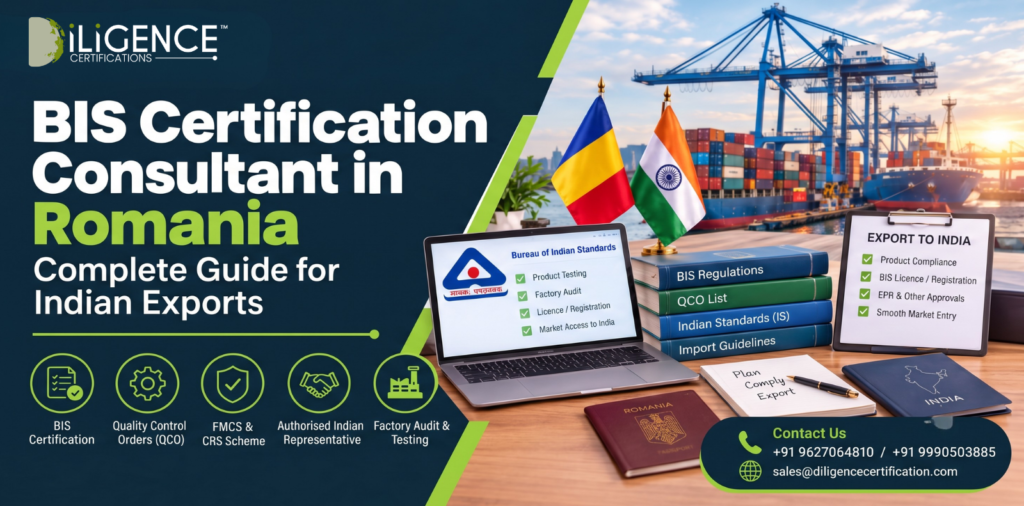
By - BIS certification may be mandatory for Romanian products exported to India when applicable Indian regulations require it.
- The Foreign Manufacturers Certification Scheme (FMCS) and Compulsory Registration Scheme (CRS) follow different procedures.
- Romanian manufacturers should verify the applicable Indian Standard, product category and current certification requirements before exporting.
- Company records, factory information, technical specifications and product test reports may be required during the certification process.
- A BIS certification consultant can help manufacturers understand the applicable scheme, organise documents and prepare for the certification process.
Introduction
I have seen a Romanian manufacturer often spend months creating a product searching for buyers and negotiating an export order. Everything seemed ready until the Indian buyer demanded a BIS certificate.
It can feel frustrating especially when the product already satisfies requirements and has passed quality checks in Romania. The Romanian manufacturer may wonder why another approval is needed and whether the existing documents will be accepted in India.
The answer really depends on the product. Some goods can be. Sold without mandatory BIS certification while other goods must meet specific Indian standards and obtain the required approval before they enter the market.
I recommend working with a BIS Certification Consultant, in Romania. BIS Certification Consultant can help Romanian manufacturers understand these requirements before investing in testing or arranging a shipment. The goal is to choose the certification route prepare the documents and avoid mistakes that could delay the export process.
If a business plans to partner with distributors, importers or industrial buyers checking product compliance early is a smart business decision. The business will find that early compliance checking saves time and money.
What Is BIS Certification?
The Bureau of Indian Standards (BIS) is India’s national standards body. BIS develops Indian Standards. Runs product certification schemes to check if products meet the rules that apply to them.
BIS certification is usually voluntary. The Indian government makes BIS certification compulsory for certain products through Quality Control Orders (QCOs) and other notifications. When a product is covered by a rule the manufacturer must follow the required BIS certification process.
For example certain steel products, electrical goods, construction materials and electronic products fall under BIS rules. The exact list changes, over time so exporters should check the official BIS rules for their product.
A CE mark or another European certificate does not automatically replace a BIS approval. Both markets have their legal rules and a manufacturer may need to meet the BIS rules of each market separately.
Why Do Romanian Manufacturers Need a BIS Certification Consultant?
India can become a market for manufacturers but the compliance process may be unfamiliar to a company exporting to India for the first time.
A BIS Certification Consultant in Romania can help the business understand what India requires to be checked before the application begins.
Finding the Indian Standard
The first question is simple: which Indian Standard applies to the product for India?
The answer may depend on the products material, design, technical specifications, capacity and intended use. Two products with names may not fall under the same Indian Standard for India.
Checking this point early helps the manufacturer avoid choosing the testing or application route for India.
Understanding the scheme
products follow different BIS certification procedures for India. FMCS and CRS for example have scopes and requirements.
A consultant can help review the product details for India. Identify the route using the current official guidance from India.
Preparing the documents
Applications can involve company records, factory details, technical specifications, test reports and other supporting information for India. If the documents are incomplete or inconsistent the application may need clarification.
Preparing the information carefully before submission makes the process easier to manage for India.
Planning. Factory assessment
Some certification routes require product testing and an assessment of the manufacturing premises in India. The manufacturer may need to demonstrate equipment, production facilities and quality control arrangements for India.
Understanding these requirements, in advance helps the company prepare its factory and staff for India.
Which BIS Certification Scheme Applies to Romania?
The correct scheme depends on the product and the applicable Indian rules. The following are important routes for foreign manufacturers.
Foreign Manufacturers Certification Scheme (FMCS)
The Foreign Manufacturers Certification Scheme allows eligible manufacturers with factories outside India to obtain a BIS licence for products that conform to the relevant Indian Standard.
FMCS generally covers products other than electronics and IT goods notified under the Compulsory Registration Scheme.
Depending on the product, the process may involve:
- Identifying the applicable Indian Standard.
- Preparing the prescribed application and supporting records.
- Demonstrating manufacturing and quality control facilities.
- Arranging the required product testing.
- Completing a factory assessment where required.
- Meeting the conditions specified by BIS before the licence is granted.
The application is made by the foreign manufacturer, not simply by an Indian importer applying on the manufacturer’s behalf.
Manufacturers should also note that separate applications may be required for different products, standards or manufacturing locations, as specified by BIS.
Compulsory Registration Scheme (CRS)
CRS applies to IT product categories that have been notified. CRS follows a procedure than FMCS and I find that distinction important.
Depending on the product the manufacturer may need to send samples for testing, at a laboratory. The manufacturer must also prepare documents and apply for registration under the relevant requirements and I recommend keeping a clear record.
Not every electronic product automatically falls under CRS. The manufacturer must check whether the exact product category is listed in the notification and I suggest double‑checking the list.
Other applicable schemes
Certain products may be covered by conformity assessment routes or sector‑specific rules. Therefore the manufacturer should not assume that FMCS or CRS applies to every product exported to India. I advise verifying each case.
The safest approach is to confirm the product classification and the current notification before starting the application. I have found this step to be very useful.
Is BIS Certification Mandatory for Products Exported from Romania?
BIS certification is not required for every product that comes into India. It becomes necessary when a government notice or rule says the product must follow a certification process.
Before sending items to a customer the Romanian manufacturer needs to look into:
- The exact product name and model.
- The Indian Standard that might apply.
- If a current QCO or other required notice covers the product.
- The date when the rule starts to apply.
- The certification. Any possible exceptions.
- If the needed license or registration is already given.
The official BIS website has a list of products that need certification. This list should be checked with the related notice because product details, start dates and rules can be different.
An buyers approval of the product does not always mean all legal rules are followed. It is better to check everything before sending the goods.
BIS Certification Process for Romanian Manufacturers
The process changes depending on the product. These steps give a good way to start.
Step 1: Gather product details
Get the name, model numbers, technical details, brand information and where it was made.
If the company has models list each one on its own. Even a small change in design or details can mean different rules apply.
Step 2: Find the Indian Standard
Check the product against the correct Indian Standard and the latest rules that must be followed.
Do not choose a standard just because it looks like an global one. Make sure to check the rules for the system.
Step 3: Check the certification method
Decide if the product is covered by FMCS, CRS or another program.
This step decides how to apply what papers are needed how testing is. What the manufacturer must do.
Step 4: Get the needed papers
Depending on the product and the program the manufacturer might need:
Company registration details.
Factory. How it is made.
Product. Technical details.
Brand information.
Quality control. How it is made.
Details of the testing tools and people who are trained if needed.
Test results made according to the Indian Standard.
Documents from an approved representative if needed.
The exact list of papers should come from the list for the right program.
Step 5: Set up product testing
Testing the product is a step in many programs. Before sending samples find out what tests are needed and which labs are allowed.
A report made for a standard should not be assumed to meet BIS needs. The test report must meet the process.
If a sample does not pass more work might be needed before applying.
Step 6: Send the application
The application has to be done the way and with the needed papers.
For FMCS BIS says that applications for a license are now accepted online through the Manakonline portal. This online only method starts on 1 June 2026.
Applicants should follow the instructions, on the portal and the latest checklist instead of using old guides.
Step 7: Finish the assessment
If the program includes a factory check the manufacturer must show that the production and quality rules are followed.
The company has to make sure its workers know the manufacturing steps, how to check and what tests are needed.
Step 8: Get approval. Follow the rules
A completed application or a test report does not mean a license or registration is given.
The manufacturer has to wait for the approval and follow what it says including what labels to use, which models are covered and what must be done after.
Documents Required for BIS Certification
Documents vary by product yet it is useful to organise documents into groups.
Company documents contain the legal name, the registered address and the company registration details.
Factory documents list the manufacturing address, the production facilities, the process details and the quality control information.
Product documents hold the technical specifications the drawings, the model numbers, the component details and the intended use.
Brand documents include the trademark or brand ownership information and the authorisation documents, where applicable.
Testing documents contain the reports and the technical evidence required by the relevant Indian Standard and the certification scheme.
Representative documents provide the information and the prescribed declarations for the Authorised Indian Representative, where required.
Before submitting documents compare the company name, the factory address, the product model and the brand information across all documents. Differences, between the application documents and the supporting documents can lead to questions.
What Is an Authorised Indian Representative?
An Authorised Indian Representative, usually called an AIR is a representative chosen by a foreign manufacturer when the BIS scheme calls for it.
The AIR takes care of tasks that link to the manufacturer certification and the manufacturer compliance duties. BIS tells the AIR what conditions and documents are needed for this role.
Romanian manufacturers must pick the AIR early, in the process. Romanian manufacturers should not think that any importer or distributor automatically fits the AIR job. The manufacturer and AIR must know their responsibilities before the application goes to BIS.
Does CE Marking Replace BIS Certification?
I believe CE marking and BIS certification serve regulatory purposes.
CE marking relates to European Union requirements while BIS certification addresses the relevant Indian Standards and certification rules.
I notice that a Romanian product may already meet requirements but still need Indian certification if it belongs to a category covered by mandatory Indian rules.
For instance a manufacturer planning to export a product should check its exact classification rather than assume that existing European test reports are sufficient.
I see that the same principle applies to materials, construction products and other regulated goods. Existing certificates can provide technical information but their acceptance, under the Indian process must be verified.
BIS Certification for E-Commerce Sales in India
Selling through an Indian e-commerce marketplace does not automatically exempt a product from certification that is required.
A Romanian company planning to sell should check whether a product requires a BIS licence or registration and whether a product approval covers the exact model that is being offered.
Before listing a product confirm:
- Whether a product is covered by a requirement.
- Which entity is responsible for a product approval.
- Whether a licence or registration covers a product model and manufacturing location.
- Whether the marking and product details are correct, for a product.
- Whether any special conditions or exemptions apply to a product.
For example a Romanian seller planning to list an accessory should first check whether that particular product is included in the current CRS requirements. It would be incorrect to assume that all electronic accessories follow the process.
The important point is to check compliance before starting sales than waiting for a marketplace or buyer to raise the issue.
Common Mistakes Romanian Exporters Should Avoid
Assuming that European approval is enough
Even if European certification is in place it does not automatically meet requirements. I have seen cases where European certification alone was not enough. Always verify the Indian Standard and any mandatory notification.
Starting with the wrong scheme
FMCS, CRS and other certification routes each have their requirements. I have worked with manufacturers who chose the wrong route and wasted time. Selecting a route can waste effort.
Sending documents
Missing factory details inconsistent model numbers and unclear brand records in documents can cause delays that could have been avoided. Documents that are incomplete will lead to delays.
Arranging the tests
Before sending samples verify the testing requirements and the laboratories that are accepted. Tests that are not aligned with the standard will not support the application.
Shipping, before checking compliance
If compliance is mandatory a pending application does not grant permission to sell the product in India. Compliance must be verified before shipping.
Expecting guaranteed approval
A consultant can guide the manufacturer and help prepare the application but cannot guarantee that BIS will approve a product that does not meet the conditions. Approval cannot be assumed without meeting all conditions.
Why Choose Diligence Certifications for BIS Certification Consultant in Romania Certification?
For a foreign manufacturer, the first challenge is often understanding which Indian requirements apply to its product. The next is preparing the information and arranging the required steps correctly.
Diligence Certifications can support businesses that need guidance on Indian product certification and regulatory compliance.
The support may include product requirement assessment, identification of the relevant certification route, document preparation guidance, testing coordination and assistance with application-related queries.
A product-specific assessment is particularly useful when the manufacturer has several models or already holds European test reports. It helps establish what needs to be checked before further time and money are committed.
The objective is to help the manufacturer understand the process and prepare the required information. The final decision on certification remains with the competent authority.
How Long Does BIS Certification Take?
There is no timeline that applies to every product or application. The time needed depends on the certification scheme, how complete the documentsre the testing requirements whether a laboratory is available and if a factory assessment is required.
It also depends on how the manufacturer responds to any questions. A manufacturer might face delays if a test sample fails if there are mistakes, in the documents or if the product’s classification needs more explanation.
For this reason exporters should talk about their product and planned shipment date before setting a delivery schedule. An estimate should be based on the needs not on a general promise that all applications will be finished in the same number of days.
Benefits of Checking BIS Requirements Early
Early compliance planning can help a Romanian manufacturer avoid several business problems.
It can reduce the risk of ordering unnecessary tests, help the company prepare its factory records, clarify the responsibilities of the Indian representative and give the importer a more realistic view of the export schedule.
It also helps the manufacturer understand the limits of its approval. A licence or registration may cover specified models, products or manufacturing premises rather than every item sold under the same brand.
These details are worth checking before the business starts accepting large orders.
Conclusion
Romanian manufacturers entering the Indian market should check product compliance before confirming shipments or investing in an application.
A BIS Certification Consultant in Romania can help the business understand the relevant Indian Standard, identify the appropriate scheme, prepare documents and coordinate the certification process.
The best starting point is to gather the product specifications, model numbers, brand details and factory information. With these details available, the manufacturer can assess the applicable requirements and plan the next steps with greater clarity.
If your company is preparing to export to India, contact Diligence Certifications to discuss your product and understand which BIS certification route may apply.
Frequently Asked Questions
1. What is BIS certification for Romanian manufacturers?
BIS certification is a product conformity process managed by the Bureau of Indian Standards in India. Romanian manufacturers may need BIS certification when their products fall under India's mandatory certification requirements before they can be imported, sold or distributed in the Indian market.
2. Is BIS certification mandatory for products exported from Romania to India?
BIS certification is mandatory only for products covered by applicable Indian regulations, Quality Control Orders or other relevant notifications. Romanian exporters should verify the exact product category and current requirements before shipping goods to India.
3. How can a Romanian manufacturer apply for BIS certification?
A Romanian manufacturer should first identify the applicable Indian Standard and certification scheme. The process may involve preparing company and factory documents, arranging product testing, submitting an application and completing a factory assessment where required. The exact procedure depends on the product and scheme.
4. What is the difference between BIS FMCS and CRS certification?
The Foreign Manufacturers Certification Scheme (FMCS) provides a certification route for eligible foreign manufacturers. The Compulsory Registration Scheme (CRS) covers specified notified product categories, including certain electronics and IT products. The correct route depends on the product and the applicable Indian requirements.
5. What documents are required for BIS certification in Romania?
Depending on the certification scheme, documents may include company registration records, factory details, product specifications, model numbers, brand information, quality control records, test reports and documents relating to an Authorised Indian Representative where required. The official checklist for the relevant scheme should be followed.
6. Can CE marking replace BIS certification for Romanian products?
No. CE marking does not automatically replace BIS certification. CE marking relates to applicable European Union requirements, whereas BIS certification follows relevant Indian standards and regulations. Products covered by mandatory Indian certification requirements must meet those requirements separately.
. How long does BIS certification take for Romanian exporters?
The timeline depends on the product, certification scheme, document completeness, laboratory testing, factory assessment requirements and responses to queries. Romanian exporters should assess these factors before confirming delivery dates with Indian buyers.
8. Does a Romanian manufacturer need an Authorised Indian Representative for BIS certification?
An Authorised Indian Representative (AIR) may be required under the applicable certification scheme for a foreign manufacturer. The manufacturer should check the current BIS requirements and ensure that the representative meets the prescribed conditions before applying.
9. Can Romanian companies sell BIS-regulated products through Indian e-commerce platforms?
Selling through an Indian e-commerce platform does not automatically exempt a product from mandatory BIS requirements. Romanian companies should confirm whether certification or registration is required and ensure that the relevant approval covers the product and manufacturing location.
10. How can a BIS certification consultant help Romanian exporters?
A BIS certification consultant can help Romanian manufacturers identify applicable Indian standards, understand the relevant certification scheme, organise documents, coordinate testing and prepare for application-related requirements. The final certification decision rests with BIS or the competent authority.