 BIS Certification
 CDSCO
CDSCO
 PESO
PESO
 CPCB
CPCB
 LMPC
LMPC
 WPC Approval
 Global Approvals
 TEC
TEC
 ARAI
ARAI
 BEE
BEE
 ISO Certification
 DGCA Certification
 NOC For Steel
 APEDA Registration










 Business Registration
 FSSAI Mark Certification

 (32).jpg)
 Legal Services
 Trademark Registration
 Copyright Registration
 Patent Registration
 By
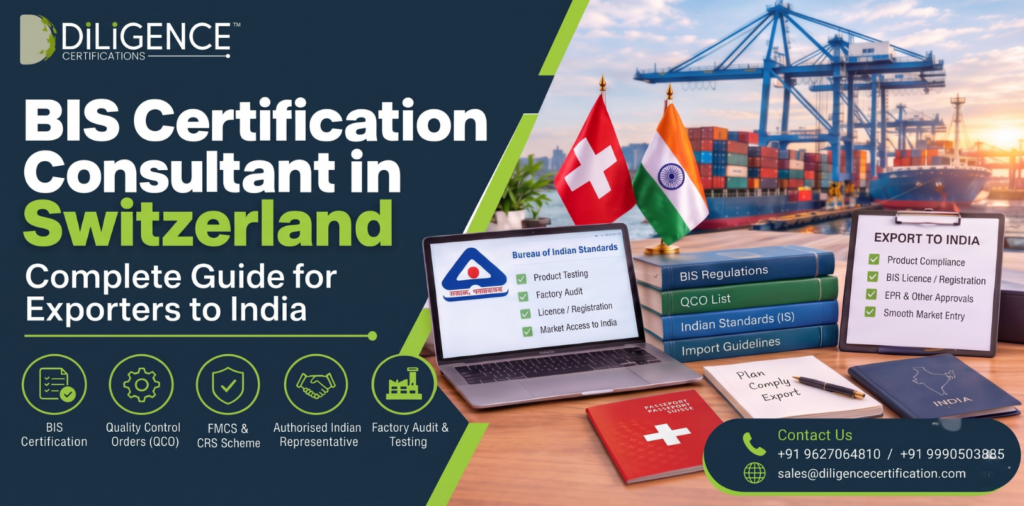
By - product certification requirements before exporting goods to India.
- BIS certification is mandatory for products covered by the relevant compulsory certification requirements.
- Foreign manufacturers might need the Foreign Manufacturers Certification Scheme (FMCS) for products that qualify.
- Some electronics and IT products are covered by the Compulsory Registration Scheme (CRS).
- The requirements, for product testing, technical documents, factory inspection and having a vary depending on the scheme that applies.
Introduction
Imagine a company from Switzerland has made a notch electrical product and got a message from a buyer in India. The product has already been checked for quality in the markets where its already sold. The price is. Both companies are excited to talk about the first delivery. But before anything the Indian buyer asks an important question: does the product need BIS certification?
For companies from other countries this question comes as a surprise. They might already have the papers, the quality certificates and the lab reports.. Even with all that those papers might not meet all the rules in India.
This is when a BIS Consultant in Switzerland can be very useful. A consultant helps companies understand the rules in India that apply to their product get the right papers ready and plan the steps before sending the product to India.
The Bureau of Indian Standards known as BIS is the standards organization in India. It creates the standards that products must follow. It also checks if products meet those standards. Depending on the product a company might need a BIS license, a registration or some other approval before selling in India.
What Is BIS Certification?
BIS certification is a process that checks if a product meets the rules of the Indian Standard that applies to it under a certification program.
India makes some products follow rules. These rules can come from Quality Control Orders or other official government messages. The exact rules depend on what the product’s what laws cover it.
Companies in Switzerland must first check whether their product satisfies the market rules. A certificate issued by Switzerland or another nation can provide details. That does not always guarantee the product is approved in India.
For instance a company might have a product tested under a rule. Before sending that product to India the company must verify whether the Indian Standard is the same different or has its rules. The company should also confirm whether the Indian certification program will accept the reports it already holds.
A BIS Consultant, in Switzerland can assist the company in answering these questions before the company invests in an application or finalises a shipment.
Why is BIS certification important for Swiss exporters?
India has buyers in industries including electronics, electrical equipment, manufacturing, construction and consumer goods. Swiss companies that supply products to these markets should review the certification rules that apply to their products.
Not meeting a required certification can lead to business issues. A shipment might be. Even blocked if the product is not allowed under local regulations. This can disrupt delivery timelines. Damage the trust, between the manufacturer and the Indian buyer.
Early compliance planning helps to find these problems of time. It allows companies to fix issues before they turn into mistakes.
Which Swiss Businesses May Need BIS Certification?
BIS requirements seem to rely on the product and on the regulations that apply not, on the country where a company is registered. Swiss businesses that may need to look at certification requirements include:
- Manufacturers of notified electronic products.
- Companies producing industrial or consumer goods.
- Swiss brands selling products manufactured at factories.
- Exporters supplying distributors, retailers or industrial customers.
- Businesses entering India through an importer or local distribution partner.
- Manufacturers whose Indian buyers request evidence of compliance, with an Indian Standard.
Not every product, in these categories automatically requires BIS certification. Each product, each model and each applicable notification must be checked.
For example a Swiss company that sells machinery should not assume that every machine needs the same BIS certification. To be clear the product classification, the intended use and the relevant Indian requirements must first be established.
This product‑specific assessment is the foundation of a BIS certification plan.
How Can a BIS Consultant in Switzerland Help?
A BIS consultant helps a manufacturer understand what is needed and organise the steps to get the approval. The consultant’s job is to offer help and support with the application. The final decision on certification stays with BIS or the group that handles the specific scheme.
1. Product assessment
The first step is to know what the company makes. The consultant might look at the product name, model number, technical details what it is used for and where it is made.
A simple word like ” equipment” might not be enough. Two products that look the same might be covered by rules or standards.
2. Identification of the Indian Standard
After getting the product details the next step is to find the right Indian Standard that applies. It is also important to check if certification is required.
This step is important because applying under the standard can take time and cause extra work.
3. Selection of the certification scheme
The consultant helps decide if FMCS, CRS or another method of checking compliance should be used.
The method needs to match the official rules. It should not be chosen just because another company in the field used it.
4. Document preparation
A consultant can help organize the manufacturers papers, product details, technical drawings, test reports and other documents.
The specific list varies depending on the product and the program. Creating a list that matches the product is usually better, than using a list that is not tailored.
5. Testing and inspection coordination
If the scheme requires product testing or a factory check the consultant can help the manufacturer understand what must be done and prepare the records.
The scheme might require looking at testing sites, quality control methods and product paperwork before the check. The consultant may review these details to ensure everything is, in order. I see how important it is that the manufacturer follows the steps.
6. Application and follow-up support
Support for the application may include checking the forms keeping track of missing documents and helping the manufacturer answer questions, from the group.
The consultant can help with the process. The consultant cannot promise approval. Replace official testing and checking.
Which BIS Certification Scheme Applies to Swiss Manufacturers?
I find that the certification process changes depending on the product.
I see two routes, for companies located outside the country: the Foreign Manufacturers Certification Scheme (FMCS) and the Compulsory Registration Scheme (CRS).
Foreign Manufacturers Certification Scheme (FMCS)
FMCS is run by BIS for products made outside India that are covered by the scheme.
Under this scheme the foreign company has to show that their product meets the Indian Standard and meets the necessary licensing rules. These rules can involve the production sites, quality control systems, testing facilities, factory checks and other conditions specific, to the scheme.
For example, a Swiss manufacturer producing a regulated industrial product should first verify whether that product is covered by FMCS and which Indian Standard applies.
If FMCS is relevant, the company should review its manufacturing and testing arrangements before submitting an application. A factory that has good production facilities but cannot demonstrate the required quality controls may need to address those gaps.
BIS provides official information about FMCS, its procedures and foreign manufacturer requirements on its website.
Compulsory Registration Scheme (CRS)
CRS applies to notified product categories, including certain electronics and IT products, under the relevant BIS registration framework.
The manufacturer must check whether its exact product category is covered and identify the applicable Indian Standard. It should not assume that all electronic goods follow the same procedure.
For example, a Swiss company manufacturing a notified electronic product may need to arrange the required testing and registration before selling it in India.
The manufacturer should also check how the product’s models, brand details and manufacturing location must be represented in the application.
Are there other BIS certification schemes?
Yes. The Indian conformity assessment framework contains other schemes. Some products might follow a route depending on the rules that apply.
Therefore the best method is to identify the product. Then choose the scheme only after you have verified the regulatory requirements.
Official starting points include the Bureau of Indian Standards and its information on products under compulsory certification.
Documents Required for BIS Certification
The required documents vary according to the product, certification scheme and manufacturing arrangement. Swiss manufacturers should prepare the following information where applicable.
Company and manufacturer documents
These may include company registration records, the manufacturer’s legal name, registered address, factory address and authorised contact details.
The information should be consistent across the application and supporting documents. If the legal manufacturer and brand owner are different companies, their roles should be clearly identified.
Product and technical documents
Depending on the scheme, these may include:
- Product name and model numbers.
- Technical specifications and product drawings.
- Component details or bill of materials.
- Product labels and rating plates.
- Existing laboratory test reports.
- Technical manuals and product instructions.
- Details of the applicable Indian Standard.
- Other declarations or product-specific records requested under the scheme.
Existing reports can help the assessment, but their acceptance depends on the relevant requirements. Manufacturers should confirm whether new testing is necessary.
Factory and quality-control records
For schemes that involve factory evaluation the manufacturer might have to share details about the production sites, testing tools, methods used for quality control and the technical staff who are, in charge.
These documents show how the manufacturer makes sure the product quality is maintained during the manufacturing process.
Authorised Indian Representative documents
Certain foreign manufacturer certification processes require an Authorised Indian Representative, called AIR. The appointment rules and who can be chosen depend on the scheme. For FMCS foreign manufacturer must follow the BIS rules for the representative. The company should check the rules carefully before it starts to prepare the nomination paperwork.
Why document accuracy matters
Consider a manufacturer that has one model number listed in its application. The test report shows a slightly different version. Even if the difference is small the authority might need to ask for clarification before moving
Issues like this can also happen if the factory address, the legal company name or the product label is different in documents.
A review of the documents, before sending them can help spot these differences. It won’t ensure a result but it can help avoid mistakes that could have been prevented.
Step-by-Step BIS Certification Process for Swiss Exporters
Step 1: Find the exact product
Write an explanation of the product what it is used for how it works, model numbers and where it was made.
Do not depend only on the name that is used for selling. Technical details are often needed to find out which Indian Standard might be needed.
Step 2: Look at the rules for certification
Check the lists from BIS, the Indian Standards that are important and any rules about quality.
The company needs to find out if certification is required and if there are any exceptions or special conditions.
Do not think a product does not need certification just because it is used in a factory or sold to other companies.
Step 3: Make sure about the way to get certification
Decide if FMCS, CRS or another way of checking is needed.
At this point the company should also know any rules about testing, the place where it is made an Indian contact or how the product is marked.
Step 4: Check if everything is ready
Before applying make sure all the needed papers are there. The factory can follow the rules for making and checking the product.
For FMCS this check is very important because it might include checking the factory and how it works.
If something is missing the company needs to know what to fix before continuing.
Step 5: Get the application
Fill in the right forms and collect all the papers that are needed.
Foreign companies should use the way to apply and follow the latest instructions from BIS. Rules can change old checklists should be checked again before submitting.
Step 6: Do the tests. Check the product
Depending on the plan this might include testing samples looking at papers or checking the factory.
The company must make sure that the samples and papers match the models in the application.
If a problem is found during testing the company may need to look into it and follow the way to fix it or test again.
Step 7: Answer any questions
I know the group in charge may ask for details or explanations. The company must give answers. Send the correct papers.
A helper can manage the answers track what is still needed and keep everything the same in the application.
Step 8: Make sure the approval is given and follow the rules
Before selling the product in India the company should check that the right license or registration has been given and that it covers the product and how it is made.
The company must follow the rules, about marking, renewing, checking and other things that happen after. Certification is not a way to change the product or how it is made without checking the rules.
How Long Does BIS Certification Take?
There is no one timeline that works for every product or every manufacturer.
The time it takes depends on the certification system, the type of product how complete the application is, what tests are needed how ready the factory is and any questions that come up during the process.
A manufacturer that has organised papers may be more ready than a company that still needs to find out its product standard set up testing and fix its quality records.. Even a fully ready application still has to go through the proper evaluation and official steps.
Swiss exporters should therefore not promise a buyer a specific approval date until the certification path is clear.
A better way is to add checks about rules when planning the export. This helps the manufacturer and the importer know what is still needed before setting a schedule, for the shipment.
What Factors Can Delay BIS Certification?
Several practical issues can affect the process.
Incorrect product classification: The manufacturer may start under a standard that does not apply to its product.
Incomplete technical records: Drawings, specifications or model details may be missing or inconsistent.
Testing issues: The product may not meet the relevant standard, or additional testing may be required.
Factory readiness: Required manufacturing, testing or quality-control arrangements may need improvement.
Representative documentation: Where an AIR is required, its nomination or supporting documents may not meet the applicable conditions.
Changes in regulations: A product’s requirements may change through new or amended notifications.
The best response is to identify the relevant requirements early and verify the current procedure before applying. A consultant can help coordinate the work, but no consultant can eliminate every possible delay.
Common Mistakes Swiss Exporters Should Avoid
Assuming European certificates automatically satisfy Indian rules
Existing certificates and test reports can be useful, but their relevance must be assessed against the applicable Indian requirements.
Choosing a scheme based on another product
Two products in the same broad industry can fall under different standards. The correct route must be based on the exact product and current rules.
Leaving certification until the shipment is ready
Waiting until the goods are packed or the buyer is expecting delivery can create unnecessary pressure. Regulatory checks should begin early enough to allow for the required process.
Ignoring factory requirements
Where inspection or manufacturing controls are required, preparing only the application documents is not sufficient.
Using inconsistent model numbers
Product labels, test reports, technical specifications and application forms should describe the relevant products consistently.
Assuming that the importer handles everything
The Indian buyer may help coordinate the process, but the foreign manufacturer should understand its own obligations. Both parties should clarify their responsibilities before proceeding.
Practical Example: A Swiss Manufacturer Preparing for the Indian Market
Consider a hypothetical Swiss company that manufactures electrical equipment and receives an order enquiry from an Indian distributor.
The company already has product test reports and technical documents for other markets. Initially, it assumes that the existing records will be enough for India.
Before shipment, the distributor asks for confirmation of the applicable Indian compliance requirements. The manufacturer arranges a product assessment to determine whether a mandatory certification order applies.
The review identifies the product category, the potentially relevant Indian Standard and the certification route that needs to be checked. The company then organises its technical documents, reviews its factory readiness and determines whether further testing is necessary.
Instead of treating approval as an issue to resolve at the last moment, the manufacturer includes the compliance process in its export planning.
This is an illustrative business scenario, not a claim about an actual client or a guarantee of approval. It demonstrates why product assessment before shipment can help manufacturers make better decisions.
How Can Swiss Companies Check Whether BIS Certification Is Mandatory?
The most reliable starting point is the official BIS website.
First, identify the product’s exact technical description and intended use. Next, review the applicable Indian Standard and check whether the product is included in a current compulsory certification requirement.
Then confirm which conformity assessment scheme applies and whether the product is subject to any additional conditions under a Quality Control Order or other notification.
Swiss manufacturers should use official sources rather than relying solely on an old checklist, a supplier’s statement or an unrelated product certificate.
For official guidance, refer to the Bureau of Indian Standards. Review the relevant product and scheme information before starting the application, and verify any recent amendments that may affect the product.
Why Choose Diligence Certifications for BIS Consultant in Switzerland Certification?
Selecting appropriate compliance support can make the certification process easier to organise, especially when the manufacturer and production facilities are outside India.
Diligence Certifications provides certification and regulatory compliance support for businesses dealing with Indian product requirements. Swiss manufacturers can explore the company’s BIS certification and compliance services to discuss their product and identify the next steps.
The support needed will depend on the applicable standard and scheme. A useful initial assessment should establish the product category, likely certification route, document requirements and any testing or factory-related considerations.
Manufacturers should also receive a clear explanation of the limits of the process. Official approval depends on meeting the applicable requirements and completing the assessment; no consultant can guarantee a licence simply because an application has been submitted.
Before requesting assistance, prepare the product name, technical specifications, manufacturing address, model details and any existing test reports. Providing this information can help make the initial discussion more useful.
Conclusion
India can offer valuable opportunities for Swiss manufacturers, but product compliance should be part of the export plan from the beginning.
A BIS Consultant in Switzerland can help a company understand which Indian requirements apply, organise the required documents and prepare for testing, inspection or registration where necessary.
The right starting point is straightforward: identify the exact product, check the applicable Indian Standard, confirm whether certification is mandatory and determine the correct route before shipping.
If your company is planning to export products from Switzerland to India, contact Diligence Certifications to discuss your product and certification requirements. A product-specific assessment can help you understand the next steps and prepare a more realistic compliance plan.
Frequently Asked Questions
1. What is a BIS Consultant in Switzerland?
A BIS Consultant in Switzerland helps Swiss manufacturers understand Indian product certification requirements, identify the applicable Indian Standard, prepare documents and coordinate testing or application procedures where require
2. Is BIS certification mandatory for products exported from Switzerland to India?
BIS certification is mandatory for products covered by applicable compulsory certification requirements. Swiss exporters should check the exact product category, relevant Indian Standard and current government notifications before shipping goods to India.
3. What is the BIS certification process for Swiss manufacturers?
The process generally involves product classification, identifying the applicable Indian Standard, selecting the relevant certification scheme, preparing documents, completing required testing or factory inspections, submitting the application and meeting the applicable approval conditions.
4. What is the Foreign Manufacturers Certification Scheme (FMCS)?
FMCS is a BIS certification scheme for eligible foreign manufacturers whose products fall under the applicable certification requirements. It may involve product testing, factory inspection, quality-control checks and compliance with licensing conditions.
5. What is the BIS Compulsory Registration Scheme (CRS)?
The Compulsory Registration Scheme covers specified product categories, including certain electronics and IT products. Manufacturers must verify whether their exact product is notified and comply with the applicable testing and registration requirements.
6. Which documents are required for BIS certification in Switzerland?
Depending on the scheme, documents may include company registration details, factory information, product specifications, technical drawings, model numbers, test reports, product labels, quality-control records and authorised representative documents where applicable.
7. Can Swiss manufacturers use European test reports for BIS certification?
Existing European test reports may help with the initial assessment, but they are not automatically accepted for BIS certification. Acceptance depends on the applicable Indian Standard, certification scheme and BIS requirements. Additional testing may be necessary.
8. How long does BIS certification take for Swiss exporters?
There is no single timeline for every product. Processing time depends on the certification scheme, testing requirements, factory inspection, document completeness and any queries raised during the application process. Manufacturers should confirm the current procedure before committing to an export deadline.
9. Can a Swiss manufacturer export products to India without BIS certification?
A manufacturer may export products without BIS certification when no applicable mandatory certification requirement applies, subject to other relevant Indian regulations. If certification is compulsory, the manufacturer must meet the applicable requirements before placing the regulated product on the Indian market.
10. How can Diligence Certifications help Swiss manufacturers obtain BIS certification?
Diligence Certifications can assist businesses with understanding applicable BIS requirements, reviewing documentation, identifying relevant certification routes and coordinating compliance-related steps. The precise support depends on the product and scheme, and final approval rests with the competent authority.