BIS Certification
 CDSCO
 PESO
 CPCB
 LMPC
 WPC Approval
 Global Approvals
 TEC
 ARAI
 BEE
 ISO Certification
 DGCA Certification
 NOC For Steel
 APEDA Registration























 Business Registration
 FSSAI Mark Certification












 (32).jpg)
 Legal Services
 Trademark Registration
 Copyright Registration
 Patent Registration
 By
- CPCB EPR certificate online applications depend on the waste category and the applicants business activities.
- Producers, importers, brand owners, manufacturers and recyclers may have registration requirements.
- EPR registration and obtaining recycling certificates are processes where the applicable rules provide for both.
- Applicants should prepare company, product, sales, import or processing records before submitting an application.
Introduction
A business owner may spend months building a product finding suppliers and acquiring customers. Yet compliance with waste management rules is sometimes only considered when a customer, a business partner or a regulatory authority asks for the required registration information.
Consider a company that sells household cleaning products in bottles. That company may not make the bottles itself. Instead it might buy products from a third‑party manufacturer and sell them under its own brand. The business owner might think that the manufacturer’s environmental compliance covers the business.
That assumption can lead to problems.
Depending on the company’s role and the regulations that apply the company may have its responsibilities under the Extended Producer Responsibility (EPR) framework. The same issue can arise for electronics sellers, battery importers and businesses that run recycling facilities.
This is where the CPCB EPR certificate online process becomes important. Businesses must understand which registration applies to them which documents they must submit and whether they also need to obtain EPR certificates to meet their obligations.
One point worth clarifying at the start is that an EPR registration certificate and a recycling certificate are not automatically the document. Registration sets a company’s status under the framework. An EPR recycling certificate however may be used to fulfil waste‑management obligations when the rules permit it.
This guide explains the process, in terms with practical examples that help businesses prepare for registration and manage their responsibilities after approval.
What Is a CPCB EPR Certificate?
Extended Producer Responsibility is a compliance method that puts certain duties on companies that are linked to products or packaging once they are used and become waste.
The goal is to make waste collection recycling more effective processing more efficient and disposal more responsible. Of thinking waste management is someone else’s job the EPR system makes the businesses that are covered have to follow specific rules.
The Central Pollution Control Board (CPCB) manages EPR systems in India. Depending on the type State Pollution Control Boards (SPCBs) Pollution Control Committees (PCCs) and other authorities also have duties.
The rules that apply might ask a business to sign up report how much product they have reach recycling goals keep records and submit reports. Some systems also allow the creation, moving or buying of EPR certificates.
For instance the E-Waste (Management) Rules, 2022 set up a system for electrical and electronic equipment. The Battery Waste Management Rules, 2022 set up another system for batteries. Plastic packaging has its rules, under the Plastic Waste Management Rules and related changes.
So there is not one way to register that works the same for every kind of business.
EPR registration certificate vs recycling certificate
The difference is important because businesses sometimes use these terms interchangeably.
EPR registration certificate: This records the registration of an eligible entity under the applicable framework. It does not automatically prove that every ongoing compliance obligation has been fulfilled.
EPR recycling certificate: Under frameworks that provide for these certificates, an eligible registered recycler or processor may generate certificates based on the prescribed process and verified activities. Eligible businesses may use them to meet specific obligations where the rules permit.
Consider an electronics producer that must fulfil an applicable recycling obligation. Registering the company is one step. Obtaining and using eligible recycling certificates may be another.
A recycling facility, on the other hand, may need registration for its own operations and must follow the relevant requirements before generating certificates.
Before applying, confirm whether you need registration, an EPR certificate transaction or both.
Who Needs CPCB EPR Certificate Online Registration?
Not every business has the same EPR responsibilities. The answer depends on the products it handles, the waste category and the definitions used in the applicable rules.
1. Producers
A producer might make products or packaging that’re part of an EPR system. Depending on the type of product the producer might need to register report amounts and reach certain recycling or waste management goals.
A company that makes electrical equipment that is covered under the rules should check if its products are included in the guidelines. If registration is needed.
2. Importers
Importers might have EPR duties when they bring products, packaging or materials that are covered under the rules into India.
An importer should not think that the environmental papers from the maker automatically meet the rules in India. It needs to look at the rules that apply to its products and its role in the business.
Classification of the product details, about the import and the right registration category should be looked at before starting the application.
3. Brand owners
A company that sells products under its brand may still have responsibilities even when another company makes the goods. For example a business that sells packaged snacks under its label might get the packaging from a third‑party manufacturer but the brand owner still puts the finished products on the shelves. The brand owner should look at the Plastic Waste Management Rules and the relevant EPR guidelines to understand its role. Outsourcing production alone does not mean that the brand owner has no duties.
4. Manufacturers of raw materials
Some manufacturers, importers and sellers of plastic raw materials as well, as other listed entities may need to register under the rules that apply. If a business deals with granules or raw materials it should check whether its activities fit the definitions that the law uses. It is not enough to assume that only companies that make finished products must look at the rules.
5. Recyclers and waste processors
A recycler may need registration under the relevant EPR framework, along with applicable environmental consents or authorisations.
The documents and verification requirements depend on the waste being processed and the facility’s activities. A recycler may also need to maintain records of incoming waste, processing quantities, recovered materials and other information required by the authority.
Where certificate generation is permitted, it must follow the prescribed process. A business should never assume that operating a recycling facility automatically gives it the right to generate certificates.
6. Battery and electronic equipment businesses
Businesses that make bring in or sell covered batteries and electrical or electronic equipment must look over the rules that apply.
The rules for batteries and, for waste do not match each other. Each set of rules has its definitions, portal steps and compliance needs.
For help turn to the CPCB E-Waste Management System and the Battery Waste EPR Portal. These portals give guidance.
The right place to start is always the business activity itself not the size of the company or the GST registration status.
How to Apply for CPCB EPR Certificate Online
The process varies according to the applicable EPR framework. However, the following steps provide a practical starting point for businesses preparing an application.
Step 1: Identify your waste category
First figure out which waste-management rules apply to your products or operations.
You need to check if your business falls under packaging, batteries, electrical and electronic equipment, waste tyres used oil or any other regulated waste stream.
Then determine your role, in the process. Are you a producer, importer, brand owner, manufacturer, recycler or another type of stakeholder?
This might seem like a step but it’s important. Getting it wrong can cause problems later.
If you pick the category you might end up preparing the wrong documents or entering details that don’t fit the application requirements.
It’s better to take a few minutes now to get this right.
Step 2: Visit the correct official portal
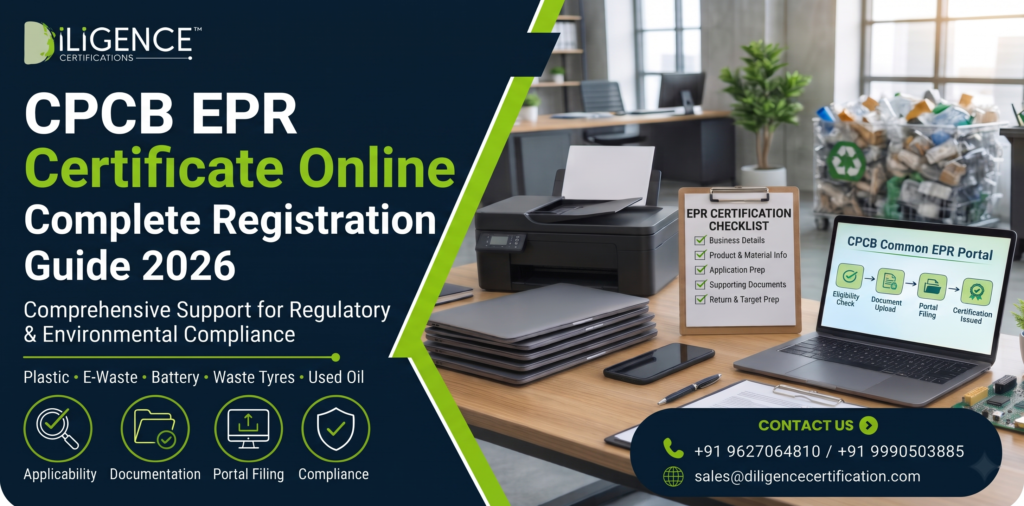
Start with the CPCB Common EPR Portal. Check the relevant module and instructions for your business category.
Plastic packaging stakeholders should pay attention to the portal transition. The previous dedicated plastic EPR portal was discontinued for operations, from 28 June 2026. Existing user data was migrated to the Common EPR Portal and stakeholders were instructed to verify the migrated information.
Businesses should therefore use the Common EPR Portal for applicable updates and transactions rather than relying on old bookmarks.
Other categories may have their portal modules or dedicated systems. Always confirm the application route before submitting information or making a payment.
Step 3: Create an account
Where the portal requires an account or user access make sure to complete all the registration and verification steps as required.
Keep the businesss email address and the authorised persons mobile number ready and easily accessible. These details are often needed for verification updates on the application and future compliance tasks.
Do not use contact information that the business does not have control over in the term. If a consultant helps with the application the business must still keep access, to its own account.
Step 4: Enter the business information
Complete the application using accurate information about the legal entity and its activities.
Depending on the category, the form may request:
- Legal name and business constitution.
- PAN and GST information.
- Registered office and facility details.
- Authorised person’s name and contact information.
- Product, packaging or material categories.
- Import, production, sales or processing quantities.
- Relevant environmental permissions and supporting records.
Do not use estimates when the applicable form requires figures supported by business records. Where the rules prescribe a calculation method, use that method consistently.
Step 5: Upload the supporting documents
Prepare documents that’re clear and easy to read following the format given by the portal.
Check the business name, address and identification details in every attachment. Small differences can cause requests for clarification and extra work.
If you run a recycling facility you may need to provide information, about the facility, its processing capacity and any environmental consents that apply. If you are a producer you may need product, import or sales records instead.
There is no document list that applies to every EPR application. Use the checklist and guidance that match your specific category.
Step 6: Review and submit the application
Before submission I review the form carefully.
Check that the applicant type is correct that the information matches the supporting documents and that the selected waste category is appropriate.
I confirm that the uploaded files are readable and complete.
I save the acknowledgement or application reference if one is generated.
I keep track of requests, for clarification. Respond within the stated period.
I know that submitting the form does not mean that the application has been approved.
I understand that the competent authority must complete the review process.
Step 7: Check the application status
After you submit your application keep an eye on the portal. Look for updates, messages asking for info or a final decision.
If they ask for clarification follow the steps they tell you to. Send any documents or info they need. Don’t forget to save a copy of your reply. Keep it with your company’s compliance files.
How long it takes to process your application depends on a things. It can vary based on the type of application how complete your submission. What the authority needs to check. Don’t trust anyone who says your application will be approved in a number of days if they can’t back it up.
Step 8: Access the approved registration certificate
If your application is approved go to the system and get your registration certificate or the digital record they give you.
Look over the details, on the certificate. Make sure everything is correct. Then save a copy. Put it in your business’s compliance documents.
Remember, getting registered is one step. Your business might still need to meet targets handle certificate-related transactions and file regular returns. Don’t stop after approval-keep going.
Documents Required for CPCB EPR Registration
The required documents depend on the applicant’s role and the applicable waste category. The following list is a preparation guide rather than a universal statutory checklist.
| Document or record | Why it may be required |
| PAN and GST details | To identify the business and verify its information |
| Incorporation or constitution documents | To establish the legal identity and type of entity |
| Authorised person’s details | To identify the person responsible for the application |
| Registered address proof | To support the business address provided |
| Product and packaging information | To identify applicable categories and quantities |
| Import records or IEC details | Where relevant to import-related activities |
| Production and sales records | To support reported quantities and calculations |
| Facility and processing information | Where required for recyclers or other processors |
| Environmental consents or authorisations | Where applicable under the relevant rules |
| Previous registration and return records | Where relevant to existing applicants or migrated data |
Do not upload unrelated documents simply because a field appears on the screen. If a requirement is unclear, check the instructions for the relevant category.
It is also sensible to maintain a single folder containing the final application, supporting documents, acknowledgement, authority correspondence and approved registration record. This makes future reporting and renewal work easier.
CPCB EPR Certificate Online for Plastic Packaging
Plastic packaging is something that often causes confusion for brand owners and businesses that send their manufacturing to companies.
The Plastic Waste Management Rules, 2016 and any updates after that create the rules for dealing with waste. The EPR guidelines explain what duties are expected from producers, importers, brand owners and plastic waste processors. Other companies that are part of the process are also included in these rules.
A company that sells products in packaging should look at what part it plays the kinds of packaging used and the duties that apply to it.
For example a company that sells personal care products might offer shampoo, moisturizer and face wash in types of packaging. It needs to collect and organize its packaging data and sales records so it can find out which categories and amounts are covered by the rules.
The fact that a separate factory makes the products does not mean the brand owner is, off the hook.
What should plastic packaging businesses check?
Before applying, review the following points:
- Which packaging categories apply to the products?
- What quantities of packaging are placed on the market?
- Does the business fall within a category that must register?
- Are the required product and sales records available?
- Which recycling, reuse or recycled-content requirements apply, if any?
- What returns and reporting periods are relevant?
- Has existing portal information been migrated correctly?
Businesses should also review the amendments and guidance that apply to their category. Do not rely on an old article that discusses only the original rules.
The CPCB Plastic Waste Management resources provide access to rules, amendments and related guidance.
How to Obtain an EPR Recycling Certificate Online
Some businesses searching for a CPCB EPR certificate online are not looking for registration. They already know their obligations and want to understand how eligible recycling certificates are obtained or used.
This is a different process.
Under an EPR framework that provides for certificate transactions, the business should first identify its applicable obligation and the relevant reporting period. It must then check the permitted source and type of certificate.
The process generally involves the following steps.
First, confirm the obligation. Establish the waste category, applicable target and reporting period before deciding which certificate is needed.
Second, identify an eligible source. Verify that the recycler or processor is registered under the relevant framework and is permitted to generate the certificate.
Third, check the certificate details. The waste category, quantity and other relevant information must match the applicable requirements.
Fourth, use the prescribed portal process. Follow the applicable purchase, transfer or settlement procedure. Do not rely only on an invoice or a private promise that a certificate will be accepted.
Finally, reconcile the transaction. Retain the transaction reference and check that the certificate has been recorded correctly for the relevant obligation.
The details vary by waste category. For example, the e-waste framework has its own rules for certificate generation and fulfilment, while battery waste operates under a separate framework.
Never assume that a certificate for one waste stream can be used to meet an obligation under another.
How Much Does a CPCB EPR Certificate Cost?
There is no one price for every CPCB EPR registration or certificate transaction.
The total cost can change based on the type of applicant the fees set by the government the amount of work needed to get the application ready. When allowed. How many certificates are bought or transferred and the terms of the deal.
It’s helpful to break the costs into three parts.
Fees: These are the official fees you pay to the government or through the online portal for applying, registering or keeping your EPR status active. These are set by the authority. Are not negotiable.
Certificate transaction costs: If the system allows buying or moving certificates the price can vary. It depends on the type of applicant how certificates you want and the rules of the market or portal you’re using.
Consultancy fees: A consultant might charge for checking your documents putting together your application helping you submit it online or following up on compliance. These are costs. Not included in the government fees.
Before hiring a service provider ask for a written plan. It should list what services they will do whether government fees are extra and how they will help if the authority asks for more information.
Don’t trust ads that say you’ll get a certificate, for a fixed price no matter what. That’s not always possible. The right process depends on your business type and the rules that apply to you.
Common Mistakes to Avoid During EPR Registration
Many registration problems start with avoidable errors rather than complicated legal questions.
Selecting the wrong applicant category
A producer, importer, brand owner and recycler may have different obligations. Review the definitions before choosing a category.
Providing inconsistent information
If the business name, address or other important details differ across the application and supporting documents, the authority may request clarification. Review the documents together before submission.
Reporting quantities without supporting records
Sales, production, import and processing figures should be supported by the relevant records and calculated using the prescribed method.
Using an outdated portal
Portal changes can affect where applications, updates and transactions must be completed. Plastic packaging stakeholders should pay particular attention to the Common EPR Portal transition that took effect on 28 June 2026.
Confusing registration with complete compliance
Registration does not automatically fulfil recycling targets, settle every certificate transaction or complete all reporting duties.
Ignoring post-registration requirements
Businesses should monitor applicable returns, deadlines, changes to registered information and notices from the authority.
Purchasing certificates without checking eligibility
A certificate should be verified against the relevant category, source, quantity and reporting requirements. A seller’s assurance alone is not enough.
The simplest way to reduce these risks is to maintain accurate business records and assign responsibility for compliance to a specific person or team.
Why Choose Diligence Certifications for CPCB EPR Certificate Online Certification?
EPR compliance can involve several connected tasks: identifying the correct applicant category, organising documents, reviewing portal requirements and understanding what must be done after registration.
Diligence Certifications can be approached for guidance on the registration process and supporting documentation. The first discussion should establish the business’s activities, the waste stream involved, any existing registration and the work that remains to be completed.
You can visit Diligence Certifications to learn more about its certification and compliance services.
When evaluating professional support, look for a service provider that:
- Checks which rules apply to the business before recommending an application.
- Understands the difference between registration and certificate transactions.
- Explains the documents and records needed for the selected category.
- Communicates consultancy charges and the scope of work clearly.
- Helps identify relevant post-registration duties.
- Does not promise guaranteed regulatory approval or unsupported processing timelines.
Businesses operating recycling facilities should also establish whether they need assistance with the relevant recycler registration procedure. Facility-related requirements can differ from those applicable to producers and brand owners.
Professional support can make the process easier to organise, but the competent authority remains responsible for its regulatory decision.
How to Maintain EPR Compliance After Registration
An approved registration is an important milestone, but businesses should plan for the work that follows.
Keep records up to date
Maintain the invoices, import records, production data, product information, processing records and other documents relevant to your category.
The reported information should be capable of being reconciled with the company’s actual records. This is particularly important when the business handles multiple products or packaging types.
Track applicable targets
Where the framework prescribes recycling, reuse or other targets, maintain a record of the obligations relevant to the business and the steps taken to fulfil them.
Do not apply a target from another category or reporting year without checking the current rules.
Check certificate transactions
Where EPR certificates form part of the compliance process, retain the transaction details and verify that the certificate category and quantity correspond to the applicable obligation.
Monitor return deadlines
Annual and quarterly reporting requirements differ between waste categories. Check the applicable instructions for the relevant financial year rather than assuming that every portal follows the same deadline.
Review official updates
Environmental regulations and portal procedures can change. Check official notices and guidance when preparing applications, returns or certificate transactions.
Update business information when necessary
Changes to the registered entity, authorised person, product range or facility may require an amendment under the applicable procedure. Review the relevant instructions before submitting changes.
A simple compliance calendar can record each deadline, the responsible person, the supporting documents and the submission reference. This is often more reliable than waiting for a reminder when a deadline is approaching.
Conclusion
Getting a CPCB EPR certificate online is simpler if your business first knows what it actually needs to do. A producer might need to register and meet targets. A recycler may need a facility, processing steps and specific rules for getting the certificate. The exact process depends on the type of waste and the rules that apply.
Before you start applying check which portal you should use. Make sure your records are correct. Look up the fees. Also keep track of what you need to report. If your business deals with packaging check your details on the Common EPR Portal. This is especially important, after the June 2026 change.
If you’re not sure which registration fits your business get help before you apply or buy an EPR certificate. You can reach out to Diligence Certifications. They can help you figure out the registration path and support you with the needed documents.
The goal isn’t just to get the certificate. It’s to understand what’s required keep records and handle environmental rules properly as your business grows.
Frequently Asked Questions
1. How can I get a CPCB EPR certificate online?
Identify the applicable waste category and applicant type, visit the relevant official portal, prepare the required documents and submit the prescribed application. Follow the portal for clarification requests and approval. If you need a recycling certificate rather than registration, check the separate transaction process under the relevant framework.
2. Is CPCB EPR registration mandatory for every business?
No. Applicability depends on the business activity, the waste category, the definitions in the relevant rules and any applicable exemptions. Businesses should check the current requirements instead of assuming that all manufacturers, sellers and importers have identical obligations.
3. What documents are required for CPCB EPR registration?
Depending on the category, the application may require PAN, GST details, business registration documents, authorised person details, product information and relevant sales, import, production or processing records. Additional documents may be required for recyclers and other facilities.
4. Is an EPR registration certificate the same as a recycling certificate?
No. An EPR registration certificate records an entity's registration under the applicable framework. A recycling certificate may represent eligible recycling or processing for compliance purposes. The rules determine who can generate, obtain or use each type of certificate.
5. Can I purchase an EPR certificate online?
Where the applicable framework permits certificate transactions, eligible businesses can follow the prescribed portal process. Before completing a transaction, verify the source, category, quantity and other relevant details. A certificate should not be treated as universally valid for every waste stream.
6. How long does CPCB EPR registration take?
There is no single processing time for every application. The timeline may depend on the applicant category, document completeness, verification requirements and clarification requests. Check the relevant portal for the latest instructions and application status.
7. What is the cost of a CPCB EPR certificate online?
The cost depends on the relevant regulatory fees, application category and, where applicable, certificate transaction terms and consultancy charges. Check the current official fee information and obtain a clear breakdown of any professional service costs.
8. Is the old plastic EPR portal still used for new applications?
The previous dedicated plastic EPR portal was discontinued for operations from 28 June 2026, and existing user data was migrated to the Common EPR Portal. Plastic packaging stakeholders should check the current portal and verify their migrated records before proceeding.