 BIS Certification
 CDSCO
 PESO
 CPCB
 LMPC
 WPC Approval
 Global Approvals
 TEC
 ARAI
 BEE
 ISO Certification
 DGCA Certification
 NOC For Steel
 APEDA Registration

















 Business Registration
 FSSAI Mark Certification












 (32).jpg)
 Legal Services
 Trademark Registration
 Copyright Registration
 Patent Registration
 By
- A CPCB EPR consultant helps producers, importers and brand owners register, file returns and answer queries on CPCB’s portal.
- Plastic EPR work moved to the Common EPR Portal on 28 June 2026, so ask any CPCB EPR consultant how they will handle your CEPR ID and migrated data.
- Check experience, process, communication and after-registration support. No consultant can promise approval.
Introduction
Take a common situation. A packaged-food brand owner in Pune hands over plastic EPR work to the cheapest person he could find. The application goes in, a query comes back from the portal, and nobody replies on time. Two months later the file is stuck, a distributor is asking for the registration number, and the owner is calling around for a better CPCB EPR consultant. This is a composite example, not a named client.
Nothing dramatic went wrong there. The person handling the file knew how to fill forms but not how to follow up. A good CPCB EPR consultant does much more than submit an application. This guide explains what the work includes, what changed in 2026, and how to judge a consultant before you pay anyone.
What Does a CPCB EPR Consultant Do?
A CPCB EPR consultant is someone who helps producers, importers and brand owners meet their Extended Producer Responsibility obligations. This role often includes checking which rules are currently in effect filling out the paperwork registering on the CPCB website tracking progress toward goals obtaining EPR certificates when needed submitting reports and responding to any queries from the CPCB. The consultant handles these tasks on your behalf.. The legal responsibility remains with your company.
Think of it like GST filing. You can file it yourself. Many companies hire an accountant who knows the system understands the deadlines and avoids mistakes. EPR works in a way.. There is one important difference. The rules change frequently. Even a small error in the data can cause a delay, in your submission. Sometimes the delay can last for weeks.
Who Needs EPR Registration in India?
EPR applies to Producers, Importers and Brand Owners called PIBOs. The main waste streams are packaging, e-waste batteries, waste tyres and used oil. Vehicle makers and importers also have duties under the End-of-Life Vehicles Rules, 2025.
Online sellers often ask if the marketplace handles this for them. Not always. If you sell goods under your brand or import products, for sale you may fall under the producer, importer or brand owner definition. Get this checked once in writing before the first notice arrives.
What Changed in 2026 for EPR Registration?
One Common EPR Portal
From February 2026, CPCB began a single sign-on system. Every registered entity gets one Common EPR ID, called the CEPR ID, to reach the plastic, e-waste, battery, tyre and used oil modules. The older stand-alone plastic portal was discontinued on 28 June 2026, and registered user data was moved to the Common EPR Portal. CPCB asked users to verify their migrated details, so please do this early.
Plastic Waste Management (Amendment) Rules, 2026
I read that these rules were announced on 31 March 2026 through G.S.R. 237(E). Industry reports say these rules set reuse targets give a role to Registered Environment Auditors and make handling of EPR certificates stricter for each packaging category. Read the notification itself. Ask your consultant to explain these rules in words and show you the clause.
Revised Annual Return Dates
Because of the portal migration, CPCB reopened the FY 2025-26 annual return for plastic waste. Reported dates are 31 October 2026 for plastic waste processors and 31 December 2026 for PIBOs. Dates can shift, so confirm on the portal before you plan around them.
Battery Labelling
Under the Battery Waste Management (Amendment) Rules, 2025, producers must carry a QR code or barcode with the EPR registration number on the battery, pack, equipment or packaging. If you deal in batteries, ask about this on the very first call.
When Should You Hire a CPCB EPR Consultant?
Not every business needs outside help. A small firm with one waste stream and a trained compliance person may manage alone. But a consultant starts to make sense in these cases:
- You are registering for the first time.
- You deal in more than one waste stream, say plastic packaging and batteries together.
- You import goods and are unsure about your category.
- Your migrated data on the Common EPR Portal does not look right.
- A CPCB query has come and your team does not know how to answer.
- Nobody in your company owns compliance full time.
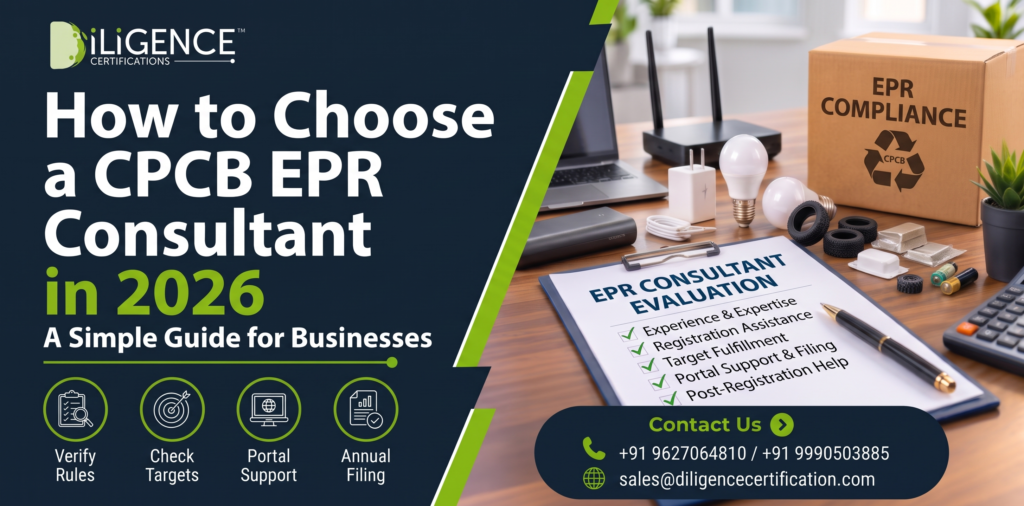
7 Checks Before You Hire a CPCB EPR Consultant
Most people choose on price and speed. Those two are the weakest signals. These seven checks tell you far more.
1. Ask Which Rules Apply to You and Why
A thoughtful advisor will ask about your products, your packaging and your sales before saying anything. If someone gives a price in the minute without asking these questions be cautious. The response should list the rules not just say “EPR is needed”.
2. Ask How Your Target Will Be Calculated
Targets vary based on your category and the amount you put into the market. Ask the advisor to go through one example. If the explanation is unclear the work may be unclear too.
3. Check Experience in Your Waste Stream
Plastic rules, battery rules and e‑waste rules are not the same. Someone who is very good, at rules may not know about battery labelling or e‑waste channels. Ask that person how files they have handled in your stream and what usually goes wrong in those files.
4. Ask Who Does the Portal Work
Some companies give the file to an employee who has never looked at your documents before. Find out who will sign in who will check the data and who will speak with you. Also find out how they will handle your CEPR ID and the moved records.
5. Ask What Happens After Registration
Registration is only the start. Annual returns, quarterly filings in some streams, certificate purchases and portal queries come next. If the consultant talks only about getting you registered, you will be searching for someone else next year.
6. Ask How They Treat EPR Certificates
If you have a shortfall against your target, you may need EPR certificates. Ask where they come from and how you can check on the portal that they are genuine. A consultant who is casual about this is putting your company at risk.
7. Get the Scope in Writing
A clear written scope says what is included, what is extra and what you must provide. It avoids arguments later. It also shows that the consultant has thought about your case.
Red Flags in a CPCB EPR Consultant
Some warning signs are easy to spot once you know them:
- A promise of approval or a fixed date for it. Approval depends on CPCB, not on the consultant.
- Words like “100% compliance guaranteed”.
- No clear answer on who will file your papers.
- No mention of annual returns or follow-up work.
- Pressure to pay quickly because “rules are changing tomorrow”.
- Unwillingness to show you what is being submitted on your behalf.
What Documents Should You Keep Ready?
The exact list depends on your waste stream and category, so ask for a written checklist before work starts. In general, businesses should keep these handy:
- PAN and GST registration details
- Company incorporation proof and authorised signatory details
- IEC, if you import
- Product and packaging details
- Sales or import quantities for the relevant year
- Details of your manufacturing unit or premises
- Earlier EPR registrations, certificates or returns, if any
What a Consultant Cannot Do for You
A consultant can prepare, file, track and advise. A consultant cannot take away your legal responsibility. If wrong quantities are filed, your company answers for it. If a certificate turns out to be invalid, your target is still pending.
So stay involved. Review the numbers before they are submitted, and keep copies of everything. A good consultant will welcome this.
Why Choose Diligence Certifications for CPCB EPR consultant Certification?
At Diligence Certifications we begin by learning what you make import or sell. Then we let you know which EPR rules apply to your business. We don’t offer the fixed package to every client.
Our team handles your documents uploads them on the Common EPR Portal and keeps you updated when the CPCB asks for information or when your return deadline is approaching. If there’s a spot in your application we let you know right away-no guessing, no surprises.
For businesses searching for a CPCB EPR consultant who explains everything in easy-to-understand words our CPCB EPR registration service is a great starting point.
We don’t promise approval. Give set timelines because those are decided by the CPCB.. What we can guarantee is honest advice and clear communication, at every step.
A CPCB EPR consultant checks which EPR rules apply to your business, prepares documents, registers you on the CPCB portal, helps with certificates and targets, files returns and replies to queries. You remain legally responsible for the information filed.
Conclusion
Choosing a CPCB EPR consultant is not about the cost. It’s about who will answer your call when the CPCB sends a query. Make sure to ask the seven questions we mentioned demand a written scope of work. Stay actively involved in your own filings.
If you want a picture of which EPR rules apply to your business our team is ready to help. Book a Free Consultation, with Diligence Certifications. Get your questions answered before you decide to move forward.
Frequently Asked Questions
Is it compulsory to hire a CPCB EPR consultant?
No. The law requires PIBOs to register and comply, but it does not require you to use a consultant. Many businesses hire one because the portal work, data checks and follow-up take time and care.
How much does a CPCB EPR consultant charge?
Fees differ by waste stream, category, quantity and the work included. Ask for a written quote that lists what is covered, and compare scope, not just the final number.
How do I check if a CPCB EPR consultant is genuine?
Ask who will handle your file, request a sample of the scope document, and ask them to explain one rule in plain words. Be careful of guarantees of approval. You can also confirm your own registration status directly on the Common EPR Portal.
Do online sellers need EPR registration?
It depends on what you sell and how. If you sell under your own brand or import goods, you may count as a brand owner or importer. A short review of your products and packaging gives a clear answer.