BIS Certification
 CDSCO
 PESO
 CPCB
 LMPC
 WPC Approval
 Global Approvals
 TEC
 ARAI
 BEE
 ISO Certification
 DGCA Certification
 NOC For Steel
 APEDA Registration























 Business Registration
 FSSAI Mark Certification












 (32).jpg)
 Legal Services
 Trademark Registration
 Copyright Registration
 Patent Registration
 By
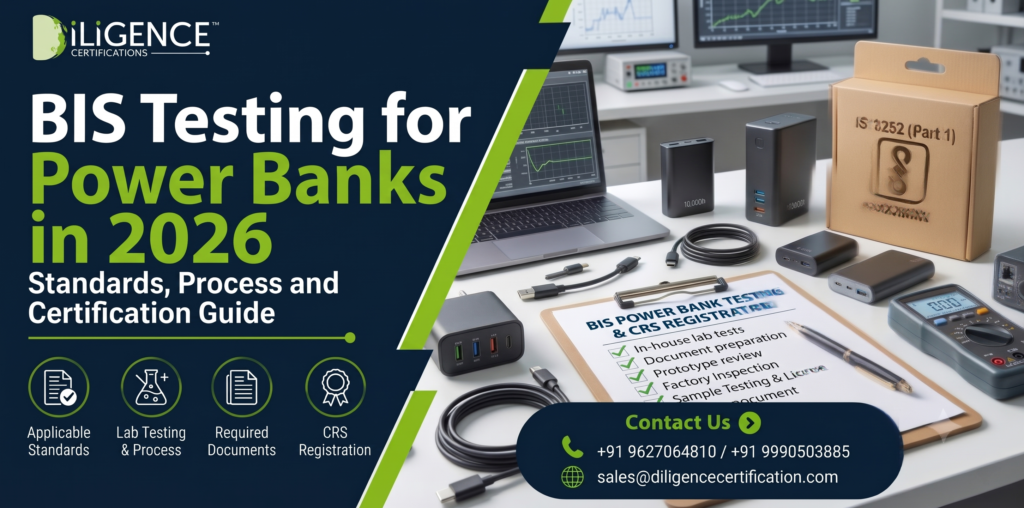
- BIS testing for power banks checks whether your product meets the applicable Indian safety standard.
- A complete power bank with internal electronic circuitry generally follows IS 13252 (Part 1).
- A battery-only product, without the circuit and charge-control unit, may be treated differently.
- Testing, BIS registration, labelling and model inclusion are four separate things. Do not mix them up.
- Correct specifications and a final, frozen design save a lot of time and avoid delays.
- Always check the current BIS requirements before you send samples to a lab.
Introduction
Look around any office or railway station. You will see someone charging a phone from a power bank. People use them for phones, earbuds, tablets and smartwatches. For sellers they are also an accessory, a good promotional gift and a fast-moving online product.
Selling a power bank in India is not just about choosing a battery capacity and a nice box. Safety rules. You need to take them seriously. There are regulations about what kind of batteries can be used how they are tested and how they are labeled. If you ignore these rules you could face fines. Even have your product pulled from the market.
The safety of a power bank is not about the battery. It’s about the circuitry, the charger, the casing and how everything works together. Poor quality power banks can overheat, swell or even catch fire. That’s why it’s important to work with certified manufacturers and get documentation.
In India the Bureau of Indian Standards sets guidelines for power banks. They check for things, like safety, heat resistance and short circuit protection. If your power bank doesn’t meet these standards it’s not safe to sell.
So if you want to sell power banks in India don’t skip the safety part. It’s not about making a sale. It’s about protecting the people who use your product.
This is where BIS testing for power banks comes in. The Bureau of Indian Standards (BIS) sets Indian product standards and runs the certification schemes. If your product is covered under compulsory registration, you must complete the required process before it goes to the Indian market.
Now, if you work with an overseas factory, a private-label product or many models with different capacities, the process can feel confusing. Which standard? Which lab? Which documents? These questions come up at almost every step.
In this guide, we explain everything in simple words, so manufacturers, importers and brand owners can plan BIS testing and registration properly.
What Is BIS Testing for Power Banks?
In simple words, it means checking your power bank against the Indian Standard that applies to it, through the proper testing and conformity assessment process.
A power bank looks simple from outside, but inside there is quite a lot going on. You have a rechargeable battery, charging and discharging circuits, protection components, input and output ports and an outer body. Some models also have a display, fast charging or wireless charging.
All these parts must work together safely. If the battery, circuit, insulation or internal construction has a problem, it can create a risk during normal use or when something goes wrong.
Testing tells you whether the product meets the requirements of its standard.
One point needs to be clear. BIS testing and BIS registration are not the same thing. Testing checks the product. Registration is the regulatory step under the scheme. Having a test report does not mean you can start selling. You still have to complete the registration formalities.
Which BIS Standard Applies to Power Banks in India?
It depends on what exactly you are supplying.
1. IS 13252 (Part 1): Information Technology Equipment, Safety
The BIS product listing places power banks for portable applications under IS 13252 (Part 1):2010. This standard gives the general safety requirements for this category of equipment.
So if you have a complete power bank with internal electronic circuitry, this is the first standard to check.
But please verify the exact edition, amendments and implementation dates on the official BIS records before testing. A test report that worked for your old model may not be enough for a new one.
2. IS 16046: Safety Requirements for Portable Rechargeable Batteries
IS 16046 covers safety requirements, for portable sealed rechargeable cells and batteries. Which part of IS 16046 applies depends on the battery chemistry. For instance IS 16046 Part 2 applies to lithium systems.
BIS guidance distinguishes a power bank, which contains electronic circuitry from a battery product that lacks the circuit and charge‑control unit. The second type may require an assessment.
Therefore you should classify your product first and only then choose the standard.
Why product classification matters
Take two products:
- Product A: A complete power bank with a rechargeable battery, a charging control circuit and USB output ports.
- Product B: A sealed rechargeable battery supplied without the electronic circuit and charge-control unit.
Both store electrical energy. Still, BIS does not necessarily treat them the same way.
So do not choose a standard just because your supplier calls the item a “power bank” in the catalogue. Look at how the product is actually built.
Why Is BIS Testing Important for Power Banks?
A power bank is charged, carried in bags and pockets, and used in all kinds of conditions. How safe it is depends on the battery, the electronics, the protection parts and the overall build quality.
Here is why testing and registration deserve your attention.
Electrical safety
The product is checked against the relevant safety requirements. Design, insulation, wiring, connections and protective arrangements can all matter.
Battery and charging protection
Rechargeable batteries need protection against unsafe operating conditions. What exactly is checked depends on the standard and your design.
Product reliability
A badly designed product can develop faults while charging or discharging. Compliance checks can catch such problems before the product reaches customers.
Market access
Where compulsory BIS registration applies, you have to complete the process to import or sell the product in India.
Brand credibility
Retailers, distributors and customers want to be sure that an electronic accessory follows the rules. Clear certification records also make talks with marketplaces and suppliers easier.
Lower compliance risk
Finding a problem before mass production or shipment is much less painful than facing a failed test, a stuck shipment or a product that does not match its registration details.
What Tests Are Conducted on Power Banks?
The actual tests depend on the standard, the product classification and the lab’s approved test plan. The points below only give you an idea of what may be checked. They are not a replacement for the official test requirements.
1. Electrical safety assessment
The lab looks at the electrical safety features of the product. This can include electrical construction, insulation, connections and protection against shock and similar hazards. The aim is to see whether the design and build meet the safety provisions.
2. Unusual working situations
Things don’t always happen the way they should. A part might. Someone might use the item in a way that it wasn’t intended for. When the standard says so the lab looks at what happens in these situations and whether the problem becomes a risk.
3. Heat and temperature
Anyone who has used a phone charger in the summer knows how hot electronic devices can get. In a power bank a lot of heat can harm the parts, the battery and even the outside case. So the lab checks how hot the product gets under the conditions and whether it stays within the range.
4. Mechanical construction
How the product is built also counts. The lab may look at the body, where the internal parts are placed, how they are fixed and how the live parts are covered. The exact checks and limits come from the standard.
4.Protection and charging functions
The circuits that charge and discharge must be suitable, for what the product’s designed to do. Depending on the design and the standard the lab may look at the protection features. Observe how the power bank works under the specified conditions.
5.Markings and user information
Ratings, warnings, instructions and product identification can also be checked. What is printed on the product and the box must match the model and its approved specifications. If the voltage, capacity or manufacturer name is incorrect it causes confusion and sometimes a compliance issue well.
BIS Registration Process for Power Banks: Step by Step
Do it in the right order and the whole thing feels much lighter.
Step 1: Identify the product category
Start by asking yourself what you are actually supplying. A complete power bank? Just a rechargeable battery? Some other portable charging product?
Then write it all down: the internal circuit, battery chemistry, charging functions, input and output ports and how the product will be used. Getting this right matters, because the category decides your standard and your registration route.
Step 2: Confirm the applicable Indian Standard
Look at the official BIS product list and the government notifications for your product.
If it is a complete power bank, check the requirements linked to IS 13252 (Part 1). If it turns out to be only a battery product, see whether a part of IS 16046 applies.
Do not forget the current edition, amendments and implementation dates too. Rules keep changing, so an old paper from your supplier is not something to rely on.
Step 3: Finalise the product specifications
Before you send any sample, get your technical details complete. You will usually need things like these:
- Brand and model number
- Manufacturer’s name and factory address
- Battery chemistry and rated capacity
- Input and output ratings
- Charging and discharging functions
- Circuit and protection details
- Product photographs and construction details
- Proposed label and packaging details
Not every product needs the same details, so your list may be a little longer or shorter than this.
Step 4: Select an appropriate testing laboratory
Pick a lab that is recognized for BIS testing and makes sure your product category is within their scope. Don’t go for the quote alone.
Before you send anything by courier ask the lab a basic questions. Is their recognition up, to date? What standards do they cover? How samples do they require? How long will the testing. How will they provide the report? A lab that tests accessories might not be approved for your specific product or standard so never assume it’s a match. Always double-check.
Step 5: Submit the samples
Send the samples in the way your lab tells you. But here is the part people often forget: the sample must be the product you plan to sell. Same battery, same circuit, same components, same body, model. If you send a “sample the report will not help you later. Once the samples arrive at the lab try to keep your design as it’s. If you really have to change something write it down.. If the design changes, during testing just call the lab and ask what it means for the test plan.
Step 6: Complete the testing
This is the labs part of the job. They do the tests. Record the results.
What if the product doesn’t work? It happens often than people want to say. Don’t hurry to send it. First sit with your team and find out why it didn’t work. It could be one part, the way it was built the safety system or even the name, on the label. Fix the problem then ask the lab if another test is needed.
Step 7: Prepare the registration application
Now that you have the test report and papers ready you can file your application through the BIS registration process.
Take another look at your application before you submit it. The manufacturer details, brand name, model name and specifications must match the test report and the records you have on hand.
A small spelling mistake, in the model name may seem trivial. It is a very common cause of BIS queries and each query can cost several days.
Step 8: Complete the required formalities
After applying, you still have some work. Keep an eye on the BIS instructions for the review, extra information if they ask for it, fees, registration and marking.
Many sellers think a test report is enough to put the BIS mark on the product. It is not. Even a filed application does not give you that right. Use the mark or the registration number only after registration is complete, and follow BIS marking instructions when you do.
Step 9: Maintain product and registration records
Once you get the registration do not put the files in some drawer. Keep the test reports documents, approved model details and registration records in one safe place. You will need them again.
Planning a model, a different battery, a circuit change or a new factory? Before you go ahead check whether it needs an update, a model inclusion or a fresh assessment, under the rules.
Documents Required for BIS Testing and Registration
The documents you need can change with the product type, where the manufacturer is located and the registration route. So use the list below as a working checklist, not as the final list for every application.
Company and manufacturer documents
- Company registration or incorporation details, where applicable
- Manufacturer’s legal name and address
- Authorisation documents, where required
- Brand ownership or brand authorisation documents, where applicable
- Applicant and authorised representative details, as required by the scheme
Product-related documents
- Product specification sheet
- Model number and brand details
- Battery chemistry and rated capacity
- Input and output ratings
- Circuit diagrams or technical information, where requested
- Product photographs and internal construction details, where requested
- User manual and product labels
- Component details and supporting reports, where relevant
Testing and application records
- Sample details and lab submission information
- Applicable test report
- Application forms and declarations
- Undertakings and other documents specified by BIS
- Any additional records asked for during the review
Foreign manufacturers should confirm the requirements for their location and application route. A document accepted for one product category may not be enough for another.
How Long Does BIS Testing for Power Banks Take?
There is no single timeline that fits every power bank.
The total time depends on a few things:
- Product classification and the applicable standard
- Availability of a suitable lab
- How ready the samples are, and shipping time
- How complete your technical documents are
- Whether the product passes the required tests
- Whether corrections or retesting are needed
- Application review and any extra information asked for
If your product is ready and the documents are complete, things move faster. If the design keeps changing or records are missing, expect delays.
If you are working towards a product launch, keep time for testing, corrections and registration. Do not plan your whole schedule around the lab’s test duration alone.
What Is the Cost of BIS Testing for Power Banks?
The total cost depends on your product and the services you need. It is better to get a quotation for your exact model than to trust a general estimate from the internet.
The main cost components are:
Laboratory testing: Charges depend on the test requirements, number of samples and the lab.
Sample preparation and shipping: You may need to prepare several samples and arrange transport, especially when the factory is outside India.
Documentation and application support: Many businesses take technical or regulatory help to prepare the application and answer queries.
Retesting: If the product fails a requirement, corrections and extra testing will add to the cost.
Other charges: Registration-related charges and other expenses should be confirmed from the current official requirements.
Before you approve a quotation, ask what is included and what is not, whether retesting is covered, and whether extra models or documents will be charged separately.
Common Mistakes to Avoid
Even an experienced manufacturer can slip on small things. Here are the common ones.
Choosing the wrong standard
A complete power bank and a loose battery may not follow the same route. Confirm the category before testing.
Using outdated technical documents
Old test reports, superseded standards or supplier certificates may not prove compliance with what is applicable today.
Sending a sample that differs from the final product
If the battery, circuit or any key component changes after testing, check whether the existing assessment still holds.
Giving inconsistent model information
When the application, product label, test report and packaging do not match, the review team will ask questions.
Assuming a supplier’s certificate covers every model
Check the scope of the registration and the test report carefully. A certificate for one manufacturer or one model is not approval for a different product.
Using the BIS mark too early
Do not use the mark or registration details until you have met the requirements and received the marking instructions.
Leaving compliance until the shipment is ready
Testing and registration should be planned before dispatch. Last-minute compliance work can disturb launch dates and inventory planning.
BIS Testing for Manufacturers, Importers and Private-Label Brands
Different businesses face different practical problems, even when the product is the same.
Indian manufacturers
Keep a clear link between the approved design, production components, test samples and what actually comes out of the factory. If an important component changes, check what it means for compliance.
Importers
Confirm the requirements before placing purchase orders or booking shipments. A foreign supplier’s declaration or an international test report does not replace mandatory Indian registration.
Private-label sellers
If you sell under your own brand, find out who the actual manufacturer is, which models are covered and how the registration details apply to your product. Private labelling does not remove the need for compliance.
Overseas manufacturers
If you want to enter the Indian market, review the relevant Indian Standard, the registration route and any representation or document requirements before you fix your export schedule.
How Diligence Certifications Can Help
If your business is new to Indian product compliance, finding the right standard and preparing documents can take a lot of time.
Diligence Certifications can help with regulatory guidance and coordination of the certification-related requirements, depending on the service agreed for your project.
This support may include:
- Reviewing your product category and identifying the key compliance questions
- Preparing a documentation checklist
- Explaining the testing and registration sequence
- Coordinating information between the manufacturer, applicant and lab
- Helping you organise replies to documentation queries
- Reminding you to verify current standards and official requirements before you proceed
The exact scope of work should be confirmed before you start. Testing has to be done by a lab with the proper recognition and scope. A consultant does not replace the lab or BIS, and no consultant can guarantee registration regardless of test results or the official review.
For power banks meant for the Indian market, a clear compliance plan helps you find documentation gaps early and avoid delays that could have been prevented.
Conclusion
BIS testing for power banks is an important part of product compliance when your product falls under the compulsory requirements in India. The first job is to identify the product correctly and confirm the standard that applies.
For complete power banks, IS 13252 (Part 1) is the key standard to check against the current official product listing. Battery-only products may need a different assessment, depending on their construction.
Once the standard is clear, prepare accurate technical documents, send representative samples to a properly recognised lab, fix any test failures and complete the registration formalities.
Do not depend only on a supplier’s certificate or an old test report. Verify the current requirements before you launch or import. With good preparation, the process becomes more organised and you can enter the Indian market with more confidence.
Frequently Asked Questions
1. Is BIS testing mandatory for power banks in India?
Power banks covered under the compulsory registration requirements must comply before they are placed on the Indian market. Please confirm the current category and official requirements for your exact product.
2. Which BIS standard applies to power banks?
The official BIS product listing places power banks for portable applications under IS 13252 (Part 1):2010. Always verify the current edition and requirements before testing.
3. Is IS 16046 applicable to power banks?
IS 16046 applies to specified portable rechargeable cells and batteries. BIS guidance separates battery products from complete power banks with electronic circuitry. The correct classification depends on how your product is built.
4. Can I sell an imported power bank without BIS registration?
If the product is covered by compulsory BIS registration, the requirements must be completed before it is legally sold in India. Check the current rules and product scope before importing or selling.
5. What tests are conducted on a power bank?
The test plan depends on the product and the standard. Safety checks may cover electrical construction, heating, abnormal operating conditions, mechanical construction and required markings. The lab will confirm the exact tests.
6. What documents are required for BIS registration of power banks?
These may include manufacturer and applicant details, brand and model information, product specifications, technical documents, test reports, labels, declarations and other records required by the scheme.