BIS Certification
 CDSCO
 PESO
 CPCB
 LMPC
 WPC Approval
 Global Approvals
 TEC
 ARAI
 BEE
 ISO Certification
 DGCA Certification
 NOC For Steel
 APEDA Registration























 Business Registration
 FSSAI Mark Certification












 (32).jpg)
 Legal Services
 Trademark Registration
 Copyright Registration
 Patent Registration
 By
- Steel bar testing checks if a bar is strong, bendable and safe enough for concrete work.
- In India, the main standard for TMT and rebar is IS 1786:2008.
- The key tests are tensile, bend and rebend, chemical analysis, weight per metre and rib checks.
- Testing happens at two levels: your own factory lab and a BIS recognised lab.
- Bars covered by the Quality Control Order need a valid BIS licence and the ISI mark before sale.
- Most failures come from poor process control and wrong sample preparation, not from bad luck.
Introductiony
Think about a blood test. You cannot know a person’s sugar level by looking at his face. You need a report. Steel bars are the same. You cannot judge strength by colour, shine or brand name on the bar. You need testing.
This matters because the bar sits inside beams, columns and slabs where nobody can see it again. If it is weak, the problem shows up years later, when it is too late and too costly to fix.
In this blog, we explain steel bar testing in very simple English. You will learn which standard applies, which tests are done, how the process works and what mistakes to avoid.
What Is Steel Bar Testing?
Steel bar testing means checking a bar sample in a lab against the limits given in the Indian Standard. The lab pulls it, bends it, weighs it, measures it and checks what it is made of.
The result tells us three simple things:
- Is the bar strong enough to carry load?
- Is it ductile enough to bend and stretch before breaking?
- Is the size, weight and chemistry within the allowed limits?
For bars sold in India, this testing is also part of BIS certification. Under the Bureau of Indian Standards rules, a manufacturer needs a licence to use the ISI mark. To get and keep that licence, the bars must pass tests regularly.
The Ministry of Steel has issued a Quality Control Order (QCO) for these bars, which makes the ISI mark compulsory for covered products. QCOs get revised from time to time, so always check the latest notification before you plan your business.
Which Standards Apply to Steel Bars?
For reinforcement bars, the main one is IS 1786:2008. Its full name is High Strength Deformed Steel Bars and Wires for Concrete Reinforcement. Most people simply call it the TMT bar standard.
| Standard | What it covers | In simple words |
| IS 1786:2008 | High strength deformed bars and wires for concrete | The main rulebook for TMT and rebar |
| IS 1608 | Tensile testing method for metals | How the pulling test is done |
| IS 1599 | Bend test method | How the bend test is done |
| IS 1786 test sections | Rebend, mass, rib geometry | Extra checks specific to rebar |
Simple example: A company makes 12 mm Fe 500D bars. The lab checks yield strength, tensile strength and elongation against the Fe 500D limits. It also checks bend and rebend, chemical content, weight per metre and rib pattern. If every result is inside the limit, the sample passes.
Note: Always take a fresh copy of the latest standard and amendments from BIS before you finalise your testing plan. Do not depend on old photocopies.
Why Is Steel Bar Testing Important?
- Safety: Weak bars can cause cracks, sagging or even collapse of a building.
- Legal need: Bars covered by the QCO cannot be sold or imported without the proper BIS licence.
- Customer trust: Builders, contractors and engineers ask for test reports before buying.
- Less wastage: Good quality control stops rejected lots and returns.
- Fewer disputes: A proper test report settles arguments quickly when there is a complaint.
- Market checks: BIS can pick samples from the market, so your bars must stay consistent every day, not just on test day.
What Tests Are Conducted on Steel Bars?
Let us go test by test. Nothing complicated, we promise.
1. Tensile Test
This is the most important test. The lab clamps a piece of the bar in a machine and pulls it until it breaks. It records three things:
- Yield strength (or 0.2% proof stress): The point where the bar starts to stretch permanently.
- Tensile strength: The maximum pull the bar can take.
- Elongation: How much the bar stretches before it breaks, shown as a percentage.
The ratio of tensile strength to yield strength is also checked. A bar that is strong but has no stretch is dangerous, because it can snap without warning.
2. Bend and Rebend Test
In the bend test, the bar is bent around a pin to a set angle. The lab then looks for cracks on the outer surface of the bend. No crack means pass.
The rebend test is tougher. The bar is bent, aged for a short time and then bent back partly. It checks if the bar can handle the rough treatment it gets at a construction site, where workers bend and straighten bars by hand.
3. Chemical Analysis
The lab checks the elements in the steel, mainly carbon, sulphur and phosphorus. Their combined effect is also checked through the carbon equivalent value.
- Too much carbon makes steel hard but brittle.
- Too much sulphur or phosphorus makes it weak and unsafe for welding.
- Carbon equivalent matters because bars are often welded or lapped on site.
4. Weight per Metre (Mass) Test
The lab cuts a bar piece of known length, weighs it and calculates the weight per metre. This is compared with the nominal weight for that diameter, within the allowed tolerance.
Why does this matter? A bar that is thinner than it claims gives less steel in the concrete. The buyer pays for 12 mm and gets something closer to 11 mm. That is both a quality and a fairness issue.
5. Rib Geometry and Dimension Check
TMT bars have ribs so concrete can grip them. The lab measures the rib height, rib spacing and the pattern. Poor ribs mean poor bonding between steel and concrete.
6. Marking and Surface Check
The lab also looks at the bar surface and marking. The bar should be free from harmful defects such as cracks, laps or heavy rust. The manufacturer’s identification and the ISI mark must be marked as the licence allows.
Understanding Steel Bar Grades
The grade is shown as Fe followed by a number. That number is the minimum yield strength in N/mm².
| Grade | Minimum yield strength | Simple meaning |
| Fe 415 | 415 N/mm² | Older, lower strength grade |
| Fe 500 | 500 N/mm² | Most common grade in houses and buildings |
| Fe 500D | 500 N/mm² | Same strength, but better ductility for seismic areas |
| Fe 550 | 550 N/mm² | Higher strength for heavier structures |
The letter D stands for ductile. A D grade bar must stretch more before it breaks, and the chemical limits are stricter too. For example, Fe 500 needs at least 12% elongation, while Fe 500D needs at least 16%.
This is useful in earthquake-prone zones, where buildings must bend a little instead of breaking suddenly.
Two Kinds of Testing: Factory Lab and Recognised Lab
People often mix these two up. Let us make it clear.
| Point | Factory lab testing | BIS recognised lab testing |
| Where | Inside the manufacturer’s own plant | Outside, at an approved independent lab |
| Purpose | Daily control of every heat or lot | Independent proof for licence and checks |
| Frequency | Regular, as per the scheme of testing | At the time of application and as BIS requires |
| Who does it | Plant’s own trained staff | Lab staff, with BIS-drawn or lab-drawn samples |
A manufacturer needs a proper in-house lab with calibrated machines. The outside lab then confirms that the same bar passes independently. You need both to stay safe.
BIS publishes details of laboratories and their scope, so check that the lab is recognised for IS 1786 before you send any sample.
Step-by-Step Process for Steel Bar Testing and BIS Registration
Here is the usual flow for an Indian manufacturer. The exact steps can change as BIS updates its system, so confirm the latest process before you start.
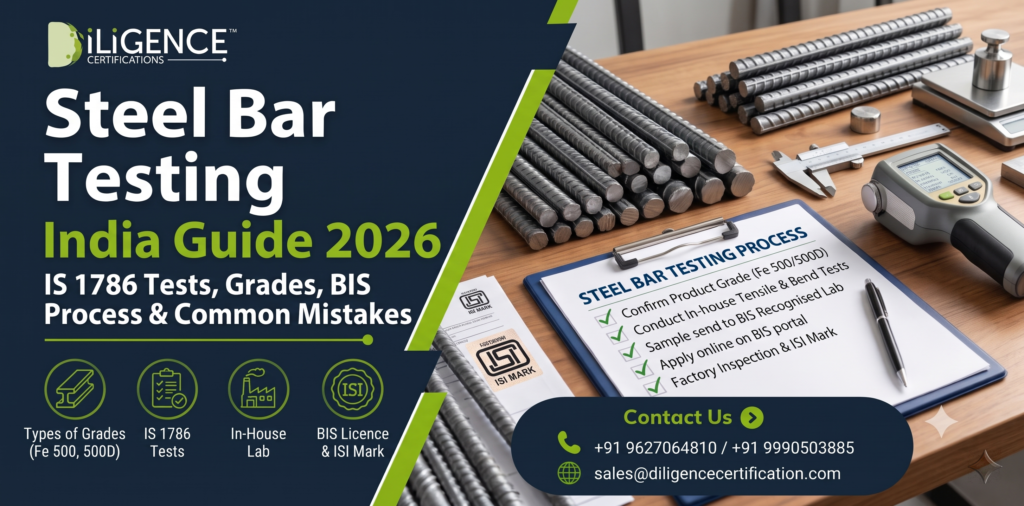
- Confirm your product and grade. Decide which sizes and grades (for example Fe 500D) you want covered.
- Read the standard. Take the latest IS 1786 and the BIS scheme of testing and inspection.
- Set up your factory lab. Arrange tensile machine, bend setup, weighing scale, measuring tools and chemical analysis facility.
- Calibrate everything. Keep calibration certificates ready for each machine and instrument.
- Make trial lots. Produce bars and test them in house first, so you know where you stand.
- Send samples to a recognised lab. Use correct sample length, marking and packing.
- Apply to BIS. File the application online with documents and fee.
- Factory inspection. A BIS officer visits, checks your process, lab and records, and may pick samples.
- Licence and ISI mark. If all is in order, BIS grants the licence. Use the mark only as the licence allows.
Which BIS Route Is Needed?
The route depends on who you are.
| Business type | Usual route | Simple note |
| Indian manufacturer | BIS licence under the ISI mark scheme | Factory inspection and lab tests needed |
| Foreign manufacturer exporting to India | Foreign manufacturers certification scheme | Needs an Indian authorised representative |
| Importer | Buys only from a BIS licensed source | Customs may ask for the licence details |
| Trader or dealer | No licence for trading | Must sell only genuine marked bars |
A licence may need changes later if you add a new grade, size or plant. Do not assume the old licence covers everything.
How Long Does It Take?
There is no fixed number that works for everyone. The time depends on how ready your factory is, the queue at the lab, how quickly you answer BIS queries and the inspection date.
Companies that keep their lab, calibration and records ready usually move faster. Those who start with missing documents lose weeks. Please do not trust anyone who promises a fixed date or guaranteed approval.
What About Cost?
The total cost is not one single number. It depends on these factors:
- Number of grades and sizes you want to cover
- Lab testing charges for each sample
- Government application and licence fees
- Cost of setting up or upgrading your in-house lab
- Calibration charges for instruments
- Consultant support, if you take one
- Travel and inspection related expenses
If you want a clear breakup for your case, share your product list and plant details with an expert.
Documents Required
Keep these ready before you apply.
Company documents
- Business registration and address proof
- Factory layout and plant details
- Authorised person details
Product documents
- List of grades, sizes and brand name
- Manufacturing process flow
- List of raw materials and suppliers
Testing records
- Calibration certificates of machines
- Daily test records and inspection logs
- Test reports from a recognised lab
Common Mistakes in Steel Bar Testing
- Sending a perfect hand-picked sample. BIS may pick samples from regular production, so keep your quality steady.
- Using uncalibrated machines. A wrong reading is worse than no reading.
- Cutting the sample badly. Rough cutting or heating the piece can change the test result.
- Ignoring the rebend test. Many bars pass the first bend and fail the rebend.
- Poor control of raw material. Mixed scrap quality means a different chemistry every day.
- Weak records. If it is not written down, the inspector assumes it was not done.
- Using an old copy of the standard. Amendments can change limits and methods.
- Marking the bars before getting the licence. Misuse of the ISI mark can lead to action.
Who Needs This?
- Manufacturers: TMT and rebar plants, rolling mills and induction furnace units
- Importers: Anyone bringing reinforcement bars into India for sale or use
- Private label sellers: Brands that get bars made by another plant and sell under their own name
- Overseas manufacturers: Foreign plants that want to supply bars into India
- Export-only units: Please check with an expert, because the rules may be different when goods never enter the Indian market
Contractors and builders do not need a licence, but they should check test reports and the ISI mark before they buy.
Why Choose Diligence Certifications for steel bar testing Certification?
BIS work looks easy on paper but gets confusing in practice. Small gaps in files, lab selection or sample preparation can cost you weeks. That is where a guide with hands-on experience helps.
At Diligence Certifications, the team explains the process in plain language, helps you understand the standard, and assists with documents, lab coordination and follow-up with BIS. You can read more about our work on the BIS certification for steel products page.
We do not promise approvals, because the decision always rests with BIS. What we promise is clear guidance and honest advice at each step.
Conclusion
Steel bar testing is not just a paperwork step. It is the check that tells you whether the bar inside a building can be trusted. Tensile, bend, rebend, chemical, weight and rib checks together give a complete picture.
If you are a manufacturer, build your factory lab first, keep records neat and test your own bars before the official lab does. If you are an importer or buyer, ask for the BIS licence details and test reports.
Start early, keep it simple and follow the latest standard. A little care now saves a lot of trouble later.
Frequently Asked Questions
1. What is steel bar testing? It is the process of checking a steel bar sample in a lab for strength, bendability, chemistry, weight and size against the Indian Standard.
2. Which standard applies to steel bars in India? IS 1786:2008 is the main standard for high strength deformed steel bars and wires used in concrete reinforcement.
3. Which tests are done on TMT bars? Tensile test, bend and rebend test, chemical analysis, weight per metre check, rib geometry and surface check.
4. What does Fe 500D mean? Fe 500 means minimum yield strength of 500 N/mm². The letter D means better ductility, so the bar stretches more before breaking.
5. Is BIS certification compulsory for steel bars? For products covered by the Ministry of Steel’s Quality Control Order, yes. Check the latest notification, since orders can be revised.
6. Can I test steel bars at my own factory? Yes, and you must keep an in-house lab for regular control. But independent testing at a recognised lab is also needed for the licence.
7. How do I know if a lab is recognised? Check the lab list and scope published by BIS, and confirm that IS 1786 is included in its scope.
8. Why is the rebend test important? It shows if the bar can survive bending and straightening at a site without cracking. Some bars pass the bend test but fail this one.
9. How long does BIS certification for steel bars take? There is no fixed time. It depends on your readiness, lab schedule, BIS queries and inspection date.
10. Can a trader sell steel bars without a licence? A trader does not need a manufacturing licence, but must sell only bars that carry a valid ISI mark from a licensed source.
11. What happens if a bar fails a test? The reason is checked, the process is corrected and the test is repeated as per the scheme. Marketing failed lots as certified bars is not allowed.
12. Do foreign manufacturers also need BIS certification? Yes, if their bars covered by the order are supplied into India, they need to follow the foreign manufacturers certification route.