BIS Certification
 CDSCO
 PESO
 CPCB
 LMPC
 WPC Approval
 Global Approvals
 TEC
 ARAI
 BEE
 ISO Certification
 DGCA Certification
 NOC For Steel
 APEDA Registration























 Business Registration
 FSSAI Mark Certification












 (32).jpg)
 Legal Services
 Trademark Registration
 Copyright Registration
 Patent Registration
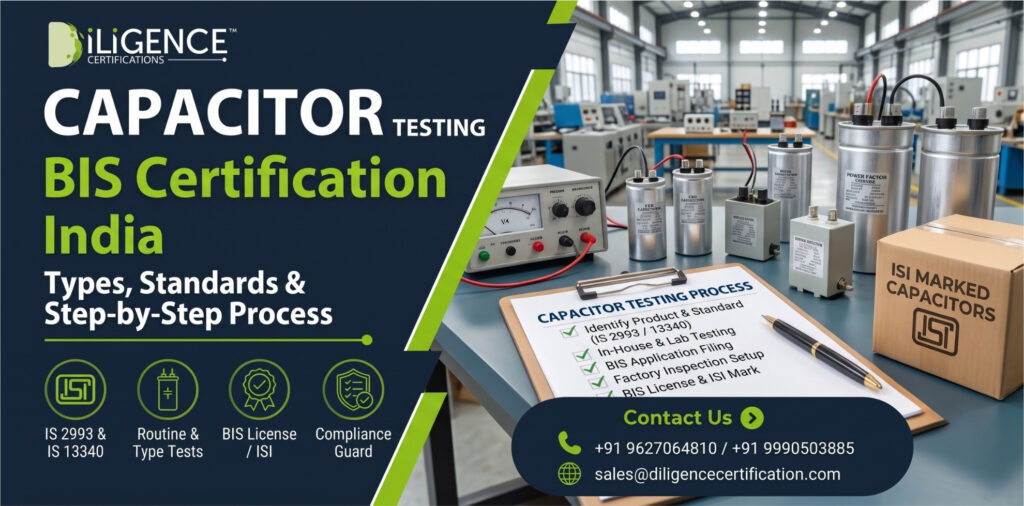
 By
- Electrical component evaluation are checked for capacitance, energy loss, insulation strength, temperature behaviour and electrical safety.
- Laboratory evaluations help manufacturers demonstrate product compliance.
- Field inspections help identify damaged or weak components.
- IS 2993, IS 13340 and IS 13585 cover different capacitor categories.
- Important checks include tan delta, voltage withstand, discharge, sealing and thermal stability.
Introduction
Capacitors are small electrical components that play an important role in many machines. Ceiling fans, water pumps, air conditioners and industrial electrical panels all depend on them for proper operation.
When a capacitor becomes weak or damaged, the connected equipment may stop working correctly. A ceiling fan may rotate slowly, a water pump may make unusual sounds, or an industrial panel may experience power factor problems.
For manufacturers, checking product quality before selling it is equally important. Electrical components must meet applicable safety and performance requirements.
This guide explains the different inspection methods, Indian Standards, laboratory procedures, BIS requirements and practical steps manufacturers should understand before applying for certification.
What Is Capacitor Testing?
It is the process of checking whether an electrical component performs according to its specified ratings and applicable technical requirements.
During laboratory evaluation, experts measure its capacitance, energy loss, insulation strength and behaviour under different operating conditions.
These checks generally happen at two levels:
- Laboratory checks: Manufacturers and recognised laboratories examine product samples to verify compliance with the applicable Indian Standard.
- Field inspections: Electricians and maintenance teams examine installed units to identify damage or performance problems.
Both activities are important. Laboratory evaluation supports product compliance, while regular maintenance helps prevent unexpected equipment failures.
Why Are These Checks Important?
Electrical components operate under different voltage, temperature and environmental conditions. A small manufacturing defect can affect the performance of an entire machine.
Here are some important reasons to inspect them:
- Electrical safety: Weak insulation or damaged sealing can increase the risk of electrical failure.
- Machine performance: A faulty unit may affect motor starting and operating performance.
- Power quality: Industrial power factor correction systems depend on properly functioning components.
- Regulatory compliance: Products covered by mandatory Quality Control Orders must meet applicable BIS requirements.
- Product reliability: Proper quality checks help reduce customer complaints and warranty claims.
- Longer service life: Identifying manufacturing defects early can prevent premature failures.
Types of Capacitors and Applicable BIS Standards in India
Different electrical applications require different capacitor designs. Therefore, manufacturers must identify the correct Indian Standard before preparing samples for laboratory evaluation.
| Capacitor type | Common application | Indian Standard |
|---|---|---|
| AC motor run and start | Ceiling fans, pumps and small motors | IS 2993 |
| Self-healing shunt power type | Low-voltage power factor correction | IS 13340 (Part 1) |
| Non-self-healing shunt power type | Power factor correction applications | IS 13585 (Part 1) |
What Is a Self-Healing Capacitor?
A self-healing design can isolate a small internal electrical fault. The affected thin metal layer burns away around the fault, allowing the component to continue operating.
A non-self-healing design does not provide the same recovery behaviour. Its construction and failure characteristics are different.
The applicable standard determines which requirements and inspection methods must be followed.
Important: BIS has published newer revisions and additional parts for some standards. Manufacturers should verify the latest applicable edition, amendments and transition dates directly through BIS before beginning laboratory work.
Important Laboratory Tests Explained
A laboratory examines different performance and safety characteristics. The exact requirements depend on the product category and applicable Indian Standard.
| Test | What it checks | Why it matters |
|---|---|---|
| Capacitance measurement | Actual value compared with the rated value | Confirms correct electrical performance |
| Tan delta test | Energy lost as heat | Identifies excessive internal losses |
| Terminal-to-terminal voltage test | Insulation between terminals | Checks electrical strength |
| Terminal-to-case voltage test | Insulation between terminals and body | Helps protect against electrical shock |
| Discharge device test | Reduction of stored charge after switching off | Reduces residual voltage risk |
| Sealing inspection | Leakage of oil or filling material | Identifies sealing problems |
| Thermal stability test | Performance at higher temperatures | Helps identify overheating risks |
| Ageing and endurance test | Performance under prolonged operating stress | Evaluates long-term reliability |
| Damp heat test | Behaviour under humid conditions | Evaluates environmental resistance |
| Marking inspection | Ratings and identification details | Ensures correct product information |
Understanding the Tan Delta Test
Tan delta is also called the dissipation factor or loss factor.
It indicates how much electrical energy is lost inside an insulating material and converted into heat.
A higher loss factor can indicate insulation deterioration, moisture or material-related problems.
Understanding Voltage Withstand Tests
These checks evaluate whether the insulation can withstand the specified electrical stress.
Two important areas are:
- Terminal-to-terminal insulation.
- Terminal-to-body insulation.
The test voltage, duration and acceptance limits must follow the applicable standard.
How to Check a Capacitor at Site
Maintenance teams can perform basic inspections to identify damaged components. However, field checks do not replace laboratory evaluations or BIS certification.
Only trained technicians should perform these procedures.
- Switch off the supply: Isolate the electrical circuit and prevent accidental switching on.
- Discharge the unit: Use a properly rated discharge method. Never use a bare screwdriver.
- Inspect the body: Look for swelling, leakage, cracks, burn marks and damaged terminals.
- Disconnect the component: Remove at least one electrical connection to avoid interference from other circuit components.
- Measure capacitance: Use a suitable capacitance meter or LCR meter.
- Compare the reading: Check the measured value against the rated value and specified tolerance.
- Replace damaged units: Do not attempt to repair a weak or failed component. Use a suitable replacement with the correct rating.
For industrial power factor panels, technicians should also examine branch current balance. A thermal camera can help identify unusual hot spots.
Safety reminder: Stored electrical charge can remain even after the supply is switched off. Follow the manufacturer’s discharge instructions and appropriate electrical safety procedures.
Difference Between Factory Testing and BIS Recognised Laboratory Testing
Manufacturers and independent laboratories have different responsibilities during the compliance process.
| Point | Factory laboratory | BIS recognised laboratory |
|---|---|---|
| Location | Inside the manufacturing facility | Independent approved facility |
| Purpose | Routine production quality checks | Independent product evaluation |
| Frequency | According to the applicable BIS scheme | As required during certification and subsequent compliance |
| Personnel | Manufacturer’s trained staff | Laboratory personnel |
| Equipment | In-house instruments | Approved laboratory equipment |
Before sending product samples, verify that the selected laboratory is recognised for the relevant Indian Standard and product category.
BIS Certification Process for Capacitors in India
Manufacturers supplying products covered under mandatory certification requirements must follow the applicable BIS licensing procedure.
The general process involves the following steps:
1. Identify the Product Category
Determine the capacitor type, ratings, models and applicable Indian Standard.
2. Understand the Indian Standard
Obtain the latest applicable standard and review its technical and safety requirements.
3. Check Raw Materials
Maintain proper control over film, foil, casing, terminals and filling materials. Keep material specifications and traceability records.
4. Prepare the Factory Laboratory
Arrange the required instruments, testing facilities and trained technical staff.
5. Calibrate Instruments
Ensure that measuring equipment has valid calibration records.
6. Conduct Internal Trial Checks
Evaluate sample products before submitting them for official laboratory assessment.
7. Submit Samples to a Recognised Laboratory
Select an appropriate laboratory and follow its sample submission requirements.
8. Apply for BIS Certification
Submit the application and required technical documents. BIS may conduct a factory inspection and examine the manufacturing process, laboratory facilities and records.
9. Obtain the BIS Licence
After meeting the applicable requirements and receiving approval, the manufacturer can use the ISI mark according to the licence conditions.
Which BIS Certification Route Is Applicable?
| Business type | General route | Important requirement |
|---|---|---|
| Indian manufacturer | ISI mark certification | Factory inspection and applicable product checks |
| Foreign manufacturer | Foreign Manufacturers Certification Scheme | Indian authorised representative and applicable compliance |
| Importer | Purchase from a BIS-licensed manufacturer | Verify the supplier’s licence |
| Fan, pump or panel manufacturer | Use compliant components | Verify applicable product markings |
| Trader | Trade in legally compliant products | Check the authenticity of the ISI mark |
A licence may require modification when a manufacturer introduces a new product type, rating or manufacturing location. Existing approval should not automatically be assumed to cover every new model.
Documents Required for BIS Certification
Preparing documents in advance can make the application process easier.
Company Documents
- Business registration certificate.
- Factory address proof.
- Factory layout and plant details.
- Authorised representative information.
Product Documents
- Product type and rating details.
- Model and brand information.
- Construction and technical specifications.
- Manufacturing process flow.
- Raw material specifications.
Laboratory Documents
- Calibration certificates.
- Routine inspection records.
- Internal quality control reports.
- Reports from the recognised laboratory.
The exact document list depends on the applicable BIS scheme and product category.
How Much Time Does Certification Take?
There is no single fixed timeline for every manufacturer.
The duration depends on several factors:
- Readiness of the manufacturing facility.
- Availability of testing equipment.
- Laboratory appointment schedules.
- Product sample performance.
- Completeness of submitted documents.
- BIS queries and inspection scheduling.
Manufacturers who prepare their laboratory, records and trial samples in advance may avoid unnecessary delays.
Be careful with anyone promising guaranteed approval or a fixed certification date.
Cost of Laboratory Evaluation and BIS Certification
The total cost depends on the product and certification requirements.
Important cost factors include:
- Number of product types and ratings.
- Laboratory charges for sample evaluation.
- Government application and licence fees.
- Factory laboratory setup or upgrades.
- Calibration and technical preparation.
- Professional consultancy support, if required.
Manufacturers should prepare a cost estimate after identifying the product scope and applicable requirements.
Common Product Failures and Their Solutions
| Common problem | Possible reason | Suggested improvement |
|---|---|---|
| Capacitance outside tolerance | Manufacturing variation | Improve winding and production controls |
| High tan delta | Moisture or poor film quality | Improve material quality and drying |
| Voltage failure | Weak insulation or impurities | Improve cleanliness and insulation control |
| Oil or gas leakage | Poor sealing | Review the sealing process |
| Thermal instability | Design or energy-loss problems | Review the design and temperature margin |
| Incorrect marking | Printing or labelling errors | Match labels with approved product details |
Identifying these problems during internal quality checks can reduce the possibility of sample rejection.
Common Mistakes Manufacturers Should Avoid
- Skipping trial runs: Always examine sample products before official submission.
- Using expired calibration certificates: Maintain valid calibration records for measuring instruments.
- Choosing poor-quality raw materials: Material quality directly affects product reliability.
- Ignoring humidity: Moisture can affect insulation and electrical performance.
- Following outdated standards: Always check the latest applicable BIS requirements.
- Using the ISI mark without approval: Do not apply the mark before obtaining the required licence.
Who Needs These Quality and Compliance Checks?
These requirements may be relevant to:
- Manufacturers of fan and motor components.
- Industrial electrical equipment manufacturers.
- Power factor correction panel manufacturers.
- Importers supplying covered products in India.
- Private-label brands using third-party manufacturers.
- Overseas manufacturers exporting regulated products to India.
- Maintenance teams responsible for electrical equipment.
Export-only manufacturing units should separately verify the applicable regulatory requirements.
Factors That Affect Capacitor Quality and Performance
The reliability of an electrical component depends on its design, raw materials, manufacturing process and operating environment. Even a small defect can affect the performance of connected equipment.
Some important factors include:
1. Quality of Dielectric Material
The dielectric material separates conductive layers and helps store electrical energy. Poor-quality insulation can increase energy losses and reduce the service life of the product.
2. Operating Temperature
High temperatures can affect insulation properties and increase internal losses. Manufacturers should select suitable materials according to the intended operating conditions.
3. Manufacturing Accuracy
Incorrect winding, loose connections or poor sealing can create performance problems. Proper production controls help maintain consistent product quality.
4. Voltage Conditions
Electrical components should operate within their specified voltage ratings. Excessive voltage can damage insulation and create safety risks.
5. Environmental Conditions
Humidity, dust and temperature variations may affect product performance. Manufacturers should consider the expected installation environment when designing their products.
Difference Between Capacitance, Resistance and Tan Delta
These three electrical parameters provide different information about component condition.
| Parameter | Meaning | Purpose |
|---|---|---|
| Capacitance | Ability to store electrical charge | Checks the rated electrical value |
| Resistance | Opposition to electrical current | Helps evaluate insulation and electrical condition |
| Tan delta | Energy loss in an insulating material | Indicates dielectric losses |
Understanding these parameters helps manufacturers and technicians identify possible electrical problems.
A capacitance reading alone cannot confirm that a product meets every safety and performance requirement. Other applicable electrical and mechanical checks are also necessary.
What Equipment Is Used in an Electrical Testing Laboratory?
A properly equipped laboratory uses specialised instruments to measure different electrical characteristics.
Common equipment includes:
- LCR meter: Measures inductance, capacitance and resistance.
- Digital capacitance meter: Checks the actual capacitance value.
- High-voltage test equipment: Evaluates insulation strength under specified electrical stress.
- Tan delta measurement instrument: Measures dielectric losses.
- Insulation resistance tester: Evaluates insulation resistance using an appropriate test method.
- Temperature chamber: Provides controlled temperature conditions for environmental evaluations.
- Thermal camera: Identifies unusual heating during suitable operating inspections.
- Calibration equipment: Helps maintain the accuracy of measuring instruments.
The required instruments depend on the product category and the applicable Indian Standard. Manufacturers should not assume that having basic measuring equipment is sufficient for BIS compliance.
Quality Control Measures for Capacitor Manufacturers
Maintaining product quality requires regular monitoring throughout the manufacturing process. Final inspection alone may not identify every production defect.
Manufacturers can introduce the following quality control measures:
- Incoming material inspection: Check the specifications and quality of film, foil, terminals and casing.
- Production monitoring: Maintain control over winding, assembly and sealing operations.
- Routine electrical checks: Measure relevant electrical parameters according to the approved quality plan.
- Visual inspection: Examine the body, terminals, labels and overall finish.
- Batch identification: Maintain records that connect finished products with their manufacturing batches.
- Instrument calibration: Verify measuring equipment at the required intervals.
- Record maintenance: Store inspection reports, corrective actions and production records.
A documented quality control system helps manufacturers identify repeated defects and improve consistency.
How to Select the Right Laboratory for Electrical Product Evaluation
Choosing a suitable laboratory is an important step before submitting samples for regulatory approval.
Manufacturers should consider these points:
- Recognition status: Verify whether the laboratory is recognised for the applicable Indian Standard.
- Available facilities: Confirm that the required instruments and testing arrangements are available.
- Technical experience: Check whether the laboratory handles the relevant product category.
- Calibration records: Confirm that instruments have valid calibration documentation.
- Report requirements: Understand the format and information included in the final report.
- Sample preparation: Follow the laboratory’s instructions for product quantity, packaging and identification.
Do not select a laboratory only because it offers a lower price or shorter appointment time. Its recognition and technical scope are more important.
What Happens If a Product Fails Laboratory Evaluation?
A failed result does not always mean that the entire manufacturing process is unsuitable. It indicates that the tested sample did not meet one or more applicable requirements.
The manufacturer should first understand the reason for failure.
A practical corrective approach includes:
- Review the laboratory report carefully.
- Identify the specific parameter that failed.
- Investigate the raw materials and manufacturing records.
- Check whether the problem affects one sample or an entire production batch.
- Make the necessary design or process corrections.
- Conduct internal verification using suitable instruments.
- Discuss further sample evaluation with the recognised laboratory.
Manufacturers should avoid changing product specifications only to obtain a passing result. All modifications must remain within the applicable standard and approved product requirements.
Role of Regular Maintenance in Electrical Safety
Industrial electrical systems require periodic maintenance to identify damaged or ageing components.
Maintenance teams should establish an inspection schedule based on equipment conditions, operating hours and manufacturer recommendations.
Important maintenance activities include:
- Checking for swelling, cracks and leakage.
- Looking for unusual heating.
- Inspecting electrical connections.
- Checking the condition of terminals.
- Monitoring power factor correction equipment.
- Maintaining records of replaced components.
- Following safe isolation and discharge procedures.
Regular maintenance can help identify problems before they affect the entire electrical system.
Why Should Manufacturers Prepare Before Applying for BIS Certification?
Preparation helps reduce documentation gaps and avoid unnecessary delays during the licensing process.
Before submitting an application, manufacturers should:
- Confirm the correct Indian Standard.
- Identify the products and ratings covered under the application.
- Arrange the required production and inspection facilities.
- Prepare calibration and quality control records.
- Verify the recognition status of the selected laboratory.
- Review applicable marking and labelling requirements.
- Understand the current BIS application procedure.
A clear preparation plan makes it easier to identify missing requirements before the official inspection.
Why Choose Diligence Certifications for BIS Certification?
Preparing for BIS certification involves several activities, including identifying the applicable Indian Standard, arranging documents, selecting a recognised laboratory and preparing the manufacturing facility.
Diligence Certifications supports businesses in understanding these compliance requirements and preparing for the certification process.
Our support can include:
- Guidance on applicable BIS standards.
- Assistance with documentation.
- Laboratory coordination.
- Application preparation.
- Support during the certification process.
- Guidance on BIS queries and compliance requirements.
You can also explore our BIS certification services to understand the available support.
Important: Diligence Certifications provides consultancy and compliance support. It does not operate as a physical product testing laboratory. Final certification decisions rest with BIS.
Conclusion
Capacitors play an important role in fans, pumps, motors and industrial electrical systems. Their quality and reliability directly affect the performance and safety of connected equipment.
Manufacturers should identify the applicable Indian Standard, maintain proper laboratory facilities, use calibrated instruments and conduct internal quality checks before applying for certification.
Following the correct compliance process can help reduce product failures, avoid unnecessary delays and improve confidence in the Indian market.
Frequently Asked Questions
1. What is capacitor testing?
It is the process of checking a capacitor for capacitance, loss, insulation strength, heat behaviour and safety against a standard.
2. Which standards apply to capacitors in India?
IS 2993 covers AC motor capacitors, IS 13340 (Part 1) covers self-healing shunt power capacitors, and IS 13585 (Part 1) covers non-self-healing shunt power capacitors.
3. Is BIS certification compulsory for capacitors?
For the capacitors covered by the Quality Control Order, yes. Please check the latest notification, since orders and standards can change.
4. What tests are done on capacitors?
Capacitance, tan delta, voltage tests, discharge device check, sealing, thermal stability, ageing or endurance checks and marking checks.
5. What is tan delta in capacitor testing?
It is a measure of energy lost inside the capacitor as heat. A lower value means a better capacitor.
6. What is a self-healing capacitor?
It is a capacitor that can recover from a small internal fault, because the thin metal layer near the fault burns away and isolates it.
7. Can I test capacitors in my own factory?
Yes. A manufacturer must keep an in-house lab for routine tests, but independent testing at a recognised lab is also needed for the licence.