BIS Certification
 CDSCO
 PESO
 CPCB
 LMPC
 WPC Approval
 Global Approvals
 TEC
 ARAI
 BEE
 ISO Certification
 DGCA Certification
 NOC For Steel
 APEDA Registration























 Business Registration
 FSSAI Mark Certification












 (32).jpg)
 Legal Services
 Trademark Registration
 Copyright Registration
 Patent Registration
 By
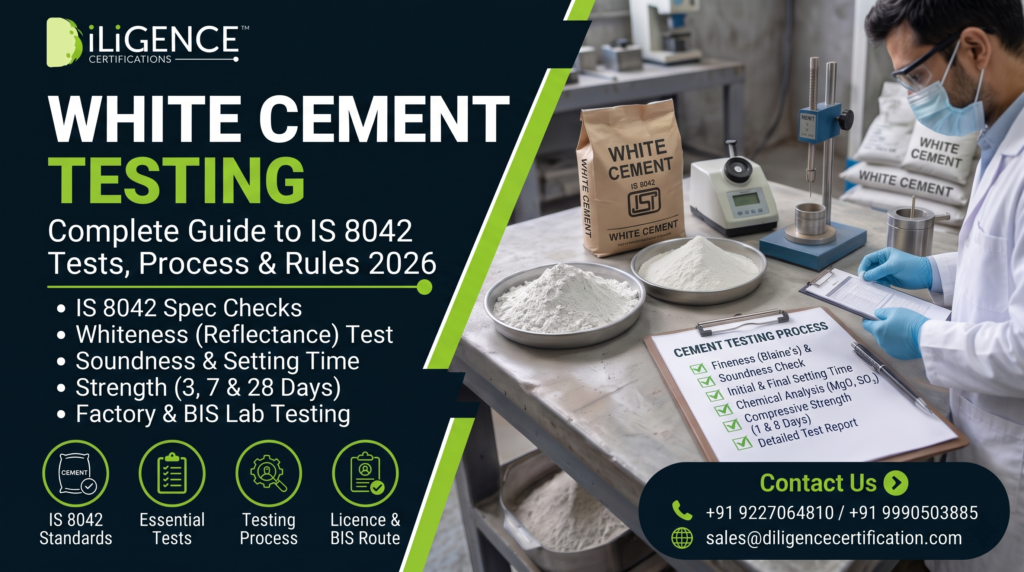
- White cement testing checks if your cement meets the chemical and physical limits of IS 8042:2015.
- Whiteness is the one extra test that grey cement does not have. It is checked as reflectance with a proper instrument.
- White cement is cement first and white second. It must also pass strength, fineness, setting time and soundness.
- Testing happens at two levels: your own factory lab every day, and a BIS recognised lab for the licence.
- Most failures come from raw material changes, wrong sampling and poor kiln or mill control, not from bad luck.
- Keep your records clean. Test reports without batch details create problems at the time of audit.
Introduction
Think about a tile shop. Two boxes of the same white tile can look different once they are laid side by side. The shop owner then gets calls, returns and arguments. White cement works in the same way. Your tests must catch the problem in the lab, before the customer catches it on the site.
That is why white cement testing is not a small formality. It protects your brand, your licence and your buyer.
In this blog, we will go step by step. What the tests are, which standard applies, how the process works, and what mistakes to avoid. Very simple language, no heavy jargon.
What Is White Cement Testing?
White cement testing means checking samples of white Portland cement in a laboratory against the requirements of the Indian Standard. The standard is IS 8042, and the current version is IS 8042:2015.
The lab checks chemical limits, physical properties and the degree of whiteness. If the results are inside the limits, the product can be said to conform to the standard.
Three things matter here:
- Legal base: Cement products come under a Quality Control Order, so BIS certification is needed for the covered products. Please confirm the current status on the BIS website before you plan, because orders and dates get updated.
- Licence: A manufacturer needs a BIS licence to use the ISI mark. Test reports from a recognised lab are a key part of getting it.
- Surveillance: After the licence, BIS keeps checking. Samples can be drawn from the factory or the market and tested again.
White Cement vs Grey Cement: The Simple Difference
Chemically, both are Portland cements. They hydrate and gain strength in a similar way. The difference is in the raw material and the colour control.
| Point | Grey Cement | White Cement |
|---|---|---|
| Raw material | Normal limestone and clay with iron | Very pure limestone and clay with very low iron |
| Colour | Grey | White, with a controlled whiteness level |
| Main extra test | None for colour | Whiteness (reflectance) test |
| Typical use | Structural work | Decorative work, tile joints, terrazzo, precast panels, wall finish |
| Handling | Normal care | Extra care to avoid contamination |
One common mistake is to treat white cement as only a decorative powder. It is not. It is a full Portland cement and must pass the strength and other physical tests too.
Which Standards Apply to White Cement?
| Standard | What It Covers |
|---|---|
| IS 8042:2015 | Specification for white Portland cement: chemical and physical requirements, whiteness, packing and marking |
| IS 4031 (various parts) | Methods of physical tests: fineness, setting time, soundness, compressive strength |
| IS 4032 | Method of chemical analysis of hydraulic cement |
| IS 269 | Referred for storage, sampling and some test practices as the standard directs |
Simple example: A manufacturer makes white cement in 50 kg bags. The lab will draw a sample, run the IS 4031 methods for physical tests, run the IS 4032 methods for chemistry, and run the whiteness test as given in IS 8042. The final report then compares every result against the limit in IS 8042.
Note: IS 8042 was revised in 2015, and the older 1989 version is now history. Always work from the latest version and check the BIS site for any amendment.
Why Is White Cement Testing Important?
- It proves the cement meets the national standard, so builders can trust it.
- It keeps the shade consistent from batch to batch.
- It protects the strength of the work, because white cement is used in real construction too.
- It is needed to get and keep the BIS licence.
- It reduces complaints, returns and claims.
- It helps you find process problems early, before a full batch is wasted.
- It builds long term brand value in a market where colour is everything.
What Tests Are Conducted on White Cement?
Here is the list in simple words. Exact limits and clauses are in IS 8042:2015, so always take them from the standard itself.
| Test Group | What the Lab Checks | In Simple Words |
|---|---|---|
| Fineness | How fine the cement powder is, usually by the air permeability method | Finer cement reacts faster and gives a smoother finish |
| Setting time | Initial and final setting time | How long the paste stays workable and when it hardens |
| Soundness | Expansion by Le Chatelier method, and autoclave where required | Will the cement crack or swell after hardening |
| Compressive strength | Strength of standard mortar cubes at the ages given in the standard | How much load the hardened cement can take |
| Chemical analysis | Magnesia, sulphur trioxide, insoluble residue, loss on ignition and other limits | Is the chemistry within the safe range |
| Whiteness | Reflectance of the cement sample | How white the cement actually is |
| Transverse strength | Bending strength, where applicable | Mostly checked as the standard directs |
| Packing and marking | Bag details, ISI mark, batch information | Is the label correct and complete |
The Whiteness Test Explained in Simple Words
This is the test that makes white cement different. The lab uses a reflectance method. A prepared cement sample is placed in front of an instrument, light falls on it, and the instrument measures how much light bounces back. A higher reading means a whiter cement.
In IS 8042, a minimum whiteness level is specified. Your result must not fall below that level. Many good manufacturers keep their own internal target well above the minimum, so that normal variation never becomes a problem.
A few practical points:
- The sample surface must be smooth and prepared exactly as the method says. A rough surface gives a wrong reading.
- Even a tiny bit of grey cement dust in the sample can pull the result down.
- The instrument must be calibrated with a proper reference standard.
- Do the test on the same type of sample every time, so your trend data is meaningful.
Two Kinds of Testing: Factory Lab vs Recognised Lab
| Point | Factory Lab | BIS Recognised Lab |
|---|---|---|
| Who does it | Your own quality team | An independent lab recognised by BIS |
| How often | Regularly, as per your testing scheme | For licence grant and as BIS asks |
| Purpose | Day to day control of every batch | Independent proof for the licence |
| Report use | Internal records and audit | Submitted with the application and kept for surveillance |
You need both. A strong factory lab makes the recognised lab results predictable.
Step-by-Step Process for White Cement Testing and BIS Registration
- Read the standard. Get IS 8042:2015 and the related IS 4031 and IS 4032 parts. Check amendments.
- Set up your factory lab. BIS expects the equipment and trained people to run the required tests in house.
- Do pre-testing. Test a few batches yourself first. Fix any gap in fineness, setting time or whiteness before going further.
- Choose a recognised lab. Confirm the lab is recognised by BIS and that white cement testing is in its scope.
- Draw the sample properly. Follow the sampling method. Record batch number, date and production line.
- Send the sample with documents. Add the forwarding letter and product details.
- Get the test report. Check that all results are inside the limits and that the details are correct.
- Apply to BIS. File the application with the test report and the other documents.
- Factory inspection and grant. BIS officials visit the plant, verify your process and, if everything is fine, the licence is granted.
Which BIS Registration Is Needed?
| Business Type | What Is Generally Needed |
|---|---|
| Indian manufacturer | BIS licence under the product certification scheme |
| Foreign manufacturer | BIS licence under the foreign manufacturer scheme, with an Authorised Indian Representative |
| Importer | Goods should come from a BIS licensed source and carry the ISI mark |
| Private label seller | Product must be made at a licensed factory and the marking must be correct |
| Export only unit | Needs depend on the buyer country, so check before planning |
When the licence needs a change: if you change the plant location, add a new production line or change the raw material source in a major way, inform BIS and ask what is needed.
Documents Required
Company documents
- Business registration proof
- Factory address and ownership proof
- Authorised signatory details
Product and plant documents
- Manufacturing process flow
- List of machines and testing equipment
- Raw material details and sources
- Quality control plan and trained personnel details
- Marking and packing details
Testing records
- Test report from a BIS recognised lab
- Calibration certificates of lab instruments
- Internal test records of recent batches
How Long Does It Take?
There is no fixed number that suits everyone. The time depends on how ready your lab is, how fast the recognised lab gives the report, how quickly your documents are complete and how soon the factory inspection is scheduled. Clean documents save the most time. Most delays come from missing papers and re-testing.
What Decides the Cost?
We are not giving any amount here, because it changes with every case. The main factors are:
- Number of tests and the lab you choose
- Number of samples and re-tests
- Your lab equipment and calibration needs
- BIS fees and inspection related expenses
- Travel, courier and documentation work
- Consultant support, if you take it
If you want a clear breakup for your plant, ask for a written one after sharing your details.
Common Failures and Easy Fixes
| Problem | Likely Reason | Easy Fix |
|---|---|---|
| Low whiteness | Iron or other colouring material in raw mix, or contamination from grey cement | Control raw material iron, clean the mill and conveying system fully |
| Whiteness varies batch to batch | Unstable kiln or fuel changes | Keep burning conditions steady and test every batch |
| High setting time | Gypsum level or fineness not balanced | Review gypsum dosage and grinding |
| Soundness failure | Free lime or high magnesia | Improve burning and check raw mix |
| Low strength | Coarse grinding or poor clinker quality | Improve fineness and clinker control |
| Report rejected | Wrong sample details or missing batch number | Fill the sample form carefully and keep records |
Common Mistakes to Avoid
- Using an old version of the standard.
- Skipping pre-testing and going straight to the recognised lab.
- Mixing grey and white cement in the same mill or storage without proper cleaning.
- Not calibrating the whiteness instrument.
- Drawing samples casually, without a proper method.
- Keeping incomplete batch records.
- Changing raw material source without informing the quality team.
- Ignoring marking and packing details until the last day.
Who Needs White Cement Testing?
- Manufacturers who make white Portland cement in India.
- Importers who bring white cement from other countries and need a licensed source.
- Private label brands that sell under their own name.
- Overseas manufacturers who want to sell in India.
- Export-only units who need to check what their buyer country asks for.
- Quality managers and lab heads who want to improve their testing system.
Why Choose Diligence Certifications for White Cement Testing Certification?
If you are planning white cement testing and BIS certification, you need clear guidance and good documentation. Diligence Certifications helps businesses understand the standard, prepare the paperwork and plan each step in an organised way. You can see the details on the BIS certification service page.
What you can expect:
- Simple explanation of IS 8042:2015 and the testing scope
- Help with document checklists and application preparation
- Support in coordinating with testing labs and the BIS process
- Practical tips from past experience to avoid common delays
No consultant can promise approval, because the final decision belongs to BIS. What a good consultant can do is make your file clean and your preparation strong.
After Registration: What Happens Next?
Getting the licence is not the end. BIS can draw samples from your factory or from the market and test them again. You must keep testing every batch, maintain records and use the ISI mark exactly as allowed. Renew the licence on time and report any major change in the plant or process.
Tips to Pass in the First Attempt
- Study the standard before you buy any equipment.
- Keep a separate mill, silo and packing line for white cement if possible.
- Keep raw material iron under tight control.
- Test every batch for whiteness, fineness and setting time.
- Calibrate instruments on schedule and keep the certificates.
- Train your lab staff on sampling and sample preparation.
- Do at least two trial batches before the recognised lab test.
- Review the test report line by line before filing the application.
Quick Checklist Before Sending Samples
- Latest IS 8042 version checked
- Batch number and date written on the sample
- Sample drawn by the standard method
- Sealed in clean, dry, airtight packing
- Whiteness instrument calibration is valid
- Forwarding letter and product details attached
- Marking and bag details match the standard
- Lab confirmed to have white cement testing in scope
Conclusion
White cement testing is simple once you understand the pattern. Follow IS 8042:2015, control your raw material, keep the mill clean, test every batch and keep your records neat. If you do these basics well, the recognised lab test and the BIS inspection become much easier.
Start early, do pre-testing and take expert help if you feel stuck. A little preparation now saves months later.
Frequently Asked Questions
1. What is rapid hardening cement?
It is a Portland cement that gains strength faster than ordinary cement, mainly because it is ground finer and has a different chemical balance.
2. Which standard covers rapid hardening cement in India?
IS 8041 is the product standard. Test methods come from IS 4031 and IS 4032.
3. Which tests are done on rapid hardening cement?
Fineness, consistency, setting time, soundness, early compressive strength and chemical analysis.
4. Why is early strength tested so carefully?
Because users depend on early strength to remove formwork and start the next work.
5. Is BIS certification needed for this cement?
As far as we know, cement comes under BIS certification. Please confirm the current notification.
6. Can I test the cement in my own lab?
Yes, for process control. But a recognised lab is needed for third party proof.