BIS Certification
 CDSCO
 PESO
 CPCB
 LMPC
 WPC Approval
 Global Approvals
 TEC
 ARAI
 BEE
 ISO Certification
 DGCA Certification
 NOC For Steel
 APEDA Registration























 Business Registration
 FSSAI Mark Certification












 (32).jpg)
 Legal Services
 Trademark Registration
 Copyright Registration
 Patent Registration
 By
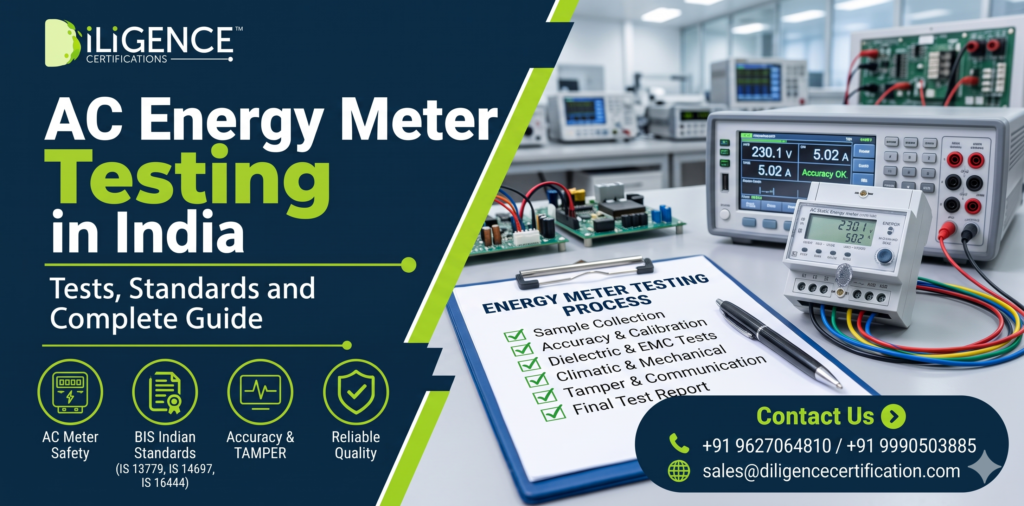
- AC energy meter testing checks whether a meter measures electricity correctly and stays safe and reliable in real field conditions.
- Most static meters in India are tested against Indian Standards such as IS 13779, IS 14697 and IS 16444 (for smart meters). Always confirm the latest version before you start.
- Accuracy is the heart of the test, but safety, climate, EMC and tamper checks matter just as much.
- Testing is done in two places: your own factory lab and a recognised third-party lab. Both are important.
- Most failures happen because of poor sample preparation, missing documents or untested design changes.
- Planning early, keeping records clean and testing a pre-check batch can save you weeks.
Introduction
Think about the weighing scale at a sabzi mandi. If it shows 900 grams instead of 1 kg, the customer loses money every single day. Now think about an electricity meter. It runs 24 hours, for years, in heat, dust, humidity and voltage fluctuations. A tiny error, repeated every minute, becomes a big bill difference.
That is why AC energy meter testing exists. Before a meter goes to a home, shop or factory, it must prove it can measure correctly and survive tough conditions.
In this blog, we will keep things simple. You will learn what the testing means, which standards apply, which tests are done, how the process works and what mistakes to avoid. If you make, import or supply energy meters, this guide is for you.
What Is AC Energy Meter Testing?
An AC energy meter measures how much electrical energy is used, usually in kilowatt-hours (kWh). AC energy meter testing is the set of checks done on a meter to confirm that it meets the requirements of the applicable standard.
In simple words, the lab asks four questions:
- Does the meter measure energy correctly at light load, normal load and heavy load?
- Does it stay accurate when voltage, frequency or temperature changes?
- Is it electrically safe and strong enough to handle surges and shocks?
- Can it resist tampering and still show reliable readings?
Testing can be done on a type sample (to approve a design) or on routine production samples (to check ongoing quality). Utilities and buyers also run their own acceptance tests on supplied lots.
Types of AC Energy Meters
Different meters have different test needs. Here is a quick view.
| Meter type | Where it is used | Testing note |
|---|---|---|
| Single-phase static meter | Homes, small shops | Most common; tested for accuracy, safety, climate and EMC |
| Three-phase whole current meter | Larger homes, commercial loads | Tested on all three phases and for phase-related disturbances |
| CT or CT-PT operated meter | Industry, high load | Accuracy class is tighter; tested with its instrument transformers where applicable |
| Smart meter | Utility rollouts | Extra checks for communication, data exchange and remote functions |
| Prepaid meter | Metering with advance payment | Extra checks for relay, credit logic and display |
Which Standards Apply?
In India, AC static energy meters are mostly tested against Bureau of Indian Standards (BIS) documents. Utilities may also add their own technical specifications on top.
| Standard | What it covers |
|---|---|
| IS 13779 | AC static watt-hour meters, Class 1 and Class 2 (typical for homes and small loads) |
| IS 14697 | AC static transformer-operated watt-hour and VAR-hour meters, Class 0.2S and 0.5S (typical for high-value metering) |
| IS 16444 | AC static direct connected watt-hour smart meters, Class 1 and Class 2 |
| IS 15959 | Data exchange for electricity meter reading, tariff and load control (used with smart and communicating meters) |
A simple example: A company makes a single-phase meter for household use. The accuracy class is 1.0. The lab will usually test it against IS 13779, and if it is a smart meter, against IS 16444 along with the data exchange requirements.
Please note: Standards get revised from time to time, and utilities also issue their own technical specifications and deadlines. Before you book a test, check the current version and the buyer’s requirement. Do not depend on old reports or old blog posts.
Why AC Energy Meter Testing Is Important
- Billing accuracy: Wrong readings mean wrong bills, complaints and legal trouble.
- Consumer trust: People trust a tested meter. An untested one creates doubt.
- Safety: Insulation and heating checks reduce the risk of shock or fire.
- Long life: Climate and vibration tests show whether the meter will survive real conditions.
- Tender eligibility: Many utilities and projects ask for valid type test reports.
- Fewer rejections: Lots that pass acceptance testing mean fewer returns and penalties.
- Brand reputation: One bad batch can damage years of goodwill.
What Tests Are Conducted?
The exact list depends on the standard and meter type, but most testing falls under these groups.
| Test group | What the lab checks | In simple words |
|---|---|---|
| Accuracy tests | Error at different currents and power factors | Is the meter reading correct? |
| Starting current and no-load | Meter must start at very low current and must not creep without load | Does it count when it should, and stay quiet when it should? |
| Influence quantities | Effect of voltage change, frequency change, temperature, harmonics, magnetic fields | Does it stay accurate when conditions change? |
| Dielectric tests | Impulse voltage and AC high-voltage withstand, insulation resistance | Can it handle surges and stay insulated? |
| EMC tests | Electrostatic discharge, fast transients, surges, radio-frequency interference | Does it ignore electrical noise? |
| Climatic tests | Dry heat, cold, damp heat cycles | Will it work in summer, winter and monsoon? |
| Mechanical tests | Vibration, shock, spring hammer | Will it survive handling and transport? |
| Ingress protection | Dust and water resistance | Will dust and water get inside? |
| Fire and heat resistance | Glow wire and heating tests for terminal block and cover | Will it catch fire under fault conditions? |
| Display and marking | Readability, correct markings, meter constant | Is the information clear and correct? |
| Tamper tests | Magnet, neutral disturbance, reverse connection, cover opening | Can someone easily cheat the meter? |
| Communication tests (smart meters) | Data exchange, remote commands, time-keeping | Does it talk properly to the head-end system? |
Accuracy Testing Explained in Simple Words
Accuracy is the first thing everyone asks about, so let us make it easy.
A meter has an accuracy class, for example Class 1.0. This means that, under reference conditions, the error should stay within a set percentage limit at the specified loads. The lab connects the meter to a test bench with a very accurate reference meter and applies known current, voltage and power factor. Then it compares both readings.
A few points to remember:
- Different loads: Error is checked at very light load, mid load and maximum current.
- Different power factors: Real loads are not always perfect, so the lab checks at unity and at lagging or leading power factor.
- Repeatability: The meter should give nearly the same result when the same test is repeated.
- Starting current: The meter must begin recording at a very small current, as per the standard.
- No-load creep: With voltage but no current, the meter pulse output should not keep running.
If your meter is borderline in any of these, it is better to find out in your own lab before sending it outside.
Two Kinds of Testing: Factory Lab and Recognised Lab
Many manufacturers get confused here. Both matter, but they do different jobs.
- Factory lab testing: Done by you on every meter or on regular samples. It checks routine accuracy, calibration and basic functions. Your calibration records here are important proof of control.
- Recognised third-party lab testing: Done on type samples by an accredited laboratory. This gives you the independent report that buyers, utilities and regulators usually ask for.
The factory lab keeps daily quality in check. The third-party lab proves your design is sound. You need both.
Step-by-Step Process for AC Energy Meter Testing
- Confirm the requirement. Check the applicable standard, accuracy class and any buyer or utility specification.
- Freeze the design. Do not change components or firmware after sample selection.
- Do an internal pre-check. Run accuracy, starting current and basic safety checks in your own lab.
- Choose a suitable lab. Pick an accredited lab that covers the scope you need, including EMC and climatic tests.
- Prepare the samples. Send the quantity the lab asks for, with proper marking, seals and test points.
- Submit documents. Share the application form, circuit diagram, bill of materials, manual and any earlier test records.
- Testing starts. The lab runs the sequence of tests and records results.
- Review observations. If any test fails, study the root cause, fix it and retest only after changes are documented.
- Receive the test report. Keep the final report, sample details and calibration certificates safely for audits and tenders.
Which Route or Approval Is Needed?
The route depends on who you are and where the meter will be used. Always verify with the buyer or the relevant authority.
| Business type | Typical need |
|---|---|
| Indian manufacturer for utility supply | Type test reports as per the tender, plus routine and acceptance tests |
| Indian manufacturer for open market | Test reports to the applicable IS standard and any regulatory requirement in force |
| Importer or trader | Reports for the imported model, authorisation from the manufacturer and documents showing the standard |
| Private label brand | Reports for the exact model carrying the brand, with a clear link to the original manufacturer |
| Overseas manufacturer | Local testing or acceptable reports, plus compliance paperwork for the Indian market |
Requirements can change when a standard is revised, when a new rule comes into force or when the meter design changes. Recheck before every new order.
Documents Required
Company documents
- Company registration and address proof
- Authorisation letter for the person handling the testing
- Manufacturing unit details
Product documents
- Model name, ratings and accuracy class
- Circuit diagram and bill of materials
- Firmware version details (for smart meters)
- User manual and marking details
- Photographs of the meter and terminal block
Testing records
- Factory calibration records
- Earlier test reports, if any
- Calibration certificates of your reference equipment
- Critical component test records (for example, shunt or CT, energy metering chip, relay, battery)
How Long Does AC Energy Meter Testing Take?
There is no single answer. The time depends on the meter type, the number of tests, the lab’s schedule and whether any test fails and needs a retest.
A simple single-phase meter with a clean pre-check can move faster. A smart meter with communication and tamper tests usually takes longer. Climatic and EMC tests also need long chambers and slots. So, plan in advance and ask the lab for a realistic schedule instead of assuming dates.
Cost of AC Energy Meter Testing
We are not mentioning a fixed amount here, because the cost changes from case to case. These are the main factors:
- Type of meter (single phase, three phase, CT operated, smart)
- Accuracy class and number of tests in scope
- Number of samples
- EMC, climatic and communication test requirements
- Retests if the first attempt fails
- Sample transport and preparation
The best way is to ask for a clear test-wise breakup before you book. That way, no surprise comes later.
Common Failures and Easy Fixes
| Common failure | Likely reason | Easy fix |
|---|---|---|
| Error beyond limit at light load | Poor calibration or noisy metering chip | Recalibrate and improve input circuit design |
| Meter creeps at no load | Offset in metering circuit | Adjust threshold and verify the firmware logic |
| Fails surge or ESD test | Weak protection on power supply or ports | Add suitable protection parts and improve layout |
| Display fades or restarts | Power supply instability | Strengthen the power supply design |
| Fails damp heat test | Moisture entering the PCB or enclosure | Use conformal coating and better sealing |
| Tamper not detected | Weak magnetic or neutral sensing | Improve the sensing logic and test with strong magnets |
| Wrong markings | Label printed from an old template | Update the label as per the standard before sampling |
Common Mistakes to Avoid
- Sending samples without a proper pre-check
- Using an old or withdrawn version of the standard
- Changing components or firmware after samples are submitted
- Sending samples that are not production representative
- Poor or missing calibration records for the reference equipment
- Incomplete or wrongly marked meters
- Ignoring buyer-specific requirements while focusing only on the IS standard
- Hurrying the retest without finding the real root cause
Who Needs AC Energy Meter Testing?
- Manufacturers: To prove the design and keep production quality steady.
- Importers: To confirm the imported model meets Indian requirements.
- Private label brands: To make sure the branded model is actually tested.
- Overseas manufacturers: To enter the Indian market with proper reports.
- Utilities and discoms: To verify supplied meters before use.
- Project contractors and EPC companies: To avoid problems during commissioning.
Why Choose Diligence Certifications for AC energy meter testing Certification?
Choosing the right partner makes the whole journey smoother. At Diligence Certifications, the focus is on clear guidance, not confusion.
- Simple guidance: We explain the standard, the tests and the documents in easy language.
- Pre-testing support: We help you review the design, records and samples before they reach the lab.
- Document help: We help you organise the files so that nothing gets missed.
- Lab coordination: We help you stay in touch with the testing lab and understand each observation.
- Updated information: We keep an eye on revised standards and changing requirements.
- Transparent approach: We tell you what is needed, step by step, without false promises. Results always depend on the product and the testing outcome.
If you want help with your meter model, you can check our services page and take the next step.
After Testing: Keep the Quality Going
Passing the test is not the finish line. Keep these habits after that:
- Follow your factory routine tests for every batch
- Keep traceability of components and firmware
- Re-test or inform the lab if you change a critical part
- Calibrate your reference meters and test benches on schedule
- Store reports and records safely for audits and tender submissions
- Track field complaints and use them to improve the next batch
Tips to Pass in the First Attempt
- Read the latest standard and buyer specification fully.
- Test your sample internally before sending it out.
- Use production-representative samples, not hand-made prototypes.
- Freeze the design and firmware before submission.
- Keep all calibration certificates ready and valid.
- Check marking and terminal details twice.
- Test protection against surge, ESD and magnets in your own lab.
- Discuss any doubt with the lab before testing starts.
Quick Checklist Before Sending Samples
- Correct standard and accuracy class confirmed
- Design and firmware frozen
- Internal accuracy and starting current checked
- Samples are production representative
- Markings and labels verified
- Circuit diagram, BOM and manual ready
- Calibration records and certificates available
- Lab scope and schedule confirmed
Conclusion
AC energy meter testing is not just paperwork. It is the proof that your meter is honest, safe and ready for years of work in real conditions. A meter that passes properly gives your customer confidence and gives you a stronger name in the market.
Start with the right standard, test internally first, keep your records clean and work with a lab and a guide who explain things clearly. That one habit saves time, money and a lot of headache later.
Frequently Asked Questions
1. What is AC energy meter testing?
It is the set of checks done on a meter to confirm that it measures energy correctly and meets the safety, climatic and EMC requirements of the applicable standard.
2. Which standards are used for AC static energy meters in India?
Commonly used standards include IS 13779, IS 14697 and IS 16444 for smart meters, along with IS 15959 for data exchange. Always check the latest version and the buyer's specification.
3. What is the accuracy class of a meter?
It is the permitted error limit under set conditions. Class 1.0 and 2.0 are common for homes, while Class 0.2S and 0.5S are used for high-value metering.
4. Is testing needed for every meter or only for samples?
Type testing is done on samples to approve a design. Routine testing is done by the manufacturer on production meters, and utilities may also run acceptance tests on lots.
5. What is starting current?
It is the smallest current at which the meter starts recording energy. The standard gives the limit for this.
6. What is no-load creep?
t means the meter keeps counting even when no load is connected. A good meter should not do this.