BIS Certification
 CDSCO
 PESO
 CPCB
 LMPC
 WPC Approval
 Global Approvals
 TEC
 ARAI
 BEE
 ISO Certification
 DGCA Certification
 NOC For Steel
 APEDA Registration























 Business Registration
 FSSAI Mark Certification












 (32).jpg)
 Legal Services
 Trademark Registration
 Copyright Registration
 Patent Registration
 By
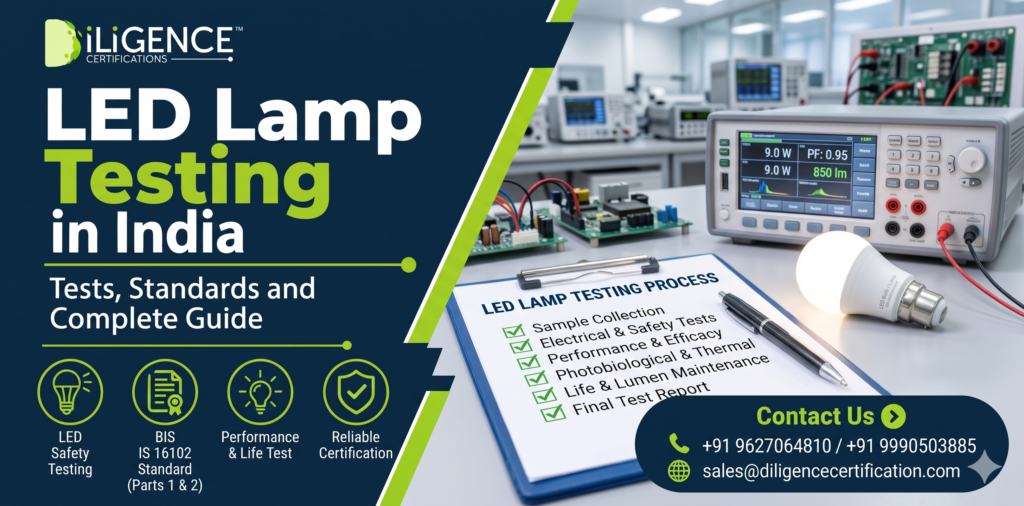
- LED lamp testing checks two big things: is the lamp safe, and does it perform as the label says.
- For self-ballasted LED lamps, the Indian standards are IS 16102 (Part 1) for safety and IS 16102 (Part 2) for performance. Both now have 2026 editions.
- BIS has extended the implementation date for the revised IS 16102 (Part 1):2026 to 02 February 2027. Please confirm the latest status before you plan anything.
- Most LED lamps fail on marking, heating, power factor, light output and life tests, not on something very rare.
- Testing is done at two levels: your own factory lab (routine) and a recognised lab (type testing).
- If you are a manufacturer, importer or brand owner, you need to plan testing and registration before you sell, not after.
Introduction
Think about the last time you bought a cheap LED bulb. It looked fine on the shop shelf. The box said 9 watt, 6500K, 2 years warranty. Then after three months it started flickering, or the plastic turned yellow, or the light was much dimmer than the old one. Now imagine the same problem in thousands of lamps going to homes, shops and offices.
That’s exactly why LED lamp testing exists. It’s like a driving test for the lamp. The lab checks whether the lamp is safe to touch, safe to heat up, and honest about the watts and the lumens it claims.
In this blog, we will go through LED lamp testing in simple words. What it is, which standards apply, which tests are done, how the process works, and where people usually go wrong. If you make, import or sell LED lamps, this will save you a lot of time.
What Is LED Lamp Testing?
LED lamp testing means checking an LED lamp against the requirements of the applicable standard. A recognised lab takes sample lamps, runs electrical, thermal, mechanical, photometric and safety tests, and then issues a test report.
In this blog, when we say LED lamp, we mainly mean the self-ballasted LED lamp. This is the bulb-type lamp that has the LED, the driver (the small electronic circuit) and the cap, all inside one body. You just screw it in or push it in, and it works.
The test report is not a decoration. It’s the main document for BIS registration, and it also helps in buyer audits, tenders and quality checks.
A few points to keep in mind:
- Testing is done on the finished lamp, not only on the LED chip or the driver.
- Every claim on your label (watts, lumens, colour temperature, life) can be checked.
- A change in the driver, the LED or the body material can mean fresh testing.
LED Lamp, LED Module, Driver and Luminaire: What Is the Difference?
People mix these four up all the time. Here is a simple way to remember.
| Product | What it is | Simple example |
|---|---|---|
| Self-ballasted LED lamp | Complete lamp with LED, driver and cap in one unit | The 9 W bulb you screw into a holder |
| LED module | The LED part only, without the full lamp body | The LED board inside a downlight |
| LED driver | The electronic circuit that gives power to the LED | The small box or board that converts mains power |
| Luminaire | The full light fitting that holds the lamp or module | A batten, a street light or a panel fitting |
Each of these can have a different standard. So first decide which one your product really is, and then plan the testing.
Which Standards Apply to LED Lamp Testing in India?
The Bureau of Indian Standards (BIS) publishes the product standards. For self-ballasted LED lamps for general lighting services, these are the main ones.
| Standard | What it covers |
|---|---|
| IS 16102 (Part 1) | Safety requirements for self-ballasted LED lamps |
| IS 16102 (Part 2) | Performance requirements for self-ballasted LED lamps |
| IS 16103 | LED modules for general lighting (safety and performance parts) |
| IS 16108 | Photobiological safety of lamps and lamp systems |
| IS 10322 series | Luminaires (the fittings), revised in 2026 as well |
A simple example: Suppose you make a 9 W, 6500 K, screw-cap (B22 or E27) LED lamp for homes. The lab will test the safety side under Part 1 (insulation, heating, marking, fire resistance) and the performance side under Part 2 (lumens, efficacy, power factor, life). Both reports are needed.
Revised Standards and the Extended Deadline
This part is important, so read it slowly.
- BIS has published revised versions of IS 16102 (Part 1) and IS 16102 (Part 2) in 2026. They replace the older editions (the 2012 edition of Part 1 and the 2017 edition of Part 2).
- The earlier transition date was 02 August 2026. BIS has since extended the implementation date for IS 16102 (Part 1):2026 to 02 February 2027.
- After the final date, BIS will take new applications only under the revised standard, and existing licence holders must move to the revised edition.
- Licence holders and new applicants should check the BIS notices for the exact declaration and scope-change rules.
Standards and deadlines can change again. Before you send samples, please check the BIS website or ask your certification consultant for the latest position. Don’t trust an old blog or an old test report blindly.
Why Is LED Lamp Testing Important?
Some people see testing as a cost with no return. It’s not like that. Here’s why it matters:
- Safety of people: A poor lamp can give an electric shock or overheat in the holder.
- Fire prevention: Weak plastic and poor drivers are known causes of burnt holders and melted caps.
- Legal need: Self-ballasted LED lamps come under BIS registration, so you need proper test reports.
- Honest labels: Testing checks whether the watt, lumen and life claims are really true.
- Fewer complaints: A lamp that passes properly is less likely to come back from the market.
- Buyer trust: Distributors, builders and government buyers ask for reports before they order.
Simply put, a good test report is cheaper than a market recall.
What Tests Are Conducted in LED Lamp Testing?
The full list in the standard is long, and the exact tests depend on the edition. But most tests fall into a few groups.
| Test group | What the lab checks | In simple words |
|---|---|---|
| Marking | Rating, brand, model, voltage, power, cap type, markings stay readable | Does the lamp tell the truth, clearly? |
| Interchangeability | Cap and dimensions fit the standard holder | Will it fit in a normal holder? |
| Protection against electric shock | Live parts cannot be touched | Can a person get a shock by touching it? |
| Insulation and electric strength | Insulation resistance and high-voltage withstand | Does the insulation hold up under stress? |
| Heating and temperature | Cap, body and terminals do not get too hot | Will the holder and the lamp stay safe after hours of use? |
| Mechanical strength | Cap torque, bending, impact | Will the lamp survive normal handling? |
| Heat and fire resistance | Plastic parts under heat and glow-wire type tests | Will it catch fire or melt in a fault? |
| Creepage and clearance | Safe air and surface gaps between live parts | Is there enough gap inside the lamp? |
| Fault conditions | Behaviour under abnormal or faulty operation | If something fails, does it fail safely? |
| Photobiological safety | Blue light hazard and similar limits | Is the light itself safe for eyes? |
| Performance | Light output, efficacy, power factor, colour, life | Does it give the light and life it promises? |
1. Marking and General Checks
- Is the rated voltage, power, brand, model number and cap type marked properly?
- Are the markings permanent, and do they stay readable after rubbing?
- Do the claims on the packing match the lamp?
Marking is a small matter, but it’s the most common reason for a retest.
2. Safety Tests (Part 1 side)
- Protection against touching live parts.
- Insulation resistance and electric strength.
- Temperature rise of the cap and the body.
- Mechanical strength tests on the cap and the body.
- Resistance of plastic to heat and fire.
- Creepage, clearance and fault condition tests.
3. Performance Tests (Part 2 side)
- Initial light output (lumens) and efficacy (lumens per watt).
- Power consumption and power factor.
- Colour temperature and colour rendering.
- Starting time and run-up time.
- Lumen maintenance, life, and switching cycles.
- Behaviour at different supply voltages.
Note: The final list, the sequence and the number of samples are decided by the standard edition applicable to your product, so please follow the lab’s sample plan.
What Is New in the Revised Standards?
The 2026 editions replace the older ones. Here is a simple summary of what is clear and what you must verify yourself.
| Point | What it means for you |
|---|---|
| Part 1 first revision, 2026 | Safety requirements are updated and the 2012 edition is replaced |
| Part 2 revision, 2026 | Performance requirements are updated and the 2017 edition is replaced |
| Alignment with IEC standards | The revised parts take reference from the international IEC standards for LED lamps |
| Declaration for the revised edition | Applicants working under the old edition had to declare that they would move to the revised one |
| Extended date | Implementation date of the revised Part 1 is now 02 February 2027 |
| Technical changes | Read the standard text or take expert help, because limits and test methods may differ from the old edition |
Don’t assume that an old test report will be accepted. Your consultant or lab can tell you which tests need to be repeated for the new edition.
Performance Parameters Explained in Simple Words
Most buyers care about performance, not the safety clauses. So let’s make these terms clear.
| Parameter | What it means | Simple example |
|---|---|---|
| Luminous flux (lumens) | How much light the lamp gives | A 9 W lamp giving around 800 lumens looks bright |
| Efficacy (lm/W) | Light you get for each watt | Higher is better, since you save electricity |
| Power factor | How well the lamp uses the supply power | A low power factor wastes electricity on the grid |
| Colour temperature (CCT) | The warmth or coolness of the light | 2700 K is warm yellow, 6500 K is cool white |
| Colour rendering (CRI) | How natural the colours look | Fruits and clothes look real under high CRI |
| Run-up time | Time to reach steady light output | Some lamps take a few seconds to settle |
| Lumen maintenance | How much light remains after long use | A lamp that dims too fast is a poor lamp |
| Rated life | How long the lamp is expected to work | Declared in hours and checked by the lab as per the method |
| Switching cycles | How many ON/OFF cycles it can take | Important for places where the light goes on and off often |
Two Kinds of Testing: Factory Lab vs Recognised Lab
People often mix these two up, so let’s keep it clear.
| Point | In-house (factory) lab | Recognised lab |
|---|---|---|
| Done by | Your own factory lab | An outside lab recognised for this product |
| Purpose | Routine checks on production | Full type testing against the standard |
| When | Regularly, batch after batch | Before registration and after major changes |
| Needed for BIS | Yes, for manufacturers | Yes, report from a recognised lab |
For a manufacturer, the factory lab is not optional. During the BIS inspection, the officer checks equipment, calibration records and staff. A weak lab can stop the whole process.
Step-by-Step LED Lamp Testing and Registration Process
The process can differ a little from case to case. But generally, it goes like this:
- Confirm the standard and the deadline. Check the current edition of IS 16102 (Part 1) and (Part 2) and the latest BIS notices.
- Finalise the lamp design and ratings. Wattage, voltage, cap type, CCT and lumen claims should be fixed before sampling.
- Do pre-testing in your own lab. Find the weak points early. It’s cheaper to fix a problem at this stage.
- Choose a recognised lab. Ask the lab about the sample count and the test schedule.
- Submit samples with documents. Give clear labels, drawings and the list of critical components.
- Lab testing is done. The lab runs the full sequence for safety and performance.
- Get the test report. If anything fails, fix the root cause and resubmit.
- Apply for BIS registration. Submit the application, test report, factory details and other documents.
- Inspection and grant. BIS may inspect the factory and then decide on the grant.
After the grant, you need to keep testing regularly and follow the marking rules.
Which BIS Registration Is Needed?
This depends on who you are and where the lamp is made.
| Business type | Usual route | Simple note |
|---|---|---|
| Indian manufacturer | Registration under the BIS scheme for your factory | Factory inspection and in-house lab needed |
| Foreign manufacturer | Registration through the foreign manufacturer route | Needs an Indian authorised representative |
| Importer | The lamp must come from a BIS-registered maker | Check the registration details of the maker |
| Private label brand | Brand added in line with BIS brand rules | Brand name and authorisation must be correct |
Registration usually needs attention again when you add a new model, change the driver or LED source, change the plant, or change the brand. Please check with BIS or your consultant before you make such changes.
Documents Required for LED Lamp Testing and Registration
The exact list depends on your route, but these are common documents.
Company documents
- Business registration and address proof
- Factory or manufacturing unit details
- Authorised signatory details
- Details of the in-house lab and equipment
Product documents
- Circuit diagram and bill of materials
- List of critical components (driver parts, LED, capacitor, plastic body, cap)
- Ratings and model list
- Label design and packing artwork
Testing records
- Calibration certificates of lab instruments
- In-house test records
- Earlier test reports, if any
- The recognised lab report
Keep all documents consistent. If the label says one thing and the circuit diagram says another, the process slows down at once.
How Long Does LED Lamp Testing Take?
There’s no single answer. It depends on the lab’s schedule, the number of models, and whether the lamp passes in the first attempt. The life and lumen maintenance tests take their own time, since the lamp has to run for long periods. After testing, the registration takes more time for the application and inspection.
The biggest time saver is passing in the first go. A failed test means fixing the lamp, making new samples and waiting for the next slot.
What Decides the Cost of LED Lamp Testing?
We are not giving exact numbers here, because the cost changes with the lab, the scope and the time. But these are the main factors:
- Number of models and ratings you want to test
- Number of samples needed by the lab
- Whether it is a fresh test, a retest or a partial test for the revised edition
- Both safety and performance testing, since both parts may be needed
- BIS fees and inspection related costs applicable to your case
- Cost of fixing and remaking samples if the first attempt fails
If you want a clear breakup, share your product list and route with your certification consultant and ask for a written quote.
Common Failures in LED Lamp Testing and Easy Fixes
| Common failure | Usual reason | Easy fix |
|---|---|---|
| Marking not accepted | Missing or unclear details | Check every marking clause before printing the label |
| Temperature too high | Poor heat sinking or weak driver | Improve the heat path, check driver efficiency |
| Low power factor | Cheap driver design | Use a better driver circuit |
| Light output below claim | LED binning or optics problem | Test your own samples and correct the claim or the design |
| Fails heat or glow-wire test | Low-grade plastic | Use the right flame-retardant grade |
| Life or lumen maintenance fails | Overheating and poor LED quality | Improve cooling and LED selection |
| Cap or body breaks | Weak moulding or glue | Improve cap fixing and body strength |
| Insulation failure | Low creepage and clearance in the driver | Redesign the layout for safe gaps |
Common Mistakes to Avoid
- Skipping pre-testing. Going straight to the recognised lab saves a week but can cost two months.
- Wrong lumen or wattage claims. Don’t print big numbers on the box without proof.
- Ignoring the revised standard. Using old edition thinking will create trouble later.
- Using different parts in samples and in production. The sample must represent what you will sell.
- Weak factory lab. Uncalibrated instruments and untrained staff cause problems during inspection.
- Changing the driver without telling anyone. A driver change is a critical change.
- Messy documents. Missing drawings or mismatched details cause delays.
- Copying a test report from another model. Each model needs its own proof, as per the rules.
Who Needs to Know About LED Lamp Testing?
- Manufacturers: You need the report and registration to sell legally and win buyer trust.
- Importers: You must make sure the lamps you bring in come from a properly registered maker and carry the correct marking.
- Private label brands: If a factory makes lamps under your brand name, you must understand how your brand is covered.
- Overseas manufacturers: If you want to sell in India, you have to follow the BIS route meant for foreign makers.
- Dealers and project buyers: Not a legal need, but knowing the basics helps you avoid unsafe, fake-label lamps.
Why Choose Diligence Certifications for LED Lamp Testing Certification?
Getting an LED lamp through testing and registration has many moving parts. The standard, the lab, the documents, the application and the inspection must all line up. That’s where a good consultant helps.
Diligence Certifications works on BIS and product compliance, and here is how the team can support you:
- Helps you understand which standard and route apply to your lamp
- Reviews your marking, circuit diagram and documents before submission
- Guides you on sample preparation and lab coordination
- Supports you step by step with the BIS application
- Helps you prepare for the factory inspection and the in-house lab setup
- Keeps you informed about changes in standards and deadlines, as far as they are published
You can visit the Diligence Certifications website to know more about the company. For product-specific support, you can also check the BIS certification service page.
Please remember, final approval always depends on BIS and the test results. No consultant can promise a grant, but a well-prepared file definitely helps.
What Happens After Registration?
Getting the registration is not the end. After that:
- Keep doing routine tests in your factory lab and keep proper records.
- Follow the marking rules on every lamp and pack you sell.
- Expect market sampling and surveillance checks from time to time.
- Inform BIS about major changes in the product, plant or brand as the rules require.
- Renew the registration on time.
A lamp that passed once but became sloppy later can run into trouble. Consistency is the real test.
Tips to Pass LED Lamp Testing in the First Attempt
- Read the standard, or ask an expert to explain the key clauses.
- Make pre-production samples with the same parts you’ll use in the real batch.
- Test heating, power factor and light output in your own lab first.
- Check the plastic grade certificates from your supplier.
- Review your label against the marking clause once more.
- Keep a few extra samples ready.
- Talk to the lab about the sample plan before sending anything.
- Keep a clean, organised document folder from day one.
Quick Checklist Before Sending Samples
- Latest standard edition and deadline confirmed
- Lamp ratings and claims finalised
- Marking checked against the standard
- In-house pre-testing done
- Critical component details ready
- Circuit diagram and bill of materials ready
- Extra samples packed
- Documents consistent with each other
Conclusion
LED lamp testing isn’t something to rush through. It’s the proof that your lamp is safe, and that the light, the watts and the life on the box are really true.
Start with the right standard, keep an eye on the revised edition and its deadline, do your own pre-testing, keep your marking and documents clean, and choose a good lab. If you do these things properly, most of the common delays can be avoided.
If you’re planning LED lamp testing or BIS registration and want help with the steps, you can talk to the Diligence Certifications team and get your file reviewed before you submit.
Frequently Asked Questions (FAQs)
1. What is LED lamp testing?
It is the process of checking an LED lamp against the applicable standard for safety and performance, so that it is safe to use and the label claims are true.
2. Which standard is used for LED lamp testing in India?
For self-ballasted LED lamps, IS 16102 (Part 1) covers safety and IS 16102 (Part 2) covers performance. Both have revised 2026 editions.
3. What is the deadline for the revised IS 16102 (Part 1):2026?
BIS has extended the implementation date to 02 February 2027. Please check the latest BIS notice before you plan, as dates can change.
4. What is a self-ballasted LED lamp?
t is an LED bulb that has the LED, the driver and the cap built into one unit, so you can use it directly in a normal holder.
5. Is BIS registration needed for LED lamps?
Self-ballasted LED lamps fall under the BIS registration scheme. Please confirm the current requirement for your exact product on the BIS website.
6. What is the difference between an LED lamp and a luminaire?
A lamp is the light source, like a bulb. A luminaire is the full fitting that holds the lamp or the LED module, such as a batten or street light.