BIS Certification
 CDSCO
 PESO
 CPCB
 LMPC
 WPC Approval
 Global Approvals
 TEC
 ARAI
 BEE
 ISO Certification
 DGCA Certification
 NOC For Steel
 APEDA Registration























 Business Registration
 FSSAI Mark Certification












 (32).jpg)
 Legal Services
 Trademark Registration
 Copyright Registration
 Patent Registration
 By
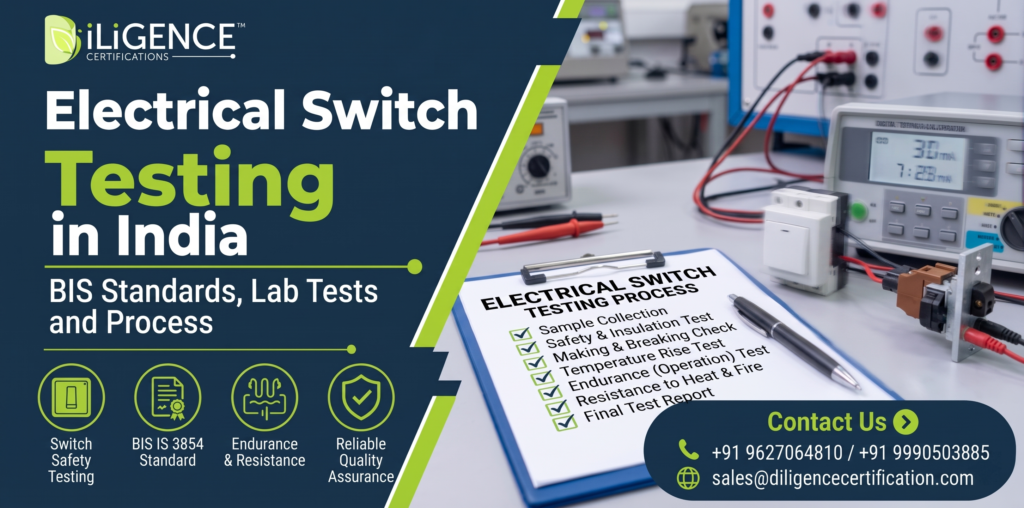
- Electrical switch testing checks whether a switch is safe, strong and reliable for daily use in homes and offices.
- The main Indian standard for domestic switches is IS 3854. The current version is IS 3854:2023 (Third Revision), which replaced the older 1997 version.
- Testing covers shock protection, heating, insulation, strength, endurance, fire resistance and marking.
- Switches are tested in two places: the factory’s own lab and a BIS recognised lab.
- Most failures happen because of poor plastic, weak contacts, loose terminals or wrong marking, not because of big design problems.
- Always check the latest BIS notification and your licence requirement before you start, because deadlines and versions can change.
Introduction
But think about it for a second. That small plastic piece sits between your wall wiring and a live current. Every light, fan, geyser and charger depends on it. If it heats up, cracks or sparks, the problem is not small anymore.
It is like the brake of a vehicle. You never notice a good brake. You only notice it when it fails. Electrical switch testing is the way we make sure the brake works before the vehicle goes on the road.
In this blog, we will explain electrical switch testing in very simple language. You will learn what the standard says, which tests are done, how the process works, and what mistakes you should avoid. It is written for manufacturers, importers, traders and anyone who wants to understand the topic without technical headache.
What Is Electrical Switch Testing?
Electrical switch testing means checking a switch in a laboratory against a set of rules written in an Indian Standard. The lab applies electrical, mechanical and heat conditions to the switch and sees if it survives without becoming unsafe.
The switch we are talking about here is the one you see on a wall plate or switch board. It is used in homes, shops, offices and similar places. Technically it is called a “switch for domestic and similar purposes”.
In India, such switches come under the Electrical Wires, Cables, Appliances and Protection Devices and Accessories (Quality Control) Order. In simple words, if you make or import these switches for the Indian market, you are expected to follow the standard and carry the BIS Standard Mark (ISI mark) as per the rules in force.
Testing is not a one-time formality. It happens first for getting the licence, and then regularly after that during factory checks and market surveillance.
Which Standards Apply to Electrical Switches?
The main standard is IS 3854. Along with it, a few other standards are referred to during testing. Here is a simple table.
| Standard | What it covers | In simple words |
|---|---|---|
| IS 3854:2023 (Third Revision) | Switches for domestic and similar purposes | The main rulebook for wall switches |
| IS 1293 | Plugs and socket outlets | Related product, often sold on the same switch board |
| IS/IEC 60669-2-1 | Electronic switches | For dimmers and similar electronic types |
| IS/IEC 60529 | Degrees of protection (IP code) | How well the switch resists dust and water |
Let us take a simple example. A company makes a 6 A one-way modular switch for home use. The lab will test it mainly against IS 3854. If the same company also sells a combined switch and socket plate, the socket part will need to follow IS 1293.
Note on the revised version: IS 3854 was earlier available as the 1997 version. BIS later published IS 3854:2023, which is the Third Revision and supersedes the 1997 version. Manufacturers should always check the latest BIS notice for the transition date and the version accepted for new and existing licences before they send samples.
Why Is Electrical Switch Testing Important?
Switches are used every day, so any small weakness shows up very fast. Here is why testing matters.
- Safety from shock: A good switch keeps live parts covered so that a finger or tool cannot touch them.
- Fire prevention: Poor plastic and loose contacts get hot. Testing checks that heat stays within safe limits and the body does not catch fire easily.
- Long life: A switch is operated thousands of times. Endurance tests show whether it will last or fail in a few months.
- Legal compliance: Selling switches without the required certification can lead to action under the Quality Control Order.
- Brand trust: Dealers and builders prefer products with valid test reports and ISI marking.
- Fewer complaints: Most returns and complaints come from heating, sparking and broken parts. Testing catches them early.
What Tests Are Conducted in Electrical Switch Testing?
The lab follows the test sequence given in the standard. The exact clauses and limits are in IS 3854:2023, so always read the standard itself. The table below gives a general picture in easy words.
| Test group | What the lab checks | In simple words |
|---|---|---|
| Marking and documents | Rated current, rated voltage, maker’s name or mark, symbols | Is the information printed clearly and does it stay after rubbing? |
| Protection against electric shock | Live parts should not be touchable when the switch is fitted | Can a finger reach any live part? |
| Terminals and connections | Screws, clamps, wire fitting | Does the wire stay tight without damage? |
| Construction | Shape, fitting, mechanism, cover and plate | Is it built properly and assembled well? |
| Insulation resistance and electric strength | Insulation between live parts and body | Does the insulation hold under high voltage? |
| Temperature rise | Heating when rated current flows | Does it stay cool enough? |
| Making and breaking capacity | Switching on and off under load | Does it survive sparks during switching? |
| Normal operation (endurance) | Many switching cycles | Will it still work after thousands of operations? |
| Mechanical strength | Impact and force on the body | Does it crack if hit or pressed hard? |
| Creepage distances and clearances | Gap between live parts on surface and in air | Are the gaps big enough to stop sparks jumping? |
| Resistance to heat and fire | Ball pressure, glow wire and similar tests | Does the plastic soften or burn easily? |
| Resistance to tracking | Behaviour of insulating material when dirty and damp | Does the surface start conducting over time? |
Not every test is done on the same sample. The standard gives a sequence and number of samples for each group. That is why you should never send random pieces. Send samples exactly as the lab asks.
A Closer Look at Three Important Tests
Temperature rise test. The switch is wired and loaded with its rated current for a fixed time. The lab measures how much the terminals and body heat up. If the rise is more than the allowed limit, the switch fails. Weak contacts and thin brass parts are the usual reasons.
Endurance test. The switch is turned on and off again and again with load. After this, it must still work properly and must not have loose parts or damaged contacts. Cheap springs and low-grade contact material often fail here.
Glow-wire and ball pressure tests. These check the plastic. A hot object is pressed against the insulating material to see if it flames or deforms. Recycled or low-quality plastic is a very common problem in this test.
Types of Switches and What Changes in Testing
Switches come in many shapes. The basic testing idea stays the same, but a few things change depending on the type.
| Switch type | What to keep in mind |
|---|---|
| One-way and two-way modular switches | Most common. Focus on contact quality, temperature rise and endurance |
| Bell push and indicator switches | Check marking, the indicator part and its insulation |
| Rotary and fan regulator type | Electronic parts need to follow the related electronic switch standard |
| Switch and socket combined plates | Switch part follows IS 3854 and socket part follows IS 1293 |
| Surface mounted and flush mounted | Mounting and fixing method affects strength and shock protection tests |
| Higher current switches | Larger terminals and stricter heating limits |
If your product range is large, ask the lab how many models they can group together for testing. Sometimes similar models with the same design and material can be covered together. That decision depends on the BIS rules, so confirm it before starting.
Two Kinds of Testing: Factory Lab vs Recognised Lab
Many people think there is only one type of testing. Actually, there are two, and both matter.
1. Testing in your own factory lab. BIS expects every licensed manufacturer to have basic testing facilities in the factory. These are used for routine checks on production batches. The schedule of tests and how often they are done is given in the Scheme of Inspection and Testing for the product.
2. Testing in a BIS recognised lab. For the licence, samples are tested in an independent lab recognised by BIS. This is a third-party check. The lab gives a test report that goes with your application. Later, BIS may also pick samples from the factory or the market and send them to a lab for checking.
The short version: your own lab keeps daily quality in control, and the recognised lab proves it to the authority.
Step-by-Step Process of Electrical Switch Testing and Certification
The exact process depends on whether you are a domestic manufacturer or a foreign manufacturer, but the flow is mostly like this.
- Check the standard and the order. Confirm the current version of IS 3854 and what BIS currently requires for your product type.
- Prepare the product. Finalise the design, material and marking. Do not change things after testing.
- Set up the factory lab. Arrange the required test equipment, trained people and calibration records.
- Choose a recognised lab. Pick a lab that has the product in its scope and the right equipment.
- Send samples. Submit the number and models asked by the lab, with the right documents.
- Lab testing. The lab runs the tests in sequence and prepares the report.
- Apply to BIS. Submit the application online with the test report, factory details and other papers.
- Factory inspection. BIS officials check your manufacturing process, test facility and quality control system.
- Grant and marking. If everything is found in order as per the rules, the licence is granted and you can use the Standard Mark on the product.
The time and the order of some steps can change depending on current BIS procedure. Always follow the latest guidelines on the BIS portal.
Which Licence or Registration Is Needed?
The route depends on who you are and where the product is made.
| Business type | What usually applies |
|---|---|
| Indian manufacturer | Licence to use the Standard Mark under the product certification scheme |
| Foreign manufacturer | Licence under the foreign manufacturers certification scheme, usually with an authorised Indian representative |
| Importer or trader | Can sell only products that carry a valid licence and the Standard Mark |
| Private label brand | Brand owner and the actual manufacturer both need to be clear in the paperwork, as per BIS rules |
A licence may need changes later if you add a new model, change a key material, shift the factory, or if the standard itself is revised. Keep checking the conditions of your licence.
Documents Required
The list can differ slightly, but most applications need these three groups of papers.
Company documents
- Business registration proof and address proof of the factory
- Details of authorised signatory
- Factory layout and list of machines
- Details of quality control staff
Product documents
- Model list and technical details of each switch
- Drawings and bill of materials
- Raw material details, such as plastic grade and contact material
- Marking details and label design
Testing records
- Test report from a BIS recognised lab
- Calibration certificates of in-house test equipment
- Sample routine test records from the factory
Keep every document consistent. A different model name in two places is enough to delay the file.
How Long Does It Take?
There is no single fixed time. It depends on how ready your product and factory are, how busy the lab is, how fast you reply to queries, and whether the samples pass in the first attempt.
A clean first attempt saves a lot of time. Every failed test means redesign, new samples and waiting for the lab again. That is why preparing well before sending samples is more useful than rushing.
Cost of Electrical Switch Testing
We will not give a number here because it changes with the lab, the number of models and the tests needed. These are the factors that decide the final cost.
- Number of models and ratings you want to test
- Whether samples pass or need re-testing
- Lab testing charges and sample preparation
- Test equipment and calibration for your own factory lab
- BIS application and licence fees as per the current schedule
- Travel and inspection related expenses
If you want a clear figure, ask the lab or your consultant for a written breakup based on your model list.
Common Failures and Easy Fixes
Most failures are repeated again and again. Here are the usual ones.
| Problem seen in test | Likely reason | Easy fix |
|---|---|---|
| Too much temperature rise | Weak contact pressure or thin brass | Improve contact material, thickness and spring force |
| Plastic burns or softens | Low-grade or recycled plastic | Use proper flame-retardant grade with test data |
| Cracks on impact | Brittle body or thin walls | Change material or increase wall thickness |
| Terminal screw loosens | Poor thread or soft screw | Use better screws and check torque |
| Fails in endurance | Weak spring or poor contact surface | Upgrade spring and contact plating |
| Marking fades | Poor ink or printing method | Use durable printing or moulded marking |
| Insulation breakdown | Dust, moisture or small gaps | Increase gaps and keep the process clean |
Common Mistakes to Avoid
- Sending samples without reading the latest version of IS 3854.
- Using a different plastic or contact material in production than the one used for testing.
- Skipping the pre-test in the factory lab and going straight to the recognised lab.
- Sending random pieces instead of production-standard samples.
- Printing the wrong rating or leaving out mandatory marking.
- Ignoring calibration of in-house equipment.
- Changing the model design after the test report is issued.
- Believing that one passed report means no further checks. Surveillance and market sampling continue after the licence.
Who Needs Electrical Switch Testing?
- Manufacturers making wall switches, modular switches and switch plates in India.
- Importers bringing switches from other countries to sell in India.
- Private label brands that get switches made by another factory under their own name.
- Overseas factories that want to supply to the Indian market.
- Builders and contractors who want to check that the switches they buy are genuine and tested.
If a product is made only for export to another country, the Indian rules may not apply in the same way. Check the exact position for your case.
Why Choose Diligence Certifications for Electrical Switch Testing Certification?
Getting a switch through testing and certification is not just about one lab report. It is about files, formats, factory readiness and following up with the authority. Many first-time applicants lose weeks because of small paperwork and preparation gaps.
Diligence Certifications helps businesses with this journey in a practical way. You can start by visiting the Diligence Certification homepage to understand the range of services. For switches in particular, you can read about the BIS certification for switches service page.
Here is how the support usually helps you.
- Understanding which standard version and route apply to your product
- Checking your factory set-up and test facility before you apply
- Helping you organise documents in the right format
- Guiding you on sample preparation before they go to the lab
- Coordinating replies to queries and follow-ups
- Explaining what to expect during the factory inspection
We do not promise approval, because approval depends on your product, your factory and the authority’s decision. What we can do is help you avoid the common mistakes and be better prepared.
After Certification: What Continues
Getting the licence is not the end. These things continue.
- Routine testing in your factory as per the scheme.
- Surveillance checks, where BIS may pick samples from the factory or the market.
- Renewal of the licence as per the rules.
- Reporting changes in model, material or factory to BIS when needed.
- Correct use of the Standard Mark on product and packing.
If you stop routine testing or ignore the marking rules, the licence can be put at risk.
Tips to Pass in the First Attempt
- Read IS 3854:2023 fully before you finalise the design.
- Buy plastic and contact material from reliable suppliers and keep their test data.
- Run your own pre-tests on temperature rise, endurance and impact.
- Check the marking against the standard line by line.
- Use production-standard tooling and process for sample making.
- Keep the same material for samples and for mass production.
- Ask the lab how many samples and what sequence they need.
- Keep a proper record of every trial, change and result.
Quick Checklist Before Sending Samples
- Latest version of the standard checked
- Model list and ratings finalised
- Raw material details and supplier data ready
- Pre-testing done in the factory lab
- Marking and label design checked
- Required number of samples prepared
- In-house test equipment calibrated
- Recognised lab selected and scope confirmed
- All documents ready and consistent
Conclusion
Electrical switch testing may look like a lab formality, but it protects people, homes and businesses. A switch that passes proper testing is safer, lasts longer and builds trust with buyers.
If you are a manufacturer or importer, start early. Read the latest standard, prepare your product and factory, run your own pre-tests, and then go to the recognised lab with proper samples. Doing this once, properly, is always cheaper than doing it three times in a hurry.
Rules, versions and deadlines can change, so always confirm the current position on the BIS website or with a trusted consultant before you apply.
Frequently Asked Questions
1. What is electrical switch testing?
It is the process of checking a switch in a lab against the requirements of the Indian Standard to see if it is safe, strong and reliable for daily use.
2. Which standard is used for electrical switch testing in India?
The main standard is IS 3854, and the current version is IS 3854:2023 (Third Revision). Related standards like IS 1293 and IS/IEC 60529 are also referred to depending on the product
3. Is BIS certification needed for switches?
Switches for domestic and similar purposes fall under a Quality Control Order, so the Standard Mark is expected as per the rules in force. Please check the latest BIS notification for your case.
4. What tests are done on a switch?
Common tests include marking, shock protection, insulation, temperature rise, making and breaking capacity, endurance, mechanical strength, creepage distances, and heat and fire resistance.
5. Where is electrical switch testing done?
In your own factory lab for routine checks, and in a BIS recognised lab for the licence and later verification.
6. How many samples are needed?
The number depends on the standard and the lab. Always ask the lab for the exact count and model list before you send anything.
7. Can one test report cover many models?
Sometimes similar models with the same design and material can be grouped, but this depends on BIS rules. Confirm with the lab and BIS guidelines.