 BIS Certification
 CDSCO
 PESO
 CPCB
 LMPC
 WPC Approval
 Global Approvals
 TEC
 ARAI
 BEE
 ISO Certification
 DGCA Certification
 NOC For Steel
 APEDA Registration



















 Business Registration
 FSSAI Mark Certification












 (32).jpg)
 Legal Services
 Trademark Registration
 Copyright Registration
 Patent Registration
 By
- Electrical switch testing checks safety, build quality and long-term working of a switch before it reaches your wall.
- Domestic switches in India are tested against IS 3854, and the current version is IS 3854:2023.
- Testing is done in a BIS-recognised lab, and the report goes with your ISI mark licence application.
- Most failures come from weak insulation, loose terminals, heating and poor marking, not from big design mistakes.
- Amendment No. 1 to IS 3854:2023 has been published, so always check the latest text before you send samples.
- Good preparation saves money, because every retest means more time and more lab charges.
Introduction
Think of a helmet. You do not trust a helmet just because it looks strong. It is dropped, hit and checked before it goes on the market. A switch needs the same kind of checking, because it sits right next to live wires and your hand.
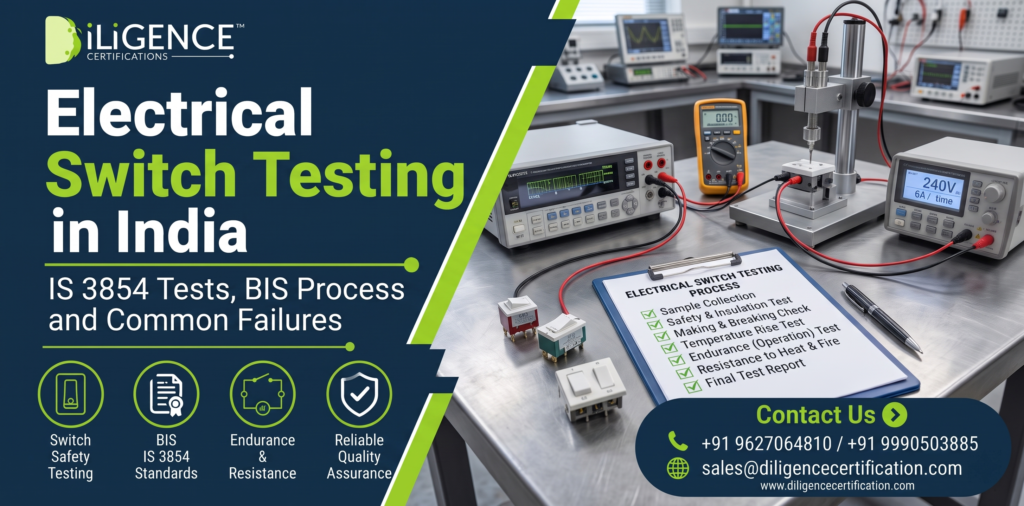
That is what electrical switch testing does. A lab takes sample switches and puts them through electrical, mechanical, heat and marking checks. If they pass, the maker can move ahead with BIS certification.
In this blog, we will go step by step in very simple words. We will cover the standard, the tests, the process, the documents, common failures and some practical tips.
What Is Electrical Switch Testing?
Electrical switch testing means checking a switch against the requirements of an Indian Standard. The lab wants to know three things:
- Is the switch safe for the user?
- Will it work properly for a long time?
- Is it marked and built the way the standard says?
In India, switches for homes and similar places come under IS 3854. These are manually operated switches used in fixed electrical wiring, like the ones on your switchboard for lights and fans. The standard is meant for low-voltage use, mainly up to 250 V AC in normal homes.
Switches are covered under a BIS quality control order, which means the ISI mark is needed to make and sell them in India. Testing is a key part of getting that mark. You can read the exact scope on the BIS website before planning your product.
Which Standard Applies to Electrical Switch Testing?
The main standard is IS 3854. It has been revised a few times, and the latest version is IS 3854:2023 (Third Revision). It replaced the older IS 3854:1997.
| Standard | What it covers | Why you should care |
|---|---|---|
| IS 3854:2023 | Switches for domestic and similar purposes | Main standard for testing and ISI mark |
| IS 3854:1997 | Older second revision | Replaced by the 2023 version |
| Amendment No. 1 to IS 3854:2023 | Changes added to the 2023 standard | BIS circular dated 9 June 2026 gives 20 November 2026 as the last date to implement it |
A simple example. Suppose you make one-way and two-way modular switches for home use. Your samples have to be tested to IS 3854:2023 along with the amendment. If you test against the old 1997 version, the report may not be accepted.
Since the last date for the amendment is very close, please check the BIS circular and the amendment text before you send samples. Do not depend on old reports or old checklists.
Why Is Electrical Switch Testing Important?
- Shock protection. A broken or poorly built switch can expose live parts.
- Fire safety. Loose connections and weak plastic can heat up and burn.
- Long life. A switch is operated again and again, so it must handle wear.
- Legal need. Without ISI mark, selling a covered switch can lead to action by authorities.
- Brand trust. Dealers and electricians remember brands that cause complaints.
- Tender and project entry. Many buyers ask for BIS-marked switches only.
Testing is not only paperwork. A failed switch in a lab is a small loss. A failed switch in someone’s home is a big one.
What Tests Are Conducted in Electrical Switch Testing?
The exact test list comes from IS 3854, and the lab follows the standard clause by clause. In simple words, the checks fall into these groups.
| Test group | What the lab checks | In simple words |
|---|---|---|
| Marking and information | Rating, maker’s name or mark, type and terminal markings | Can the user read what the switch is and how to use it? |
| Protection against electric shock | Live parts should not be touchable in normal use | Can a finger or a tool reach live metal? |
| Terminals and wire connection | Screws, terminal grip, wire space | Does the wire stay tight and safe? |
| Construction | Fixing, covers, mechanism, material quality | Is the switch built properly and will it stay in place? |
| Mechanism and operation | Smooth, clear on and off action | Does it switch cleanly without sticking? |
| Moisture and ageing | Behaviour of the switch after humidity treatment | Does damp weather spoil its insulation? |
| Insulation resistance and electric strength | Insulation between live parts and body | Will the insulation hold under voltage? |
| Temperature rise | Heat at terminals and parts under rated load | Does it run hot with normal current? |
| Breaking capacity and normal operation | Switching under load many times | Does it survive real daily use? |
| Mechanical strength | Impact and force on the switch | Will it crack if knocked? |
| Heat and fire resistance | Behaviour of plastic parts near heat | Will the material catch fire or soften badly? |
| Creepage distances and clearances | Gaps between live parts | Is enough safe space kept inside? |
The lab does not do these in random order. Sample sets are planned so that every sample goes through its own set of tests. That is why a lab asks for a fixed number of samples of each type and rating.
Types of Switches and How Testing Differs
Not every switch is the same. Lab planning changes slightly with the type.
- Plate switches and modular switches. The most common ones. They are tested as per rating and number of ways.
- One-way and two-way switches. Each wiring type needs proper sample coverage.
- Intermediate and special function types. The standard has requirements that depend on how the switch works.
- Different current ratings. A higher rating means heavier load tests, so a 6 A switch and a 16 A switch are not treated alike.
- Different series or models. If the internal design is different, expect separate samples.
If you have many models, talk to the lab early. Sometimes models can be grouped, and sometimes they cannot. That decision depends on design and the BIS scheme rules, so it is better to ask before wasting samples.
Two Kinds of Testing: Factory Lab and Recognised Lab
This point confuses many first-time manufacturers, so let us make it clear.
Factory lab testing is what you do in your own plant. Under the ISI scheme, a licensee must have a basic in-house lab and test every lot as per the scheme. This is routine quality control.
Recognised lab testing is done in a lab recognised by BIS. For a new licence, BIS looks at the samples tested there. You cannot replace this with your own test report.
So you need both. The factory lab keeps daily quality in check. The recognised lab gives proof that your switch meets the standard.
Step-by-Step Process for Switch Testing and ISI Mark
Here is the usual path in plain words. Always check the latest BIS guidelines, because forms and portals change.
- Check your product scope. Confirm the switch type, rating and standard.
- Buy or set up the testing facility. Your factory needs the basic equipment the product manual asks for.
- Prepare the product. Finish design, material and marking properly.
- Pre-test internally. Run your own quick checks before sending anything out.
- Choose a BIS-recognised lab. Check that the lab has IS 3854 in its approved scope.
- Send samples. Give the correct number of samples with the correct ratings and models.
- Collect the test report. Read it fully, because a pass in the summary can still hide a remark.
- Apply for the licence. Submit the application with documents and the test report.
- Factory inspection and grant. BIS officers check your plant, process and lab, and then decide on the licence.
Please do not treat this as a promise of approval. Each case depends on product, documents and factory readiness.
Which BIS Route Is Needed for Switches?
For switches, the normal route is the ISI mark licence from BIS. The right path depends on who you are.
| Business type | Usual route | Simple note |
|---|---|---|
| Indian manufacturer | ISI mark licence for the factory | Factory inspection and lab setup are needed |
| Foreign manufacturer | ISI mark licence under the foreign manufacturer route | Needs proper Indian representation and process |
| Importer | Sells products made by a BIS-licensed maker | Check the licence and marking before import |
| Private label brand | Product must be made by a licensed maker and marked as per rules | Brand rules and licence details matter |
| Trader or dealer | Sells only certified switches | Checking marking and licence number is your job |
When the licence needs change: if you change the design, add a new rating, shift the factory or change the marking, speak to BIS or your consultant before you sell the new version.
Documents Required for Electrical Switch Testing and Licence
Document lists keep changing slightly, so always match this against the current BIS checklist.
Company documents
- Business registration and address proof
- Factory details and layout
- Authorised person details
- Authorisation letter for the applicant
Product documents
- Product drawings and list of models and ratings
- Bill of materials and material details
- Marking details and sample of the label or print
- Circuit or wiring type details
Testing records
- Test report from a BIS-recognised lab
- Factory lab equipment list and calibration records
- Production and inspection process details
A missing or mismatched document can slow the whole case more than a test failure. Keep names, addresses and model numbers the same everywhere.
How Long Does Electrical Switch Testing Take?
There is no single answer, and anyone who gives you one fixed date is guessing. Time depends on:
- How busy the lab is
- Whether your samples are ready and correct
- How many models and ratings you want to test
- Whether any test fails and needs a retest
- How fast you reply to queries
Testing is only one part. After that comes the licence application, factory inspection and review. A realistic plan keeps a buffer for each stage.
Cost of Electrical Switch Testing
We are not giving a single number here, because the cost changes with the lab, the number of models and the number of tests. These are the main factors:
- Number of switch types, ratings and series
- Testing charges of the chosen lab
- Cost of samples, since some tests damage them
- Retest charges if you fail
- BIS application and licence fees
- Factory lab equipment and calibration
- Consultant support, if you take it
A good tip: ask the lab for a clear breakup in writing before you send samples. Testing charges are listed on the BIS lab information pages, so compare before deciding.
Common Failures in Electrical Switch Testing and Easy Fixes
| Common failure | Why it happens | Easy fix |
|---|---|---|
| Terminal gets loose | Weak screw or poor thread | Use better screws and check torque in production |
| Too much heating | Poor contact or thin metal | Improve contact material and current path |
| Insulation failure | Weak plastic or moisture effect | Change the material grade and control moulding |
| Cracking in impact | Brittle plastic | Use tougher material and check wall thickness |
| Marking fades or is missing | Cheap printing | Use durable marking and test it by rubbing |
| Mechanism sticks | Poor spring or fit | Review design and tolerances |
| Not enough gap between live parts | Cramped inside layout | Redesign layout for proper distances |
| Fire test issue | Wrong plastic | Use flame-retardant material with test proof |
Most of these are fixed before testing, not after. A small change in material usually costs less than a retest.
Common Mistakes Manufacturers Make
- Testing against the old 1997 version instead of the current one
- Ignoring the latest amendment and its last date
- Sending samples that were hand-made and not from regular production
- Using different material in the sample than in the final product
- Choosing a lab that does not have IS 3854 in its scope
- Skipping an internal pre-test
- Printing marking that fades with a little rubbing
- Applying with mismatched model names or ratings in documents
Who Needs Electrical Switch Testing?
- Manufacturers who make switches in India
- Importers who bring switches from other countries
- Private label brands who get switches made under their name
- Overseas manufacturers who want to sell in the Indian market
- Export-only units should check rules for their case, because requirements can differ when products never enter India
If you are not sure which group you belong to, ask before you invest in samples or stock.
Why Choose Diligence Certifications for Electrical Switch Testing Certification?
Switch certification has many small steps, and a mistake in any one can waste weeks. This is where a clear guide helps.
Diligence Certifications supports manufacturers with the BIS process in a practical way. For switches, you can read more on the BIS certification for switches page.
Here is what such support usually covers:
- Checking your product against the current standard
- Guiding you on the right BIS route for your business type
- Helping you prepare the document set properly
- Explaining lab selection and sample planning
- Following up on queries during the process
No consultant can promise approval, because BIS and the lab take the final decision. What good guidance can do is reduce avoidable mistakes.
After Registration: Market Checks Do Not Stop
Getting the licence is not the end. BIS can pick samples from the market or from your factory to confirm that quality is still the same. So:
- Keep production the same as the tested sample
- Maintain your factory lab records
- Mark every switch as the licence requires
- Inform BIS before making major design changes
Tips to Pass Electrical Switch Testing in the First Attempt
- Read the full IS 3854:2023 and the amendment before final design.
- Make samples from the regular production line.
- Run your own pre-tests on heating, insulation and marking.
- Check the lab scope and the sample list in writing.
- Use stable, tested materials and keep supplier records.
- Keep a spare set of samples if possible.
- Check marking durability and spelling on every sample.
- Keep documents and model names consistent from start to end.
Quick Checklist Before Sending Samples
- Product matches the current IS 3854:2023 with the amendment
- Lab has IS 3854 in its recognised scope
- Correct number of samples for each model and rating
- Marking is clear and durable
- Material and design are the same as the final product
- Internal pre-test done and notes saved
- Documents ready and matching
Conclusion
Electrical switch testing is not just a step to tick off. It is what stands between a good switch and a risky one. A switch that passes carefully planned tests is safer for users and easier for your brand to sell.
Start with the current standard, plan your samples well and keep your documents clean. Choose the lab with care and do not skip your own pre-testing. If you want a guide through the process, you can contact Diligence Certifications and discuss your product.
Frequently Asked Questions
1. What is electrical switch testing?
It is the process of checking a switch against the Indian Standard to confirm that it is safe, well built and properly marked.
2. Which standard is used for domestic switch testing in India?
IS 3854 is used, and the current version is IS 3854:2023. Amendment No. 1 has also been published.
3. Is BIS certification needed for switches?
Switches for domestic and similar purposes come under a BIS quality control order, so the ISI mark is needed. Please confirm the latest status on the BIS website for your product.
4. Where can switches be tested?
In a BIS-recognised lab that has IS 3854 in its approved scope.
5. Can I test switches in my own factory lab only?
No. Your factory lab is needed for routine quality checks, but a recognised lab report is needed for the licence process.
6. What is the difference between IS 3854:1997 and IS 3854:2023?
IS 3854:2023 is the third revision and replaced the 1997 version. Always use the current one for new work.
7. What is the last date for Amendment No. 1?
A BIS circular dated 9 June 2026 gives 20 November 2026 as the last date of implementation. Please check the circular for details.