BIS Certification
 CDSCO
 PESO
 CPCB
 LMPC
 WPC Approval
 Global Approvals
 TEC
 ARAI
 BEE
 ISO Certification
 DGCA Certification
 NOC For Steel
 APEDA Registration























 Business Registration
 FSSAI Mark Certification












 (32).jpg)
 Legal Services
 Trademark Registration
 Copyright Registration
 Patent Registration
 By
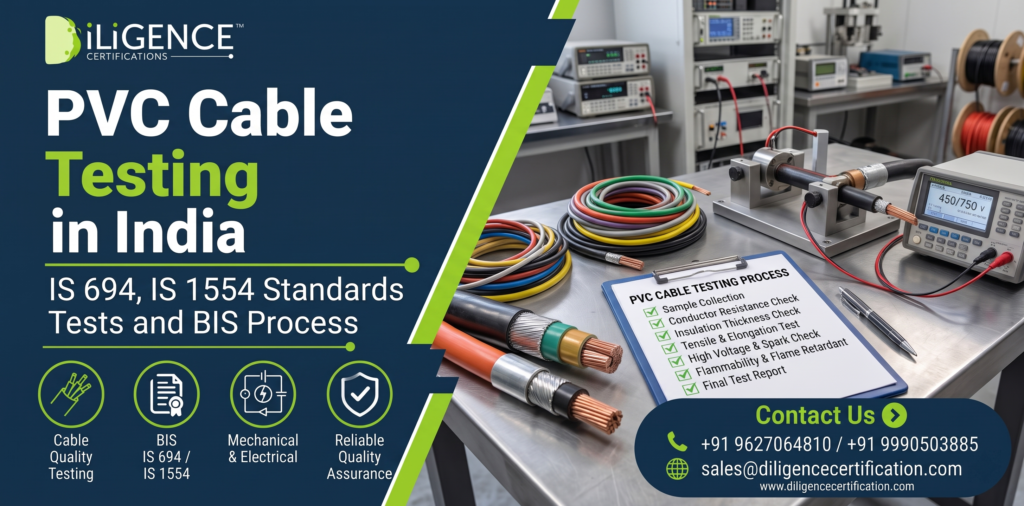
- PVC cable testing checks whether your cable is safe, strong and fit for use in homes, shops, factories and buildings.
- In India, PVC insulated cables are tested against Bureau of Indian Standards (BIS) specifications such as IS 694 and IS 1554 (Part 1).
- Testing covers the conductor, the PVC insulation, the sheath, the overall build of the cable, and the marking on it.
- There are two kinds of testing: in-house testing at your factory lab and testing at a recognised external lab.
- A weak copper or aluminium conductor, thin insulation or poor-quality PVC compound are the most common reasons for failure.
- Good planning, correct documents and well-prepared samples save a lot of time and repeat testing.
Introduction
Think about a school bag. The bag looks fine from outside. But if the stitching is weak or the zip is cheap, it fails in a few months, usually at the worst time. A cable is similar. Two PVC cables can look exactly the same, same colour, same size, same price tag. Only testing tells you which one will stay safe for years and which one will heat up, crack or catch fire.
That is why PVC cable testing matters. It is not just a paper formality. It is the proof that the copper is right, the insulation is thick enough and the plastic will not melt or turn brittle too early.
In this blog, we will explain PVC cable testing in very simple English. You will learn the standards, the tests, the step-by-step process, the documents, the common mistakes and some easy tips to pass in the first attempt.
What Is PVC Cable Testing?
PVC cable testing means checking a PVC insulated cable in a laboratory against a defined standard. PVC stands for polyvinyl chloride. It is a very common plastic used to cover and protect the metal conductor inside the cable.
The lab takes a sample from your cable and runs a set of tests. These tests check things like:
- Is the conductor made of the right material and is its resistance within limits?
- Is the PVC insulation thick enough and strong enough?
- Does the insulation hold high voltage without breaking down?
- Does the plastic stay stable when it is heated or aged?
- Does the cable have the correct marking, size and colour?
If the cable passes all required tests, you get a test report. This report is used for your quality records, for your buyers and, most importantly, for BIS certification where it is applicable.
Please note that rules, quality control orders and standard versions can change. Always check the latest position on the BIS website or with a certification expert before you start.
Which Standards Apply to PVC Cable Testing?
In India, the standard depends on the type of cable and the voltage it is made for. Here are the common ones.
| Standard | What it covers |
|---|---|
| IS 694 | PVC insulated unsheathed and sheathed cables with copper or aluminium conductors, for working voltages up to and including 450/750 V. Mostly used for house wiring |
| IS 1554 (Part 1) | PVC insulated (heavy duty) electric cables for working voltages up to and including 1100 V. Used in buildings, industries and power distribution |
| IS 1554 (Part 2) | PVC insulated heavy duty cables for working voltages from 3.3 kV up to and including 11 kV |
| IS 8130 | Conductors for insulated electric cables and flexible cords. Tells you the class and size of the conductor |
| IS 5831 | PVC insulation and sheath compounds used for electric cables |
| IS 10810 | Methods of test for cables. Many of the test methods are described here |
A simple example: A company makes single core copper wires for house wiring, 1.5 sq mm and 2.5 sq mm. These will normally be tested against IS 694. Another company makes a three core armoured power cable for a factory. That will normally be tested against IS 1554 (Part 1).
Note: Standards get revised from time to time, and the exact list of products under a quality control order can change. Please confirm the current version and the current requirement before you apply.
Why Is PVC Cable Testing Important?
A cable is hidden inside walls, ducts and trays. Nobody checks it every day. So the quality has to be right from the start.
- Fire safety. Poor insulation can overheat and start a fire. Short circuits are one of the most common causes of electrical fires.
- Shock safety. Weak insulation can leak current and cause shocks.
- Long life. Good PVC and a good conductor mean the cable lasts for decades without cracking.
- Correct current carrying. If the conductor is thinner than claimed, the cable heats up under normal load.
- Legal need. Where a quality control order applies, you cannot sell the product without the required BIS licence and mark.
- Buyer trust. Dealers, contractors and project buyers ask for test reports before they place bulk orders.
- Less rejection and returns. Testing at your end catches problems before the material reaches the market.
What Tests Are Conducted in PVC Cable Testing?
The exact list of tests depends on the standard and the type of cable. Here are the main groups in simple words.
1. Tests on the Conductor
The conductor is the metal part that carries the current.
- Material and construction check. The lab checks the number of wires, the wire diameter and the class of the conductor.
- Resistance test. The lab measures the electrical resistance of the conductor at a standard temperature. If the resistance is too high, it usually means the metal is thinner or of lower quality.
- Annealing and tinning checks (where applicable). Soft, properly annealed copper bends easily and carries current well.
2. Tests on the PVC Insulation
- Thickness measurement. The lab measures the insulation at several points. It should not fall below the minimum value in the standard.
- Tensile strength and elongation. A small piece of the insulation is pulled until it breaks. This shows how strong and flexible the plastic is.
- Ageing test. The insulation is kept in an oven for a fixed time and then tested again. Good PVC does not become brittle after ageing.
- Hot deformation test. The lab checks that the insulation does not get pressed in too much when it is heated under load.
- Heat shock test. The sample is kept at a high temperature to see if it cracks.
- Shrinkage test. The lab checks that the insulation does not shrink back too much after heating.
- Cold bend and cold impact tests (where applicable). These check that the PVC does not crack in cold conditions.
3. Electrical Tests
- High voltage test. A high voltage is applied for a set time. A good cable does not break down.
- Insulation resistance test. This measures how well the insulation stops current from leaking.
- Spark test (in some cases). A quick check for pin holes or weak spots in the insulation.
4. Tests on the Sheath and Overall Cable
For sheathed and multi core cables, the lab also checks the following.
- Thickness and strength of the outer sheath.
- Overall diameter of the cable.
- Colour of the cores and their identification.
- Fillers, bedding and armour (for armoured cables).
5. Flammability and Special Tests
- Flame retardant checks. Some cables, such as flame retardant low smoke types, need extra tests for flame spread and smoke. These follow separate methods.
- Oxygen index, smoke density and acid gas tests may be needed for special grades.
6. Marking and Packing Checks
- The lab checks the printed marking on the cable. This usually includes the manufacturer name or brand, voltage grade, size and year of manufacture.
- Where BIS certification applies, the licence number and the standard mark must be shown correctly.
- Length of the coil or drum and the way it is packed are also checked.
Raw Materials Used in PVC Cables and Why They Matter
A cable is only as good as what goes into it. Testing the finished cable is important, and so is checking the raw material before production.
| Raw material | What it is used for | What to check |
|---|---|---|
| Copper or aluminium rod | Conductor | Purity, size, resistance |
| PVC insulation compound | Covers each core | Grade, filler content, batch test report |
| PVC sheath compound | Outer cover | Grade, colour, batch test report |
| Fillers and binders | Fill gaps in multi core cables | Material type and quality |
| Armour wire or strip | Mechanical protection | Size, material, coating |
| Printing ink | Marking on the cable | Durability, readability |
Many failures happen because the PVC compound was changed to save cost, or the copper was thinner than needed. Keep a record of every batch of raw material and match it with the batch of cable made.
Two Kinds of Testing: In-House Lab and Recognised Lab
PVC cable testing is generally done in two places.
1. Your factory lab (in-house testing). Routine tests are done here during and after production. For BIS certification, the manufacturer is expected to have a proper in-house lab with calibrated instruments and trained staff. This testing is done regularly, batch by batch.
2. A recognised external lab. Some tests, especially type tests, are done at a laboratory that is recognised for the purpose. The test report from this lab is a key document for your licence application. Always confirm that the lab is recognised for the exact standard and scope you need.
| Point | Factory lab | Recognised lab |
|---|---|---|
| Purpose | Daily quality control | Type testing and independent proof |
| Frequency | Every batch or lot | When needed for licence, renewal or surveillance |
| Who does it | Your own team | Lab staff |
| Use of report | Internal records | Licence and buyers |
Step-by-Step Process for PVC Cable Testing and BIS Registration
The steps below are a simple outline. Details can change with the scheme and the product, so confirm with BIS or your consultant.
- Identify the standard. Decide whether your cable falls under IS 694, IS 1554 (Part 1), IS 1554 (Part 2) or any other standard.
- Check if a quality control order applies. Confirm whether BIS certification is compulsory for your cable type and size.
- Prepare your factory. Arrange the required machines, in-house lab and testing instruments. Make sure the instruments are calibrated.
- Make sample cables. Produce the cable in the sizes and types you want to certify, with proper marking.
- Select a recognised lab. Choose a lab that covers your standard. Ask about the samples needed, the time and the test list.
- Send the samples. Pack them properly and send them with the required forms and details.
- Testing is done. The lab runs the tests and prepares a report. If anything fails, you need to find the root cause, fix it and retest.
- Apply to BIS with documents. File the application with the test report and the other documents on the BIS portal.
- Factory inspection and licence. BIS may inspect your factory and take samples. After the process is complete, the licence is granted and you can use the standard mark as allowed.
After the licence, regular testing, records and surveillance continue. Certification is not a one time job.
Which BIS Registration or Licence Is Needed?
The route depends on who you are.
| Business type | What is generally needed |
|---|---|
| Indian manufacturer | A BIS product certification licence for the cable, under the applicable scheme |
| Foreign manufacturer exporting to India | Registration or licence under the BIS scheme for foreign manufacturers, with an authorised Indian representative |
| Importer | The product must carry a valid BIS licence of the manufacturer. Importers should verify it |
| Private label brand | The licence must be in line with the brand and manufacturer arrangement. Confirm with BIS |
| Export only manufacturer | May not need BIS for export, but the buyer country may have its own rules |
When does your licence need an update? If you add a new size, a new cable type, a new factory unit or change the compound grade, you may need to update or extend your licence. Always check before you make the change.
Documents Required
The list can vary, but these are commonly asked for.
Company documents
- Company registration proof and address proof
- Factory layout and details of machines
- Details of authorised signatory
- Authorised Indian representative details (for foreign manufacturers)
Product documents
- List of cable sizes and types to be certified
- Product drawings or construction details
- Marking details and label design
- Raw material details and supplier names
Testing records
- Test report from a recognised lab
- Calibration certificates of in-house lab instruments
- In-house test records and quality control plan
- Raw material test certificates
How Long Does PVC Cable Testing Take?
The time depends on the standard, the number of sizes and the lab workload. Some tests are quick. Ageing and heat related tests take longer because the samples need to stay in the oven for a fixed time.
If a sample fails, the retest adds more days. So plan with some buffer. A well prepared sample usually moves faster than a rushed one.
Cost of PVC Cable Testing
The cost is not a fixed number. It depends on these factors.
- Which standard you are testing against.
- The number of sizes and types.
- How many samples the lab needs.
- Whether special tests such as flame retardant checks are included.
- Whether you need a retest.
- Whether you also want BIS application support.
The best way is to ask the lab or consultant for a clear breakup before you start.
Common Failures in PVC Cable Testing and Easy Fixes
| Common failure | Why it happens | Easy fix |
|---|---|---|
| High conductor resistance | Thin wires or low quality metal | Check the wire size and metal purity before stranding |
| Low insulation thickness | Poor control at the extruder | Measure thickness regularly during production |
| Low tensile strength | Wrong PVC compound or too much filler | Use the right compound and verify each batch |
| Failure after ageing | Poor stabilisers in the PVC | Change the compound grade and recheck |
| High voltage test failure | Pin holes or weak insulation spots | Use online spark testing and fix extrusion problems |
| Wrong marking | Printing errors or missing details | Check the marking format against the standard |
| Shrinkage problems | Cooling and processing issues | Adjust the cooling process and line speed |
Common Mistakes to Avoid
- Sending samples without checking them in your own lab first.
- Using a different PVC compound for the test samples than for regular production.
- Choosing a lab that is not recognised for your standard.
- Ignoring calibration of in-house instruments.
- Not keeping batch wise records of raw material and finished cable.
- Printing the wrong marking or an incorrect licence number.
- Adding new sizes or types without informing BIS.
- Thinking that one test report is enough for all time.
Who Needs PVC Cable Testing?
- Manufacturers. To control quality and to get the licence where needed.
- Importers. To make sure the imported cable meets Indian requirements.
- Private label brands. To protect the brand from poor quality supply.
- Overseas manufacturers. To sell in India under the proper scheme.
- Export only units. To meet the buyer’s country rules and quality needs.
- Contractors and project buyers. To confirm the material before bulk purchase.
Why Choose Diligence Certifications for PVC Cable Testing Certification?
PVC cable testing and BIS registration involve many small steps, and one missed document can cost you weeks. At Diligence Certifications, our team guides you step by step in simple language.
Here is how we can help.
- Check which standard and which rules apply to your cable.
- Guide you on documents, factory readiness and sample preparation.
- Coordinate with the lab and help you understand the test report.
- Support you with the application and follow up during the process.
- Help you plan for renewals and surveillance after the licence.
To know more about our support, you can visit our service page. We do not promise approvals or fixed timelines, because the final decision is always with the concerned authority. What we promise is clear guidance and honest advice.
After Certification: Market Checks and Surveillance
Getting the licence is not the end. BIS may collect samples from the market or from your factory to check that quality is maintained. You also need to keep up your in-house testing, calibration and records. Keep your marking correct and keep your records ready for any inspection.
Tips to Pass PVC Cable Testing in the First Attempt
- Test every size in your own lab first.
- Use the same raw material for samples as for regular production.
- Check insulation thickness at many points, not just one.
- Do online spark testing during production.
- Keep the conductor resistance a little inside the limit, not right at the limit.
- Check your marking against the standard before sending the sample.
- Pack the samples well so they do not get damaged on the way.
- Talk to the lab beforehand about the test list and the quantity of samples.
Quick Checklist Before Sending Samples
- Standard and cable type confirmed
- Samples made with regular production material
- In-house tests done and records kept
- Marking checked and correct
- Instruments calibrated
- Lab confirmed for your standard
- Forms and documents filled
- Samples packed properly
Conclusion
PVC cable testing is the base of safe wiring. It checks the conductor, the insulation, the sheath and the marking, so that the cable you sell is safe, strong and long lasting.
If you are a manufacturer, importer or brand owner, start early. Know your standard, prepare your factory, test in your own lab first and keep your records clean. A little planning at the beginning saves a lot of time and money later.
If you need help with PVC cable testing or BIS registration, reach out to a trusted certification partner and get clear guidance before you begin.
Frequently Asked Questions (FAQs)
1. What is PVC cable testing?
It is the process of checking a PVC insulated cable in a lab against a standard, to confirm that it is safe and of good quality.
2. Which standard is used for PVC cable testing in India?
Common standards are IS 694 for house wiring cables and IS 1554 (Part 1) for heavy duty cables up to 1100 V. Always confirm the latest version.
3. Is BIS certification compulsory for PVC cables?
In many cases, yes, under quality control orders. The exact requirement can change, so check the current position before you sell.
4. What tests are done on PVC insulation?
Common tests are thickness, tensile strength, elongation, ageing, hot deformation, heat shock and shrinkage.
5. What is the high voltage test?
A high voltage is applied to the cable for a set time to check that the insulation does not break down.
6. Why is conductor resistance tested?
It shows whether the conductor is of the right size and material. High resistance means more heat and more power loss.It shows whether the conductor is of the right size and material. High resistance means more heat and more power loss.