BIS Certification
 CDSCO
 PESO
 CPCB
 LMPC
 WPC Approval
 Global Approvals
 TEC
 ARAI
 BEE
 ISO Certification
 DGCA Certification
 NOC For Steel
 APEDA Registration























 Business Registration
 FSSAI Mark Certification












 (32).jpg)
 Legal Services
 Trademark Registration
 Copyright Registration
 Patent Registration
 By
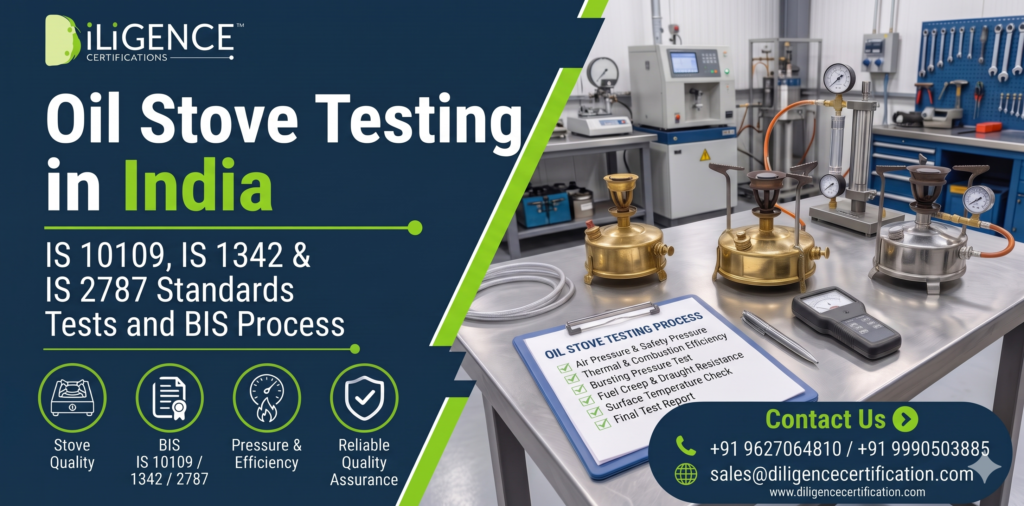
- Oil stove testing means checking a kerosene stove in a lab for safety, fuel leakage, flame quality, efficiency and strength.
- In India, oil pressure stoves come under BIS certification, so the ISI mark is needed before sale.
- IS 10109 is the main standard for oil pressure stoves with an offset burner. IS 1342 and IS 2787 also cover oil pressure stoves.
- Key tests include air pressure, safety pressure, bursting pressure, thermal efficiency, combustion efficiency, fuel creep, draught resistance and surface temperature.
- Most failures come from small things like a bad weld, a weak joint or a poor burner, not from big design faults.
- Always check the latest version of the standard before you build or send samples.
Introduction
Think about a pressure cooker. Everyone knows it needs a safety valve. Nobody buys one without it. An oil stove is similar. Inside the tank, kerosene is kept under pressure. It goes to the burner as vapour and burns. If the tank leaks, or the joint is weak, or the flame goes wrong, the risk is real.
That is why oil stove testing is done. A lab checks the stove the way a doctor checks a patient. Is it strong? Does it leak? Does the flame burn clean? Does it waste fuel? Does the body get too hot?
In this blog, we will understand oil stove testing in plain language. We will cover the standards, the tests, the BIS steps, the documents and the common mistakes. No heavy theory. Just practical points.
What Is Oil Stove Testing?
Oil stove testing is a set of lab checks done on a kerosene or oil stove. The lab checks if the stove is safe to use and if it performs as the standard demands.
There are three broad parts:
- Safety tests: pressure tests, leakage checks and surface temperature.
- Performance tests: thermal efficiency, combustion quality and flame stability.
- Construction checks: materials, dimensions, markings and finish.
A stove can cook well and still fail on safety. In that case, it does not pass.
Legal Base in India
In India, oil pressure stoves are covered under BIS product certification. Manufacturers need a BIS licence to use the ISI mark on them. Selling these stoves without the required certification is a compliance problem.
So for a manufacturer, testing is not a one-day activity. It is part of getting the licence and keeping it. Even after the licence is granted, BIS can inspect the plant and pick samples again.
Types of Oil Stoves
People use the word “oil stove” for many things. Here is a simple way to understand the main types.
| Type | How It Works | Simple Note |
|---|---|---|
| Oil pressure stove (offset burner) | Kerosene is pressurised by a hand pump and turns into vapour at the burner | Common in homes without easy gas access |
| Multi-burner oil pressure stove | Same idea, but with more than one burner | Used for bigger cooking needs |
| Kero-gas stove | A pressure stove that looks like an LPG stove and gives a blue flame | Cleaner flame with less noise |
| Wick stove | Kerosene rises through a wick and burns | Simpler design, no pump needed |
Not every type has the same standard. First find out which type you make. Then pick the correct standard.
Which Standards Apply to Oil Stove Testing?
| Standard | What It Covers |
|---|---|
| IS 10109 | Oil pressure stoves, offset burner type |
| IS 1342 | Oil pressure stoves |
| IS 2787 | Multi-burner oil pressure stoves |
| IS 15333 | Kero-gas stove (domestic, pressurised kerosene vapour) |
| IS 4473 | Burners for oil pressure stoves and oil pressure heaters |
A simple example: A factory makes an offset burner pressure stove. The main product standard is IS 10109. The burner may also be checked against IS 4473. The lab tests the stove as per the method in the standard and compares the results with the limits.
Please note: Standards get revised. IS 10109 has a newer 2018 version, but many web pages and old reports still show the 2002 version. Check the BIS website for the current version before you start, and do not depend on old PDFs.
Why Is Oil Stove Testing Important?
- Fire safety: A leaking tank or a weak joint can cause fire.
- Burn safety: Hot body parts can hurt the user.
- Air quality: A badly tuned burner produces smoke and harmful gases like carbon monoxide.
- Fuel saving: An efficient stove uses less kerosene for the same cooking.
- Legal compliance: You need the licence to sell with the ISI mark.
- Customer trust: People trust a stove that carries the ISI mark.
- Long life: A tested stove lasts longer and gives fewer complaints.
What Tests Are Conducted on an Oil Stove?
| Test | What the Lab Checks | In Simple Words |
|---|---|---|
| Air pressure test | Leakage in the tank and joints | Does air escape anywhere? |
| Safety pressure test | Behaviour under working pressure and above | Does the stove stay safe under pressure? |
| Bursting pressure test | Strength of the tank | At what pressure does it fail? |
| Thermal efficiency | How much heat reaches the pot | How much fuel is wasted? |
| Combustion efficiency | Quality of burning | Does it burn clean? |
| Fuel creep | Fuel seeping from places it should not | Does kerosene crawl out? |
| Resistance to draught | Flame stability in moving air | Does a little wind put it out? |
| Surface temperature | Heat on knobs, handles and body | Is it safe to touch? |
Let us look at each of these one by one.
1. Air Pressure Test
The lab fills the tank with air, closes the openings and watches for leaks. Often, the tank is kept in water and checked for bubbles. Any bubble means a leak. Even a tiny hole is a problem because kerosene can creep through where air can.
2. Safety Pressure Test
The stove is taken to a pressure above its normal working pressure and held there. The lab checks that nothing deforms, leaks or fails. This tells us the stove has a safety margin and will not give up on a slightly bad day.
3. Bursting Pressure Test
This is the extreme test. Pressure is increased until the tank fails. The standard sets a minimum value that the tank must cross. It looks harsh but it is useful, because it shows the real strength of welds, seams and the metal sheet.
4. Thermal Efficiency
Thermal efficiency tells us how much of the heat from the flame actually goes into the cooking pot. A standard pot with a fixed amount of water is heated, and the fuel used is measured. Higher efficiency means less kerosene for the same work, which saves money for the user.
5. Combustion Efficiency
This is about how well the fuel burns. Poor combustion gives yellow flame, smoke, soot and carbon monoxide. The lab checks the gases coming from the flame. A clean blue flame is what everyone wants.
6. Fuel Creep
Sometimes kerosene slowly seeps out of the cap, the filler or a joint. This is called fuel creep. It may look small, but it can create a fire hazard under a lit burner. The lab keeps the stove in different conditions and checks if any fuel appears outside.
7. Resistance to Draught
A kitchen is never perfectly still. A fan, a window or a person walking by can move the air. The test checks if the flame stays stable and does not go out or become unsafe in moving air.
8. Surface Temperature
Handles, knobs and the pump must not become too hot. The lab measures the temperature during use. If the user cannot safely touch the control parts, the stove fails.
9. Marking and Construction Checks
The lab also checks basic things:
- Name or trademark of the maker
- Model and capacity details
- Safety instructions and warnings
- Material and thickness
- Finish, sharp edges and stability on a table
Some stoves fail only on marking. This is the easiest failure to avoid.
Special Section: Pump, Regulator and Burner
Three parts need extra attention in a pressure stove.
| Part | Why It Matters | What Labs Usually Look At |
|---|---|---|
| Pump | Builds pressure in the tank | Smooth working, no leakage, a good seal |
| Regulator or valve | Controls fuel supply | Proper opening and closing, no kerosene coming out when closed |
| Burner | Gives the flame | Even flame, clean burning, no choking of nipple |
A good burner is half the stove. If you buy burners from outside, check that they are made as per the burner standard. Keep the supplier test reports ready.
Two Kinds of Testing: Factory Lab and Recognised Lab
| Type | Where | Purpose |
|---|---|---|
| Factory (in-house) lab | Inside your plant | Daily and batch wise checks to control quality |
| Recognised or BIS lab | Outside lab approved for this work | Independent testing for licence and surveillance |
The factory lab is like practice at home. The outside lab is the real exam. If your in-house tests are weak, the outside test becomes risky. So do not skip the practice.
Step-by-Step Process for BIS Registration of Oil Stoves
Here is the basic flow in simple steps. Details can change a little with the product and scheme, so please confirm with BIS or an expert.
- Identify your product and standard. Decide the type of stove and its matching IS number.
- Study the latest standard. Read the full text, not only a summary.
- Set up your lab. Get the machines, gauges and trained staff for in-house testing.
- Prepare a quality control plan. Write which tests, how often and who is responsible.
- Collect documents. Company papers, factory details, process flow, machine list and lab details.
- Apply on the BIS portal. Fill the form carefully and upload the documents.
- Factory inspection and sampling. A BIS officer visits and picks samples.
- Independent lab testing. The samples are tested against the standard.
- Grant of licence. If the process and test results meet the requirements, the licence is granted and you can use the ISI mark.
After the licence, BIS can do surveillance. So testing never really stops.
Which BIS Licence Is Needed?
| Business Type | What Is Generally Needed |
|---|---|
| Indian manufacturer | BIS licence for each product type and factory |
| Foreign manufacturer selling in India | Registration under the foreign manufacturer scheme |
| Importer or trader | Should deal only in certified stoves from a licensed source |
| Private label brand | Must work with a licensed maker, and the licence should match the product |
A licence is usually linked to a product, a standard and a unit. If you start making a new type, add a new model line or shift the plant, check whether your licence needs an extension or a fresh application.
Documents Required
Company documents:
- Business registration papers
- Factory address proof
- Authorised signatory details
Product documents:
- Product type, model and capacity
- Manufacturing process details
- Factory layout and machine list
- Raw material and bought-out part details
Testing records:
- Quality control plan
- In-house lab details and calibration records
- Past test reports
Keep every paper updated and signed. Missing signatures and old dates cause a lot of delay.
How Long Does Oil Stove Testing Take?
Some tests take hours. Others need a proper setup and repeat readings. The lab also has a schedule, so waiting time is part of the game.
The full BIS process includes the application, inspection, sampling, testing and reports. The total time depends on your preparation, how fast you answer queries and the lab’s workload. Nobody can promise an exact date, so plan with some buffer.
What Decides the Cost?
We are not giving amounts here, because costs change from case to case. The cost depends on:
- Type and number of models
- Number of samples and tests
- Lab charges
- Government fees under the scheme
- Setup of your own lab and instruments
- Repeat testing, if a sample fails
- Travel and inspection related expenses
If you want a clear breakup, share your product type and location with a consultant and ask for a written quote.
Common Failures and Easy Fixes
| Common Problem | Likely Reason | Easy Fix |
|---|---|---|
| Leak in air pressure test | Poor weld or bad seal | Improve welding and use better sealing parts |
| Tank fails bursting test | Thin sheet or weak seam | Check sheet thickness and seam quality |
| Low thermal efficiency | Wrong burner or poor flame spread | Tune the burner and check the pot support height |
| Smoky flame | Choked nipple or poor air mix | Clean the nipple and check air holes |
| Fuel creep | Loose cap or bad gasket | Replace the gasket and check the tightening |
| Flame goes out in draught | Weak flame design | Improve the burner ring and flame guard |
| Hot knob | Poor insulation or bad placement | Change the material or move the part away from heat |
| Marking mismatch | Wrong or missing details | Correct the label as per the standard |
Common Mistakes to Avoid
- Using an old version of the standard.
- Testing only the stove and ignoring bought-out parts like burners and valves.
- Skipping the air pressure test before sending samples.
- Using worn or uncalibrated gauges.
- Sending a prototype that is different from the production model.
- Weak or missing labels and safety warnings.
- Incomplete documents in the application.
- Ignoring surveillance samples after getting the licence.
Who Needs Oil Stove Testing?
- Manufacturers: to get and keep the BIS licence.
- Importers and traders: to deal only in certified products.
- Private label brands: to confirm the partner factory is compliant.
- Overseas manufacturers: to sell in India through the correct scheme.
- Part suppliers: burner and valve makers who want their parts to match the standard.
Why Choose Diligence Certifications for Oil Stove Testing Certification?
BIS work can feel heavy, especially on the first attempt. One small paperwork mistake can cost weeks. That is where practical guidance helps.
Diligence Certifications helps businesses understand the right standard, prepare the documents and plan testing in the correct order. The team explains each step in simple language, so you know what is going on and why. You can learn more on the Diligence Certifications homepage, and you can read about the related support on the BIS certification services page.
We do not promise approvals, because the final decision always rests with the authority. What we can do is help you prepare well, avoid common mistakes and save time.
Conclusion
Oil stove testing may sound technical, but the idea is simple. We check that the stove does not leak, does not burst, burns clean, saves fuel and does not burn the user. Every test has a reason and every limit protects someone at home.
For a manufacturer, it is also the base of BIS certification. If you plan well, use the latest standard, keep your lab ready and maintain good records, the process becomes much easier. Start early, ask when in doubt and never compromise on welds, joints and paperwork.
Frequently Asked Questions (FAQs)
1. What is oil stove testing?
It is a set of lab checks on a kerosene stove for safety, leakage, flame quality, efficiency and strength.
2. Is BIS certification needed for oil stoves in India?
Yes. Oil pressure stoves come under BIS certification, and the ISI mark is needed for sale.
3. Which standard is used for oil pressure stoves?
IS 10109 covers oil pressure stoves with offset burner. IS 1342 and IS 2787 also cover oil pressure stoves.
4. What is a kero-gas stove?
It is a kerosene pressure stove that looks like an LPG stove and gives a blue flame. IS 15333 covers it.
5. What is the air pressure test?
The tank is filled with air and checked for leakage, often by keeping it in water and watching for bubbles.
6. What is the bursting pressure test?
Pressure is raised until the tank fails. It shows the real strength of the tank, welds and seams.
7. What does thermal efficiency mean for a stove?
It shows how much of the flame heat reaches the pot. Higher efficiency means less fuel use.