BIS Certification
 CDSCO
 PESO
 CPCB
 LMPC
 WPC Approval
 Global Approvals
 TEC
 ARAI
 BEE
 ISO Certification
 DGCA Certification
 NOC For Steel
 APEDA Registration























 Business Registration
 FSSAI Mark Certification












 (32).jpg)
 Legal Services
 Trademark Registration
 Copyright Registration
 Patent Registration
 By
- Tyre testing checks whether a tyre is strong, safe and long-lasting before it goes on the road.
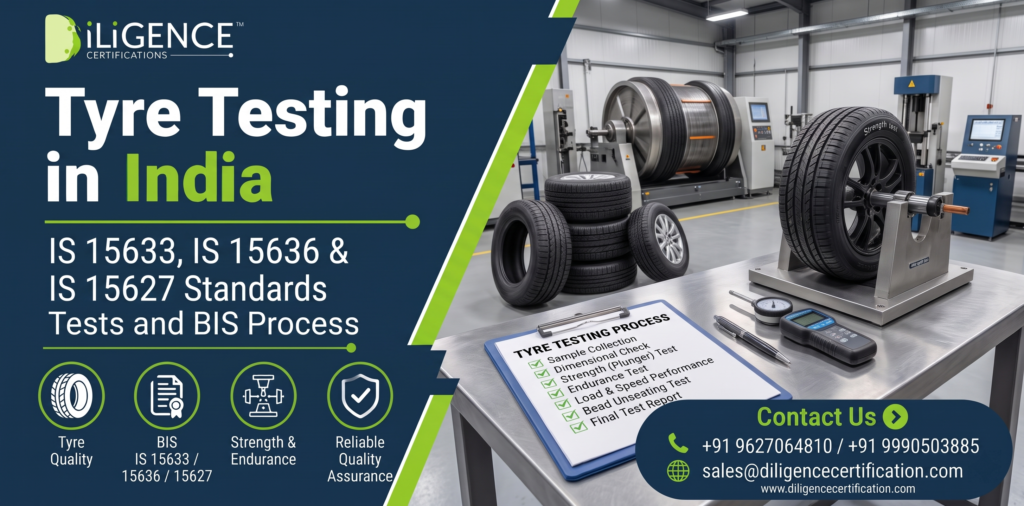
- In India, tyres follow IS 15633 (cars), IS 15636 (commercial vehicles) and IS 15627 (two and three-wheelers), all in their 2022 versions.
- The main tests are marking, dimensions, tread wear indicator, strength, endurance, load and speed performance, and bead unseating for tubeless tyres.
- Testing happens at two places: your in-house factory lab and a recognised lab.
- Most failures come from weak rubber compounds, poor bead build or wrong marking, and these can be fixed before sampling.
- Always check the latest BIS notice before you start, because standards and deadlines can change.
Introduction
But think about it for a second. A car weighs more than a tonne, and the whole weight sits on four patches of rubber, each about the size of your palm. Every turn, every brake and every pothole goes through those patches.
It is a bit like footwear. A bad pair of shoes can ruin your day. A bad tyre can ruin much more than that.
The tricky part is that you cannot judge a tyre by looking at it. Two tyres can look the same from outside, and one can burst at high speed while the other runs for years. That is why tyre testing is such an important step.
In this blog, we will explain tyre testing in very simple words. You will learn what it is, which standards apply, what tests are done, how the process works and which mistakes to avoid.
What Is Tyre Testing?
Tyre testing means checking a tyre under controlled conditions to confirm that it meets the safety and performance rules of the standard.
The lab measures the tyre. It reads the markings. It pushes a steel rod into the tread. It runs the tyre on a big rotating drum with heavy load for many hours. It also checks how well the tyre stays on the rim.
In India, many automotive tyres come under compulsory BIS certification under the ISI Mark scheme. The legal base is a Quality Control Order on pneumatic tyres and tubes. In simple words, if your tyre is covered, you need a valid BIS licence before you make it, import it or sell it in the market.
Tyre testing happens in two places:
- In your own factory lab: regular checks on production.
- In a recognised lab: formal testing of samples for the licence.
Types of Tyres Covered
Different vehicles use different tyres, so the standard changes too.
| Tyre Type | Used On | Standard |
|---|---|---|
| Passenger car tyres | Cars and similar light vehicles | IS 15633:2022 |
| Commercial vehicle tyres | Trucks, buses and similar vehicles | IS 15636:2022 |
| Two and three-wheeler tyres | Motorcycles, scooters, autos, quadricycles, e-rickshaws and e-carts | IS 15627:2022 |
| Tubes | Used inside tube-type tyres | IS 13098 |
Tyres can also be diagonal ply (also called bias) or radial ply. Radial tyres have cords running straight across the tyre, which gives better grip and a cooler run. Diagonal tyres have cords crossing each other at an angle, which makes the sidewall stiffer. The standards cover both.
Which Standards Apply to Tyre Testing?
The Bureau of Indian Standards (BIS) publishes the Indian Standards for tyres. Here is the simple list.
| Standard | What It Covers |
|---|---|
| IS 15633:2022 | Pneumatic tyres for passenger car vehicles, diagonal and radial ply |
| IS 15636:2022 | Pneumatic tyres for commercial vehicles, diagonal and radial ply |
| IS 15627:2022 | Pneumatic tyres for two and three-wheeled motor vehicles, quadricycles and e-rickshaws or e-carts |
| IS 13098 | Tubes for pneumatic tyres |
A simple example: If you make tyres for hatchback cars, IS 15633 is the standard your tests will follow. If you make tyres for a delivery truck, it is IS 15636. If you make tyres for scooters or e-rickshaws, it is IS 15627.
Please note that these standards were revised in 2022. Older versions of the standards were from 2005, 2012 or 2016. So always check which version BIS is asking for, and what transition date applies to your product. Rules and deadlines can change, so confirm everything on the BIS website before you apply.
Why Is Tyre Testing Important?
- Road safety: A tyre burst at speed is one of the most dangerous things that can happen on a road.
- Legal need: If your tyre is covered, you cannot sell it without a valid licence and the ISI Mark.
- Consistent quality: Testing makes sure every batch is built the same way as the approved sample.
- Fewer complaints: Early testing catches problems before the tyre reaches customers.
- Fuel and wear: A well-built tyre keeps its shape and wears evenly.
- Buyer trust: Vehicle makers, fleet owners and dealers prefer tested and certified tyres.
- Better design: Test results show exactly where the design or compound is weak.
How to Read a Tyre Size: A Simple Guide
The lab checks markings very carefully. So it helps to know what the numbers mean. Take this common size: 195/65 R15 91V.
| Part | Meaning |
|---|---|
| 195 | Width of the tyre in millimetres |
| 65 | Height of the sidewall as a percentage of the width |
| R | Radial construction |
| 15 | Rim size in inches |
| 91 | Load index, which tells how much weight one tyre can carry |
| V | Speed symbol, which tells the top speed the tyre is designed for |
Most tyres also carry a code for the week and year of manufacture, a mark for tubeless or tube type, and the ISI Mark with the licence number. If any of this is missing, wrong or hard to read, the tyre can fail the marking check.
What Tests Are Conducted in Tyre Testing?
The exact list depends on the standard and the tyre category. But the main tests look like this.
| Test | What the Lab Checks | In Simple Words |
|---|---|---|
| Marking | Size, load index, speed symbol, tubeless or tube type, date code, ISI Mark | Is every detail present and readable? |
| Dimensions | Section width and overall diameter after inflation | Is the tyre the size it claims to be? |
| Tread wear indicator | Small raised bars in the grooves | Will the driver know when the tyre is worn out? |
| Strength test | A steel plunger pushed into the tread | How much force can the tyre take before it breaks? |
| Endurance test | Tyre runs on a drum with load for many hours | Can it run long without failing? |
| Load and speed performance | Drum speed is raised step by step under load | Can it handle the speed it claims? |
| Bead unseating resistance | Force needed to push the bead off the rim | Will a tubeless tyre stay on the rim in a hard turn? |
| Growth in size | How much the tyre grows when running | Does it keep its shape? |
Not every test applies to every category. For example, bead unseating is for tubeless tyres, and some checks are different for two-wheeler tyres. Always read your own standard for the exact list.
The Big Tests Explained in Simple Words
Strength test
Imagine pressing a thick steel nail into the tread with a machine. The lab does something similar with a round-ended steel rod called a plunger. It keeps pushing until the tyre breaks or the limit is reached. The energy needed to break the tyre is measured and compared with the minimum in the standard.
A tyre that passes this test has strong cords and good rubber bonding. A weak tyre cuts or tears too easily.
Endurance test
The tyre is fitted on a rim, inflated and pressed against a large rotating drum. It then runs for many hours with the load increased in steps. After the run, the lab opens up the tyre and looks for separation, cracks, loose cords or any damage.
This test shows how the tyre will behave on a long highway trip in summer.
Load and speed performance test
Here the drum speed is raised in steps while the tyre carries a heavy load. Each step runs for a set time. If the tyre survives all steps without any failure, it passes. This test proves that the load index and speed symbol written on the sidewall are honest.
Bead unseating resistance (for tubeless tyres)
The bead is the part of the tyre that sits on the rim. In a tubeless tyre, there is no tube to help hold air. So a force is applied to the sidewall to see how much it takes to push the bead off the rim. A good tyre stays firmly locked even in a sharp turn.
Two Kinds of Tyre Testing
Many people mix these up, so let us make it clear.
1. Factory lab testing. This is done by you in your own plant. Daily or batch checks on dimensions, markings, visual quality, inflation and some strength or endurance checks, based on your approved test plan. It keeps production steady.
2. Recognised lab testing. This is done on samples at a lab that BIS accepts. The full list of required tests is carried out and the report goes to BIS.
You need both. Your in-house lab proves that your daily production is under control. The recognised lab proves that your product meets the standard.
Step-by-Step Process for Tyre Testing and BIS Certification
- Find your standard. Check whether your tyre falls under IS 15633, IS 15636 or IS 15627, and note the version.
- Check the BIS notice. See what is currently compulsory and what the deadline is.
- Build your in-house lab. You need the testing equipment, trained staff and a clear test plan.
- Prepare documents. Company papers, factory details, equipment list and process chart.
- Apply to BIS. Submit the application and fee on the BIS portal.
- Factory inspection. A BIS officer visits your plant to check production and the in-house lab.
- Sample drawing and testing. Samples are taken from the factory and sent to a recognised lab.
- Check the report. If all tests pass, BIS reviews the report. If something fails, find the cause, fix it and retest.
- Get the licence and use the ISI Mark. After BIS grants the licence, you can mark your tyres as per the rules.
Which BIS Route Do You Need?
The route depends on who you are.
| Business Type | Usual Route |
|---|---|
| Indian manufacturer | Apply for a BIS licence under the ISI Mark scheme |
| Foreign manufacturer | Apply under the Foreign Manufacturers Certification Scheme with an Authorised Indian Representative |
| Importer | Import tyres from a manufacturer holding a valid BIS licence |
| Brand owner or private label | Follow BIS rules for brand use with the licensed factory |
| Export-only manufacturer | The order has exemptions for tyres made only for export, so check the latest text |
Some vehicle makers have special rules for tyres they import for their own fitment. These rules can change, so read the latest notice before you plan an import.
If you add a new size, change your compound or shift your factory, tell BIS. Your licence may need an update.
Documents Required
Keep your papers ready before you apply.
Company documents
- Business registration proof
- Factory address and ownership or lease papers
- Authorised signatory details
- Manufacturing unit details
Product documents
- List of tyre sizes, types and categories
- Manufacturing process chart
- Raw material list with supplier names
- Sample marking and mould details
Testing records
- List of in-house testing equipment
- Calibration certificates
- In-house test plan and records
- Recognised lab test reports
How Long Does Tyre Testing Take?
There is no fixed number of days. It depends on a few simple things:
- How ready your factory, lab and papers are
- How many sizes and categories you want to certify
- How busy the recognised lab is, because endurance and speed tests take many hours per sample
- Whether any sample fails and needs to be repeated
- How fast you reply to BIS questions
If your records are clean, the process moves smoothly. If something is missing, it slows down. So do not promise dates to your customers too early.
What Decides the Cost?
We are not giving fixed numbers here, because the cost is different for every case. These are the main factors:
- Number of tyre sizes and categories
- Number of samples the lab asks for
- Long tests like endurance and speed performance
- Cost of setting up or upgrading your in-house lab
- Factory inspection and travel
- Retesting if a sample fails
- BIS fees and licence charges
- Consultant support, if you take it
A good tip is to ask the lab and the consultant for a full break-up in writing before you begin.
Common Failures and Easy Fixes
| Common Failure | Usual Reason | Easy Fix |
|---|---|---|
| Low strength test result | Weak cord layers or poor bonding | Check cord quality and bonding process |
| Endurance test failure | Heat build-up or poor sidewall build | Review the compound and construction |
| Separation after the run | Dirty or uneven layers during building | Keep the building area clean and follow the process chart |
| Size is out of range | Wrong mould or wrong inflation setting | Check mould dimensions and measuring method |
| Marking is wrong | Mould engraving mistake | Recheck marking against the standard before cutting the mould |
| Bead unseating failure | Weak bead bundle or wrong bead shape | Improve bead wire quality and bead design |
| Tread wear indicator missing | Mould design error | Add the indicator as per the standard |
| Speed test failure | Poor heat resistance of the compound | Use a better compound for the speed symbol claimed |
Common Mistakes to Avoid
- Starting the application before the in-house lab is ready
- Marking a higher load index or speed symbol than the tyre can really handle
- Using a different compound in production than in the tested sample
- Skipping calibration of testing machines
- Not keeping batch-wise test records
- Applying for the wrong standard or an old version
- Changing a supplier or compound without telling BIS
- Picking a lab only on price, without checking if BIS recognises it
Who Needs Tyre Testing?
- Manufacturers: They need testing and a BIS licence for covered tyres and tubes.
- Importers: They must make sure the foreign factory holds a valid BIS licence.
- Private label brands: They must follow BIS rules for brand use and licensed production.
- Overseas manufacturers: They must follow the foreign manufacturer route to sell in India.
- Export-only units: They should check the exemption in the order and the buyer country’s rules.
- Fleet owners and dealers: They can ask for certification proof before buying in bulk.
Why Choose Diligence Certifications for tyre testing Certification?
BIS paperwork, lab planning and factory inspection can feel heavy, especially for new applicants. This is where Diligence Certifications can help.
Here is how the support usually works:
- We help you find the right standard, version and BIS route for your tyre.
- We guide you on documents so the application starts clean.
- We help you prepare your in-house lab and test records before inspection.
- We coordinate with the recognised lab for sample testing.
- We stay with you through BIS queries and follow-ups.
You can read more about our work on our services page. We explain every step in simple language so you always know where your file stands. Please note that approval and timelines finally depend on BIS and the lab, and no consultant can promise a result.
After Certification: Market Checks
Getting the licence is not the end. BIS can draw tyre samples from the factory or the market and test them again. If a sample fails, there can be action on the licence.
So keep these habits:
- Follow the same materials and process every time
- Keep batch-wise records for all in-house tests
- Keep machines calibrated
- Use the ISI Mark only on products covered by your licence
- Tell BIS about changes in design, size range or factory
Tips to Pass Tyre Testing in the First Attempt
- Read the full standard before you finalise the design.
- Test a few tyres in your own lab before sending samples.
- Use stable, good quality cords, beads and rubber compounds.
- Match the load index and speed symbol to what the tyre can truly do.
- Check mould engraving and markings twice.
- Keep your test machines calibrated and records neat.
- Make sure the sample comes from regular production.
- Talk to an expert before booking long tests, because repeating them costs time.
Quick Checklist Before Sending Samples
- Standard and version confirmed
- Tyre sizes and categories finalised
- Samples taken from regular production
- Markings checked against the standard
- Dimensions measured in-house
- Strength and endurance checked in-house
- Load index and speed symbol confirmed
- Calibration certificates available
- Lab recognition confirmed
- Documents and drawings ready
Conclusion
Tyre testing may sound heavy, but the idea is simple. It makes sure the tyre will carry the load, hold its shape, stay on the rim and survive the road. That is a big promise, and testing is how you prove it.
If you make, import or sell tyres, treat testing as part of your business and not as paperwork. Know your standard, test early in your own lab, keep your records clean and choose a recognised lab. And if you need help, take it from someone who has done this before.
Do remember that standards and deadlines can change, so always check the latest BIS notices before you begin.
Frequently Asked Questions
1. What is tyre testing?
It is a set of checks that prove a tyre is strong, correctly marked and safe to use at the load and speed it claims.
2. Which standard applies to car tyres in India?
IS 15633:2022 covers pneumatic tyres for passenger car vehicles, both diagonal and radial ply.
3. Which standard applies to truck and bus tyres?
IS 15636:2022 covers pneumatic tyres for commercial vehicles.
4. Which standard applies to two-wheeler and e-rickshaw tyres?
IS 15627:2022 covers tyres for two and three-wheeled motor vehicles, quadricycles and e-rickshaws or e-carts.
5. Are tubes also tested?
Yes. Tubes follow IS 13098, and they have their own checks.
6. What is the endurance test?
The tyre runs on a rotating drum under load for many hours, and the lab checks for any damage afterwards.
7. What is the strength test?
A steel plunger is pressed into the tread to measure the energy needed to break the tyre.