BIS Certification
 CDSCO
 PESO
 CPCB
 LMPC
 WPC Approval
 Global Approvals
 TEC
 ARAI
 BEE
 ISO Certification
 DGCA Certification
 NOC For Steel
 APEDA Registration























 Business Registration
 FSSAI Mark Certification












 (32).jpg)
 Legal Services
 Trademark Registration
 Copyright Registration
 Patent Registration
 By
- Gas valve testing checks whether a valve can hold gas safely, open and close properly, and survive daily use without leaking.
- In India, LPG cylinder valve fittings are covered by Indian Standards like IS 8737 and IS 8776, and BIS certification is needed for them.
- Main tests include leak test, torque test, impact test, endurance test, material checks, thread gauge checks and marking checks.
- Testing is done in two places: the factory’s own lab and a BIS-recognised lab.
- Most failures come from small things like bad threads, weak seals, wrong material or poor marking.
- Always read the latest version of the standard and the BIS notification before sending samples.
Introduction
Think about the valve on your kitchen LPG cylinder. You turn it, the gas flows, and you never think about it again. But that small brass part is holding back a lot of pressure, every single day. If it leaks even a little, the result can be fire, injury or worse.
That is why gas valve testing exists. Just like a footwear brand tests a shoe sole again and again before selling it, a valve maker has to test every design for leaks, strength and life. The difference is that a bad shoe gives you a blister. A bad gas valve can give you a disaster.
In this guide, we will explain gas valve testing in very simple words. You will learn which standards apply, which tests are done, how the process works, and what mistakes to avoid. If you are a manufacturer, importer or a buyer, this blog will help you.
What Is Gas Valve Testing?
Gas valve testing means checking a valve in a lab, using fixed methods, to confirm that it is safe and works as it should. The tests follow an Indian Standard, so every maker is judged on the same rules.
A gas valve can be many things. It can be the valve fitted on an LPG cylinder, a burner valve on a gas stove, a safety shut-off valve on a pipeline, or an industrial valve used with compressed gases. All of them need testing, but the rules and standards are different for each type.
In India, the most common case is the LPG cylinder valve fitting. This is covered by BIS (Bureau of Indian Standards) under the mandatory certification system. It means you cannot manufacture, sell or import these valves without the proper BIS licence and ISI mark.
Testing is not a one-time thing. It happens in three stages:
- Type testing at the time of applying for the licence.
- Routine testing in the factory on regular batches.
- Surveillance testing when BIS picks samples from the factory or market later.
Simple Difference Between Valve Types
People often mix up gas valves. This small table clears the confusion.
| Valve type | Where it is used | Standard (examples) |
|---|---|---|
| LPG cylinder valve (above 5 litre) | Domestic and commercial LPG cylinders | IS 8737 |
| LPG cylinder valve (up to 13 litre) | Small LPG cylinders | IS 8776 |
| Valve for other compressed gas cylinders | Oxygen, nitrogen and similar gases, excluding LPG | IS 11286 |
| Pressure regulator | Fitted on the valve to reduce pressure | IS 9798 |
| Burner or stove valve | Domestic gas stoves | Gas stove standard |
This blog mainly focuses on LPG cylinder valve fittings, because that is where BIS certification is most asked for.
Which Standards Apply to Gas Valve Testing?
Here is a simple view of the main standards.
| Standard | What it covers |
|---|---|
| IS 8737 : 2017 | Valve fittings for LPG cylinders of more than 5 litre water capacity, up to 250 litre. Covers taper-stem valves, material, dimensions and tests |
| IS 8776 : 2024 | Valve fittings for LPG cylinders up to and including 13 litre water capacity |
| IS 9798 | Low pressure regulators used with LPG |
| IS 15894 | Inspection gauges for checking taper threads of gas cylinder valves and cylinders |
| IS 11286 | Valve fittings for compressed gas cylinders other than LPG |
Simple example: A company makes brass valves for 14.2 kg domestic LPG cylinders. These cylinders are more than 5 litre capacity, so IS 8737 applies. If the same company makes valves for a small 5 kg composite-type cylinder, the smaller-cylinder standard may apply instead. So first confirm the cylinder size, then pick the standard.
Note on revisions: IS 8737 : 2017 has been updated through amendments. BIS has issued Amendment No. 3 for it, and the scope now speaks of valves for cylinders up to 250 litre water capacity, including valves with an anti-pilferage device. Standards and deadlines can change, so always check the latest BIS notification and product manual before you start.
Why Is Gas Valve Testing Important?
- Safety first. A leaking valve is a fire and explosion risk inside homes, restaurants and factories.
- Legal need. For LPG valve fittings, BIS certification is mandatory. Selling without it can bring penalties.
- Trust. Gas companies, dealers and buyers prefer valves with the ISI mark.
- Fewer returns. A tested design has fewer field failures, so fewer complaints and recalls.
- Better quality control. Testing tells you early if your material or machining process has a problem.
- Market access. Many tenders and large buyers ask for test reports and licence copies.
What Tests Are Conducted in Gas Valve Testing?
The exact list depends on the standard, but most gas valve testing falls into the groups below.
| Test group | What the lab checks | In simple words |
|---|---|---|
| Visual and dimension check | Shape, size, finish, thread dimensions | Is the valve made as per drawing? |
| Material check | Chemical composition and mechanical properties of brass or steel parts | Is the metal the right grade? |
| Thread gauge check | Taper threads checked with proper inspection gauges | Will it fit the cylinder properly? |
| Leak test (pneumatic) | Valve tested with gas or air under pressure, open and closed | Does it hold pressure without leaking? |
| Hydrostatic or strength test | Body tested at higher pressure | Will the body survive more than normal pressure? |
| Torque test | Force needed to open and close, and force valve can take | Can it be operated easily but not break? |
| Impact test | Valve is dropped or hit as described in the standard | Will it stay safe if the cylinder falls? |
| Endurance test | Valve opened and closed many times | Will it work after months and years of use? |
| Self-closing check | Valve shuts when the regulator or adapter is removed | Does it stop gas flow when it should? |
| Marking check | Maker’s mark, batch details, ISI mark | Can the valve be traced and identified? |
Let us understand some of these in more detail.
1. Leak Test
This is the heart of gas valve testing. The valve is fitted on a test setup, pressure is applied, and the lab watches for any leakage. It is done in different positions, such as valve closed and valve open with outlet blocked. Even a very tiny leak can mean failure.
2. Torque Test
A valve should open with normal hand force. But it should also not break if someone turns it too hard. The torque test measures both.
3. Impact Test
Cylinders do fall in real life, during loading, unloading and transport. The impact test checks that the valve does not crack or start leaking after such a hit.
4. Endurance Test
The valve is operated again and again, as many cycles as the standard says. After that, it is leak tested again. This tells you whether seals and springs are strong enough for long use.
5. Material Check
Brass is the most common material. The lab checks its composition and strength. Wrong or low-quality brass can crack, corrode or cause sparks and leaks over time.
Two Kinds of Testing: Factory Lab and Recognised Lab
| Point | Factory lab | BIS-recognised lab |
|---|---|---|
| Who runs it | Manufacturer | Independent lab approved by BIS |
| When | Daily and batch-wise | At licence stage and when BIS asks |
| Purpose | Control quality, catch defects early | Prove the product meets the standard |
| Needed for licence | Yes, minimum test facility must be available | Yes, for type testing of samples |
Think of it like school. The factory lab is your daily class test. The recognised lab is the board exam. You need to do well in both.
Step-by-Step Process for Gas Valve Testing and BIS Certification
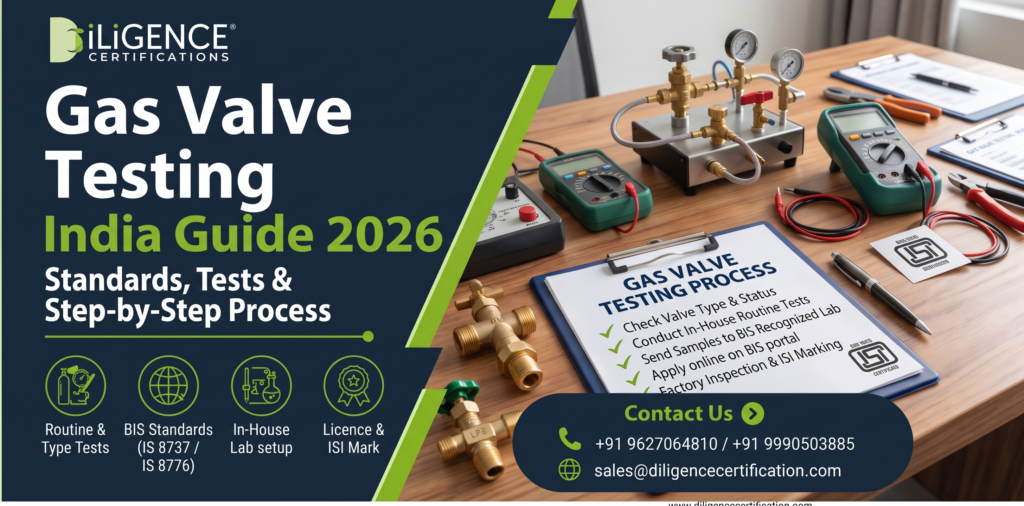
Step 1: Find the right standard. Check the cylinder size and valve type, then confirm whether IS 8737, IS 8776 or another standard applies.
Step 2: Check the scheme. Confirm that the product is under BIS mandatory certification and read the latest product manual.
Step 3: Prepare the factory. You need machines, gauges, test benches and trained staff. Calibrate all instruments.
Step 4: Make sample valves. Make samples from the actual production line, not special hand-made pieces.
Step 5: Do in-house testing. Test your samples first in the factory lab. Fix problems before sending to outside lab.
Step 6: Send samples to a recognised lab. The lab tests as per the standard and issues a test report.
Step 7: Apply to BIS. Submit the application with documents, test report and fees.
Step 8: Factory inspection. A BIS officer visits and checks your process, testing setup and records.
Step 9: Licence and ISI mark. If everything is in order, BIS grants the licence, and you can use the ISI mark. Surveillance continues after that.
Which Registration Is Needed?
| Business type | What is needed |
|---|---|
| Indian manufacturer | BIS licence under the product scheme |
| Importer | Product must come from a BIS-licensed maker, with proper documents |
| Foreign manufacturer | Registration through the foreign manufacturers certification scheme and an authorised Indian representative |
| Private label seller | Must ensure the valve carries a valid licence and proper marking |
| Exporter only | Normally not needed for export-only goods, but check buyer rules |
Please note that other approvals may also apply for gas cylinder fittings, such as approval from the Petroleum and Explosives Safety Organisation (PESO). Confirm this with your consultant before launching the product.
Documents Required
Company documents
- Business registration and GST details
- Factory address proof and layout
- Authorised person details
Product documents
- Product drawings and bill of materials
- Raw material details and supplier information
- Manufacturing process flow
Testing records
- Calibration certificates of gauges and machines
- Factory test records
- Recognised lab test report
How Long Does the Process Take?
There is no single fixed number. The time depends on how ready your factory is, how quickly the lab tests your samples, and how fast documents move. A well-prepared company usually moves faster. A company that fails a test and has to redo it will take longer. So prepare well and avoid rework.
What About Cost?
Cost depends on several things:
- Number of valve models and sizes
- Lab test charges
- BIS application and licence fees
- Cost of setting up or upgrading the factory lab
- Consultant support, if you take it
- Yearly marking fees and surveillance expenses
The total changes from case to case. Ask for a clear breakup before you start, so there are no surprises later.
Common Failures and Easy Fixes
| Failure | Likely reason | Easy fix |
|---|---|---|
| Leak at closed position | Weak seal or rough seat surface | Improve seal material and seat finish |
| Leak after endurance test | Seal wear or spring fatigue | Use better seal and test spring life |
| Thread gauge failure | Machine wear or wrong tool setting | Check tools and gauge regularly |
| Torque out of limit | Spindle friction or wrong thread fit | Adjust design and lubrication as allowed |
| Material test fail | Low-grade brass or mixed scrap | Buy from trusted supplier, keep test certificate |
| Marking not proper | Wrong size, place or details | Follow the marking clause exactly |
Common Mistakes to Avoid
- Using an old version of the standard.
- Sending special hand-made samples instead of production samples.
- Skipping in-house testing before the outside lab.
- Not calibrating gauges and test machines.
- Changing raw material supplier without informing or retesting.
- Keeping poor or incomplete test records.
- Ignoring marking rules on the valve body.
- Selling valves before the licence is actually granted.
Who Needs Gas Valve Testing?
- Manufacturers of LPG cylinder valves in India.
- Importers who bring valves from other countries.
- Private label brands that get valves made by someone else and sell under their name.
- Overseas manufacturers who want to supply to the Indian market.
- Export-only units, who should still test to meet buyer needs even if BIS is not required.
Why Choose Diligence Certifications for gas valve testing Certification?
Getting a test report is only one part of the job. The real trouble starts with documents, factory readiness, lab coordination and follow-ups.
Diligence Certifications supports companies with the process from start to end. You can visit the Diligence Certifications website to know more about the company, and see the BIS certification service page for details on how the support works.
Here is how a consultant like Diligence Certifications helps:
- Checks which standard and scheme applies to your valve.
- Guides you on factory lab and test setup.
- Helps in preparing the application and documents.
- Coordinates with the recognised lab for sample testing.
- Supports you during BIS factory inspection.
- Guides on marking and post-licence compliance.
Please note, approval depends on BIS and the product meeting the standard. No consultant can promise approval, and we also do not.
After Registration: What Happens Next?
Getting the licence is not the end. BIS can pick samples from your factory or the open market and test them. If a sample fails, there can be action on the licence. So keep your quality checks running every day, keep records ready, and renew the licence on time.
Tips to Pass in the First Attempt
- Read the latest standard line by line.
- Fix your design before making samples, not after.
- Use good quality brass and seal material.
- Test every sample in your own lab first.
- Keep thread gauges in good condition.
- Check marking before final dispatch.
- Keep all calibration and test records organised.
- Take expert guidance if this is your first licence.
Quick Checklist Before Sending Samples
- Latest standard and amendments downloaded
- Samples from regular production
- In-house leak and torque tests done
- Thread gauges checked
- Material test certificate available
- Marking checked on every sample
- Drawings and bill of materials ready
- Calibration certificates updated
Conclusion
Gas valve testing is not just paperwork. It protects homes, kitchens and workers. A valve that passes leak, torque, impact and endurance tests is a valve people can trust.
If you make, import or sell LPG cylinder valves, start with the right standard, test in your own lab first, then go to a recognised lab, and keep your records clean. Avoid shortcuts, because in gas safety shortcuts always cost more later.
And always check the latest BIS notification before you begin, because standards and rules get updated from time to time.
Frequently Asked Questions
1. What is gas valve testing?
It is the checking of a gas valve in a lab as per an Indian Standard, to confirm it is leak-proof, strong and safe for use.
2. Which standard is used for LPG cylinder valve testing?
IS 8737 is used for valve fittings of LPG cylinders above 5 litre water capacity, and IS 8776 is used for cylinders up to and including 13 litre.
3. Is BIS certification mandatory for LPG valves
Yes, LPG cylinder valve fittings come under BIS mandatory certification. Always confirm the current notification before launch.
4. What are the main tests in gas valve testing?
Leak test, torque test, impact test, endurance test, material check, thread gauge check, self-closing check and marking check.
5. Who can do the testing?
For BIS purposes, samples must be tested in a BIS-recognised lab. Factories also do routine testing in their own labs.
6. What is a leak test in a gas valve?
The valve is put under pressure and checked for any gas escape, in both open and closed positions.
7. Why is the endurance test done?
It shows whether the valve still works properly after many open-close cycles, like real daily use.
8. Why is the impact test important?
Cylinders can fall during transport. This test checks that the valve stays safe after a hit.