BIS Certification
 CDSCO
 PESO
 CPCB
 LMPC
 WPC Approval
 Global Approvals
 TEC
 ARAI
 BEE
 ISO Certification
 DGCA Certification
 NOC For Steel
 APEDA Registration























 Business Registration
 FSSAI Mark Certification












 (32).jpg)
 Legal Services
 Trademark Registration
 Copyright Registration
 Patent Registration
 By
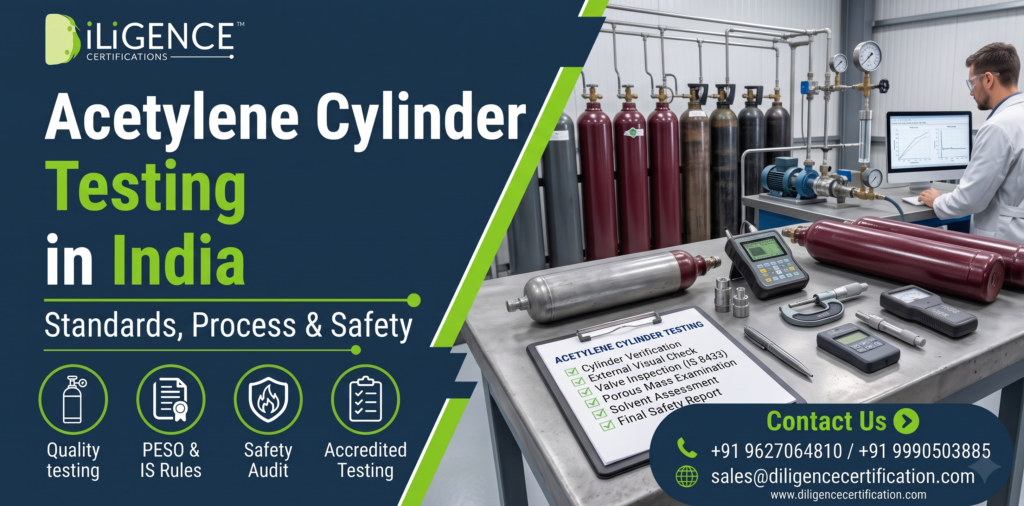
- Acetylene cylinder testing checks the condition, safety and reliability of cylinders used for storing dissolved acetylene gas.
- Acetylene is a highly flammable gas commonly used in welding, metal cutting and industrial applications.
- The Gas Cylinders Rules, 2016, provide important safety and compliance requirements in India.
- IS 8433 covers the periodic inspection and maintenance of dissolved acetylene gas cylinders.
- Important checks include external inspection, valve examination, porous mass condition, solvent quantity and cylinder identification.
- Cylinders with serious damage or failed inspection must not be refilled or used.
- Proper inspection records and maintenance help prevent accidents and support regulatory compliance.
Introduction
Acetylene is widely used in industries where welding, metal cutting and other high-temperature operations are required. It is an important industrial gas, but it also needs careful handling because it is highly flammable and can become unstable under certain conditions.
Many businesses use acetylene cylinders every day without paying enough attention to their inspection and maintenance. A cylinder may look normal from the outside, but problems with its valve, porous material, solvent or body can affect its safety.
This is why acetylene cylinder testing is important.
Regular inspection helps identify damage, leakage risks and other problems before they become serious. It also helps cylinder owners, gas suppliers and industrial users follow the applicable safety requirements.
In this guide, we explain acetylene cylinder testing in India, the relevant standards, inspection methods, testing procedures, documents and common mistakes in simple language.
What Is Acetylene Cylinder Testing?
Acetylene cylinder testing is the process of examining dissolved acetylene gas cylinders to check whether they remain suitable for safe storage, transportation and use.
Unlike many ordinary compressed gas cylinders, acetylene cylinders contain a porous material and a solvent. Acetylene gas is stored dissolved in the solvent, which is distributed through the porous mass.
This special construction helps reduce the risk of dangerous decomposition.
During inspection, the condition of the cylinder and its important components is examined. The inspection method depends on the cylinder design, applicable standards and regulatory requirements.
Acetylene cylinder inspection generally covers:
- External condition of the cylinder.
- Cylinder markings and identification details.
- Valve condition and operation.
- Porous mass condition.
- Solvent quantity and condition.
- Evidence of corrosion, dents or fire damage.
- Leakage and other visible defects.
- Previous inspection and maintenance records.
The main purpose is to make sure that the cylinder meets the applicable safety requirements before it is filled again.
Why Is Acetylene Cylinder Testing Important?
Acetylene cylinders operate under special conditions. Their safety depends not only on the metal body but also on the porous material and solvent inside them.
Here are some important reasons why testing and inspection matter.
1. Prevents Gas Leakage
A damaged valve, faulty connection or defective cylinder can cause gas leakage. Since acetylene is highly flammable, leakage can create a serious fire or explosion risk.
Inspection helps identify visible defects and possible leakage problems.
2. Checks Cylinder Safety
Regular examination helps identify corrosion, mechanical damage, dents and other defects that may affect cylinder strength.
3. Protects Industrial Workers
Welding operators, factory workers, gas suppliers and maintenance personnel work around industrial gas cylinders. Proper inspection helps reduce workplace safety risks.
4. Maintains Porous Mass Condition
The porous mass plays an important role in the safe storage of acetylene. Damage, shrinkage or deterioration may affect the cylinder’s ability to contain the gas safely.
5. Supports Regulatory Compliance
Following applicable Gas Cylinders Rules and relevant Indian Standards helps businesses maintain proper safety practices.
6. Reduces Unexpected Problems
Identifying cylinder defects early can prevent operational interruptions, emergency repairs and unnecessary safety risks.
Which Standards and Rules Apply to Acetylene Cylinder Testing in India?
Acetylene cylinders in India are covered by specific safety requirements. Businesses must understand the difference between statutory rules and technical standards.
The important regulatory references include:
Gas Cylinders Rules, 2016
The Gas Cylinders Rules, 2016, issued under the Explosives Act framework, establish requirements for the manufacture, possession, filling, storage, transportation, examination and testing of gas cylinders.
These rules are administered through the Petroleum and Explosives Safety Organisation (PESO).
Important provisions include:
- Rule 35: Periodicity of examination and testing of cylinders.
- Rule 36: Condemning of cylinders.
- Rule 37: Additional requirements for dissolved acetylene cylinders.
- Rule 38: Restrictions on filling dissolved acetylene cylinders.
- Rule 39: Examination of dissolved acetylene cylinders before filling.
- Rule 40: Licence requirements for compression of acetylene.
- Rule 41: Records of dissolved acetylene cylinders.
IS 8433: Periodic Inspection and Maintenance
IS 8433 provides guidance for the periodic inspection and maintenance of dissolved acetylene gas cylinders.
It is an important technical reference for examining cylinder condition, porous material, valves and other relevant components.
IS 7312: Additional Requirements
IS 7312 is referenced in the Gas Cylinders Rules for additional tests relating to dissolved acetylene cylinders, particularly requirements connected with the acetone quantity and cylinder design.
IS 15975: Periodic Testing Requirements
The Gas Cylinders Rules, 2016, refer to IS 15975 for the prescribed periodic examination and testing intervals, or to an interval approved in writing by the Chief Controller.
The applicable interval should be confirmed against the current standard and relevant approval conditions. Do not assume that every gas cylinder follows the same testing schedule.
Important: Always verify the latest BIS editions, amendments and PESO requirements before conducting inspection or filling operations.
Special Design of Acetylene Gas Cylinders
Understanding the construction of an acetylene cylinder makes its testing requirements easier to understand.
An acetylene cylinder is different from a standard compressed gas cylinder because it contains additional materials.
1. Cylinder Shell
The outer metal body provides structural strength and holds the internal components.
2. Porous Mass
The porous mass fills most of the cylinder interior. It provides a supporting structure in which the solvent and dissolved acetylene are distributed.
The porous material must meet the applicable requirements for composition and porosity.
3. Solvent
Acetone is commonly used as a solvent for dissolving acetylene. The solvent quantity must remain within the required limits.
An incorrect solvent quantity can affect the safe storage of acetylene.
4. Cylinder Valve
The valve controls the release of acetylene gas. It must be suitable for the cylinder and comply with the applicable material and safety requirements.
5. Safety Devices
Depending on the design, the cylinder may include safety relief arrangements such as fusible plugs.
These components help manage certain abnormal temperature or pressure conditions.
Important Tests and Inspections for Acetylene Cylinders
Acetylene cylinder testing is not limited to checking the outer surface. Different components need examination because they contribute to overall cylinder safety.
| Test or inspection | What it checks |
|---|---|
| External visual inspection | Dents, corrosion, cracks and physical damage |
| Cylinder identification | Manufacturer details, serial number and test markings |
| Valve inspection | Valve condition and suitability |
| Porous mass examination | Condition of the internal porous material |
| Solvent examination | Quantity and condition of the solvent |
| Leakage examination | Signs of leakage from valves and connections |
| Weight verification | Comparison with the marked tare weight |
| Safety device examination | Condition of applicable safety arrangements |
| Record verification | Previous tests, repairs and maintenance history |
1. External Visual Inspection
The external surface of the cylinder is checked for corrosion, dents, bulging, cracks, damaged threads and other visible defects.
A cylinder showing serious damage should be removed from normal service until it has been evaluated by an authorised facility.
2. Valve Inspection
The valve is an important safety component. Its physical condition, connection and suitability are examined.
Damaged or defective valves require appropriate attention before the cylinder can be considered suitable for further service.
3. Porous Mass Inspection
The porous mass is one of the most important parts of an acetylene cylinder.
Its condition is checked for signs of deterioration, shrinkage, damage or other defects that could affect safe gas storage.
The applicable procedure must be followed because the presence of porous material changes how acetylene cylinders can be inspected.
4. Solvent Quantity Examination
Acetone or another approved solvent helps keep acetylene dissolved inside the cylinder.
The solvent quantity needs to be maintained according to the manufacturer’s design and applicable requirements.
Excessive or insufficient solvent can create safety concerns.
5. Weight Verification
The cylinder’s weight is checked against its marked tare weight and previous records.
Unusual changes may indicate solvent loss, damage or other conditions requiring further examination.
6. Leakage Examination
The cylinder valve and relevant connections are examined for leakage using an appropriate approved method.
Any suspected leakage must be addressed by trained personnel following the required safety procedures.
7. Cylinder Marking Verification
The markings provide important information about the cylinder’s identity, manufacturer, test history, water capacity, porous mass and other specifications.
Missing, damaged or unreadable identification details should be investigated before the cylinder is accepted for filling.
Hydrostatic Testing of Acetylene Cylinders: What Should You Know?
Hydrostatic testing is commonly associated with gas cylinder strength evaluation. However, acetylene cylinders need special attention because of their internal porous material.
Under Rule 37 of the Gas Cylinders Rules, 2016, an acetylene cylinder is hydrostatically tested before it is filled with porous mass. The rules specify a test pressure of at least 60 kgf/cm², which may be reduced to 53 kgf/cm² when the cylinder is fitted with a fusible plug.
The rules also specify a limit for permanent stretch during this test.
This requirement should not be confused with routine periodic inspection of an already filled acetylene cylinder.
Because of the porous material, the inspection procedure for a completed dissolved acetylene cylinder differs from the ordinary hydrostatic testing procedure used for many other gas cylinders.
The applicable technical standard and authorised testing procedure must always be followed.
How Often Should Acetylene Cylinders Be Tested?
The inspection schedule depends on the cylinder design, applicable standard and regulatory requirements.
The Gas Cylinders Rules, 2016, provide important requirements for periodic examination and testing.
Rule 39 also specifies that:
- Every time an acetylene cylinder is charged, it must undergo a thorough visual examination according to IS 8433.
- If the cylinder’s history does not show an examination within the previous two years, the valve must be removed and the condition of the porous material at the neck must be checked.
- For cylinders filled with loose porous mass, the periodic examination period specified in this provision is one year.
The periodic re-test interval under Rule 35 must also be checked against IS 15975 or the written approval of the Chief Controller, as applicable.
Cylinder owners should maintain a proper inspection calendar and never fill a cylinder whose prescribed testing is overdue.
Step-by-Step Process of Acetylene Cylinder Testing
The inspection process should be carried out by an appropriately approved and equipped cylinder testing station.
The general process includes the following stages:
Step 1: Cylinder Identification
The cylinder’s serial number, manufacturer, markings and previous testing details are recorded.
Step 2: Record Verification
The inspection team checks the cylinder history, previous examination reports, repair details and other available documents.
Step 3: External Examination
The cylinder body is examined for corrosion, dents, cracks, fire damage and other physical defects.
Step 4: Valve Examination
The valve is checked for physical damage, suitability and other defects according to the applicable procedure.
Step 5: Porous Mass Examination
The condition of the porous material is examined using the method prescribed for the cylinder type.
Step 6: Solvent Assessment
The solvent quantity and condition are evaluated as required.
Step 7: Additional Required Checks
Other applicable inspections and tests are performed according to the relevant standard and approval conditions.
Step 8: Report Preparation
The findings are documented, including cylinder identification, inspection details and the results.
Step 9: Acceptance or Rejection
Cylinders meeting the applicable requirements may be accepted for further service. Unsafe or failed cylinders must be handled according to the condemnation and safety provisions.
Step 10: Record Updating
The inspection history is updated so that future examinations and maintenance can be tracked properly.
Safety note: Acetylene cylinder examination is specialised work. Do not attempt to open, dismantle, empty, test or repair a cylinder yourself. These activities must be handled by trained personnel at an appropriately approved facility.
Documents Required for Acetylene Cylinder Testing
Proper documentation helps identify cylinders and maintain their inspection history.
Commonly required documents include:
Cylinder Documents
- Cylinder manufacturer’s name and details.
- Cylinder serial or identification number.
- Manufacturing specifications.
- Original test and inspection certificate.
- Previous testing and examination reports.
- Tare weight and water capacity details.
- Porous mass and solvent information.
Business and Facility Documents
- Cylinder ownership or authorisation details.
- Applicable PESO licence or approval details.
- Cylinder inventory records.
- Maintenance and repair records.
- Details of the responsible person or inspection agency.
The exact document list may differ depending on whether the applicant is a cylinder owner, gas filler, manufacturer or testing station.
Who Needs Acetylene Cylinder Testing?
Several industries and businesses use acetylene cylinders in their daily operations.
1. Welding and Fabrication Units: These businesses use acetylene for gas welding and metal cutting.
2. Manufacturing Industries: Industrial production facilities may use acetylene in specialised processes.
3. Metal Processing Companies: Metal cutting and fabrication operations require properly maintained gas cylinders.
4. Gas Filling Companies: Businesses involved in filling acetylene cylinders must follow applicable examination and filling requirements.
5. Industrial Gas Suppliers: Suppliers should maintain cylinder identification, inspection and maintenance records.
6. Cylinder Manufacturers: Manufacturers must follow the applicable design, manufacturing and testing requirements.
7. Cylinder Testing Stations: Approved testing stations perform specialised examination and testing activities within their approved scope.
Common Mistakes to Avoid During Acetylene Cylinder Testing
Even small mistakes can create serious safety concerns.
Here are some common mistakes businesses should avoid.
- Ignoring inspection dates: Filling overdue cylinders can violate applicable safety requirements.
- Using damaged cylinders: Dents, corrosion and fire damage should never be ignored.
- Neglecting porous mass condition: The internal material is essential for safe acetylene storage.
- Ignoring solvent quantity: Incorrect solvent levels can affect cylinder safety.
- Not maintaining records: Missing cylinder history makes proper inspection difficult.
- Using unauthorised testing facilities: Always verify the testing station’s approval and scope.
- Ignoring valve defects: Damaged valves can create leakage and operational risks.
- Mixing testing requirements: Acetylene cylinders have special inspection requirements and should not automatically follow procedures for ordinary compressed gas cylinders.
How to Choose the Right Acetylene Cylinder Testing Station?
Selecting the right testing facility is important for reliable results and regulatory compliance.
Consider these points before selecting a testing station:
- Check whether the facility has the required PESO approval.
- Confirm that its approval covers dissolved acetylene cylinders.
- Verify the availability of appropriate testing equipment.
- Check the training and experience of technical personnel.
- Ask about applicable standards and inspection procedures.
- Review the format and completeness of previous test reports.
- Confirm that cylinder identification and records are maintained properly.
A low-cost testing service should never be selected at the expense of safety and regulatory compliance.
Why Choose Diligence Certifications for Acetylene Cylinder Testing Certification?
Understanding industrial gas cylinder requirements can be challenging for manufacturers, suppliers and industrial businesses.
Questions about PESO approval, cylinder inspection, applicable Indian Standards and documentation can make the compliance process confusing.
At Diligence Certifications, we help businesses understand applicable certification and regulatory requirements. Our team provides guidance on relevant standards, documentation, compliance procedures and the steps involved in industrial product-related approvals.
We help businesses understand:
- Applicable PESO rules and compliance requirements.
- Relevant BIS standards and technical references.
- Documentation needed for regulatory procedures.
- Testing and inspection requirements.
- General guidance for maintaining compliance records.
Our aim is to make the compliance process easier to understand so that businesses can take informed decisions.
For more information, visit Diligence Certifications or explore our services page.
Important: Diligence Certifications provides compliance guidance and consultancy. We are not claiming to operate an acetylene cylinder testing laboratory or perform physical cylinder testing. Physical inspection and testing must be conducted by an appropriately approved facility.
Conclusion
Acetylene cylinder testing is an important part of industrial gas safety. Since acetylene is highly flammable and stored using a special porous material and solvent system, its cylinders require specific inspection and maintenance procedures.
Following the Gas Cylinders Rules, 2016, and relevant Indian Standards helps cylinder owners and industrial businesses maintain safe operations.
Businesses should pay attention to external damage, valve condition, porous mass, solvent quantity, inspection dates and cylinder records. They should also ensure that testing is performed by an appropriately approved facility.
Regular inspection is not simply a compliance activity. It is an important step towards protecting workers, equipment and industrial operations.
Frequently Asked Questions
1. What is acetylene cylinder testing?
Acetylene cylinder testing is the examination of dissolved acetylene cylinders to check their physical condition, valve, porous mass, solvent and other safety-related requirements.
2. Which rules apply to acetylene cylinder testing in India?
The Gas Cylinders Rules, 2016, provide the main statutory requirements. Relevant BIS standards, including IS 8433, also guide inspection and maintenance.
3. What is IS 8433?
IS 8433 is the Indian Standard covering periodic inspection and maintenance of dissolved acetylene gas cylinders.
4. What is the role of PESO in acetylene cylinder safety?
PESO administers the applicable gas cylinder regulatory framework and grants relevant approvals and licences under the rules.
5. Why are acetylene cylinders different from ordinary gas cylinders?
They contain a porous material and solvent in which acetylene is dissolved. This special construction requires specific inspection procedures.
6. Is hydrostatic testing required for acetylene cylinders?
The Gas Cylinders Rules specify hydrostatic testing before the cylinder is filled with porous mass. Routine inspection of completed acetylene cylinders follows their specialised requirements.