BIS Certification
 CDSCO
 PESO
 CPCB
 LMPC
 WPC Approval
 Global Approvals
 TEC
 ARAI
 BEE
 ISO Certification
 DGCA Certification
 NOC For Steel
 APEDA Registration























 Business Registration
 FSSAI Mark Certification












 (32).jpg)
 Legal Services
 Trademark Registration
 Copyright Registration
 Patent Registration
 By
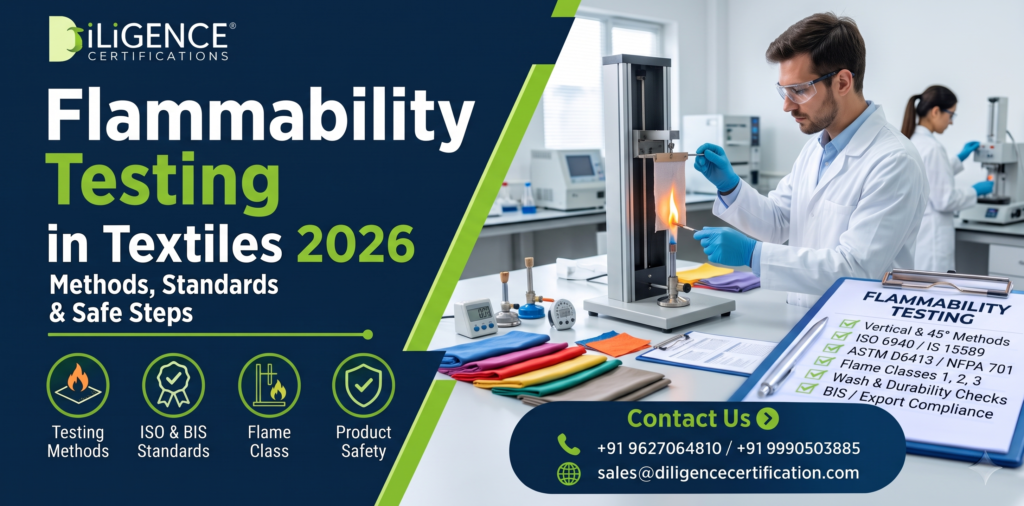
- Flammability testing in textiles checks how easily a fabric catches fire and how fast the flame spreads.
- It matters most for children’s wear, nightwear, curtains, upholstery, bedding and protective clothing.
- Different products and countries follow different standards, so choose the right one first.
- Fabric type, weave, weight and finish all change the burning result.
- Flame retardant finishes must be tested after washing, not only when the fabric is new.
- A good test report is useful for buyers, exports and your own quality control.
Introduction
Think of a fire drill in a school. Nobody wants a real fire, but the drill tells you how people will react if one happens. Flammability testing in textiles works the same way. The lab sets a small, controlled flame on your fabric and watches what happens. Does it catch fire fast? Does the flame run up the cloth? Does it stop on its own?
These answers decide if a fabric is safe for a child’s nightwear, a hotel curtain or a worker’s uniform. In this guide, we will keep things very simple. You will learn what the test is, which standards are used, how the process works and what mistakes to avoid.
What Is Flammability Testing in Textiles?
Flammability testing in textiles is a lab test that measures how a fabric behaves when it meets a flame. The lab checks three basic things:
- How quickly the fabric ignites.
- How fast the flame spreads across the surface.
- Whether the fabric keeps burning, glows or melts after the flame is removed.
The test is done on small, cut samples under fixed conditions. Same size, same flame, same angle, same time. This is important because only then can results be compared fairly between two fabrics or two labs.
Note: flammability testing does not mean the fabric is fireproof. Almost every fabric burns if the fire is big enough. The test only tells you how it behaves and how risky it is.
Why Flammability Testing Is Important
- Safety of people: Fast-burning fabric can cause serious burns, especially for children and elderly people.
- Buyer requirement: Many export buyers ask for a flammability report before placing an order.
- Legal need: Some countries have rules for certain products like children’s sleepwear or public-place furnishings.
- Better quality control: Testing shows if a flame retardant finish is working or not.
- Brand trust: A tested product gives your customer confidence.
- Fewer rejections: Checking early saves shipments from being stopped later.
Which Textile Products Need Flammability Testing?
Not every product is tested the same way. Here is a simple view.
| Product | Why testing is needed | Common concern |
|---|---|---|
| Children’s nightwear | Worn close to the body during sleep | Fast flame spread |
| General apparel | Everyday safety | Raised-surface fabrics like brushed cotton |
| Curtains and drapes | Used in homes, hotels, hospitals, theatres | Flame running upwards |
| Upholstery and sofa fabric | Large surface, often near ignition sources | Smouldering and glow |
| Bedding and mattresses | Long contact with people | Cigarette or flame ignition |
| Protective workwear | Used in welding, oil, gas and fire jobs | Afterflame and char length |
| Toys and soft items | Used by children | Burning rate of soft material |
Common Standards Used for Flammability Testing
The right standard depends on the product and the country where it will be sold. Some well-known ones are given below.
| Standard | What it generally covers |
|---|---|
| 16 CFR Part 1610 (USA) | Flammability of general wearing apparel and textiles |
| 16 CFR Parts 1615 and 1616 (USA) | Children’s sleepwear sizes |
| ASTM D6413 | Vertical flame test for textile fabrics |
| ASTM D1230 | Flammability of apparel textiles |
| ISO 6940 and ISO 6941 | Ease of ignition and flame spread of vertical fabrics |
| ISO 15025 | Limited flame spread for protective clothing |
| EN 1103 | Burning behaviour of fabrics for clothing |
| NFPA 701 | Flame propagation of curtains and drapes |
| BS 5852 | Ignition of upholstered seating |
| EN 71-2 | Flammability of toys |
For India, BIS also has Indian Standards on burning behaviour of textiles and protective clothing. Always confirm the exact standard number and its latest version before testing. Standards are revised from time to time, and your buyer may ask for a specific one.
A simple example: a Gujarat exporter making cotton nightwear for the US market would check against 16 CFR 1610 and the sleepwear rules, while a Tirupur brand supplying curtains to a European hotel chain may be asked for a different standard. Same fabric, different market, different test.
BIS Standards for Flammability Testing in Textiles
In India, the Bureau of Indian Standards (BIS) publishes the test methods and product specifications used for flammability testing in textiles. Many of these are the same as international methods, so one report can often help both your local and export buyers.
Here are the main ones in simple words.
| BIS standard | What it covers | Where it is used |
|---|---|---|
| IS 11871:1986 | Methods to find flammability and flame resistance of textile fabrics. Applies to woven, knitted, bonded, laminated or coated fabrics, clothing and garments | General fabrics and garments |
| IS 13501 (latest revision) | Flammability by oxygen index, meaning the least oxygen needed to keep the fabric burning | Clothing and protective textiles |
| IS 15589:2005 (same as ISO 6940) | Ease of ignition of vertically placed fabric samples with a small flame | Fabrics, coated and quilted materials |
| IS 15590:2005 (same as ISO 6941) | Flame spread of vertically placed fabric samples | Fabrics, coated and quilted materials |
| IS 15612 (Parts 1 to 4) | Burning behaviour of curtains and drapes: classification, large-flame spread, small-flame ignition and flame spread | Curtains, drapes, blinds, hangings |
| IS 15741:2007 | Resistance to ignition of curtains and drapes (specification) | Curtains and drapes |
| IS 12467 (Part 1):2006 | Ignitability of upholstered furniture | Sofa and seating fabric |
| IS 15768:2008 | Resistance to ignition of upholstered composites for non-domestic furniture | Offices, public places |
| IS 17291:2019 | Flame retardant jute based decorative and cover fabric for temporary structures | Pandals, tents, temporary setups |
Note: the table gives the general idea only. Standards are reviewed and revised from time to time, and a few have newer versions, so always check the current edition on the BIS website before testing.
A Simple Example
Say a Delhi curtain manufacturer supplies fabric to a hotel. The hotel asks for burning behaviour as per the Indian Standard. The maker would look at IS 15612 for curtains and drapes, and the lab would test the fabric as per the right part, small flame or large flame. A garment unit making workwear would instead look at IS 11871 or the oxygen index method.
Is BIS Certification Compulsory?
Most of the standards above are test methods. They tell the lab how to test, but they do not by themselves make a BIS licence compulsory. Some products, like certain protective or technical textiles, may fall under a Quality Control Order or a BIS product specification. So the answer depends on your product.
Before you start, check:
- Is your product covered by a current Quality Control Order?
- Does your buyer or tender ask for a specific IS number?
- Is the test needed only as a quality report, or for a BIS licence?
If the answer is not clear, take guidance first. It saves time and repeat testing.
What the Lab Actually Checks
When the flame touches your sample, the lab looks at these points.
| What lab checks | In simple words |
|---|---|
| Ignition time | How long the fabric takes to catch fire |
| Flame spread time | How fast the flame travels across a marked distance |
| Afterflame | How long the flame stays after the ignition source is removed |
| Afterglow | Whether the fabric keeps glowing without a visible flame |
| Char length | How much of the fabric is burnt or damaged |
| Melting and dripping | Whether burning drops fall from the fabric |
Some products pass only if the flame goes out quickly. For others, the result is graded into classes, like Class 1 (normal flammability), Class 2 (intermediate flammability) and Class 3 (rapid and intense burning). Class 3 fabrics are generally not accepted for clothing, because they burn too fast.
Main Flammability Test Methods
- 45-degree angle test: The sample is held at a slant and a flame is applied at the lower edge. The lab records the time the flame takes to burn a set distance. This is often used for general apparel.
- Vertical flame test: The fabric hangs straight and a flame is applied at the bottom edge. The lab records afterflame, afterglow and char length. This is common for curtains, protective clothing and nightwear.
- Horizontal test: The sample lies flat and the burning rate is measured. This is often used for soft furnishing and toy fabrics.
- Surface flash test: The flame touches the surface only briefly, to check if raised fibres (like brushed or napped fabric) catch fire quickly.
- Upholstery ignition test: A small flame source or a smouldering cigarette is placed on the covered seating, to check ignition and glow.
Tip: Always ask your buyer which method they want. Do not guess. A wrong method means a wasted report.
How Fabric Type Changes the Result
- Cotton and viscose: Burn quickly and keep burning, with an afterglow. Light cotton, especially with a raised surface, can be risky.
- Polyester and nylon: Tend to melt and shrink away from the flame. Dripping molten material can still cause burns.
- Wool: Burns slowly and often goes out on its own.
- Blends: Behave in mixed ways. For example, a cotton-polyester blend can burn in an unexpected manner because the melted polyester holds the burning cotton.
- Weight and weave: Lighter, loosely woven fabric burns faster than heavy, tightly woven fabric.
- Finishes and coatings: Softeners, prints and laminates may change the burning speed.
Flame Retardant Finishes and Testing
Some fabrics are treated with a flame retardant finish so they burn slower or stop burning. These are of two basic types:
- Durable finish: Stays on the fabric even after many washes. Used for uniforms and curtains that are cleaned again and again.
- Non-durable finish: Washes out after a few cleanings. Used for items that are rarely washed.
The key point: a fabric may pass when new but fail after washing. So many standards ask for testing both before and after laundering. If your product claims to be flame retardant, test it after the number of washes you promise to the customer.
Step-by-Step Process of Flammability Testing
- Know your product and market. Decide where the product will be sold and what the buyer expects.
- Pick the right standard. Match the product type with the correct test method.
- Select a competent lab. Choose a lab with the right equipment and accreditation for the method.
- Prepare the samples. Send enough fabric, cut from different parts of the roll, with clear labels.
- Pre-treatment, if needed. Samples may be washed, dry-cleaned or conditioned before testing.
- Conditioning. The lab keeps the samples in fixed temperature and humidity before the test.
- Burn testing. The flame is applied and the behaviour is recorded as per the method.
- Result evaluation. The lab compares the observations with the pass limits or flame classes.
- Test report. You get the report with the standard name, sample details and results.
Sample and Document Requirements
| Group | What is usually needed |
|---|---|
| Product details | Fabric type, composition, weight, weave, colour, finish |
| Sample details | Sample size, number of pieces, direction of cut (warp and weft) |
| Test details | Standard name, number of washes before test, class or pass limit needed |
| Company details | Name, address, contact, buyer or order details if asked |
Tip: Keep a few extra pieces of the same fabric. Re-testing is sometimes needed, and matching the same lot is important.
How Long Does It Take and What Affects the Cost?
The time depends on the standard, the number of samples and whether washing cycles are needed before the burn test. A simple one-time test is quicker. Tests with many washes take longer, because the washing itself needs time.
The cost also depends on a few factors:
- Type and number of standards.
- Number of samples and fabric colours.
- Pre-washing or dry-cleaning cycles.
- Whether the lab is accredited for that specific method.
- Urgent or normal turnaround.
For an exact figure, ask the lab for a clear breakup. Do not compare only on price, because the method and accreditation matter more.
Common Mistakes to Avoid
- Testing against the wrong standard for the buyer’s country.
- Sending the sample in only one direction (warp or weft), when both are needed.
- Testing only new fabric and ignoring the wash durability.
- Sending too little fabric, so re-tests become impossible.
- Changing the fabric finish after the report is made, and still using the old report.
- Assuming a polyester fabric is safe because it does not burn like cotton.
- Not mentioning the test method in the purchase order.
- Keeping no record of lot number, dyeing batch and finish details.
Who Needs Flammability Testing?
- Garment manufacturers and exporters: Especially for children’s wear and nightwear.
- Home textile makers: Curtains, bedding, mattress covers and sofa fabric.
- Fabric mills and processors: To check their flame retardant finish.
- Importers and traders: To check product safety before selling in India.
- Private label brands: When a factory makes the product and the brand takes the legal responsibility.
- Workwear suppliers: For industries where fire risk is high.
Why Choose Diligence Certifications for flammability testing in textiles Certification?
Testing and compliance can feel confusing, with so many standards and buyer rules. This is where a good guide saves time. At Diligence Certifications, the team helps businesses understand which test or standard fits their product, what documents are needed and how to prepare samples properly.
Here is how the support usually helps:
- Simple explanation of standards in everyday language.
- Help in choosing the correct test for your product and market.
- Guidance on sample preparation and documents.
- Clear follow-up during the process.
- Support for related testing and certification services if your product needs more than one approval.
No approval or result is promised, because the result always depends on the product and the lab test. What you get is clear direction, so you avoid common mistakes.
Conclusion
Flammability testing in textiles is not just a paper formality. It is a safety check that protects people, saves shipments and builds buyer trust. The basic idea is simple: choose the right standard, prepare proper samples, test the fabric in a competent lab and keep records.
Also remember that fabric type, weave and finishes change the result. If you use a flame retardant finish, test it after washing as well. And if you are unsure about the standard, ask your buyer or a compliance expert before you cut a single sample.
Frequently Asked Questions
1. What is flammability testing in textiles?
It is a lab test that checks how easily a fabric catches fire, how fast the flame spreads and whether it keeps burning after the flame is removed.
2. Does a flammability test make a fabric fireproof?
No. The test only measures burning behaviour. It does not change the fabric.
3. Which products need this test the most?
Children's nightwear, curtains, upholstery, bedding, protective workwear and toys are the most common ones.
4. Which fabrics burn the fastest?
Light cotton, viscose and brushed or raised-surface fabrics generally burn faster than heavy, tightly woven fabrics or wool.
5. Do polyester fabrics burn?
Yes. They usually melt and shrink from the flame, but they can still burn and the molten drops can cause burns.
6. What is the difference between afterflame and afterglow?
Afterflame is the flame that remains after the ignition source is taken away. Afterglow is the red glow without a visible flame.