BIS Certification
 CDSCO
 PESO
 CPCB
 LMPC
 WPC Approval
 Global Approvals
 TEC
 ARAI
 BEE
 ISO Certification
 DGCA Certification
 NOC For Steel
 APEDA Registration























 Business Registration
 FSSAI Mark Certification












 (32).jpg)
 Legal Services
 Trademark Registration
 Copyright Registration
 Patent Registration
 By
- pH value testing in textiles tells you if a fabric is acidic, neutral or alkaline.
- Skin is slightly acidic, so fabric that touches the body should stay close to that range.
- The test is done on a water extract of the fabric, not on the dry cloth.
- ISO 3071, IS 1390 and AATCC 81 are the common test methods buyers ask for.
- Wrong pH can cause skin irritation, colour change and weak fabric.
- Most failures come from poor washing after dyeing, so the fix is usually simple.
Introduction
Many times, the reason is leftover chemicals from dyeing and finishing. These chemicals change the pH of the fabric. If the pH is too high or too low, it can irritate the skin.
That’s why buyers, brands and exporters ask for pH value testing in textiles. It’s a small and low-cost test, but it tells you a lot about the quality of the wet processing.
In this blog, we’ll understand the test in very simple words. We’ll see the standards, the method, the safe limits, and what to do if your fabric fails.
What Is pH Value Testing in Textiles?
pH is a number from 0 to 14. It shows how acidic or alkaline something is.
- 0 to 6.9 means acidic
- 7 means neutral
- 7.1 to 14 means alkaline
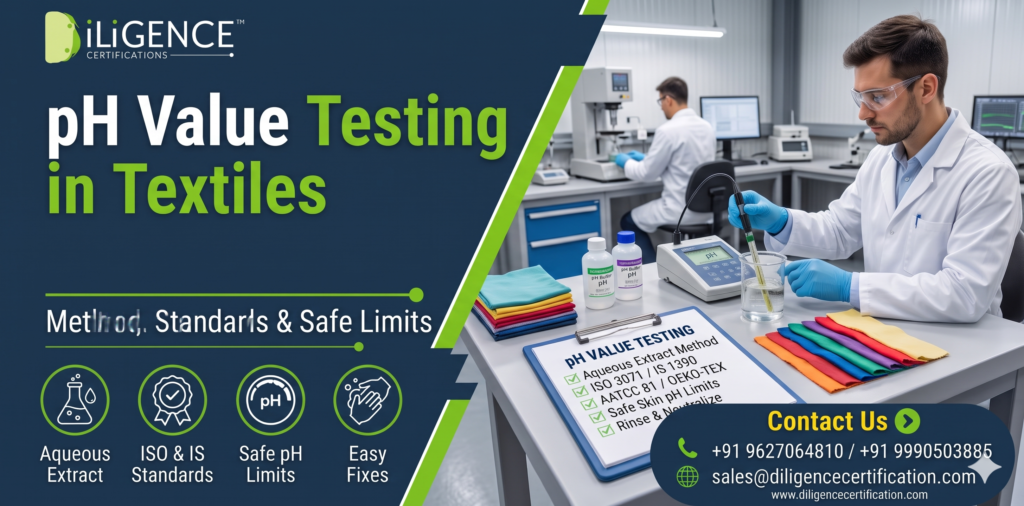
Now, in textiles, we don’t put a pH meter on the dry fabric. That won’t work. Instead, a small piece of fabric is soaked and shaken in water (or a salt solution). The water pulls out any acid or alkali sitting in the fabric. This is called the aqueous extract.
Then the pH of that extract is measured with a calibrated pH meter. The number you get is the pH value of the fabric.
Simple idea. But the result matters a lot, especially for baby wear, innerwear, bedsheets and anything that touches the skin for a long time.
Why Is pH Testing Important in Textiles?
Fabric goes through many wet processes. Scouring, bleaching, dyeing, printing and finishing. Each step uses acids, alkalis or salts. If the fabric is not washed and neutralised properly at the end, those chemicals stay behind.
Here’s why the pH test is important:
- Skin safety: Healthy skin has a pH of around 4.5 to 5.5. Fabric far from this range can cause rashes, itching or dryness.
- Baby and children’s wear: Baby skin is more sensitive, so buyers keep tighter limits.
- Colour stability: Wrong pH can make dyes bleed, fade or change shade.
- Fabric strength: Strong acid or alkali left in the cloth can slowly damage the fibres, especially cotton and wool.
- Buyer and export needs: Most international buyers and eco-labels have a pH limit in their requirements.
- Process control: If a lot fails, you know the final rinsing or neutralising step needs fixing.
Which Standards Are Used for pH Testing of Textiles?
There is no single rule for every buyer. Different buyers ask for different methods. These are the common ones:
| Standard | What it covers | Where it is commonly used |
|---|---|---|
| ISO 3071 | Determination of pH of aqueous extract of textiles | Export orders, international buyers |
| IS 1390 | Indian method for pH of aqueous extract of textile materials | Indian domestic testing |
| AATCC 81 | pH of the water extract from wet processed textiles | US buyers and brands |
| OEKO-TEX Standard 100 | Limits for harmful substances, including a pH range | Eco-label and brand requirements |
A simple example. If you are exporting bed linen to Europe, the buyer will most likely ask for ISO 3071 with the pH limit of their own specification. If you are selling in India, IS 1390 may be accepted.
One small advice. Standards get revised from time to time. Always confirm the latest version and the exact limit with your buyer or your lab before sending samples.
BIS and pH Value Testing of Textiles
BIS means Bureau of Indian Standards. It’s India’s national standards body, and it writes the Indian Standards (IS) that many textile products follow.
So where does pH come in? In two places.
1. The test method. IS 1390 is the BIS standard for finding the pH of the aqueous extract of textiles. The latest version is IS 1390:2022, which is aligned with ISO 3071:2020 (third revision). So when a lab says “tested as per IS 1390″, it follows the same method that international buyers already know.
One small note. Older versions of IS 1390 had a hot extraction method, which was removed in the 2019 revision. Some product standards may still mention it, so confirm with your lab which method they will use.
2. The pH limit in product standards. Many BIS product standards for textiles have their own pH requirement in the table of requirements. The test method given there is IS 1390. Here are a few examples:
| BIS product standard | pH limit of aqueous extract |
|---|---|
| Absorbent cotton gauze (IS 758:2023) | 6.5 to 8.5 |
| Handloom cotton shirting (second revision, 2024) | 6.0 to 8.5 |
| Cotton selvedge tape for electric cables (IS 2847:2024) | 6.0 to 8.0 |
| Handloom cotton bed sheets (IS 745:2003) | 6.0 to 10 |
See the pattern? The pH limit is not the same for every product. Medical textiles keep it tighter, and a bed sheet gets a wider range. Always read the table in the standard of your own product.
These limits are from the versions we checked. Standards get revised, so always confirm the latest edition on the BIS website or with your lab before testing.
BIS Certification and the Standard Mark
Most of these standards have a clause saying the product may be certified under the BIS conformity assessment schemes, and can carry the BIS Standard Mark (the ISI mark). This is the rule from the BIS Act, 2016.
Now, is BIS certification compulsory for your textile product? It depends. For many products it is voluntary. But some products come under a Quality Control Order (QCO), and for those, BIS certification is mandatory. QCO lists change from time to time, so check the current list before you plan.
If you want the Standard Mark, the simple path looks like this:
- Find the BIS standard that matches your product
- Check all its requirements, including the pH limit and IS 1390 method
- Test your product samples in a recognised lab
- Apply to BIS for the licence
- BIS checks your factory and your testing arrangements
- After the licence is granted, keep the quality steady, because BIS does surveillance later
pH is just one test in this list. But it’s an easy one to fail if the final washing is weak, so keep an eye on it from the start.
Quick Tips for BIS-Related pH Testing
- Always check the product standard first, not just the general test method
- Use IS 1390 as the method, and note the version in your test report
- Keep your in-house pH checks regular, so surprises don’t come at licence stage
- Keep the test reports and lot records ready for BIS inspection
- Don’t assume one pH limit works for every product
What Is the Safe pH Range for Textiles?
The exact limit depends on the buyer’s specification. But as a general guide, this is the range many buyers follow:
| Product type | Commonly followed pH range |
|---|---|
| Baby wear (up to 3 years) | 4.0 to 7.5 |
| Fabric that touches the skin directly (innerwear, T-shirts, bedsheets) | 4.0 to 9.0 |
| Fabric that doesn’t touch the skin much (jackets, curtains) | 4.0 to 9.0 |
| Decoration material (upholstery, carpets) | 4.0 to 9.0 |
These numbers follow the commonly used OEKO-TEX product classes. Some buyers keep their own stricter range. Always check your buyer’s requirement first.
Simple rule: the closer to neutral or slightly acidic, the better for skin contact.
How Is pH Value Testing Done? (The Method in Simple Words)
The lab steps are almost the same in all methods. Small details like the extraction liquid and time can change.
- Sample cutting. The lab cuts the fabric into small pieces, usually around 2 grams. Cutting is done with clean scissors. No hand touching, because sweat can change the result.
- Extraction liquid. In ISO 3071, a salt solution (potassium chloride) is the main liquid, though some methods allow distilled water. The method tells which one to use.
- Soaking and shaking. The fabric is placed in the liquid in a bottle. It is shaken for the time given in the method, at room temperature.
- Settling. The liquid is poured out into a clean beaker.
- Measuring. A calibrated pH meter is dipped in the extract. The reading is noted once it becomes stable.
- Repeat. The test is repeated on more specimens. The average is reported.
The pH meter must be calibrated with standard buffer solutions before every testing session. If calibration is wrong, the whole result is wrong.
Two Kinds of Testing: In-House Lab vs Accredited Lab
Textile units usually have two options.
In-house lab. Good for daily checks. You can test a lot before despatch, find problems early, and save time. But buyers may not accept this report for final approval.
Third-party or accredited lab. The lab follows a recognised method, has calibrated instruments and gives a formal report. Most buyers and export orders want this one.
A smart way is to use both. Do routine checks in-house. Send the final lot sample to an accredited lab for the official report.
Step-by-Step Process to Get Your Fabric Tested
If you have never done this before, here is the simple path:
- Check the buyer requirement. Which standard? What pH limit? What product category?
- Choose the right lab. Look for a lab that works to ISO, IS or AATCC methods.
- Prepare the sample. Take it from the final finished fabric, not from the grey fabric.
- Label the sample. Write fabric name, lot number, colour and date.
- Fill the test request. Mention the standard and the limit clearly.
- Send the sample. Wrap it in a clean plastic bag. Don’t touch it too much.
- Lab testing. The lab does the extraction and measures the pH.
- Receive the report. Check the method, the result and the sample details.
- Take action. If it passes, good. If it fails, find the cause, fix the process and retest.
What Samples Do You Need to Send?
Usually, labs ask for a small piece of fabric, often around 10 grams or one small swatch. Some labs may ask for more, especially if retesting is needed.
A few important points:
- Send the final finished fabric, not the grey cloth
- Keep it away from dust, oil and direct sunlight
- Don’t wash or iron it before sending
- Pack it in a clean, dry plastic cover
- Share the lot number and product details
How Long Does the Test Take?
The test itself is quick. In most cases, you get the result in a few working days. The time can be longer if the lab has a queue, or if many other tests are asked together.
If you’re in a hurry, ask the lab about urgent service before sending the sample.
What Decides the Cost?
We’re not putting any amount here, because prices change from lab to lab. But these things usually decide the cost:
- Number of samples or lots
- Which standard is asked
- Whether other tests (like colourfastness, formaldehyde) are added
- Urgent or normal turnaround
- In-house or third-party lab
Always ask for a clear quote before sending the sample.
Why Does a Fabric Fail pH Testing? Common Causes and Easy Fixes
| Problem | Why it happens | Easy fix |
|---|---|---|
| pH too high (alkaline) | Leftover caustic soda, soda ash or bleaching chemicals | Proper washing and neutralising with a mild acid |
| pH too low (acidic) | Leftover acid from dyeing or finishing | Rinse well and adjust with a mild alkali |
| Different pH in different lots | No process control, water quality changes | Standard recipe, regular checks |
| Result changes on retest | Sample was handled badly or stored wrongly | Handle with clean tools, store properly |
| Fails after storage | Residual chemicals or humid storage | Better final rinse, dry storage |
| Wrong reading from the meter | pH meter not calibrated | Calibrate before every session |
Most of the time, the fix is in the final rinse and neutralising stage. It doesn’t need big machine changes.
Common Mistakes to Avoid
- Testing grey fabric instead of the finished fabric
- Not checking the buyer’s pH limit before testing
- Using a pH meter without calibration
- Touching the sample with bare hands
- Using a different method than the one the buyer asked for
- Sending too small a sample
- Ignoring a borderline result and hoping it will pass next time
- Not keeping a record of lot numbers and results
Who Needs pH Value Testing in Textiles?
- Fabric manufacturers and processors. To check the wet processing quality.
- Garment exporters. Most overseas buyers ask for a test report.
- Brands and private label sellers. To protect their customers and their name.
- Baby wear and innerwear makers. Limits are tighter here.
- Home textile makers. Bedsheets, towels and curtains are all checked.
- Importers and traders. To check the quality before accepting a lot.
Why Choose Diligence Certifications for pH value testing in textiles Certification?
Testing and compliance can feel confusing, especially when every buyer has a different requirement. That’s where a good consultant helps.
Diligence Certifications can guide you on which standard and pH limit may apply to your product, how to prepare the sample, which test report your buyer may accept, and what to do if the result doesn’t meet the limit.
You can visit the Diligence Certification homepage to know more about the company, or see the services page for the support available.
No one can promise a pass result, because it depends on your fabric and your process. But with the right guidance, you can avoid common mistakes and save time.
Tips to Pass pH Testing in the First Attempt
- Check the buyer’s pH limit before you start production
- Wash the fabric well after dyeing and printing
- Neutralise properly at the end of wet processing
- Keep the water quality under check
- Test one lot in-house before sending the final sample
- Calibrate the pH meter regularly
- Store the finished fabric in a dry place
- Keep a record of every lot and its result
Conclusion
pH value testing in textiles is a small test, but it protects your customer’s skin, your fabric quality and your business reputation.
If the pH is in the right range, the fabric feels comfortable and the colour stays stable. If it’s not, you’ll face complaints, rejections and rework.
So, check your buyer’s limit, follow the right standard, wash and neutralise well, and test before despatch. It’s simple, and it saves a lot of trouble later.
Frequently Asked Questions
1. What is pH value testing in textiles?
It's a test that measures how acidic or alkaline a fabric is. The lab soaks the fabric in water or a salt solution and measures the pH of the extract.
2. Why is pH important for fabric?
Wrong pH can irritate the skin, change the colour and weaken the fibres. It also shows how well the fabric was washed after dyeing.
3. What is the ideal pH of textiles?
For skin contact, slightly acidic to neutral is better. Many buyers accept a range of about 4.0 to 7.5 for baby wear and 4.0 to 9.0 for other products.
4. Which standards are used for pH testing?
ISO 3071, IS 1390 and AATCC 81 are common. Buyers may also refer to OEKO-TEX limits.
5. Can pH be tested on dry fabric directly?
No. The test is done on a water extract of the fabric.