BIS Certification
 CDSCO
CDSCO
 PESO
PESO
 CPCB
CPCB
 LMPC
LMPC
 WPC Approval
 Global Approvals
 TEC
TEC
 ARAI
ARAI
 BEE
BEE
 ISO Certification
 DGCA Certification
 NOC For Steel
 APEDA Registration























 Business Registration
 FSSAI Mark Certification












 (32).jpg)
 Legal Services
 Trademark Registration
 Copyright Registration
 Patent Registration
 By
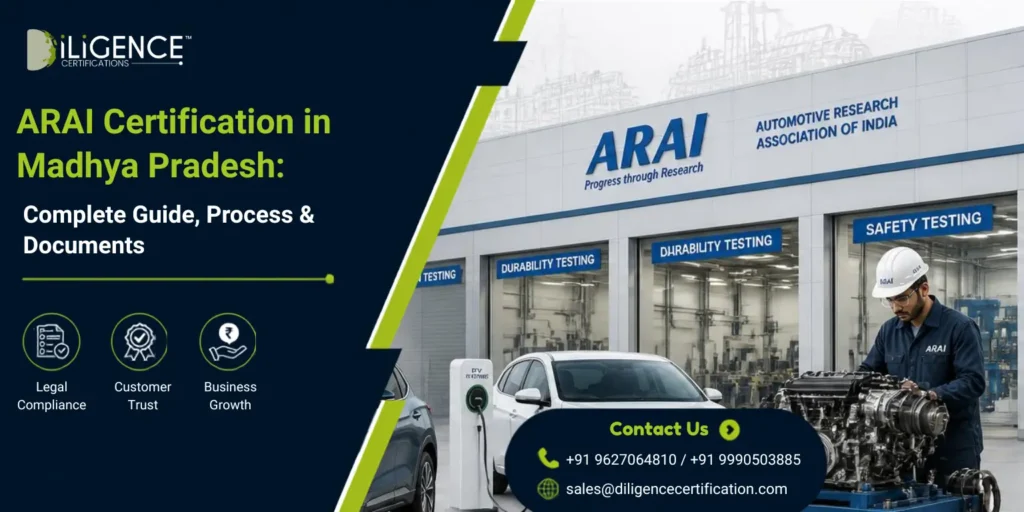
By - ARAI Certification in Madhya Pradesh generally refers to automotive testing, type approval, homologation and related compliance required for eligible vehicles, engines, components and automotive products.
- ARAI approval may involve technical documentation, prototype or component testing, applicable CMVR/AIS requirements, corrections and final certification.
- Manufacturers in Madhya Pradesh can prepare and coordinate their approval process with professional compliance support such as Diligence Certifications, while testing and certification are carried out through the applicable notified testing and certification framework.
Introduction
A manufacturer in Indore recently approached a compliance consultant after reaching an uncomfortable stage in a new vehicle project. The prototype was ready, the engineering team had completed months of development, and commercial production was being planned. But one question remained unanswered.
This situation is common in the automotive industry. A company may have a technically sound product but still face delays because certification requirements were considered only after the prototype had been finalised.
For businesses searching for ARAI Certification in Madhya Pradesh, the important point is that ARAI compliance is not simply a document-based registration. Depending on the product, it can involve technical specifications, drawings, prototype or component testing, applicable safety and performance requirements, emissions-related requirements, and certification under the relevant regulatory framework.
What Is ARAI Certification in Madhya Pradesh
ARAI Certification in Madhya Pradesh is the process of obtaining applicable automotive testing, type approval, homologation or related certification for eligible products manufactured, developed or supplied by businesses operating in Madhya Pradesh.
ARAI is headquartered in Pune and operates within India’s automotive testing, engineering, certification and homologation ecosystem. Its certification services cover a broad range of automotive products and applications.
It is important to understand that there is no single universal “ARAI certificate” applicable to every automotive product.
The exact requirement depends on factors such as:
- Product category
- Vehicle classification
- Fuel or propulsion technology
- Intended use
- Technical specifications
- Applicable Central Motor Vehicle Rules
- Applicable Automotive Industry Standards
- Whether the product is a complete vehicle or component
- Whether the approval is for a new model, modification or extension
- Whether export homologation is involved
ARAI’s official information states that it provides certification and homologation services for the automotive industry, including vehicles, systems and components.
Which Products May Need ARAI Certification
Not every automotive product follows the same certification route. A manufacturer should first identify the product category and applicable regulations.
Two-Wheeler Vehicles
Motorcycles, scooters, mopeds and other eligible two-wheelers can fall under vehicle type approval requirements.
ARAI’s published vehicle certification information includes petrol, diesel, CNG, LPG and alternate-fuel two-wheelers above specified thresholds, as well as eligible electric vehicles.
For an EV startup in Bhopal or Indore, this makes early regulatory mapping particularly important. Battery specifications, motor power, vehicle configuration and other technical parameters can affect the applicable compliance requirements.
Three-Wheeler Vehicles
Three-wheelers used for passenger or goods transportation may require type approval.
This can include fully built vehicles and certain incomplete vehicle configurations. Both conventional-fuel and eligible electric three-wheelers are covered within ARAI’s vehicle certification framework.
Four-Wheeler Vehicles
Passenger cars, goods vehicles and other eligible four-wheelers can require type approval based on their category and specifications.
ARAI identifies separate requirements for M1/N1 vehicles and other categories such as M2, M3, N2 and N3.
Electric Vehicles
The growth of EV manufacturing has made automotive homologation particularly relevant for new businesses.
An EV manufacturer should not assume that being electrically powered removes the need for vehicle compliance. Electric vehicles can have requirements covering safety, construction, performance and other applicable parameters.
Agricultural Tractors and Harvesters
Agricultural tractors and combined harvesters are also covered under the relevant Central Motor Vehicle Rules framework.
This is especially relevant to Madhya Pradesh because the state has a substantial agricultural and equipment-manufacturing ecosystem.
Construction Equipment Vehicles
Construction equipment vehicles can also fall within the applicable CMVR compliance framework when road-use requirements apply.
ARAI lists construction equipment vehicles among the categories for which it provides CMVR type approval-related services.
Why Is ARAI Certification Important for Madhya Pradesh Manufacturers
A vehicle or component can be well engineered and still face a regulatory roadblock if the approval route is misunderstood.
ARAI certification and homologation help establish that applicable technical and regulatory requirements have been addressed.
For a manufacturer, the practical benefits can include:
- Regulatory compliance
- Structured product validation
- Improved market readiness
- Greater confidence among OEMs and buyers
- Better documentation control
- Support for vehicle registration and regulatory processes where applicable
- Assistance with export homologation for suitable products
ARAI Certification Process in Madhya Pradesh
The exact process depends on the product and approval category. However, a typical project can be understood through the following stages.
Step 1: Identify the Applicable Approval
The first question should be:
This may involve determining the vehicle category, propulsion system, component classification, applicable AIS standards and CMVR requirements.
This stage is often where professional guidance provides the most value.
Step 2: Review Technical Specifications
The manufacturer needs to organise the product’s technical information.
Depending on the application, this can include dimensions, weights, powertrain information, performance specifications, drawings, electrical details, safety-related information and other prescribed technical data.
ARAI’s vehicle type approval information refers to technical specifications and drawings in prescribed formats, including AIS 007-related documentation.
Step 3: Prepare Drawings and Supporting Documents
Documentation should match the actual prototype.
A frequent practical problem is a mismatch between engineering drawings, technical specifications and the physical prototype. Such inconsistencies can create avoidable questions during testing and assessment.
The compliance team should therefore perform a document-to-prototype check before submission.
Step 4: Submit the Application
The applicable request is submitted through the relevant ARAI process.
ARAI states that its CMVR type approval applications require documents such as an application letter, authorisation information, technical specifications, drawings/layouts, applicable type approval or component certificates, WMI/WMC documentation where relevant, and tentative dates for prototype or sub-assembly submission.
Step 5: Prototype or Component Testing
Testing depends on the product and applicable standards.
A vehicle may undergo a range of technical assessments, while a component may be subjected to specific performance, safety or durability tests.
Testing should therefore be planned before the prototype is frozen.
Step 6: Address Non-Conformities
If a product does not meet an applicable requirement, the manufacturer may need to modify the design or correct the relevant documentation before further evaluation.
This is one reason why companies should maintain close coordination between engineering and compliance teams.
Step 7: Certification and Further Compliance
Once the applicable requirements are satisfactorily completed, the relevant certification or approval documentation can be issued under the applicable process.
However, certification is not necessarily the end of compliance responsibilities.
For applicable products, manufacturers may also have ongoing obligations such as Conformity of Production or other surveillance/testing requirements.
Documents Required for ARAI Certification
The exact document list varies by product. A typical application may require:
- Manufacturer details
- Application and authorisation documents
- Product technical specifications
- Vehicle or component drawings
- Electrical and mechanical specifications
- Prototype details
- Applicable component certificates
- WMI/WMC information where applicable
- Test-related documents
- Previous approval documents, where relevant
- Technical declarations
- Production and manufacturing information
- Supporting regulatory documents
Common Reasons for ARAI Approval Delays
In our experience at Diligence Certifications, manufacturers often focus heavily on testing while underestimating the preparation stage.
Typical causes of delay include:
Incomplete Documentation
Missing technical information can stop an application from moving smoothly.
Prototype and Drawing Mismatch
The physical vehicle should correspond with the submitted technical documentation.
Unfinished Component Approvals
Some vehicle-level approvals depend on relevant component-level compliance being completed.
Late Engineering Changes
Changing the product after the testing scope has been established can affect the certification pathway.
Why Choose Diligence Certifications for ARAI Certification
Diligence Certifications assists businesses with automotive compliance requirements, including ARAI Vehicle Certification.
Our role is to help manufacturers understand the applicable certification route, organise documentation and coordinate the approval process.
The practical support can include:
- Initial requirement assessment
- Product compliance mapping
- Documentation guidance
- Technical document review
- Application support
- Testing coordination
- Clarification management
- Follow-up during the approval process
- Assistance with addressing compliance observations
- Support for applicable certification extensions or related requirements
Diligence Certifications states that its ARAI service covers assistance for vehicles, engines and components and provides end-to-end support around documentation, testing coordination and approval.
For a manufacturer, the value of a consultant is not in replacing the testing authority. It is in reducing avoidable mistakes before and during the regulatory process.
Conclusion
ARAI Certification in Madhya Pradesh is an important compliance step for manufacturers and businesses dealing with eligible vehicles, electric vehicles, automotive components, engines and other regulated automotive products. The process is not limited to submitting an application. Product classification, applicable CMVR and AIS requirements, technical documentation, prototype readiness, testing and component approvals all need to be considered carefully.
A common mistake is to approach certification only after the product has been fully developed. Early compliance planning can help identify applicable requirements before testing, reduce documentation errors and minimise the risk of costly design changes or retesting.
Frequently Asked Questions
What is ARAI Certification in Madhya Pradesh?
ARAI Certification in Madhya Pradesh refers to applicable automotive testing, type approval, homologation and certification requirements for eligible vehicles, engines, components and related products manufactured or developed by businesses in Madhya Pradesh.
Is ARAI Certification mandatory for electric vehicles?
Eligible electric vehicles can be subject to type approval and other applicable automotive regulatory requirements. The exact requirements depend on the vehicle category, specifications and applicable rules.
How much does ARAI Certification cost in Madhya Pradesh?
There is no universal cost. Fees and total project expenses depend on the product, testing scope, documentation, prototype requirements, applicable standards and whether retesting is necessary.
How long does ARAI approval take?
The timeline varies by product and application type. ARAI publishes indicative timelines for certain vehicle type approval categories, but actual completion depends on documentation, prototype availability, testing and compliance with applicable requirements.
Can a component manufacturer apply for ARAI approval?
Yes, eligible automotive components can be subject to component approval requirements. The applicable route depends on whether the component is covered by a notified safety or technical requirement.
Does ARAI certification apply only to manufacturers?
The exact applicant structure depends on the certification category and regulatory framework. Manufacturers, component suppliers and other eligible businesses may have different documentation and approval requirements.
What happens if an ARAI test is unsuccessful?
The manufacturer may need to address the identified non-compliance, modify the product or documentation and undergo the applicable further testing or assessment.
Is ARAI certification required before starting production?
The answer depends on the product and applicable regulatory requirements. For products requiring type approval, manufacturers should establish the approval pathway before commercial production rather than treating certification as an afterthought.
Can Diligence Certifications help with ARAI approval?
Yes. Diligence Certifications provides assistance with ARAI vehicle certification, including compliance guidance, documentation support, testing coordination and approval-related assistance.
Does ARAI provide export homologation support?
Yes. ARAI provides export homologation-related support for various international markets and works with international certification organisations for applicable requirements.