BIS Certification
 CDSCO
CDSCO
 PESO
PESO
 CPCB
CPCB
 LMPC
LMPC
 WPC Approval
 Global Approvals
 TEC
TEC
 ARAI
ARAI
 BEE
BEE
 ISO Certification
 DGCA Certification
 NOC For Steel
 APEDA Registration























 Business Registration
 FSSAI Mark Certification












 (32).jpg)
 Legal Services
 Trademark Registration
 Copyright Registration
 Patent Registration
 By
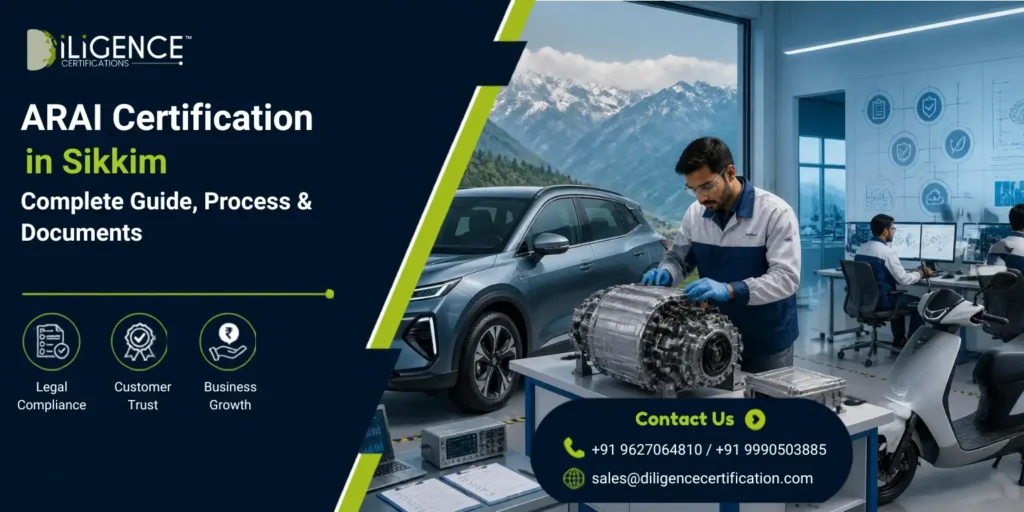
By - ARAI Certification in Sikkim involves automotive testing and approval requirements applicable to eligible vehicles, engines and components.
- The process to be adopted is dependent on the nature of the product and the relevant CMVR requirements.
- Diligence Certifications can provide services such as requirement assessment, documentation and certification assistance.
Introduction
A company in Sikkim may design an electric scooter or any other automotive component, but just because they have completed the engineering part does not necessarily mean that the product is ready for the certification process.
Before proceeding with the certification process, the manufacturer will need to be aware of the vehicle category, technical requirements, documents and testing which applies to the product.
That’s when ARAI Certification in Sikkim comes into play.
ARAI stands for the Automotive Research Association of India and offers certifications, homologation and testing of vehicles, engines and automotive components.
At present, the areas of certification include two wheelers, three wheelers, four wheelers, electric vehicles, tractors for agriculture, construction equipment vehicles and other applicable automotive products.
The key issue for the manufacturers in Sikkim is that certification requirements depend on the type of product and Indian regulation, and not on the location of the business.
What is ARAI Certification in Sikkim?
ARAI Certification in Sikkim entails the automotive testing, certification, homologation and type approval procedures that need to be undertaken for certain automobiles, engines, parts and other automotive products.
ARAI is an abbreviation for Automotive Research Association of India. ARAI is one of the leading organizations providing automotive research and testing services in India.
It depends upon the product which type of approval procedure has to be followed.
For instance, the type approval of automobiles offered by ARAI includes petrol, diesel, CNG, LPG and alternative fuel automobiles, as well as electric automobiles from a certain category. The coverage includes agricultural tractors and combined harvesters and construction equipment vehicles.
In such a scenario, the manufacturer cannot consider all types of automotive products to follow the same certification procedure.
Why is ARAI Certification Important?
Automotive products must comply with applicable technical, safety, performance and environmental requirements before they can be introduced under the relevant regulatory framework.
Depending on the product, evaluation may involve:
- Vehicle safety
- Emission compliance
- Performance
- Braking systems
- Electrical systems
- Vehicle dynamics
- Construction requirements
- Safety-critical components
- Applicable technical standards
ARAI provides certification and homologation services across the automotive sector, including vehicles, engines and components.
For a manufacturer, the practical lesson is simple: compliance should be considered during product development rather than after the final prototype is completed.
Who Needs ARAI Certification in Sikkim?
The requirement depends on the product and applicable regulations. However, several automotive businesses may require relevant testing or approval.
Vehicle Manufacturers
Vehicle manufacturers like motorcycles, scooters, passenger vehicles, commercial vehicles, and other regulated vehicles may be required to have applicable vehicle type approval.
The current scope of vehicle certification services offered by ARAI includes two wheelers, three wheelers, four wheelers, and other specified types of vehicles.
Electric Vehicle Manufacturers
EV manufacturers may be required to undergo testing and type approval processes based on vehicle type and applicability.
ARAI has explicitly indicated the inclusion of electric vehicles in their type approval scope for relevant two, three, and four wheeler categories.
Automotive Component Manufacturers
Some components which are safety critical may require component level approval.
According to ARAI, the Central Government provides notification regarding safety standards of specified vehicle parts/components/assemblies, and testing agencies notified under Rule 126 conduct relevant approvals.
Engine Manufacturers
Engine manufacturers may be required to have applicable testing and type approval based on engine application and fuel types.
Tractor and Construction Equipment Manufacturers
Agricultural tractors, combine harvesters, and construction equipment vehicles may be included in relevant type approval under CMVR.
ARAI Certification Process in Sikkim
The exact process varies according to the product, but manufacturers generally follow a structured sequence.
The Sikkim ARAI Certification Procedure depends on the type of vehicle/automotive product and the relevant technical requirements. The typical procedure followed by the manufacturers includes:
Step 1: Determination of Relevant Requirements
Identification of the right type of vehicle/product is the first step to be taken since some vehicles like electric two wheelers, commercial vehicles, tractors etc. and the automotive parts might require different test and approval procedures.
Step 2: Preparation of Technical Documents
Preparation of technical documents like application letter, authorisation letter, technical specification, drawings, approval certificate, BIS licence if any, WMI/WMC and prototype submission details that correspond to the actual product.
Step 3: Submission of Application
Submission of the application with the required documents through the relevant certification procedure. Relevant vehicle/engine approvals are done through the CMVR-TAS online portal for ARAI.
Step 4: Prototyping and Testing
This will depend on the nature of the vehicle, prototype, system or component and could involve conducting tests that could be on safety, performance, emission, braking, electrical systems among others.
Step 5: Solve Any Compliance Problems
In case any technical or documentation problems arise from testing, then the manufacturer is supposed to clarify or make the relevant changes.
Step 6: Finalize Type Approval
This step will be possible once the tests have been satisfactorily carried out. Some products will require Conformity of Production after type approval.
Documents Required for ARAI Certification
There is no universal document list for every automotive product. The requirements depend on the vehicle, engine or component category.
Common documentation may include:
- Manufacturer details
- Application letter
- Authorisation letter
- Technical specifications
- Drawings and layouts
- Relevant approval certificates
- Applicable BIS licences
- WMI/WMC information where applicable
- Prototype or component submission details
ARAI’s published requirements for vehicle type approval provide a useful indication of the documentation expected for relevant applications.
One point deserves special attention: document consistency.
The information provided in technical specifications, drawings, application documents and the physical prototype should correspond with the actual product. A small inconsistency can create additional questions during the approval process.
ARAI Certification for Electric Vehicles in Sikkim
Electric vehicle manufacturers should assess certification requirements at the design stage itself.
ARAI’s current vehicle type approval scope specifically includes electric vehicles in applicable two-wheeler, three-wheeler and four-wheeler categories.
Depending on the vehicle category, manufacturers may need to consider areas such as:
- Electric powertrain
- Battery system
- Electrical safety
- Braking
- Vehicle performance
- Safety-critical components
- Charging-related systems
- Applicable vehicle standards
For an EV startup, the certification process should not begin only when the production model is already frozen. Changes to major systems after testing can result in additional engineering work and potentially further evaluation.
Difference Between ARAI Certification and Vehicle Registration
ARAI certification and vehicle registration are separate requirements ARAI Type Approval concerns technical and regulatory compliance of a vehicle model, engine or applicable component. It involves the relevant testing and evaluation process.
Vehicle Registration is a separate procedure handled by the appropriate transport authority for registration of an individual vehicle.
In simple terms:
| ARAI Type Approval | Vehicle Registration |
| Technical and regulatory compliance | Registration of an individual vehicle |
| Model/product focused | Individual vehicle focused |
| Includes applicable testing and evaluation | Involves registration formalities |
| Relevant to product approval | Relevant to legal road use |
A manufacturer should therefore not treat an ARAI type approval certificate as the registration certificate for every individual vehicle.
How Long Does ARAI Certification Take?
The time frame for ARAI Certification in Sikkim is based on the nature of the product and the level of approval required along with documentation standards.
The time frame proposed by ARAI for CMVR type approval requests of relevant vehicles is as follows:
- Type approval for a full vehicle: 45 business days
- Type approval for a partial vehicle: 30 business days
- Document approvals: 10 business days
It is important to note that the above timelines are subject to certain conditions set by ARAI, such as correct documentation and submission of prototype/sub assembly along with component level certifications.
Therefore, it is appropriate to view them as stated service time frames and not a guarantee for all projects.
Cost Factors for ARAI Certification
Cost of ARAI Certification in Sikkim varies based on the nature of the product and extent of testing required. There is no universal fee for certification which is applicable to all manufacturers.
Total cost would depend on the following factors:
- Classification of vehicle or component
- Nature and number of tests
- Complexity
- Prototyping
- Component certification
- Documentation
- Further testing/Retesting
Manufacturers are advised to analyze the full scope of certification first before planning the expenditure.
Proactive approach would help save unnecessary costs as well. For instance, it is easier to identify any documentation discrepancies prior to testing than a technical problem with the prototype itself.
Common Challenges During ARAI Certification
Incomplete Technical Documents
Missing or inconsistent information can slow down the approval process.
Incorrect Classification
Selecting the wrong vehicle or component category can lead to unnecessary testing or documentation.
Component-Level Compliance
Some products require separate component approval. This should be checked before vehicle-level testing begins.
Prototype Changes
Changes made after testing can require additional assessment, depending on their nature and effect on the approved configuration.
Lack of Early Planning
Starting compliance work only after the product is finalised can make corrections more expensive and time-consuming.
Conformity of Production After Type Approval
Type approval does not mark the end of the manufacturer’s compliance obligations.
Depending on the type of the product, the manufacturer might have to prove Conformity of Production (COP).
The aim here is to ensure that the production vehicle, engine or component continues to meet the approved specifications.
ARAI offers COP services for vehicles, engines and components.
This is especially critical when dealing with large-scale manufacturing of vehicles. The production design should still comply with the one that had been evaluated.
ARAI also provides inspection and audit services for quality control and conformity of applicable manufacturers.
Where Can You Verify ARAI Requirements?
Manufacturers should verify current requirements directly through authoritative sources before beginning an approval project. Automotive standards, testing procedures and regulatory requirements can change.
The official ARAI website provides information about vehicle type approval, component certification, COP, testing and related automotive services.
Businesses can also review ARAI’s current CMVR-related documents and approved component information where relevant.
Before submission, it is advisable to confirm the latest requirements applicable to the specific product rather than relying on an old checklist or third-party article.
Why Choose Diligence Certifications?
Certification of a vehicle goes beyond just filling out the application form. The manufacturer must be well informed about the requirements, organise technical data and make the vehicle ready for inspection.
Diligence Certifications takes the same approach while carrying out the task.
Our assistance in the process includes:
- Requirement assessment: Understanding the product and figuring out the path of compliance.
- Documentation help: Arranging technical and legal information for the relevant application.
- Compliance check: Spotting any gaps prior to submission.
- Process coordination: Assisting businesses in managing the process.
Such assistance is beneficial for MSMEs and startups that do not have a regulatory team.
Conclusion
ARAI Certification in Sikkim is a key compliance issue for eligible vehicle manufacturing companies, EV start-ups, engine manufacturing companies and automotive components companies.
It includes more than just filling out the application. The manufacturers must know which category of the product they are dealing with, the requirements, create proper documentation and testing along with addressing the observations.
Early compliance planning will help avoid unnecessary work.
If your company plans on ARAI Certification in Sikkim, we at Diligence Certifications can assist you in requirement analysis and other compliance issues.
CTA: Contact Diligence Certifications for ARAI Certification Support
Frequently Asked Questions
What is ARAI Certification in Sikkim?
ARAI Certification in Sikkim refers to applicable automotive testing, homologation and type approval activities for eligible vehicles, engines and components.
Who needs ARAI certification?
Vehicle, EV, engine and applicable automotive component manufacturers may require ARAI testing or approval depending on the relevant regulations.
Is ARAI certification required for electric vehicles?
Applicable electric vehicle categories may require type approval and testing based on their vehicle category and regulatory requirements.
What documents are required for ARAI approval?
Documents may include application letters, technical specifications, drawings, approval certificates, applicable BIS licences, WMI/WMC details and prototype information.
How long does ARAI certification take?
The timeline depends on the approval type and project readiness; ARAI currently indicates specific timelines for full-level, partial-level and documentation approvals subject to conditions.
How much does ARAI certification cost?
The cost depends on the vehicle or component category, testing scope, technical complexity, prototype requirements and possible retesting.
Can EV startups in Sikkim obtain ARAI approval?
Yes, eligible EV manufacturers can seek applicable type approval and testing based on their vehicle category and regulatory requirements.
What is vehicle type approval?
Vehicle type approval is the evaluation of a vehicle model against applicable technical and regulatory requirements.
Is ARAI certification the same as vehicle registration?
No. ARAI approval concerns technical compliance, while vehicle registration is a separate procedure for applicable individual vehicles.
Can Diligence Certifications help with ARAI certification?
Yes, Diligence Certifications can assist with requirement identification, documentation, compliance preparation and professional certification support.