BIS Certification
 CDSCO
CDSCO
 PESO
PESO
 CPCB
CPCB
 LMPC
LMPC
 WPC Approval
 Global Approvals
 TEC
TEC
 ARAI
ARAI
 BEE
BEE
 ISO Certification
 DGCA Certification
 NOC For Steel
 APEDA Registration























 Business Registration
 FSSAI Mark Certification












 (32).jpg)
 Legal Services
 Trademark Registration
 Copyright Registration
 Patent Registration
 By
By - Regulated by BEE: BEE Rules for TFL (Tubular Fluorescent Lamps) are governed under energy efficiency and labeling regulations to ensure controlled power consumption and standardized performance.
- Mandatory Standards: Compliance with IS 2418 (Part I & II) and IEC benchmarks is essential for safety, quality, and market approval.
- Regular Updates: Multiple amendments like S.O. 2789(E) and S.O. 1930(E) keep the compliance framework aligned with evolving energy norms.
- 2026 Labeling Rules: From 1st January 2026, mandatory star labeling and product registration will apply under new regulations.
- Compulsory Registration: BEE approval under the Standards & Labeling program is required before selling or importing TFL products in India.
Introduction |BEE Rules for TFL
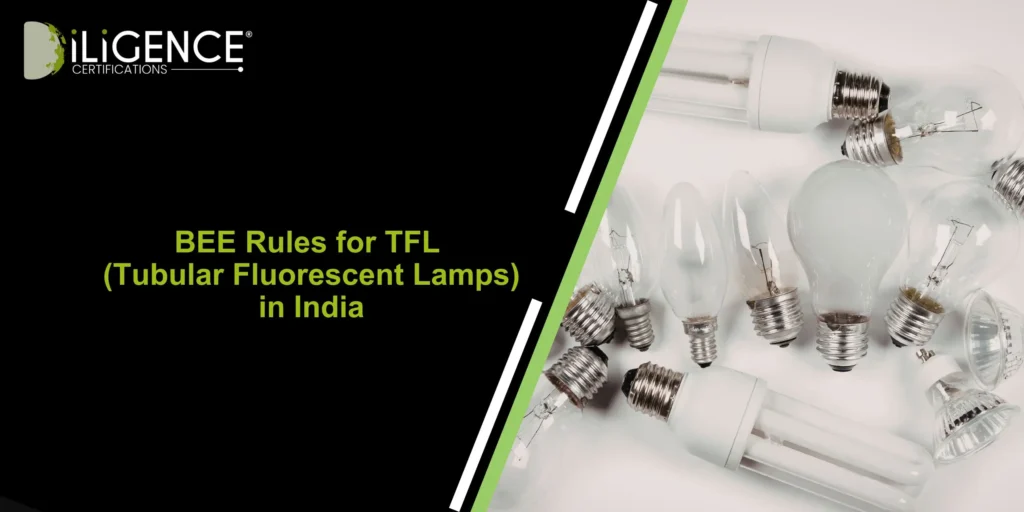
Tubular Fluorescent Lamps (TFL) are widely used lighting products in residential, commercial, and industrial applications across India. Due to their large-scale usage, they fall under strict energy efficiency and compliance regulations governed by Indian authorities such as the Bureau of Energy Efficiency (BEE).
For manufacturers, importers, and exporters, compliance is not optional. It directly impacts product approval, market entry, and long-term business sustainability in India’s regulated lighting sector.
What is a Tubular Fluorescent Lamp (TFL)?
Tubular Fluorescent Lamp (TFL) is a gas-discharge lighting product that produces visible light using fluorescence. It operates through mercury vapor excitation and phosphor coating inside a tubular structure.
In India, TFL is classified as an energy-consuming electrical appliance and is regulated under the Energy Conservation Act, 2001.
Key Points:
- Energy-efficient lighting product used in bulk installations
- Governed under BEE energy labeling framework
- Requires IS 2418 compliance for approval
- Subject to labeling and performance verification
Why This Certification is Important
Compliance for Tubular Fluorescent Lamps is mandatory due to its direct impact on national energy consumption and environmental safety.
Key Points:
- Ensures energy efficiency compliance under Indian law
- Mandatory for legal sale and import in India
- Prevents rejection at customs and regulatory checkpoints
- Avoids penalties under Energy Conservation Act
- Supports standardization of lighting efficiency in market
Importance & Benefits
| Benefit | Explanation | Business Impact |
| Legal Market Access | Ensures compliance with BEE regulations | Enables sales in Indian market |
| Energy Efficiency Certification | Confirms product meets energy standards | Improves brand trust |
| Standardized Product Quality | Follows IS/IEC benchmarks | Reduces product rejection risk |
| Regulatory Approval | Mandatory for import and manufacturing | Avoids customs blockage |
| Labeling Compliance | Required star rating system | Improves consumer acceptance |
Step-by-Step Process
1. Product Testing
TFL samples are tested in NABL-accredited or BEE-recognized labs as per IS 2418 standards.
2. Documentation Preparation
Manufacturers prepare technical specifications, test reports, and manufacturing details.
3. Application Submission
Application is filed under BEE S&L portal with required details and fees.
4. Regulatory Review
BEE authorities evaluate submitted documents and test reports for compliance verification.
5. Registration Approval
Once approved, product is registered and allowed for labeling and sale in India.
6. Label Authorization
Star labeling approval is issued under applicable energy efficiency norms.
Key Regulatory Timeline and Standards
| Year / Date | Notification / Regulation / Amendment | Reference Number | IS / IEC Standards / Notes |
| 27th June, 2023 | Amendment II - Tubular Fluorescent Lamp | S.O. 2789(E) | IS 2418 (Part I & II) |
| 22nd June, 2023 | Supersession under BEE S&L program | BEE/S&L/TFL/22-23 | Energy efficiency compliance update |
| 9th June, 2020 | Amendment I | S.O. 1930(E) | IS 2418 (Part I & II) |
| 9th March, 2018 | Supersession Notification | S.O. 1033(E) | Previous compliance framework update |
| 9th March, 2018 | Supersession Notification | S.O. 1034(E) | Revised regulatory alignment |
| 12th January, 2009 | Initial Regulation | S.O. 178(E) | Base notification for TFL standards |
| 12th January, 2009 | Initial Regulation | S.O. 179(E) | Baseline compliance framework |
| 26th December, 2025 | New Compliance Notification | No. 5506/BEE/S&L/AL/2025-26 | Appliance Labeling & Compliance Regulations, 2026 |
| 1st January, 2026 (w.e.f.) | Appliance Labeling & Compliance Regulations, 2026 | Applicable Regulation | Mandatory star labeling framework |
Challenges Without a Consultant
Managing TFL compliance without expert support often leads to delays, errors, and regulatory risks. The process involves technical standards, documentation accuracy, and continuous updates, which can be difficult for businesses to handle independently.
Key Points:
- Misinterpretation of IS 2418 (Part I & II) requirements
- Errors in documentation and application filing
- Delays due to incomplete or incorrect submissions
- Product test failures in approved laboratories
- Difficulty in tracking amendments and regulatory updates
- High risk of application rejection or resubmission
- Compliance gaps in labeling and BEE registration
- Possible penalties or restriction on market entry
Why Choose Diligence Certification
Partnering with Diligence Certification ensures a structured and error-free approach to TFL compliance, helping businesses meet regulatory requirements efficiently and avoid unnecessary delays.
Key Points:
- End-to-end support for BEE Standards & Labeling (S&L) registration
- Expert handling of IS 2418 compliance and documentation
- Coordination with NABL-approved labs for product testing
- Faster approval process with reduced rejection risk
- Regular updates on amendments and regulatory changes
- Accurate guidance on labeling and energy efficiency requirements
- Dedicated support for importers, manufacturers, and exporters
- Cost-effective compliance solutions with minimal business disruption
Conclusion
Tubular Fluorescent Lamp compliance is a critical requirement under India’s energy efficiency framework. With multiple amendments, IS standards, and upcoming labeling regulations, businesses must ensure full regulatory alignment before manufacturing or importing.
Proper compliance ensures legal market access, avoids penalties, and strengthens long-term business stability in India’s regulated electrical appliance sector.
Frequently Asked Questions (FAQs)
Is TFL certification mandatory in India?
Yes, it is mandatory under BEE energy efficiency regulations.
Which standard applies to TFL?
IS 2418 (Part I & II) applies to TFL products.
Who issues TFL approval?
The Bureau of Energy Efficiency (BEE) issues approval.
Can imported TFL be sold without registration?
No, registration is compulsory before sale.
What is the validity of BEE registration?
It is valid as per BEE guidelines and product category.
Is lab testing required?
Yes, NABL or BEE-recognized lab testing is mandatory.
What is S&L program?
Standards & Labeling program under BEE for energy efficiency.
What happens if non-compliant products are sold?
Penalties and market restriction can be imposed.
Is labeling mandatory for TFL?
Yes, star labeling is required under regulations.
Are amendments important for compliance?
Yes, all amendments must be followed for legal compliance.