BIS Certification
 CDSCO
CDSCO
 PESO
PESO
 CPCB
CPCB
 LMPC
LMPC
 WPC Approval
 Global Approvals
 TEC
TEC
 ARAI
ARAI
 BEE
BEE
 ISO Certification
 DGCA Certification
 NOC For Steel
 APEDA Registration























 Business Registration
 FSSAI Mark Certification












 (32).jpg)
 Legal Services
 Trademark Registration
 Copyright Registration
 Patent Registration
 By
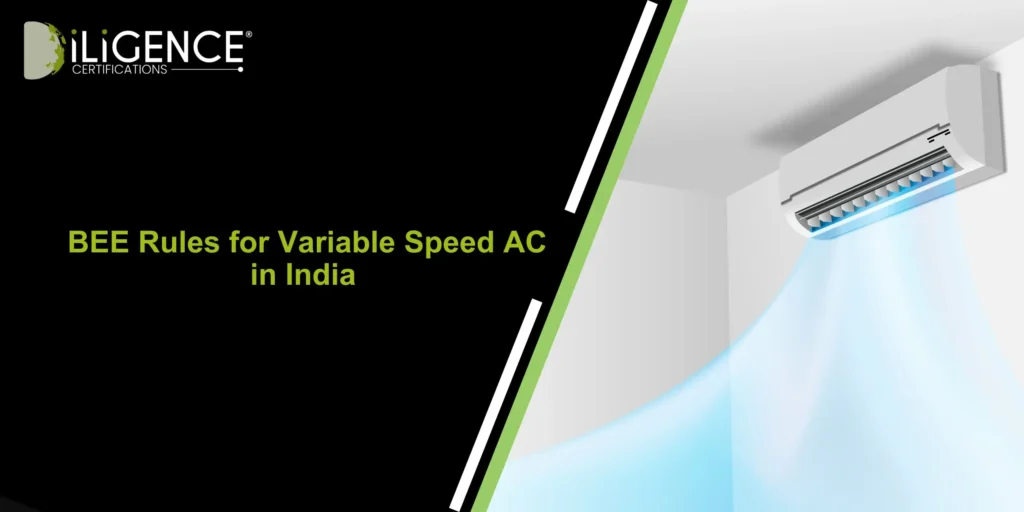
By - Mandatory BIS Compliance for Market Access BEE Rules for Variable Speed AC under compulsory certification schemes in India. No manufacturer or importer can legally sell products without BIS approval.
- IS Standards Define Technical Safety & Performance All compliance is based on IS 1391 (Part I & II), ensuring uniform safety, cooling performance, and electrical protection requirements.
- Energy Efficiency Regulation is Mandatory BEE S&L labeling ensures products meet minimum energy performance standards. This directly affects star ratings and market competitiveness.
- Frequent Amendments Affect Compliance Strategy Regulations are frequently updated through S.O. notifications, requiring businesses to stay updated to avoid non-compliance.
- Labeling Compliance is Legally Enforced Appliance labeling under BEE regulations is mandatory from manufacturing to retail packaging stage.
Introduction | BEE Rules for Variable Speed AC
Room Air Conditioners (Variable Speed) are covered under India’s mandatory quality and energy compliance framework to ensure safety, performance efficiency, and standardization across domestic and imported products. For manufacturers, importers, and exporters, compliance is not optional-it directly impacts market access in India.
India regulates air conditioners under BIS certification, energy efficiency norms (BEE S&L), and updated appliance labeling regulations. These rules are continuously revised to align with evolving technology and energy conservation goals.
For businesses in HVAC trade, ignoring these requirements can lead to shipment rejection, penalties, and market bans. Therefore, understanding the regulatory structure is critical before manufacturing or importing Variable Speed Room Air Conditioners into India.
Equipment Compliance Table (Mandatory Regulatory Framework)
| Equipment Short Title | Notification / Regulation / Amendment & Date | Reference IS / IEC Standards |
| Room Air Conditioners | 14(a) Amendment V S.O. 3984(E) dated 28th August, 2025 | IS 1391 (Part I and Part II) with all amendments |
| Room Air Conditioners | 14(a) Amendment IV S.O. 2794(E) dated 16th July, 2024 | IS 1391 (Part I and Part II) |
| Room Air Conditioners | 14(a) Amendment III S.O. 4634(E) dated 10th November, 2021 | IS 1391 (Part I and Part II) |
| Room Air Conditioners | 14(a) Amendment II S.O. 4485(E) dated 10th December, 2020 | IS 1391 (Part I and Part II) |
| Room Air Conditioners | 14(a) Amendment I S.O. 3897(E) dated 29th October 2019 | IS 1391 (Part I and Part II) |
| Room Air Conditioners | 14(d) BEE/S&L/AC/37/2017-18 dated 29th November 2017 | Energy Performance Standards (BEE) |
| Room Air Conditioners | 14(b) S.O. 2527(E) dated 8th August 2017 | Initial BIS framework notification |
| Appliance Labeling and Compliance Regulations | 2026 (w.e.f. 1st Jan 2026) No. 5506/BEE/S&L/AL/2025-26 dated 26th Dec 2025 | Mandatory labeling & energy compliance rules |
What is BEE Rules for Variable Speed AC Certification?
BEE Rules for Variable Speed AC certification in India is a regulatory approval process ensuring that HVAC products meet BIS safety standards, energy efficiency norms, and labeling requirements.
Variable Speed AC systems use inverter technology that adjusts compressor speed based on cooling demand. Because of this advanced technology, compliance evaluation includes electrical safety, thermal performance, refrigerant handling, and energy efficiency testing.
The certification is governed primarily by BIS under IS 1391 standards, along with BEE energy labeling regulations and periodic government amendments.
Why BEE Rules for Variable Speed AC Certification is Important
BEE Rules for Variable Speed AC compliance is not just a technical requirement; it is a legal entry barrier in India.
Key compliance importance points:
- Mandatory under Indian law for manufacturing and import
- Ensures electrical and fire safety for end users
- Controls energy consumption standards nationally
- Protects market from substandard imported products
- Required for retail distribution and e-commerce listing
Non-compliance risks:
- Customs seizure of imported units
- BIS penalties and legal action
- Product recall from market
- Rejection in procurement tenders
- Loss of brand credibility in Indian market
Importance & Benefits for BEE Rules for Variable Speed AC
| Benefit | Explanation | Business Impact |
| Legal Market Access | BIS certification allows legal sale in India | Enables distribution and import clearance |
| Consumer Trust | Certified products ensure safety and reliability | Higher brand acceptance and sales |
| Energy Efficiency Compliance | Meets BEE star rating requirements | Improved product competitiveness |
| Reduced Regulatory Risk | Avoids penalties and legal issues | Stable business operations |
| Export Compatibility | Aligns with international standards | Easier global expansion |
Step-by-Step Process for Certification
1. Standard Identification
Identify applicable IS 1391 (Part I & II) standards and BEE labeling requirements.
2. Product Testing
Sample tested in BIS-approved laboratory for:
- Electrical safety
- Cooling performance
- Energy consumption
- Durability
3. Application Submission
Submit application to BIS with:
- Product details
- Factory information
- Test reports
4. Factory Inspection
BIS officials verify manufacturing setup and quality control systems.
5. Approval & License Issuance
After successful evaluation, BIS grants certification license.
6. Energy Label Registration
Register with BEE for star rating approval and labeling authorization.
Challenges Without a Consultant for BEE Rules for Variable Speed AC
BEE Rules for Variable Speed AC compliance in India without expert support often leads to delays, errors, and regulatory risks. The process involves strict BIS standards, multiple amendments, and coordination with testing labs and authorities, which can be difficult for businesses without prior experience.
Key Challenges:
- Misinterpretation of IS 1391 (Part I & II) technical requirements
- Errors in documentation leading to application rejection
- Delays in product testing from BIS-approved laboratories
- Lack of clarity on latest amendments and notifications
- Poor preparation for factory inspection and audit
- Difficulty in coordinating BIS and BEE compliance simultaneously
- Incorrect or non-compliant energy labeling
- Increased time-to-market due to procedural inefficiencies
- Higher risk of penalties or shipment rejection
- Compliance gaps affecting brand credibility in India
Why Choose Diligence Certification
Diligence Certification provides structured compliance support for BEE Rules for Variable Speed AC certification in India. With expertise in BIS standards and BEE regulations, the consultancy helps businesses navigate complex regulatory requirements efficiently and without delays.
Key Advantages:
- End-to-end support for BIS certification and BEE registration
- Expert guidance on IS 1391 (Part I & II) compliance requirements
- Accurate documentation preparation to avoid rejection
- Coordination with BIS-approved laboratories for faster testing
- Assistance in handling latest amendments and regulatory updates
- Support during factory inspection and audit readiness
- Efficient management of energy labeling and star rating compliance
- Reduced approval timelines through process optimization
- Dedicated support for importers, manufacturers, and brand owners
- Minimization of compliance risks and regulatory penalties
Conclusion
BEE Rules for Variable Speed AC compliance in India is governed by strict BIS standards, energy efficiency regulations, and updated government notifications. Businesses must ensure full alignment with IS 1391 and BEE labeling requirements to operate legally in the Indian market.
Proper certification not only ensures regulatory approval but also improves product credibility, energy efficiency compliance, and long-term market stability in India’s competitive HVAC sector.
Frequently Asked Questions (FAQs)
Is BIS certification mandatory for Room Air Conditioners in India?
Yes, it is mandatory under Indian regulatory law.
Which IS standard applies to AC units?
IS 1391 (Part I and II) applies.
What is Variable Speed AC certification?
It ensures compliance for inverter-based air conditioners.
Is BEE labeling compulsory?
Yes, for energy efficiency compliance.
How long does BIS approval take?
Typically 6-10 weeks depending on documentation.
Can imported ACs be sold without BIS?
No, they require mandatory certification.
What happens if rules are not followed?
Products can be seized or banned.
Are amendments important in compliance?
Yes, they update legal requirements regularly.
Is factory inspection required?
Yes, BIS conducts mandatory inspection.
Who needs this certification?
Manufacturers, importers, and brand owners selling in India.