BIS Certification
 CDSCO
 PESO
 CPCB
 LMPC
 WPC Approval
 Global Approvals
 TEC
 ARAI
 BEE
 ISO Certification
 DGCA Certification
 NOC For Steel
 APEDA Registration























 Business Registration
 FSSAI Mark Certification












 (32).jpg)
 Legal Services
 Trademark Registration
 Copyright Registration
 Patent Registration
 By
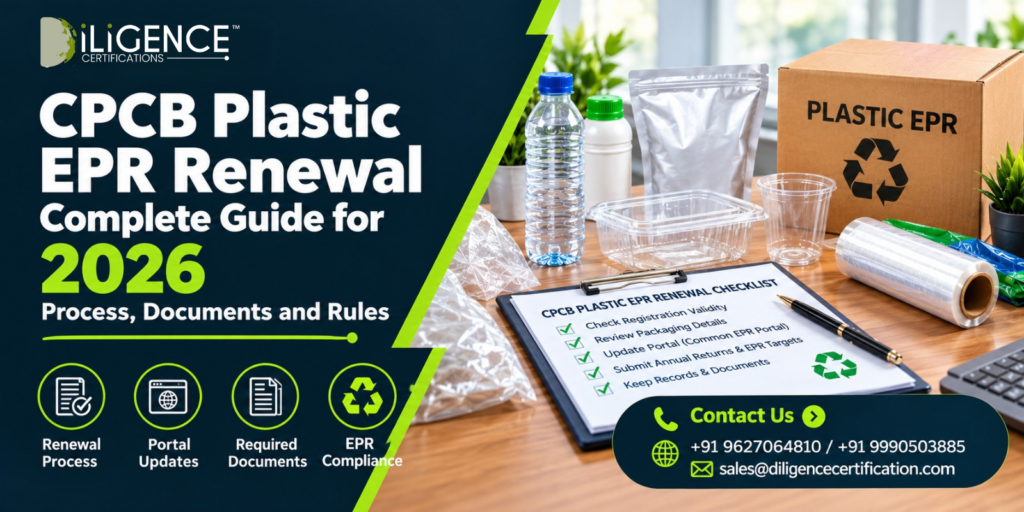
- CPCB plastic EPR renewal involves checking an existing registration’s validity and following the applicable renewal or continuation procedure.
- Producers, Importers and Brand Owners (PIBOs) must identify their responsibilities under the Plastic Waste Management Rules, 2016, and applicable EPR guidelines.
- The former dedicated plastic EPR portal was discontinued for new updates on 28 June 2026. The Common EPR Portal should be used for current activities.
- Company PAN, GST details, packaging quantities, sales or import records and previous registration information should be reviewed before filing.
- Annual returns, EPR target fulfilment and registration renewal are related but separate compliance matters.
Introduction
Imagine a company that sells packaged food, cosmetics or household products across India. Its products are selling well. Distributors keep placing regular orders. The business is planning to enter markets. Still the company has a compliance task that is pending: its plastic packaging Extended Producer Responsibility (EPR) registration needs attention.
The company may already have an EPR certificate. It may also have worked with a recycler and maintained records of its plastic packaging. But that does not automatically mean its compliance responsibilities are complete.
This is where CPCB plastic EPR renewal becomes important. Businesses need to check the validity and status of their existing registration, review their plastic packaging obligations, maintain supporting records and follow the applicable procedure on the official portal.
There is also an important development in 2026. The former dedicated plastic EPR portal was discontinued for new updates from 28 June 2026. CPCB migrated registered users’ data to the Common EPR Portal. Businesses should therefore check their migrated information and use the new portal for current activities.
A common mistake is to treat renewal as filling out a form. In reality the business should first check what kind of registration it currently has. It should also confirm if it has any returns to file or Extended Producer Responsibility obligations. Then it must make sure that the information being carried over to the portal is accurate and up to date.
This guide walks through the renewal process how to prepare the required documents how to move to the portal the packaging categories involved and practical steps that Indian businesses can follow to stay compliant, with EPR rules.
What Is CPCB Plastic EPR Renewal?
CPCB plastic EPR renewal refers to the process of addressing the continuation or renewal of an existing registration for plastic packaging compliance, according to the registration conditions and rules applicable to the business.
Extended Producer Responsibility makes certain businesses responsible, for handling the packaging that comes with their products. The system is controlled by the Plastic Waste Management Rules from 2016, which have been updated. It also includes the EPR guidelines that were announced in February 2022.
In terms a business cannot focus only on the plastic packaging it buys. It must also consider its role in the supply chain the packaging it puts into the market and the responsibilities that come with that action.
For example a company that sells shampoo under its brand might use plastic bottles made by another company. Even if the company does not make the bottles itself its position, as a brand owner could still place it under the producer responsibility rules.
The exact rules depend on what the business does how it’s registered, the type of packaging it uses and any exemptions or conditions that apply.
Who Needs Plastic EPR Registration or Renewal?
The EPR framework covers specified categories of businesses, including:
Producers: Entities that manufacture plastic packaging or fall within the applicable legal definition of a producer.
Importers: Businesses importing plastic packaging, intermediate materials covered by the rules or products in plastic packaging.
Brand Owners are businesses that sell their products in plastic packaging. These Brand Owners must follow the rules that apply to them and also respect any exclusions that are listed.
Plastic Waste Processors are the businesses that do work like recycling plastic waste turning waste into energy turning waste into oil or industrial composting. These Plastic Waste Processors must meet the requirements that apply to them.
The framework also covers manufacturers and importers of plastic raw materials. It also covers manufacturers who make items from biodegradable plastics as set out in the amendments that are, in force.
Not every business follows the registration route. The authority that a business must talk to and the steps it must take depend on the businesss category and on the rules that’re in force right now. Every business should check the requirements before it applies.
What Changed in CPCB Plastic EPR Renewal in 2026?
The portal transition is one of the most important issues for businesses handling CPCB plastic EPR renewal in 2026.
The former dedicated Plastic EPR Portal stopped operating for new updates from 28 June 2026. CPCB announced that registered users’ data had been migrated to the Common EPR Portal. The old portal remains available for checking historical data up to the migration date and comparing it with migrated information.
Businesses should take the following steps:
1. Verify Your Migrated Information
Go through your company’s registration details authorised person information and any historical records. Compare them carefully with what’s shown on the Common EPR Portal. If you spot any incorrect data note the difference and use the correct process on the portal to report it.
2. Match the Correct Account Details
The CPCB’s notice says that existing users must register on the Common EPR Portal using the same PAN of the authorised person and the company PAN as in the old account. These details must be exact to make the account linking work properly. Don’t create accounts before checking the official instructions.
3. Review Your Existing Registration
Look at your registration category certificate details, validity conditions and any compliance tasks that are still pending. Do not assume that the migration process automatically renews a registration or clears past obligations. You need to check your status
4. Report Discrepancies
If the information that was migrated does not match your records follow the discrepancy-reporting process, on the Common EPR Portal. Save copies of your certificate, screenshots or any other records. Keep any confirmation or acknowledgement you receive.
Remember, portal migration and registration renewal are two things. Businesses must check their registration status and determine what actions are needed for their account.
How to Complete CPCB Plastic EPR Renewal Step by Step
The first step is not to start a fresh application immediately. Check the existing registration and determine whether the portal requires renewal, correction, account linking or another compliance action.
Step 1: Check Your Current Registration Status
Keep a copy of your EPR registration certificate. Note down the registration number, the name of the registered entity the category and the conditions under which it’s valid.
Go to the Common EPR Portal. Check the status of your registration. Look for any instructions or messages shown for your account.
If your registration is about to expire or has already expired double-check the renewal process with the right authority. Don’t assume the old renewal method still works. Always follow the instructions.
Step 2: Verify Company and Authorised Person Details
Go over the details used in your existing account. This includes:
- Company name and PAN
- GST registration details
- Registered office address
- Name and PAN of the person
- CIN or business registration details if applicable
- Importer Exporter Code (IEC) if applicable
- Existing registration number and certificate details
Make sure all these details match across your supporting documents. If your company has changed its name, address or authorised representative find out how to update those details
Step 3: Review Plastic Packaging Quantities
Gather all records of the plastic packaging you put on the market during the time period that matters. What you need depends on your business. You might need purchase invoices, production records, import documents, sales data and details about your packaging.
For example if you run a personal care brand you might sell shampoo in bottles, refill products, in flexible pouches and gift packs that include several types of packaging. Don’t put all these into one group. Each type should be tracked separately.
Split your packaging data into the categories and follow the reporting rules. If you misclassify your packaging it can mess up your EPR obligations. Make sure you get the categories right.
Step 4: Review Returns and Outstanding Compliance
Renewing your registration doesn’t mean you’ve completed your returns or EPR duties.
Check if you’ve filed the required returns for the financial years. Compare the numbers you reported with your business records. Also review the status of your EPR targets and certificates.
If you find a mismatch find out why. A gap between sales data and reported packaging quantities could be due to missing records, wrong category mapping or a change in how you’re reporting.
Step 5: Prepare the Required Documents
Gather all documents needed for your applicant category and based on the current portal rules.
Don’t use a checklist from the old plastic EPR portal. Even if older CPCB guidance explains what used to be required always follow the instructions and any new rules that are in place now.
Step 6: Follow the Applicable Procedure on the Common EPR Portal
Go to the Common EPR Portal. Follow the steps that match your account and registration category.
Enter information upload the required documents and save the acknowledgement or application reference number.
If the portal doesn’t show a clear renewal option don’t rush to start an application. Ask CPCB or the relevant State Pollution Control Board or Pollution Control Committee for help
Step 7: Track the Application and Retain Records
Keep an eye on your application status. Respond to any requests for information. Save copies of everything you submit. The information, acknowledgement, any emails or messages and final registration letters.
Having records helps you answer future questions, from regulators, auditors, customers or your own compliance team.
Documents Required for CPCB Plastic EPR Renewal
| Document or Record | Why It Matters |
| Existing EPR certificate | Helps verify registration details and history |
| Company PAN | Identifies the legal entity |
| GST registration certificate | Supports business identity and tax details |
| Incorporation or business registration proof | Establishes the applicant’s legal identity |
| Authorised person’s details | Supports account access and official communication |
| IEC, where applicable | Supports importer-related information |
| Product and packaging details | Helps identify the packaging covered by EPR |
| Production, import and sales records | Supports packaging quantity calculations |
| Previous annual returns | Helps review earlier compliance filings |
| EPR certificates and related records, where applicable | Supports verification of relevant obligations |
| Existing portal account details | Helps link the correct account and check migration data |
| Applicable permissions or authorisations | May be required depending on the business activity |
The exact checklist depends on the category, registration history and procedure that are currently available on the portal. The following is a preparation guide, not a substitute for the official checklist. For waste processors additional records relating to the facility, processing activity, capacity and applicable permissions may be necessary.
Do not prepare documents only to satisfy a checklist. Do not submit documents that do not match the numbers in the application. Make sure the figures in the documents agree with the figures entered in the application. Consistency, between the documents and the application is particularly important when the business has product lines or multiple packaging suppliers.
Understanding Plastic Packaging Categories Under EPR
Packaging classification is an important part of plastic EPR compliance because obligations may differ according to the type of packaging.
The framework identifies categories of plastic packaging and has been amended over time. Businesses should use the current legal definitions rather than relying only on simplified descriptions.
| Category | General Description | Example |
| Category I | Rigid plastic packaging | Plastic bottles, jars and rigid containers |
| Category II | Flexible plastic packaging made from specified plastic materials | Plastic films, pouches, sachets and bags |
| Category III | Multilayered packaging with plastic and other materials | Certain laminated food wrappers |
| Category IV | Plastic packaging materials covered by the rules relating to compostable plastics | Eligible compostable plastic packaging |
| Category V | Packaging materials covered by the applicable provisions for biodegradable plastics | Eligible biodegradable plastic packaging |
The correct legal classification must be checked against the changes and the specific type of packaging material used.
Imagine a company that sells cookies in bags and also sells items in hard plastic boxes. If their records group all packaging, under one label it could be hard to calculate and report the responsibilities.
A better way is to keep packaging information organized by product, material and the right category. If the same product is sold in sizes use a clear way to figure out the matching packaging amounts.
CPCB Plastic EPR Renewal Fees and Processing Time
I have seen that there is no fee or guaranteed processing period that can be quoted for every renewal case unless one checks the applicable requirements. The fee payable, if any and the time needed may depend on the registration category, the procedure, the completeness of the documents and whether the authority requests further information.
Businesses should verify any fee through the current official portal or the relevant authority before payment. Be cautious about websites that promise guaranteed approval in a fixed number of days. A complete application can help reduce delays but the application does not guarantee approval. The competent authority remains responsible, for the decision.
Common Mistakes to Avoid During CPCB Plastic EPR Renewal
Several compliance problems can be avoided by checking the application before submission.
1. Using the Discontinued Portal for New Activities
The former dedicated plastic EPR portal is no longer the place for new updates. Businesses should use the Common EPR Portal for current activities and retain the old portal for the historical-data verification purpose announced by CPCB.
2. Treating Renewal and Annual Returns as the Same Thing
A registration certificate does not, by itself, prove that every annual reporting requirement or EPR target has been fulfilled.
Review each requirement separately and maintain evidence of completion.
3. Reporting Incorrect Packaging Quantities
Estimates without supporting records can lead to inconsistent reporting. Use reliable production, import, purchase and sales information to calculate the relevant quantities.
4. Ignoring EPR Certificates and Supporting Records
Where EPR certificates are relevant to fulfilling obligations, verify that the records relate to eligible registered processors and are correctly reflected in the applicable portal process.
Businesses should retain supporting evidence rather than relying only on verbal confirmation from a service provider or recycler.
5. Entering Inconsistent Company Details
Differences between PAN, GST, registration records and authorised person information can complicate account linking or application review.
Resolve discrepancies through the appropriate correction procedure instead of entering information that does not match the underlying documents.
6. Assuming a Consultant Can Guarantee Approval
A consultant can help with document preparation, application review and compliance coordination. However, no private consultant can guarantee a regulatory outcome or replace the decision of CPCB or the relevant State authority.
What Are the EPR Obligations of a Brand Owner?
A brand owner may have EPR responsibilities even if another company manufactures and packs the product.
For instance, a business may outsource the manufacturing of its packaged snacks to a third-party factory. The finished products carry the brand owner’s label and are sold through retailers or online marketplaces.
The brand owner should assess its own legal role and the packaging placed on the market. It should not assume that the contract manufacturer automatically handles every obligation on its behalf.
The business should establish which packaging categories apply, maintain accurate quantity records, verify its registration requirements and complete the applicable reporting and EPR obligations.
A written agreement with the manufacturer can help establish who maintains packaging data and provides supporting records. However, a commercial agreement does not automatically remove any statutory responsibility imposed on the brand owner.
The same principle applies to businesses selling cosmetics, personal care items, packaged food, electronics accessories and household products. The relevant rules and exemptions must be assessed against the actual business activity.
Annual Returns, EPR Targets and Renewal: What Is the Difference?
These terms are often used together, but they refer to different compliance activities.
| Compliance Activity | Purpose |
| Registration renewal or continuation | Addresses the validity and continuation of an existing registration where required |
| Annual return | Reports information for the relevant financial year in the prescribed format |
| EPR target fulfilment | Addresses the applicable obligation for managing plastic packaging waste |
| EPR certificate records | Supports fulfilment of relevant obligations through eligible certificates |
| Portal account verification | Helps ensure that migrated or existing account information is correct |
Under the Plastic Waste Management framework, the 2024 amendment also addressed registration and reporting requirements for additional categories of entities. Businesses should review the applicable notifications and current portal instructions rather than relying solely on older summaries of the rules.
For official legal reference, consult the Ministry of Environment, Forest and Climate Change and the CPCB Common EPR Portal:
Why Choose Diligence Certifications for CPCB Plastic EPR Renewal Certification?
Managing EPR compliance can be difficult when a business has multiple products, different packaging materials, incomplete historical records or questions about its existing registration. The portal transition in 2026 adds another point that businesses need to check carefully.
Diligence Certifications provides regulatory compliance support for businesses that need help understanding registration requirements, preparing documents and handling certification-related procedures.
Its CPCB EPR registration service can help businesses review relevant registration requirements, identify the information needed for an application and prepare supporting records.
Support may be useful in the following areas:
- Document review: Checking company details and identifying missing information before submission.
- Registration assessment: Understanding the applicable applicant category and registration requirements.
- Packaging data preparation: Organising relevant production, import and packaging records.
- Portal guidance: Reviewing account information and identifying discrepancies that need attention.
- Compliance planning: Helping businesses identify relevant reporting and documentation responsibilities.
The aim is to make the process clearer and reduce avoidable errors. The actual requirements and final decision depend on the applicable rules and the competent authority.
Businesses can learn more about the company and its regulatory compliance support through the Diligence Certifications.
Conclusion
CPCB plastic EPR renewal should be treated as part of a wider compliance process, not simply as a form submitted before a certificate expires. Businesses need to verify their registration status, maintain reliable packaging records, review annual returns and applicable EPR obligations, and follow the current portal instructions.
The 2026 transition to the Common EPR Portal makes it especially important to verify migrated information and avoid relying on outdated procedures. A business that keeps its records organised throughout the year will generally be better prepared when renewal or other compliance action becomes necessary.
If your company manufactures, imports or sells products in plastic packaging, review your current registration and identify any outstanding requirements before taking the next step. Where the procedure is unclear, seek guidance from the competent authority or a qualified compliance professional.
Frequently Asked Questions
Q1. What is CPCB Plastic EPR Renewal?
CPCB Plastic EPR Renewal refers to the applicable process for continuing or renewing an existing registration related to plastic packaging Extended Producer Responsibility (EPR). Businesses should check their registration validity, category, outstanding compliance requirements and current portal instructions before applying.
Q2. Who needs CPCB Plastic EPR registration or renewal?
Producers, Importers and Brand Owners (PIBOs) covered by the Plastic Waste Management Rules, 2016, may need registration and ongoing compliance. The exact requirements depend on the business category, activities, applicable rules and any relevant exemptions.
Q3. How can I complete CPCB Plastic EPR Renewal in 2026?
First, check your existing registration status and certificate validity. Verify your company and authorised person's details, review packaging data and outstanding returns, and follow the applicable procedure on the official Common EPR Portal. Contact the competent authority if the renewal procedure is unclear.
Q4. Which documents are required for CPCB Plastic EPR Renewal?
Commonly useful documents include the existing EPR certificate, company PAN, GST registration, business registration proof, authorised person's details, packaging information, production or import records and previous returns. The official document checklist may vary depending on the applicant category and current procedure.
Q5. What is the Common EPR Portal for plastic packaging?
The Common EPR Portal is the online platform used for applicable EPR registration and compliance activities across covered waste categories. Businesses should follow the latest CPCB instructions to access their accounts, verify migrated information and complete the relevant activities.
Q6. What changed in the CPCB Plastic EPR Portal in 2026?
According to the information outlined in this guide, the former dedicated plastic EPR portal stopped accepting new updates from 28 June 2026, with registered-user data migrated to the Common EPR Portal. Businesses should verify this transition and their account details against official CPCB notices.
Q7. Is CPCB Plastic EPR Renewal the same as filing an annual return?
No. Registration renewal or continuation, annual returns and EPR target fulfilment are separate compliance activities. A business should check each applicable requirement independently and maintain evidence of completion.
Q8. What are the main categories of plastic packaging under EPR?
The framework covers different types of plastic packaging, including rigid packaging, flexible packaging, multilayered packaging and packaging covered by provisions for compostable or biodegradable plastics. Businesses must confirm the applicable legal category using current rules and amendmen
Q9. What are the fees and processing time for CPCB Plastic EPR Renewal?
Fees and processing times depend on the applicable registration category, procedure and authority requirements. Businesses should check the current official portal or contact the competent authority for accurate information. Approval timelines should not be assumed or guaranteed.
Q10. Can a consultant help with CPCB Plastic EPR Renewal?
Yes. A compliance consultant can assist with reviewing documents, checking registration requirements, organising packaging records and providing portal guidance. However, the applicant remains responsible for accurate information, and the final regulatory decision rests with the competent authority.