BIS Certification
 CDSCO
CDSCO
 PESO
PESO
 CPCB
CPCB
 LMPC
LMPC
 WPC Approval
 Global Approvals
 TEC
TEC
 ARAI
ARAI
 BEE
BEE
 ISO Certification
 DGCA Certification
 NOC For Steel
 APEDA Registration























 Business Registration
 FSSAI Mark Certification












 (32).jpg)
 Legal Services
 Trademark Registration
 Copyright Registration
 Patent Registration
 By
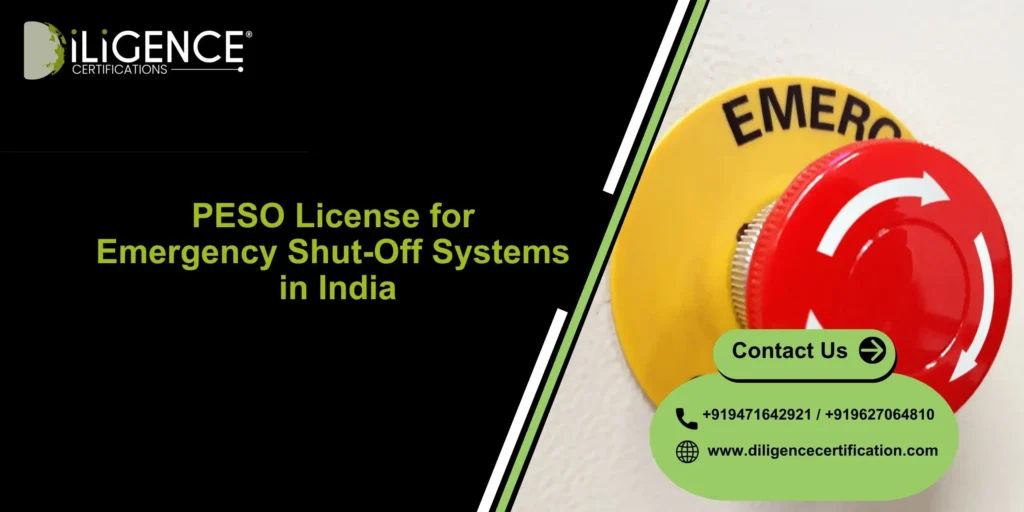
By - Emergency Shut-Off Systems are important safety controls used to stop fuel, gas, chemical, or hazardous product flow during an emergency.
- PESO compliance is required where emergency shut-off systems are connected with petroleum, LPG, compressed gases, tankers, storage tanks, filling stations, or hazardous installations.
- These systems help prevent fire spread, leakage, explosion risk, overfilling, and uncontrolled discharge of dangerous substances.
- PESO checks design, installation safety, technical drawings, documents, site layout, and compliance with applicable rules before approval or licensing.
- A proper consultant helps avoid application rejection, wrong documentation, technical non-compliance, and delay in approval.
Introduction | Emergency Shut-Off Systems
Emergency shut-off systems play a vital role in ensuring safety in petroleum, gas, chemical, and hazardous materials handling facilities. In India, these are implemented in various places like petrol pump stations, LPG plants, tank farms, petroleum storage depots, road tankers, compressed gas facilities, and industrial premises dealing with flammable products.
The primary function of an emergency shut-off system is straightforward - to immediately cut off the source when there is a risk. In situations involving leaks, fires, abnormal pressure conditions, machine failures, or unsafe operations, the system enables control of the situation before it escalates into a catastrophe.
PESO, standing for Petroleum and Explosives Safety Organisation, oversees safety in petroleum, explosives, compressed gases, pressure vessels, and associated hazardous facilities in India. For numerous facilities, emergency shut-off facilities are mandatory requirements. These are part of safety compliance under relevant petroleum, gas, and hazardous material regulations. PESO guidelines indicate that petroleum road tankers require effective emergency shut-off valves, alternate operation methods, and fusible connections capable of shutting off valves during fires.
What is PESO License for Emergency Shut-Off Systems?
“PESO License for Emergency Shut-Off System” refers to the licensing or compliance that pertains to the emergency shut-off system in hazardous establishments. It applies where an emergency shut-off system is involved in activities such as petroleum storage, LPG filling, gas handling, loading or unloading of tank trucks, pressure vessel installation, among others.
The emergency shut-off system could involve an emergency shut-off valve, remote shut-off control, automatic shut-down panel, fusible link, emergency push button, isolation valve, product cut-off system, and electric power cut-off system. In layman’s language, the emergency shut-off system is aimed at stopping any flow or power supply of products in an emergency situation.
Key points:
- It is mainly required for facilities handling petroleum, LPG, compressed gases, flammable liquids, or hazardous products.
- It may be part of a larger PESO license for storage, transport, filling, manufacturing, or installation approval.
- The system must be reliable, accessible, and suitable for emergency use.
- In petroleum tankers, PESO guidance mentions that each compartment requires an effective shut-off valve with secondary operation from an easily accessible position.
- Fusible links are used in some systems so that valves close automatically in case of fire.
- The approval process usually includes drawings, technical details, safety documents, and site inspection where required.
Why PESO License for Emergency Shut-Off Systems is Important
Emergency shut-off systems are important because hazardous materials can create serious risk within seconds. A small leakage of petrol, LPG, or flammable vapour can become a fire or explosion hazard if not controlled quickly. Manual control may not always be possible during panic, heat, smoke, or equipment failure. That is why emergency shut-off systems are installed for immediate isolation.
PESO compliance ensures that these systems are not installed casually. The design, location, operation method, safety distance, technical specification, and emergency access must be suitable for the premises. The Petroleum Act also gives authority to inspect places where petroleum is imported, stored, produced, refined, blended, or transported, along with plant and appliances used in such operations.
Key points:
- It helps reduce the risk of fire, explosion, and uncontrolled leakage.
- It protects workers, operators, transporters, customers, and nearby public areas.
- It supports legal operation of petroleum, LPG, gas, and hazardous installations.
- It helps businesses follow PESO safety requirements.
- It reduces business shutdown risk due to non-compliance.
- It improves emergency response during loading, unloading, storage, and transfer.
- It shows that the facility follows structured safety standards.
Importance and Benefits for Emergency Shut-Off Systems
| Importance | Benefits |
| Controls hazardous flow during emergency | Reduces fire, leakage, and explosion risk |
| Supports PESO safety compliance | Helps in smooth licensing and approval |
| Protects workers and nearby people | Improves workplace and public safety |
| Required in many petroleum and gas operations | Avoids legal problems and penalties |
| Helps isolate unsafe equipment quickly | Reduces damage to plant and machinery |
| Supports safe loading and unloading | Prevents uncontrolled discharge |
| Improves emergency preparedness | Builds trust with authorities and clients |
| Ensures proper technical installation | Reduces chances of inspection failure |
Process for PESO License for Emergency Shut-Off Systems
The process may change depending on the type of premises, product, quantity, storage capacity, and applicable rule. However, the general process follows these steps:
1. Identify the Applicable Requirement
First, the business must check whether the emergency shut-off system is required for petroleum storage, LPG installation, compressed gas facility, road tanker, filling station, terminal, or industrial plant. Different rules may apply to different activities.
2. Review Site and Product Details
The consultant or technical team reviews the site layout, product category, storage capacity, operating pressure, pipeline route, transfer points, loading/unloading area, and emergency access points.
3. Prepare Technical Design
The design must show where emergency shut-off valves, isolation controls, remote operation points, emergency switches, and fusible links are installed. The system must be practical and easy to operate during emergency conditions.
4. Prepare Required Documents
Common documents may include:
- Application form
- Site layout plan
- Technical drawings
- Equipment specifications
- Valve and system details
- Safety distance details
- Ownership or lease documents
- Factory or company documents
- Fire safety details, if applicable
- Manufacturer or supplier certificates
- Existing PESO license details, if applicable
- Undertakings and declarations
5. Submit Application to PESO
The application is submitted to the concerned PESO office or online portal, depending on the type of approval. Details must be accurate because wrong information may lead to query or rejection.
6. Document Scrutiny by PESO
PESO reviews the application, drawings, safety details, and technical documents. If any correction is required, the authority may raise a query.
7. Site Inspection or Technical Verification
In many cases, PESO may inspect the site or verify the installation before granting approval. The system must match the submitted drawings and comply with applicable safety rules.
8. Query Reply and Correction
If PESO raises any technical or document query, the applicant must reply properly with revised drawings, clarification, or supporting documents.
9. Grant of License or Approval
After satisfactory review and inspection, PESO grants approval, license, or acceptance as applicable. The business must maintain the system in working condition after approval.
10. Renewal and Compliance Maintenance
PESO compliance is not finished after approval. The emergency shut-off system must be tested, maintained, inspected, and repaired whenever required. Any major modification should be reported or approved as per rules.
Challenges of Getting This Certification Without a Consultant
Many businesses think PESO approval Emergency Shut-Off Systems is only a form submission process. In reality, PESO compliance is technical and safety-based. Emergency shut-off systems are directly connected with hazardous operations, so even small errors in design or documents can delay approval.
Without proper guidance, applicants may not understand which rule applies, what drawings are needed, how the shut-off system should be shown, or how to reply to PESO Emergency Shut-Off Systems. This can create unnecessary delays and business loss.
Key challenges:
- Wrong selection of applicable PESO rule or license category
- Incomplete technical drawings
- Incorrect valve location or emergency access planning
- Missing equipment specification documents
- Poor understanding of safety distance requirements
- Improper documents for petroleum, LPG, or gas premises
- Delay in query reply
- Mismatch between site installation and submitted drawing
- Lack of coordination with manufacturer, fabricator, or installer
- Rejection risk due to non-compliance
- Delay in business operation, storage, transport, or commissioning
Why Choose Diligence Certification for PESO License for Emergency Shut-Off Systems?
Diligence Certification provides professional support for PESO license, documentation, technical coordination, and approval assistance. Emergency shut-off system compliance needs careful handling because it is related to public safety, fire risk, hazardous material control, and legal operation.
Our team helps businesses understand the correct requirement, prepare documents, coordinate technical drawings, and submit the application properly. We also support clients during PESO queries and follow-ups so that the approval process becomes smoother and more organized.
Key points:
- Expert guidance for PESO license and approval process
- Support for emergency shut-off system documentation
- Assistance in preparing proper technical drawings
- Help in identifying applicable rules and safety requirements
- Error-free application filing support
- Coordination with client, installer, and technical team
- Proper query reply and follow-up with authority
- End-to-end support from documentation to approval
- Faster and hassle-free compliance process
- Suitable support for manufacturers, importers, storage facilities, tankers, and industrial units
Conclusion
Emergency Shut-Off Systems are a major safety requirement for hazardous installations handling petroleum, LPG, compressed gases, chemicals, and flammable products. These systems help stop product flow, isolate dangerous equipment, and control emergency situations before they become major accidents.
PESO compliance ensures that emergency shut-off systems are properly designed, installed, documented, and maintained. For businesses, this approval is important not only for legal compliance but also for worker safety, public safety, asset protection, and smooth operations.
Getting PESO approval without technical knowledge can be difficult because the process involves rules, drawings, documents, inspections, and authority queries. Diligence Certification helps businesses complete this process with proper guidance and end-to-end support.
Frequently Asked Questions
What is an emergency shut-off system?
An emergency shut-off system is a safety arrangement used to stop fuel, gas, chemical, or hazardous product flow during an emergency.
Is PESO approval required for emergency shut-off systems?
PESO compliance may be required when the system is part of petroleum, LPG, compressed gas, tanker, storage, filling, or hazardous installations.
Where are emergency shut-off systems used?
They are used in petrol pumps, LPG plants, tank farms, petroleum depots, road tankers, gas facilities, and chemical handling units.
What is the main purpose of an emergency shut-off valve?
Its main purpose is to stop product flow quickly during leakage, fire, overpressure, accident, or unsafe operation.
Does PESO inspect emergency shut-off systems?
In many cases, PESO may inspect the site, drawings, and installation before granting approval or license.
What documents are required for PESO compliance?
Documents may include company details, site layout, technical drawings, gas details, cylinder documents, test reports, and safety certificates.
How long does PESO approval take?
Timeline depends on system type, document accuracy, inspection requirements, and query handling.
Can an imported fire fighting system need PESO approval?
Yes, imported systems using compressed gas cylinders, pressure vessels, or regulated equipment may need PESO approval before use.
What happens if PESO approval is not taken?
The business may face rejection, penalties, project delay, shutdown risk, or safety-related legal issues.
How can Diligence Certification help?
Diligence Certification helps with applicability checks, documentation, application filing, query replies, authority coordination, and final approval.