BIS Certification
 CDSCO
CDSCO
 PESO
PESO
 CPCB
CPCB
 LMPC
LMPC
 WPC Approval
 Global Approvals
 TEC
TEC
 ARAI
ARAI
 BEE
BEE
 ISO Certification
 DGCA Certification
 NOC For Steel
 APEDA Registration























 Business Registration
 FSSAI Mark Certification












 (32).jpg)
 Legal Services
 Trademark Registration
 Copyright Registration
 Patent Registration
 By
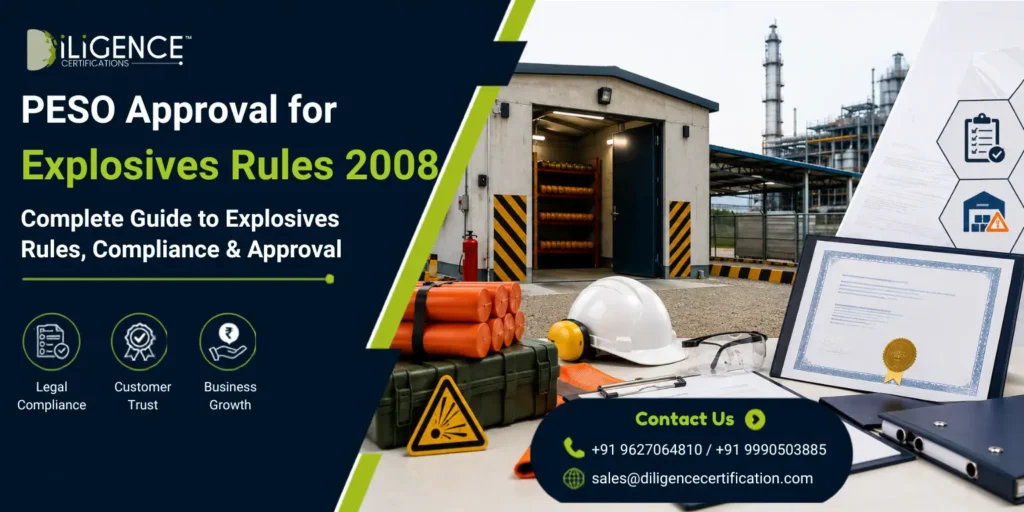
By - The guide comprises all information needed concerning the Explosives Rules 2008 and the regulations governing business enterprises that engage in activities relating to explosives.
- It deals with matters such as eligibility, application, documentation, premises, storage, handling, transport, safety standards, inspection, licensing, record keeping, and compliance.
- The main aim of this guide is to give enterprises detailed and understandable information on the Explosives Rules 2008 and compliance responsibilities for regulated explosive activities.
Introduction
Explosives are used for legitimate purposes in various industries such as mining, construction, development of infrastructure, quarrying, controlled industrial processes, and other authorized activities. But because the use of explosives is hazardous in terms of safety and security, especially if they are manufactured, stored, transported, sold, and used without any control measures, these activities are regulated by law.
The Explosives Rules 2008 are an essential legal framework for the regulation of various activities in relation to explosives in India. The businesses engaged in the process of explosives should pay attention to more than just licensing but also premises, storage, transport, security, handling, documents, inspection, and contingency planning.
The Petroleum and Explosives Safety Organisation (PESO) is a vital agency for the implementation and administration of safety laws concerning explosives in India. Approval, license, and permission depend upon the nature of activity, nature of explosives, quantity, premises, and purpose.
What are Explosives Rules 2008?
The Explosives Rules 2008 are statutory requirements that regulate the following specified activities relating to explosives in India.
These rules are used to regulate activities including the manufacture, possession, storage, sale, use, transportation, importation, exportation, and other allowed activities involving explosives under the Petroleum and Explosives Safety Organization (PESO) regulations.
The main aim of the statutory requirements is to make sure that the activities of dealing with explosives take place through authorized systems, proper places, proper safety measures, and necessary authorizations.
Therefore, businesses undertaking activities involving explosives should first identify the relevant requirements prior to commencing their activities..
The services included in Explosives Rules 2008 Compliance are:
- PESO Registration and Licensing Assistance
- Explosives Compliance Assistance
- Explosives Safety Compliance
- Licensing Assistance
- Documentation Support
- Technical Compliance
- Regulatory Advisory
- Application Filing
- Inspection Preparation
- Compliance Management
Following the applicable Explosives Rules 2008 helps organizations establish structured systems for the safe storage, handling, transportation, use, and management of regulated explosives.
Applications of Explosives Rules 2008
Explosives Rules 2008 may be applicable to different business organizations engaged in regulated activities pertaining to the handling of explosives. The obligations to comply may vary depending on the nature of the activities, types and quantities of the explosives, premises, purposes, modes of storage and transportation, among others.
Some entities that may have regulatory obligations include:
- Explosives Manufacturers
- Mining Companies
- Quarrying Businesses
- Infrastructure Companies
- Construction Companies
- Industrial Explosives Users
- Authorized Explosives Importers
- Authorized Exporters
- Explosives Storage Facilities
- Explosives Suppliers
- Distributors
- Warehousing Facilities
- Licensed Magazine Operators
- Businesses Handling Regulated Explosive Materials
- Organizations Using Explosives for Permitted Industrial Purposes
Compliance with the applicable Explosives Rules 2008 helps organizations establish safer and more controlled systems for handling regulated explosives.
Who Needs to Comply with Explosives Rules 2008?
Businesses involved in regulated activities concerning explosives may need to obtain the relevant licence, approval, authorization, registration, or permission under the applicable regulatory framework.
Organizations that may require relevant compliance include:
- Explosives Manufacturing Units
- Industrial Explosives Users
- Mining Companies
- Quarry Operators
- Construction and Infrastructure Businesses
- Explosives Storage Facilities
- Licensed Magazine Operators
- Authorized Importers
- Authorized Exporters
- Explosives Suppliers
- Distributors
- Industrial Manufacturing Units
- Businesses Transporting Regulated Explosives
- Organizations Handling Explosives for Permitted Purposes
Other eligible businesses may also fall within the applicable requirements of the Explosives Rules 2008, depending on their specific activities.
Compliance allows eligible organizations to carry out regulated operations while maintaining the required safety, security, technical, documentation, and operational standards.
Types of Compliance Under Explosives Rules 2008
The compliance requirements for explosives depend on the nature of the explosives, amount, operation, premises, storage facility, manufacturing process, transportation methods, uses, and regulations applicable to the explosives.
As explosives are meant to be controlled, companies should have adequate systems regarding their premises, storage, handling, transportation, documentation, security, and inspections.
Compliance of Premises & Storage Facilities
Premises intended to be used for production, storage, possession, or handling of explosives shall meet all relevant technical, safety, security, and operational standards.
Design and layout of the premises shall be suitable for the type of regulated activity.
Important areas of premises and storage compliance may include:
- Suitable Storage Premises
- Approved Layout
- Safe Storage Arrangements
- Adequate Ventilation
- Fire Safety Arrangements
- Restricted Access
- Ignition Source Control
- Electrical Safety
- Security Measures
- Facility Maintenance
Useful for:
- Explosives Manufacturers
- Mining Companies
- Quarrying Businesses
- Industrial Explosives Users
- Explosives Warehouses
- Licensed Magazine Operators
Proper premises compliance helps reduce operational risks and supports safe management of explosives.
Storage & Handling Compliance
Explosives require careful storage and handling because inappropriate conditions, unauthorized access, poor housekeeping, unsuitable equipment, or unsafe handling practices can create serious hazards.
Businesses should establish controlled procedures for receiving, storing, issuing, handling, and managing explosives.
Compliance with safe storage and handling may include:
- Controlled Storage
- Safe Material Handling
- Fire Prevention Measures
- Separation of Incompatible Materials
- Restricted Access
- Suitable Ventilation
- Emergency Preparedness
- Material Identification
- Inventory Management
- Safe Internal Movement
Useful for:
- Explosives Manufacturers
- Mining Businesses
- Quarry Operators
- Infrastructure Companies
- Construction Businesses
- Explosives Storage Facilities
- Authorized Suppliers
Proper storage and handling practices help organizations maintain a safer working environment and better control over regulated explosive materials.
Transportation Compliance
Transportation is also one area that is equally significant regarding compliance with explosives. Explosives should only be transported using proper transportation channels.
Transportation companies should look into relevant aspects with regards to vehicle issues, documentation, routing, security, loading, unloading, and handling.
Transportation compliance may involve:
- Approved Transportation Arrangements
- Suitable Vehicles
- Required Documentation
- Safe Loading and Unloading
- Security Measures
- Route Controls
- Emergency Preparedness
- Driver and Personnel Requirements
- Material Identification
- Transportation Records
Proper transportation compliance reduces avoidable risks during the movement of explosives and supports regulatory control throughout the supply chain.
Documentation & Inspection Compliance
Accurate records are an important part of explosives compliance. Businesses may be required to maintain relevant information concerning licences, inventory, storage, transportation, inspections, safety procedures, and other regulated activities.
Documentation may include:
- Business Records
- License and Approval Records
- Storage Details
- Inventory Records
- Inspection Records
- Safety Records
- Technical Documents
- Transportation Records
- Purchase and Sale Records
- Regulatory Correspondence
Maintaining organized records helps businesses demonstrate compliance and respond more effectively to inspections, regulatory queries, and verification requirements.
Documents Required for Explosives Rules 2008 Compliance
The documents required for compliance under the Explosives Rules 2008 can vary depending on the type of explosive activity, premises, quantity, business structure, storage arrangements, technical facilities, and approval being sought.
Generally, documents may include:
- PAN Card
- GST Registration Certificate
- Business Registration Certificate
- Identity Proof of Authorized Signatory
- Address Proof
- Site Plan
- Layout Plan
- Ownership or Lease Documents
- Organization Details
- Technical Specifications
- Explosives Details
- Storage Details
- Safety Arrangement Details
- Fire Safety Documents
- Security Arrangement Details
- Transportation Details, where applicable
- Inspection and Testing Documents
- Authorization Letter, if applicable
- Digital Signature Certificate, where applicable
- Other documents required under applicable regulations
The exact documentation depends on the particular activity and regulatory permission. Preparing accurate and consistent documents helps the authority assess the proposed operation, premises, safety arrangements, and compliance framework.
Step-by-Step Process for Explosives Rules 2008 Compliance
Following the Explosives Rules 2008 can be made simpler if companies adopt an organized approach. This usually includes the process of comprehending the regulations, documentation, filing of the relevant application, meeting the verification requirements, inspections if any, and getting the necessary approval..
Step 1: Eligibility Assessment
The first step is to determine which regulatory requirements apply to the proposed explosives-related activity.
The assessment may depend on:
- Nature of Business Activity
- Type of Explosives
- Intended Use
- Quantity Handled
- Storage Premises
- Manufacturing Process
- Transportation Arrangements
- Technical Infrastructure
- Security Arrangements
- Applicable Regulations
A proper assessment helps identify whether a specific licence, approval, authorization, registration, or other permission is required.
Step 2: Gathering All Required Documents
After identifying the applicable requirements, the business should prepare the necessary documents and technical information.
This stage is important because the authority needs sufficient information to evaluate the applicant, premises, storage facilities, safety measures, security arrangements, and proposed activities.
Common documents may include:
- Business Registration Certificate
- PAN Card
- GST Registration Certificate
- Identity and Address Proof
- Site and Layout Plans
- Explosives Details
- Storage Details
- Safety Arrangement Details
- Technical Documents
- Security Arrangement Details
- Inspection Documents
Accurate documentation creates a clear picture of the proposed operation and helps avoid unnecessary inconsistencies.
Step 3: Filling Out the Application
After preparation of the necessary documentation, the relevant application must be filled out with accurate details about the applicant, company, location, explosives, storage, proposed use, technical facilities, and safety provisions.
Details included in the application must correspond with those in the documents.
The application may cover:
- Business Information
- Applicant Information
- Premises Information
- Explosives Details
- Activity Details
- Storage Information
- Technical Information
- Safety Information
- Security Information
- Contact Information
- Compliance Information
Careful application preparation can help reduce avoidable queries during the regulatory review.
Step 4: Verification of the Application
After submission, the relevant authority may examine the application and supporting documents to determine whether the proposed activity meets applicable regulatory and safety requirements.
Verification may include:
- Business Verification
- Documentation Verification
- Premises Verification
- Technical Documentation Verification
- Storage Arrangement Verification
- Safety Arrangement Verification
- Security Verification
- Compliance Verification
Depending on the nature of the activity, an inspection or technical assessment may also be required.
Where additional information or clarification is requested, the applicant should provide the required response within the applicable process.
Step 5: Grant of Applicable Approval or License
Once the applicable requirements have been satisfactorily completed, the competent authority may grant the relevant licence, approval, authorization, registration, or permission.
The benefits of obtaining applicable approval under the Explosives Rules 2008 include:
- Regulatory Compliance
- Safe Material Management
- Controlled Operations
- Regulatory Recognition
- Better Business Credibility
The approval confirms that the applicant has satisfied the requirements applicable to the particular regulated activity, subject to the conditions of the approval.
Step 6: Ongoing Compliance
Obtaining a licence or approval does not mean that compliance responsibilities have ended. Businesses must continue to follow applicable safety, security, storage, transportation, documentation, inspection, and operational requirements.
Ongoing responsibilities may include:
- Regular Inspection
- Safety Monitoring
- Record Maintenance
- Inventory Monitoring
- Regulatory Reporting
- Equipment Maintenance
- Updating Business Information
- Storage Safety Monitoring
- Security Monitoring
- Compliance Review
Continuous compliance helps organizations maintain safer operations and avoid preventable regulatory difficulties.
Timeline, Cost & Validity of Explosives Rules 2008 Compliance
The timeline, cost, and validity of approvals associated with the Explosives Rules 2008 depend on factors such as the nature of the activity, type of explosives, application requirements, document preparation, technical assessment, premises inspection, regulatory review, applicable government fees, and conditions attached to the approval.
| Timeline | Cost | Validity |
| The approval timeline depends on document verification, technical assessment, inspection, and application processing. | The cost depends on the applicable government fee and professional service charges, if any. | The applicable approval or license remains valid as per the applicable regulations, license conditions, and approval requirements. |
| Proper documentation helps reduce processing delays. | Additional charges may vary depending on the nature of explosives activities and compliance requirements. | Businesses should comply with applicable renewal, inspection, or update requirements whenever necessary. |
| Processing time may vary based on the completeness of the application and regulatory verification. | Proper planning helps manage the compliance cost efficiently. | Maintaining updated business, storage, safety, and regulatory information helps support continued compliance. |
Importance & Benefits of Explosives Rules 2008 Compliance
| Importance | Benefits |
| Helps organizations comply with applicable regulations and explosives safety requirements. | Enhances business credibility and demonstrates commitment to safe material management. |
| Supports safe storage, handling, transportation, and management of explosives. | Improves confidence among customers, business partners, workers, and regulatory authorities. |
| Encourages responsible industrial practices and regulatory discipline. | Enables smoother compliance with applicable safety and operational requirements. |
| Promotes long-term operational safety and responsible management of regulated materials. | Reduces compliance risks and improves operational efficiency. |
| Helps businesses fulfill their legal and regulatory responsibilities. | Strengthens long-term business growth and industry reputation. |
Why are Explosives Rules 2008 Important?
It is important to consider the Explosives Rules 2008 because it ensures the implementation of regulations concerning explosive materials. While explosives may prove to be helpful in industrial contexts, poor storage of, access to, handling of, or transport of the material can pose dangerous threats.
This is why organizations that deal with explosive materials must know the regulations relating to such materials and implement adequate systems to manage them safely and effectively.
These regulations ensure that the organization will have the proper premises, storage, inventory management, transport, documentation, security, inspection, and emergency planning systems in place.
Moreover, compliance with regulations ensures that the business builds an attitude towards safety and compliance rather than simply obtaining necessary licenses.
Organizations that manufacture, store, possess, supply, transport, import, export, or use explosive materials for legal purposes must know the regulations relating to the particular activity carried out by the company.
The importance of Explosives Rules 2008 includes:
- Regulatory Compliance
- Industrial Safety
- Safe Material Handling
- Operational Reliability
- Industry Recognition
- Risk Reduction
- Responsible Explosives Management
Proper compliance helps businesses maintain safer operations while supporting regulatory discipline and responsible management of explosives.
Consequences of Non-Compliance with Explosives Rules 2008
Failure to follow applicable explosives requirements can create significant regulatory and operational difficulties. Since explosives are subject to strict safety and security controls, businesses should ensure that their activities remain within the conditions of applicable licences, approvals, and regulations.
Some possible consequences include:
Regulatory Non-Compliance
Organizations may face regulatory difficulties if they manufacture, store, possess, transport, sell, use, import, export, or otherwise handle explosives without fulfilling applicable requirements.
Action by the Competent Authority
The competent authority may take appropriate action where an organization is found to have violated applicable licensing, safety, security, technical, or operational requirements.
Operation Restrictions
Businesses may face restrictions on certain activities until identified compliance deficiencies are addressed.
Business Activity Time Lags
Non-compliance can cause delays in obtaining approvals, expanding facilities, modifying premises, introducing new activities, or continuing regulated operations.
Suspension or Withdrawal of Approval
Serious or continued non-compliance may lead to suspension, cancellation, withdrawal, or other regulatory action concerning an existing permission, subject to applicable law and procedure.
Safety Hazard Risks
Poor storage, handling, transportation, or security practices can increase the possibility of fire, accidents, property damage, injury, or other serious safety incidents.
Reputation of the Business
Regulatory violations can negatively affect the confidence of customers, suppliers, employees, investors, business partners, and other stakeholders.
Risk of Bad Reputation
Repeated failure to maintain required safety and regulatory standards may weaken the credibility of businesses operating in regulated industrial sectors.
Growing the Business
Non-compliance can make it more difficult for businesses to expand facilities, increase permitted activities, obtain additional approvals, or develop regulated operations.
Following applicable requirements allows organizations to operate in a more structured, responsible, and compliant manner.
Renewal of Explosives Approval or License
Renewal, amendment, revision, or updating of the respective explosives licence or authorization may constitute a significant obligation for enterprises that function under the Explosives Rules 2008.
It is advisable that enterprises should carry out reviews of their regulatory permissions to find out whether there have been any changes to their business operations, premises, storage facilities, ownership, management, technology, machinery, quantities, etc.
The common steps involved in reviewing or updating applicable approval may include:
- Updating Business Information
- Reviewing License Details
- Updating Premises Information
- Updating Storage Information
- Updating Operational Information
- Submitting Required Documents
- Maintaining Safety Compliance
- Checking Regulatory Requirements
Keeping licensing and regulatory information current helps businesses continue their regulated activities while maintaining applicable safety and compliance standards.
How Professional Assistance Helps in Explosives Rules 2008 Compliance?
Comprehending the rules for explosives concerning legislation, standards, licensing, documentation, premises, storage, and inspection can pose difficulties for companies.
A professional can assist an organization to get the proper information and arrange the entire process of compliance with the relevant regulations.
Professional assistance generally includes:
- Understanding Explosives Rules 2008 Requirements
- Eligibility Assessment
- Documentation Preparation
- Application Filing Assistance
- Technical Compliance Guidance
- Safety Compliance Guidance
- Regulatory Advisory
- Application Status Tracking
- Query Resolution
- Post-Approval Compliance Support
The professional services generally cover:
- Eligibility Verification
- Documentation Assistance
- Online Application Support
- Regulatory Compliance Guidance
- Technical Documentation Support
- Inspection Preparation Assistance
- End-to-End Approval Assistance
- Ongoing Compliance Advisory
With appropriate professional guidance, businesses can organize regulatory requirements more efficiently while focusing on their core industrial activities.
Why Choose Diligence Certifications for Explosives Rules 2008 Compliance?
Adherence to the Explosives Rules 2008 necessitates a good knowledge of the regulations, documentations, facilities, storage conditions, safety measures, technical data, inspection, licensing, and compliance issues.
The professionals’ assistance can be of great use for the businesses in organizing all those issues mentioned above and handling the application, documentation, regulatory issues, technical details, and compliance issues in a proper manner.
Diligence Certifications helps businesses in regulatory compliance regarding industrial operations, approvals, explosives-related issues, chemical safety, and other regulated issues..
The advantages of choosing Diligence Certifications include:
- Documentation Assistance
- Application Filing Support
- Regulatory Compliance Guidance
- Approval Query Resolution
- Technical Documentation Assistance
- End-to-End Approval Assistance
- Continuous Compliance Support
- Regulatory Guidance
- Process Management
With professional support from Diligence Certifications, businesses involved in explosives-related activities can manage applicable documentation, regulatory applications, technical requirements, safety arrangements, and compliance responsibilities more systematically.
Conclusion
Explosives Rules, 2008, hold significance for businesses and organizations engaged in regulated activities involving explosives in India.
Since explosives need to be properly controlled, it is necessary that the business focuses on the aspects of storage, handling, transportation, security, inventory, record-keeping, premises, inspection, preparedness for emergencies, and authorization and permission, among others.
The specific permission, license, authorization, registration, and approval depend upon the type of the activity, the type of explosives, the amount, the premises, the intended use, and the relevant rules and regulations.
Appropriate premises, secure storage, proper handling, safe transportation, appropriate record-keeping, proper documentation, inspection readiness, security measures, and continuous monitoring are some of the crucial components of proper explosive management.
When the regulatory requirements are not clear or the activity requires licensing or is quite complicated, it is advisable to seek professional assistance.
Frequently Asked Questions
What are Explosives Rules 2008?
The Explosives Rules 2008 provide regulatory requirements for specified activities involving explosives, including manufacturing, possession, storage, sale, transportation, import, export, and permitted use.
Who needs to comply with Explosives Rules 2008?
Businesses and organizations carrying out regulated activities involving explosives may need to comply with the applicable requirements, licences, approvals, or permissions.
Is compliance with Explosives Rules 2008 mandatory?
Yes, applicable regulatory requirements must be followed for activities that fall within the scope of the relevant explosives regulations.
What documents are required for Explosives Rules 2008 compliance?
Documents may include business details, identity and address proof, site and layout plans, storage information, technical documents, safety arrangements, security details, and other activity-specific documents.
Does Explosives Rules 2008 cover storage?
Yes, regulated possession and storage of explosives are subject to applicable safety, security, premises, and licensing requirements.
Does transportation of explosives require compliance?
Yes, transportation of regulated explosives must follow applicable requirements relating to authorization, safety, security, documentation, vehicles, and handling.
Why are Explosives Rules 2008 important?
They establish regulatory controls intended to support safe, secure, and responsible management of explosives.
What happens if explosives requirements are not followed?
Non-compliance may lead to regulatory action, operational restrictions, delays, or other consequences depending on the nature and seriousness of the violation.
How can businesses maintain ongoing explosives compliance?
Businesses should maintain required licences, records, storage arrangements, safety systems, security measures, inspections, and other applicable regulatory requirements.
How can consultants help with Explosives Rules 2008 compliance?
Consultants can assist with eligibility assessment, documentation, application preparation, regulatory guidance, inspection preparation, query handling, and ongoing compliance support.