BIS Certification
 CDSCO
CDSCO
 PESO
PESO
 CPCB
CPCB
 LMPC
LMPC
 WPC Approval
 Global Approvals
 TEC
TEC
 ARAI
ARAI
 BEE
BEE
 ISO Certification
 DGCA Certification
 NOC For Steel
 APEDA Registration























 Business Registration
 FSSAI Mark Certification












 (32).jpg)
 Legal Services
 Trademark Registration
 Copyright Registration
 Patent Registration
 By
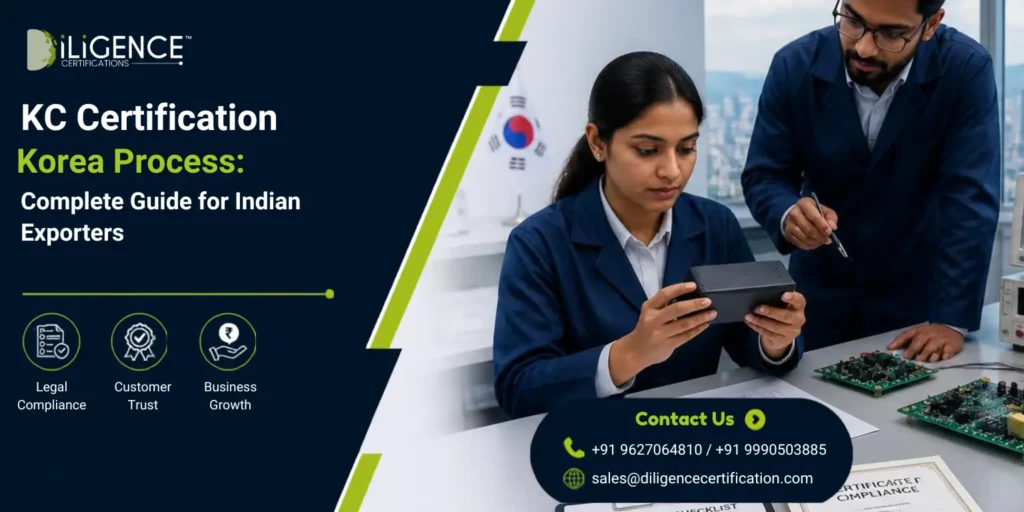
By - The KC Certification Korea Process Certification is beneficial for manufacturers and exporters to know the appropriate KC compliance path before marketing their regulated products in the Korean market.
- This may involve the following steps: product classification, safety requirements, testing, assessment of factories, KC certification/reporting and KC Marking.
- Indian manufacturers can save themselves from avoidable delays, paperwork and compliance costs by determining the right KC route before the testing phase.
Introduction
KC Korea Compliance Process is the compliance process employed for products that need to comply with South Korea’s relevant safety and product management requirements. The acronym KC stands for Korea Certification; the applicable compliance process will depend on the type of product and the law regulating such.
For importers and exporters, it is noteworthy that there is no single KC compliance process for all products. There are several product safety compliance processes in South Korea which are regulated according to product categories and their risks.
As an illustration, for example, under Korea’s Electrical and Consumer Product Safety Act, there are Safety Certification, Safety Confirmation, Supplier’s Declaration of Conformity, among others, which might apply for certain types of products.
This is why a business shouldn’t first ask itself “What do I have to do to get a KC certificate?”. A more appropriate question would be:
Which compliance process for products applies to my specific product in Korea?
The answer to the above question will lead to further steps.
Why Is KC Certification Important for Exporting to Korea?
There might be a product by an Indian manufacturer that conforms to BIS, IEC, CE or any other international standards. Nonetheless, the existing conformity does not necessarily imply that the product is in full compliance with all the requirements of Korea.
The Korean market has its own regulations, technical requirements and product safety measures. It might be necessary for the manufacturer or importer of the product to undertake various procedures in order for the product to be sold.
According to the official Korean Product Safety Information Center, some electrical products made locally are supposed to be certified before distribution, whereas imported electrical products require certification prior to their importation through customs.
Classification becomes the first important step in the process.
KC Certification Korea Process: Step-by-Step
Step 1: Identify the Product
Start with accurate product details, including the brand, model, intended use, electrical ratings, voltage, frequency, components, materials, dimensions, photographs and existing test reports. Correct classification is important because similar products can fall under different Korean requirements.
Step 2: Determine the Appropriate KC Route
Under the Korean safety regime, Safety Certification, Safety Confirmation, or Supplier’s Declaration of Conformity may be required. The exact route is dependent upon the category of product and regulatory requirements.
The Safety Certification process could involve product testing and factory inspection while Safety Confirmation normally requires testing and the required confirmation/reporting process. In some cases, the Supplier’s Declaration of Conformity route may be followed.
Step 3: Determine the Relevant Korean Standards
Identify the relevant Korean technical standards. The requirements can include electrical safety, insulation, electric shock protection, heat, mechanical safety, fire hazard, components, materials, EMC and markings. The IEC report may prove to be sufficient for meeting compliance but it does not necessarily mean that it provides for complete Korean conformity.
Step 4: Technical Documentation Preparation
Prepare specifications, circuit/block diagram, BOM, component information, PCB data, manuals, photos, label, test report, manufacturer and factory information. Make sure that the configuration of the product model remains consistent.
Step 5: Select Testing or Certification Body
Select the appropriate recognized testing/certification body in Korea, for example KTL, KTC, or KTR.
Step 6: Conduct Product Testing
Tests will include electrical safety, heat, insulation, leakage current, dielectric strength, abnormal operation, mechanical safety and other testing as per product specific standards.
Step 7: Factory Inspection
If necessary, factory evaluation may be conducted to evaluate the production control system, quality control procedures, testing equipment, components handling and traceability system.
Step 8: Certification & KC Marking
Once a positive assessment is made, certification is provided. KC marking and product information will have to be applied as per Korean marking requirements.
Documents Required for KC Certification
The exact document list depends on the product and route, but exporters should generally be prepared with:
| Document | Purpose |
| Product specification | Identifies technical characteristics |
| Product photographs | Helps establish product configuration |
| Circuit diagram | Supports electrical evaluation |
| Component list | Identifies critical components |
| User manual | Provides operating and safety information |
| Rating label | Confirms required product information |
| Test reports | Demonstrates technical compliance |
| Factory details | Supports manufacturing assessment where applicable |
| Manufacturer details | Establishes responsible party |
| Existing certifications | Provides supporting compliance information |
The important point is consistency.
If the model number on the test sample differs from the documentation, or the submitted product configuration differs from the actual production version, the compliance process can become complicated.
How Long Does the KC Certification Process Take?
There is no single processing period applicable to every KC product.
The time depends on factors such as:
- Product category
- Applicable conformity procedure
- Number of models
- Testing requirements
- Availability of samples
- Document completeness
- Factory assessment requirements
- Test failures or modifications
- Certification-body workload
A straightforward product with complete documentation can move more efficiently than a technically complex product requiring several rounds of testing For this reason, exporters should avoid promising a fixed timeline before the product classification and testing requirements have been reviewed.
What Is the Cost of KC Certification?
The cost of the KC certification Korea process varies according to the product and compliance route.
The major cost factors can include:
- Laboratory testing
- Certification or assessment fees
- Factory inspection
- Sample transportation
- Technical documentation
- Model or variant evaluation
- Retesting
- Consultancy
- Translation or local documentation requirements
A product requiring only a conformity-related testing procedure may have a very different cost from a product requiring certification and factory assessment.
A proper quotation should therefore be prepared after reviewing the product specification and model details.
Common Mistakes Indian Exporters Make
Assuming CE Certification Is Enough
CE compliance can be valuable when entering European markets, but it should not automatically be treated as a substitute for Korean requirements.
The applicable Korean product-safety procedure must be checked separately.
Selecting the Wrong Product Category
This can lead to the wrong testing plan and unnecessary expense The classification should be established before committing to testing.
Ignoring Product Variants
Different models may have differences in:
- Power rating
- Components
- PCB
- Housing
- Functions
- Software
- Dimensions
Those differences can affect the compliance assessment.
Treating KC Marking as a Design Exercise
The KC mark is not simply a logo to add to packaging The marking has prescribed requirements, and the applicable format should be confirmed before printing labels or packaging.
KC Certification Korea Process for Indian Manufacturers
An Indian manufacturer planning to enter South Korea should ideally follow this sequence:
Product identification → Korean regulatory classification → Applicable standard identification → Document review → Testing → Factory assessment where applicable → Certification/confirmation → KC marking → Market entry
The biggest practical advantage comes from doing the classification correctly at the beginning.
Consider a manufacturer preparing to export a new electrical appliance from India. If the company orders testing immediately without checking the Korean product category, it may later discover that the applicable route also requires factory-related evaluation or different documentation.
That is why compliance planning should happen before the sample reaches the laboratory.
Why Choose Diligence Certifications for KC Compliance Support?
For Indian manufacturers, the challenge is often not understanding what the KC mark looks like. The difficult part is determining which Korean requirement applies and how to prepare the product accordingly.
Diligence Certifications can support businesses with product compliance assessment, documentation review, certification coordination and regulatory guidance for international market access.
The objective is straightforward: identify the applicable route first, prepare the technical file properly, and avoid unnecessary testing or documentation corrections later.
For broader compliance requirements, you can also explore Diligence Certifications services.
Official Korean Product Safety Information
For authoritative information on Korean product-safety requirements, product categories, certification procedures and certification records, exporters should refer to the Korean government’s Product Safety Information Center (Safety Korea).
Safety Korea - Official Product Safety Information Center
This is particularly useful when checking whether a specific product falls within a Korean safety-management category.
Conclusion
The KC certification Korea process starts with product classification, not with the KC mark itself. Once the applicable Korean safety route is identified, the manufacturer can determine the required standards, documents, testing, factory assessment and conformity procedure.
For Indian exporters, early compliance planning can prevent a common problem: completing an expensive test programme only to discover that the product was placed under the wrong Korean regulatory route.
Diligence Certifications can assist Indian manufacturers in reviewing product requirements, preparing compliance documentation and coordinating the certification process for international market access.
Frequently Asked Questions
What is KC certification in Korea?
KC certification confirms that applicable products meet South Korean safety and conformity requirements.
Is KC certification mandatory for all products?
No, KC requirements depend on the product category and applicable Korean regulations.
Can Indian manufacturers apply for KC certification?
Yes, Indian manufacturers can apply for the relevant KC compliance procedure for regulated products.
Is KC certification the same as CE certification?
No, KC and CE are separate regulatory systems with different compliance requirements.
Does every KC product require factory inspection?
No, factory inspection depends on the applicable KC certification or conformity assessment procedure.
What documents are required for KC certification?
Requirements vary, but commonly include product specifications, technical documents, test reports, manuals and product samples.
How long does KC certification take?
The timeline depends on the product, testing requirements, documentation and applicable certification route.
Can one KC certification cover multiple models?
It may be possible for related models, depending on Korean rules, product classification and model differences.
What is the KC Mark?
The KC Mark indicates that a product has completed the applicable Korean safety or conformity assessment requirements.
Where can I verify KC certification information?
You can verify product-safety and KC information through Korea's official Safety Korea system.