 BIS Certification
 CDSCO
CDSCO
 PESO
PESO
 CPCB
CPCB
 LMPC
LMPC
 WPC Approval
 Global Approvals
 TEC
TEC
 ARAI
ARAI
 BEE
BEE
 ISO Certification
 DGCA Certification
 NOC For Steel
 APEDA Registration




















 Business Registration
 FSSAI Mark Certification











 (32).jpg)
 Legal Services
 Trademark Registration
 Copyright Registration
 Patent Registration
 By
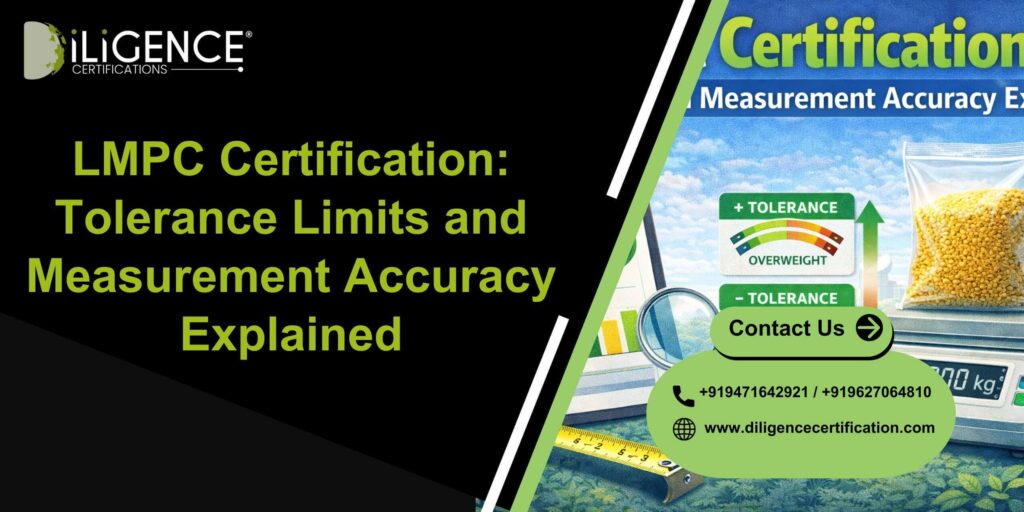
By - LMPC Certification Tolerance Limits and Measurement Accuracy Explained emphasizes the necessity of exact quantity indication and allowable variation in pre-packaged goods according to the Indian Legal Metrology laws.
- Tolerance limits must be set in order to specify the variation between the declared and actual quantities of packaged products that is acceptable.
- Measurement accuracy grants fair trading conditions by making it impossible for consumers to be supplied with less than the declared amount.
- If the tolerance limits are not complied with, penalties, confiscation of products, and litigation may be the result.
- Properly following the LMPC regulations not only keeps the companies away from the risks of enforcement but also helps them keep the customers’ trust.
Introduction
In the regulated Indian market, declaring quantities accurately is the basis of trust, consumer confidence, and fairness. Packaged goods-food and beverages, cosmetics, pharmaceuticals, and so forth-are sold mainly according to their quantity information printed on the labels.
The Legal Metrology (Packaged Commodities) Rules impose strict guidelines on tolerance limits and measurement accuracy for businesses. The purpose of these rules is to guarantee that consumers receive the quantity they have paid for even when very slight, unavoidable variations take place during manufacturing or packaging. Noncompliance can lead to financial penalties and legal actions against a company. Thus, it is very important to know the tolerance limits under LMPC Certification Tolerance Limits for both legal and sustainable business activities.
What Is LMPC Certification?
LMPC Certification Tolerance Limits is the compulsory registration according to the Legal Metrology (Packaged Commodities) Rules for Indian businesses dealing in pre-packed goods.
It is applicable to:
- Manufacturers of the pre-packed goods
- Importers of packaged products
- Packers or re-packers of the products
- Sellers or distributors of packaged goods
LMPC Certification Tolerance Limits guarantees that the uniformity of labeling, proper quantity declaration, and adherence to the accepted measurement standards are maintained throughout the entire supply chain.
Understanding LMPC Certification Tolerance Limits Under Rules
LMPC Certification Tolerance Limits are those that define the range of variations which are allowed between the stated quantity on a package and the actual quantity packed inside.
The reason for these limits is:
- There might be slight variations in the quantity during the process of packaging
- The varying environmental conditions could have different impacts on the weight or volume of the product
- The machinery could cause the deviations to be within the limits
Nonetheless, the tolerance limits should not be interpreted as a green light for intentionally short supply. The average quantity in a batch must be equal to or more than the declared quantity, even if at the same time some individual packages are found to be slightly below it.
Importance of Measurement Accuracy
Accuracy in measurements guarantees that:
- Consumers were given fair value for money
- Businesses behaved ethically in trade practices
- Market transparency was kept
Accurate measurements require the use of calibrated instruments, the implementation of standardized packaging processes, and the execution of quality control checks. Any underlying cause of error that results in the under-declaration of the quantity can be classified as a serious offense under the Legal Metrology Act.
Legal Requirements for Quantity Declaration
According to LMPC regulations, companies are required to take the following actions:
- Properly state the weight, volume, or number
- Deploy standard measurement units
- No misleading or false quantity statements at all
- Adherence to specified tolerance limits
If the packages continuously exceed the allowed limits, they will be classified as non-compliant and enforcement actions will be taken.
Consequences of Non-Compliance with Tolerance Limits
Non-adherence to the LMPC tolerances and accuracy standards may produce the following results:
- Monetary penalties and fines
- Seizure or recall of goods not meeting standards
- Legal notifications and possible prosecution
- Halting of business operations
- Loss of brand reputation and consumer trust
Getting caught for violations more than once will probably lead to more inspections and thus higher penalties.
Role of the Legal Metrology Department
The Legal Metrology Department applies enforcement measures by:
- Routine and surprise inspections
- Testing of the net contents in packages
- Calibration of weighing and measuring instruments
- Careful review of LMPC certificates and records
- Investigations based on complaints
The department carries out its activities at both State and Central levels to guarantee uniformity of enforcement across the country.
LMPC Registration Certificate and Compliance Assurance
An LMPC Certification Tolerance Limits Certificate is a document of official recognition given by the Legal Metrology Department which allows companies to sell pre-packaged goods in a legal way.
The certificate verifies that:
- Labeling and quantity standards are satisfied
- Measurement practices are in accordance with law
- Consumer rights are safeguarded
- Business operations are legally valid
Having a valid LMPC Certification Tolerance Limits means a big cutdown on the risks of enforcement
Importance and Benefits of LMPC Compliance
| Importance | Benefits |
| Ensures fair trade practices | Avoids legal penalties and seizures |
| Protects consumer interests | Builds consumer confidence |
| Maintains uniform measurement standards | Enhances market credibility |
| Promotes transparency in packaging and labeling | Supports uninterrupted business operations |
LMPC Certification Tolerance Limits Process Step-by-Step
Step 1: Documentation Preparation
Assemble documents for your business, product information, and showcase of labels.
Step 2: Application Submission
Present the LMPC application to the relevant Legal Metrology department.
Step 3: Scrutiny by Authorities
The officials check the compliance of the documents and the labeling.
Step 4: Inspection (If Needed)
The inspection of the factory or packaging process may take place.
Step 5: Issuance of LMPC Certificate
The certificate is granted after completion of the successful checking process.
Documents Required for LMPC Certification
- Business registration certificate
- Applicant’s PAN card
- Proof of business premises address
- Product and packaging details
- Label artwork
- Import Export Code (for importers)
Timeline, Validity & Renewal
- Processing Time: 7-15 working days
- Validity: 1 to 5 years (state-dependent)
- Renewal: Must be completed before expiry to avoid penalties
Conclusion
LMPC certification tolerance limits and measurement accuracy explain the need for accurate quantity declaration in keeping legal compliance and consumer trust. Tolerance limits are intended to allow for slight differences-not to justify unfaithful trading practices.
LMPC Certification Tolerance Limits compliance, accurate measuring devices, and proper certification all together eliminate legal risks, promote generation of transparency and establish long-lasting trust with the consumers in the Indian market. Knowing and complying with the tolerance and accuracy requirements is not only a legal obligation but also a part of the good and lasting business growth foundation.